
Unlocking Investment Clarity: A Deep Dive into GIPS Standards
Navigating the world of investment performance with standardized, ethical reporting.
The Global Investment Performance Standards (GIPS) represent a critical framework in the financial industry, designed to ensure that investment performance is reported ethically, transparently, and consistently across the globe. Understanding these standards is crucial for both investment professionals and clients seeking reliable performance data.
Core Insights into GIPS
- Ethical Foundation: GIPS aims to prevent misrepresentation of investment performance, promoting fair representation and full disclosure.
- Global Comparability: The standards enable investors to compare the performance of different investment firms on a like-for-like basis, regardless of their geographic location.
- Client-Centric Approach: GIPS serves both prospective and existing clients by providing them with trustworthy performance information, fostering confidence and informed decision-making.
The Genesis and Purpose of GIPS Standards
Why Were GIPS Standards Created?
The GIPS standards were established by the CFA Institute in collaboration with the global investment community to address significant concerns regarding inconsistencies and potential misrepresentations in how investment performance was reported. Before GIPS, firms could employ varying calculation methodologies and selective disclosures, making it challenging for investors to evaluate and compare investment managers fairly. This lack of standardization could lead to misleading performance figures and erode investor trust.
The primary purpose of GIPS is to instill a set of voluntary, ethical principles that ensure investment performance is calculated and presented in a manner that is:
- Transparent: Full disclosure of relevant performance information is mandated.
- Fair: Performance representation should not mislead investors.
- Consistent: Methodologies for calculation and presentation are standardized.
- Comparable: Investors can make meaningful comparisons between different investment firms and strategies.
By achieving these objectives, GIPS aims to promote ethical practices within the investment industry, foster investor confidence, and support industry self-regulation on a global scale. The standards create a level playing field, especially in regions with varying degrees of regulatory oversight, by providing a universal benchmark for performance reporting.
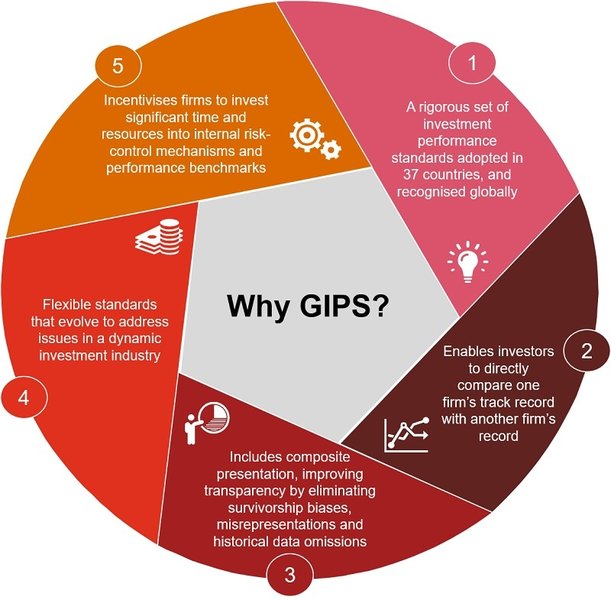
Conceptual overview highlighting the reasons behind adopting GIPS.
Applicability and Beneficiaries of GIPS
Who Adopts GIPS and Who Benefits?
Parties to Whom GIPS Standards Apply
GIPS standards apply to investment management firms on a firm-wide basis. A "firm" is defined as a distinct business entity that is held out to clients or prospective clients as such. This means that if a firm claims GIPS compliance, its entire investment management operations must adhere to the standards, not just selected departments or strategies. While compliance with GIPS is voluntary, it is widely adopted globally and considered a best practice, particularly in the institutional market. Many of the top asset management firms and over 1,700 organizations worldwide claim compliance. Some large third-party investment platforms even require firms to be GIPS compliant and verified to market their performance.
Who is Served by GIPS?
The GIPS standards serve several key stakeholders:
- Prospective Clients: GIPS provides prospective clients with reliable and comparable performance data, enabling them to make more informed decisions when selecting an investment manager. It allows for an "apples-to-apples" comparison of track records.
- Existing Clients: Current clients benefit from ongoing transparent reporting, reinforcing their trust in the firm's performance presentation and accountability.
- Investment Firms: Compliant firms can enhance their credibility, gain a competitive advantage, and demonstrate a commitment to ethical practices. This can improve their internal policies and procedures.
- Regulators and the Market: GIPS promotes industry self-regulation, supporting market integrity and reducing the potential for misleading performance claims. The standards have also been referenced in regulatory requirements, such as the SEC's marketing rule for investment advisors and FINRA requirements for private fund presentations.
Ultimately, GIPS aims to benefit the entire investment community by fostering greater transparency and integrity in performance reporting.
Composites: The Cornerstone of GIPS Reporting
Understanding Composite Construction and Purpose
Composites are a fundamental element of GIPS compliance, ensuring that performance is presented fairly and represents a firm's strategy accurately.
What is a Composite?
A composite is an aggregation of one or more actual, fee-paying, discretionary portfolios managed according to a similar investment mandate, objective, or strategy. For example, a firm might create a composite for its "U.S. Large-Cap Growth Equity" strategy or its "Global Fixed Income" strategy. The key is that all portfolios within a composite share common investment characteristics.
Construction of Composites
The GIPS standards have specific requirements for composite construction:
- Inclusion of All Eligible Portfolios: Firms must include all actual, fee-paying, discretionary portfolios in at least one composite. Discretionary means the firm has the authority to make investment decisions. Portfolios with client-imposed restrictions that make them unrepresentative of the strategy are typically considered non-discretionary and may be excluded.
- Defined Criteria: Composites must be defined according to clear, pre-established criteria.
- No Cherry-Picking: Firms cannot selectively include only well-performing portfolios or exclude poorly performing ones. This prevents survivorship bias and ensures a fair representation of the strategy's historical performance.
- Timely Inclusion: New portfolios must be added to a composite on a timely basis (e.g., after the first full performance measurement period under management). Terminated portfolios must remain in the historical record of the composite up to the last full measurement period they were under management.

Illustrative example of how composite performance might be presented (actual data varies).
Purpose of Composites
The primary purpose of composites is to provide a fair and comprehensive representation of a firm's track record for a specific investment strategy. This allows:
- Representative Performance: Composites reflect the collective investment results of a particular strategy, offering a more accurate picture than individual account performance, which can vary due to specific client needs or timing of cash flows.
- Comparability: They enable prospective clients to compare the performance of similar strategies across different investment firms.
- Evaluation of Skill: Composites help in assessing the firm's ability to implement its stated investment strategy effectively over time.
Firms must present a minimum of five years of GIPS-compliant performance data for each composite, or performance since the composite's inception if it has existed for less than five years. This track record must be extended annually until at least 10 years of performance data are provided. GIPS Composite Reports should include essential information such as time-weighted rates of return and a measure of internal dispersion of returns for each annual period.
GIPS Verification: Ensuring Compliance Integrity
The Role and Requirements of Third-Party Verification
While GIPS compliance is a claim made by the investment firm itself, verification offers an additional layer of credibility through an independent assessment.
What is Verification?
Verification is a voluntary process performed by an independent third-party verifier. The verifier assesses two primary aspects:
- Whether the firm has complied with all the composite construction requirements of the GIPS standards on a firm-wide basis.
- Whether the firm’s policies and procedures are designed to calculate and present performance in compliance with the GIPS standards.
It is crucial to understand that verification is performed on the entire firm and its processes, not on individual composites or specific performance reports. While a firm may choose to have a more in-depth examination of a specific composite's compliant presentation (often called a performance examination), this is a separate engagement from firm-wide verification.
Requirements and Scope
- Firm-Wide Scope: Verification applies to all aspects of the firm's claim of compliance with GIPS, including its definition of the firm, policies for maintaining lists of composites, and procedures for ensuring compliant presentations.
- Independent Verifier: The verifier must be an independent entity with the necessary expertise in performance measurement and GIPS standards.
- Not a Guarantee of Accuracy: Verification provides assurance that the firm's policies and procedures are designed to achieve GIPS compliance and that composite construction requirements are met. It does not, however, guarantee the accuracy of the performance results of any specific composite or GIPS Report, nor does it ensure that the firm has adhered to all aspects of GIPS at all times.
Benefits of Verification
Although voluntary, verification is strongly encouraged by the GIPS Executive Committee. Benefits include:
- Enhanced Credibility: Provides clients and prospects with external assurance that the firm's claim of GIPS compliance is robust.
- Marketing Advantage: Can be a significant differentiator in a competitive marketplace, particularly when seeking institutional mandates.
- Improved Internal Processes: The verification process often helps firms refine their internal controls, policies, and procedures related to performance measurement and reporting.
Firms are not required to undergo verification to claim GIPS compliance, but doing so demonstrates a higher level of commitment to the standards.
Visualizing GIPS Adoption Factors
Relative Importance of GIPS Considerations
The decision for an investment firm to adopt GIPS involves weighing various factors. The radar chart below illustrates a hypothetical assessment of the relative importance or impact of several key considerations associated with GIPS compliance and verification. These are subjective assessments and can vary by firm.
This chart visually represents how factors such as boosting investor confidence and achieving global comparability are highly significant benefits, while aspects like implementation cost, though important, might be perceived as a lesser barrier compared to the advantages gained. Operational rigor is necessary but also a positive outcome of adoption.
GIPS Standards Mindmap
A Structured Overview of Key GIPS Concepts
The following mindmap provides a hierarchical view of the Global Investment Performance Standards, breaking down its core components and their interrelationships. It illustrates the overarching structure from the fundamental purpose to the specifics of composites and verification.
& Full Disclosure"] id1c["Enable Global Comparability"] id1d["Promote Ethical Practices"] id1e["Foster Investor Confidence"] id2["Application of GIPS"] id2a["Applies to: Investment Management Firms
(Firm-Wide Basis)"] id2b["Serves: Prospective Clients"] id2c["Serves: Existing Clients"] id2d["Benefits: Investment Firms (Credibility)"] id2e["Supports: Market Integrity"] id3["Composites in Performance Reporting"] id3a["Definition: Aggregation of discretionary
portfolios with similar strategy/objective"] id3b["Construction Requirements"] id3b1["Include all actual, fee-paying,
discretionary portfolios"] id3b2["Clearly defined criteria"] id3b3["No cherry-picking"] id3b4["Timely inclusion/exclusion"] id3c["Purpose of Composites"] id3c1["Provide representative performance"] id3c2["Allow strategy comparison"] id3c3["Reflect firm's skill for a strategy"] id4["Verification of GIPS Compliance"] id4a["Process: Voluntary, third-party assessment"] id4b["Scope: Firm-wide (not individual composites)"] id4b1["Assesses composite construction compliance"] id4b2["Assesses policies & procedures design"] id4c["Performed by: Independent Verifier"] id4d["Benefits: Enhanced credibility,
marketing advantage, improved internal processes"] id5["Key Features"] id5a["Voluntary Standards"] id5b["Developed by CFA Institute"] id5c["Global Applicability"] id5d["Minimum 5 years performance (up to 10)"]
This mindmap summarizes how GIPS aims to achieve its goals through specific applications, the meticulous use of composites for fair performance portrayal, and the option of verification to bolster credibility in the investment industry.
GIPS Standards: Key Features and Requirements Table
A Summary of Essential GIPS Elements
To further clarify the core components of GIPS, the following table summarizes some of its essential features and requirements. This provides a quick reference for understanding the fundamental aspects of achieving and maintaining GIPS compliance.
| Aspect of GIPS | Description | Key Implication/Requirement |
|---|---|---|
| Definition of the Firm | The investment firm, subsidiary, or division held out to clients as a distinct business entity. | Compliance must be claimed for this entire defined entity. |
| Document Policies & Procedures | Firms must document their policies and procedures used to comply with GIPS. | Essential for consistent application and verification. |
| Claim of Compliance | A specific statement used by firms that fully comply with all GIPS requirements. | Must use prescribed wording: "[Insert name of firm] claims compliance with the Global Investment Performance Standards (GIPS®)." |
| Input Data | Performance calculations must be based on accurate and consistent input data. | Portfolios valued at fair value; accrual accounting for fixed income and similar assets. |
| Calculation Methodology | GIPS mandates specific methodologies, primarily time-weighted rates of return. | Returns must be calculated net of actual trading expenses. Gross-of-fees and/or net-of-fees returns can be presented. |
| Composite Construction | Grouping of discretionary portfolios representing a single, distinct investment strategy. | All actual, fee-paying, discretionary portfolios must be included in at least one composite. |
| Disclosures | Firms must disclose specific information about their performance presentation and calculation methodologies. | Includes definition of the firm, composite descriptions, fee schedules, use of leverage, derivatives, short selling, benchmark descriptions, currency, etc. |
| Presentation and Reporting | Minimum of five years of annual GIPS-compliant performance (or since inception), building to ten years. | Specific data points required in compliant presentations, including annual returns, number of portfolios, composite assets, internal dispersion. |
| Verification | Voluntary, firm-wide review by an independent third party. | Provides additional credibility; verifier opines on compliance with composite construction and design of policies/procedures. |
This table highlights the comprehensive nature of the GIPS standards, emphasizing the detailed requirements firms must meet to claim compliance and ensure ethical and transparent performance reporting.
Understanding GIPS Standards: An Overview
Video Introduction to Global Investment Performance Standards
For a concise visual and auditory explanation of the GIPS standards, the following video provides a helpful overview. It touches upon why GIPS was created, its voluntary nature, and its role in ensuring full disclosure and fair representation in investment performance reporting globally.
This video, "What Are Global Investment Performance Standards (GIPS)?", reinforces the core concepts discussed, such as the aim to enable accurate comparisons between investment firms by standardizing how performance is reported. It highlights the global adoption and the benefits for investors seeking trustworthy data.
Frequently Asked Questions (FAQ) about GIPS
Is GIPS compliance mandatory for investment firms? +
No, GIPS compliance is voluntary. However, it is widely considered a best practice in the global investment industry, and many clients, particularly institutional investors, may require or prefer to work with GIPS-compliant firms. Adopting GIPS can enhance a firm's credibility and competitiveness.
Can a single investment strategy or composite be GIPS verified? +
No, GIPS verification applies to the entire investment firm's claim of compliance, not to individual composites or strategies. While a firm can engage a verifier to perform a specific performance examination on a composite, this is distinct from the firm-wide GIPS verification process.
What is the minimum period for which a firm must present GIPS-compliant performance? +
A firm must present a minimum of five years of GIPS-compliant annual investment performance for each composite. If the firm or composite has been in existence for less than five years, compliant performance since the firm's or composite's inception must be presented. After the initial five-year presentation, the firm must add one additional year of performance each year, building up to a required 10-year track record.
Who develops and maintains the GIPS standards? +
The GIPS standards are developed and maintained by the CFA Institute, in partnership with industry experts and sponsors from around the world. The GIPS Executive Committee is responsible for the development and interpretation of the standards, ensuring they remain relevant and effective in the evolving investment landscape. The 2020 edition of the GIPS standards includes separate chapters for Firms, Asset Owners, and Verifiers.
How do composites help ensure fair representation of performance? +
Composites ensure fair representation by requiring the aggregation of all actual, fee-paying, discretionary portfolios managed according to a similar investment strategy. This prevents firms from "cherry-picking" only their best-performing accounts for inclusion in a performance presentation. By including all eligible portfolios, composites provide a more complete and representative picture of a firm's capabilities in managing a particular strategy over time.
Recommended Further Exploration
Delve Deeper into Investment Performance Standards
- What are the specific disclosure requirements under GIPS standards?
- How do the GIPS standards address pooled funds and alternative investments?
- What is the role of the GIPS Standards Handbook for Firms in achieving compliance?
- Compare the GIPS standards for asset managers versus asset owners.
References
Sources for GIPS Information
Last updated May 13, 2025