
Unlock the Power of Data: What Exactly is Machine Learning?
Discover how computers learn to think, predict, and act without explicit instructions, transforming industries and our daily lives.
Machine learning (ML) stands as a pivotal subfield of artificial intelligence (AI) and computer science. At its heart, machine learning empowers computer systems to learn from data, identify patterns, and make decisions with minimal human intervention. Unlike traditional programming where developers write explicit rules for every task, ML algorithms build mathematical models based on sample data, known as "training data," to perform predictions or make decisions without being explicitly programmed to do so. This data-driven approach allows systems to continuously improve their accuracy and performance over time as they are exposed to more data.
Essential Insights into Machine Learning
- Learning from Experience: Machine learning enables computers to learn from historical data to identify patterns, make predictions, and improve performance on specific tasks autonomously.
- Diverse Approaches: The field encompasses several learning styles, primarily Supervised (learning from labeled data), Unsupervised (finding patterns in unlabeled data), and Reinforcement Learning (learning through trial and error with rewards/penalties).
- Transformative Applications: ML drives innovation across countless sectors, powering everything from recommendation engines and virtual assistants to medical diagnosis tools and self-driving cars.
Understanding the Core Concepts
The Building Blocks of Intelligent Systems
Machine learning operates on a foundation of several key components that work together to enable learning from data.
Data: The Fuel for Learning
Data is the cornerstone of machine learning. The quality, quantity, and relevance of the data used for training directly impact the performance and reliability of the resulting ML model. Data can range from structured tables (like spreadsheets) to unstructured formats like text documents, images, and audio recordings.
Algorithms: The Learning Mechanisms
Machine learning algorithms are the engines that process data, learn the underlying patterns, and generate the model. There's a vast array of algorithms, each suited for different types of tasks and data. Examples include linear regression, decision trees, support vector machines (SVMs), neural networks, and clustering algorithms like k-means.
Models: The Learned Representation
An ML model is the output of the training process. It's essentially a mathematical representation of the patterns learned from the data. Once trained, the model can be used to make predictions or decisions on new, unseen data.
Training and Evaluation: Refining Performance
Training involves feeding the chosen algorithm with training data to allow it to learn. Evaluation follows, where the model's performance is tested on a separate dataset (test data) to assess its accuracy and generalization capabilities. This iterative process helps tune the model for optimal performance.
Machine Learning vs. Traditional Programming
In traditional programming, humans provide data and explicit rules (a program) to a computer, which then produces an output. In machine learning, humans provide data and the desired outputs (or examples of patterns), and the computer *learns* the rules (the program/model) that connect the inputs to the outputs or discover the underlying structure.
Major Categories of Machine Learning
Different Paths to Learning
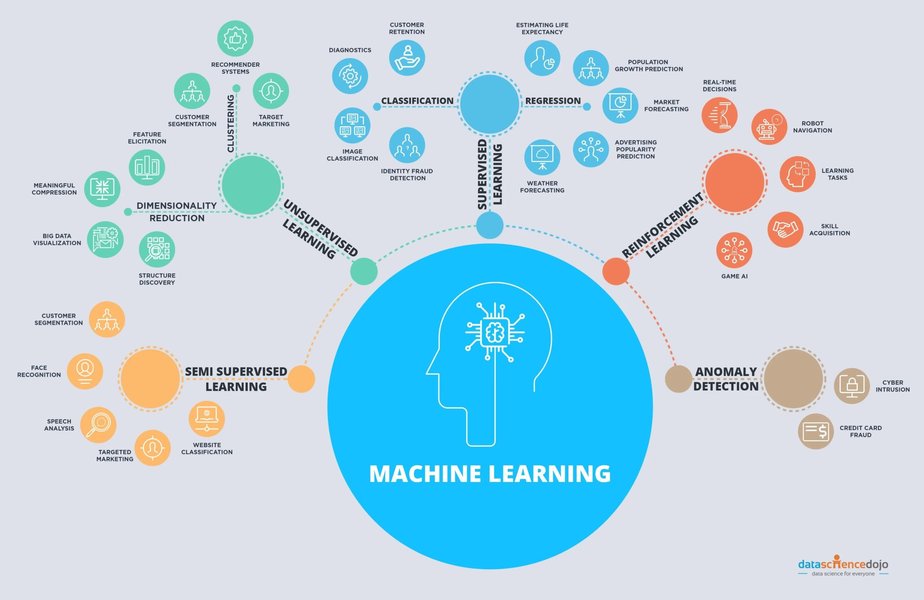
Machine learning isn't a monolithic field; it comprises several distinct approaches or types, categorized based on the nature of the learning signal or feedback available to the learning system.

Visual representation of the primary machine learning paradigms.
1. Supervised Learning
This is the most common type of machine learning. It involves training a model on a labeled dataset, meaning that each training example is paired with a correct output label or value. The goal is for the model to learn a mapping function that can accurately predict the output for new, unseen input data.
- Classification: Predicting a discrete category (e.g., spam vs. not spam, cat vs. dog, disease diagnosis).
- Regression: Predicting a continuous value (e.g., house prices, temperature, stock prices).
Common algorithms include Linear Regression, Logistic Regression, Support Vector Machines (SVM), Decision Trees, Random Forests, and Neural Networks.
2. Unsupervised Learning
In unsupervised learning, the model works with unlabeled data. The objective is to identify hidden patterns, structures, or relationships within the data without predefined outputs.
- Clustering: Grouping similar data points together (e.g., customer segmentation, grouping news articles by topic).
- Dimensionality Reduction: Reducing the number of features (variables) while preserving important information (e.g., data compression, feature extraction for visualization).
- Anomaly Detection: Identifying rare items or events that deviate significantly from the norm (e.g., fraud detection, detecting faulty equipment).
Common algorithms include K-Means Clustering, Hierarchical Clustering, Principal Component Analysis (PCA), and Autoencoders.
3. Reinforcement Learning (RL)
Reinforcement learning involves an agent learning to make a sequence of decisions by trying to maximize a reward it receives for its actions. The agent learns through trial and error by interacting with an environment. It receives feedback in the form of rewards (positive) or penalties (negative) for the actions it takes.
Applications include game playing (e.g., AlphaGo), robotics (learning to walk or grasp objects), navigation systems, and resource management.
4. Semi-Supervised Learning
This approach falls between supervised and unsupervised learning. It uses a combination of a small amount of labeled data and a large amount of unlabeled data for training. It's useful when acquiring labeled data is expensive or time-consuming.
Visualizing Machine Learning Concepts
A Mindmap Overview
This mindmap provides a visual summary of the core ideas and types within the field of machine learning, helping to illustrate the relationships between key concepts.
Learning from Data"] id1a["No Explicit Programming"] id1b["Pattern Recognition"] id1c["Prediction & Decision Making"] id2["Key Components"] id2a["Data (Input)"] id2b["Algorithms (Learning Process)"] id2c["Model (Output/Learned Rules)"] id2d["Training & Evaluation"] id3["Types of Learning"] id3a["Supervised Learning"] id3aa["Labeled Data"] id3ab["Classification"] id3ac["Regression"] id3b["Unsupervised Learning"] id3ba["Unlabeled Data"] id3bb["Clustering"] id3bc["Dimensionality Reduction"] id3bd["Anomaly Detection"] id3c["Reinforcement Learning"] id3ca["Agent & Environment"] id3cb["Rewards & Penalties"] id3cc["Trial & Error"] id3d["Semi-Supervised Learning"] id3da["Mix of Labeled & Unlabeled Data"] id4["Applications"] id4a["Healthcare"] id4b["Finance"] id4c["E-commerce"] id4d["Transportation"] id4e["Entertainment"] id4f["NLP"]
The mindmap connects the central theme of Machine Learning to its core principles, the essential components involved, the different learning paradigms (Supervised, Unsupervised, Reinforcement, Semi-Supervised), and some major application areas.
Machine Learning in Action: Real-World Applications
Transforming Industries and Daily Life
Machine learning is no longer a futuristic concept; it's deeply embedded in numerous applications we interact with daily and is revolutionizing industries worldwide. As of 2025, its impact continues to grow.
A visualization of common machine learning algorithms used across applications.
Healthcare
- Disease Diagnosis: Analyzing medical images (X-rays, MRIs, CT scans) to detect conditions like cancer or diabetic retinopathy.
- Drug Discovery: Accelerating the process of identifying potential drug candidates.
- Predictive Analytics: Forecasting patient outcomes, predicting disease outbreaks, and personalizing treatment plans.
Finance
- Fraud Detection: Identifying suspicious financial transactions in real-time to prevent fraud.
- Algorithmic Trading: Making automated trading decisions based on market data analysis.
- Credit Scoring: Assessing the creditworthiness of loan applicants more accurately.
- Investment Recommendations: Providing personalized financial advice.
Retail and E-commerce
- Recommendation Systems: Suggesting products or content users might like (e.g., Netflix, Amazon, Spotify).
- Customer Churn Prediction: Identifying customers likely to stop using a service.
- Price Optimization: Dynamically adjusting prices based on demand and competitor pricing.
- Sentiment Analysis: Analyzing customer reviews and feedback to understand opinions.
Transportation
- Autonomous Vehicles: Enabling self-driving cars to perceive their environment, navigate, and make driving decisions.
- Traffic Prediction: Optimizing routes and managing traffic flow (e.g., Google Maps, Waze).
- Predictive Maintenance: Forecasting when vehicle parts might fail.
Entertainment and Media
- Content Recommendation: Curating personalized feeds on social media platforms and streaming services.
- Automated Content Moderation: Detecting and removing harmful or inappropriate content.
Natural Language Processing (NLP)
- Machine Translation: Translating text between languages (e.g., Google Translate).
- Virtual Assistants & Chatbots: Understanding and responding to human language (e.g., Siri, Alexa, Google Assistant, customer service bots).
- Sentiment Analysis: Determining the emotional tone behind text data.
Image and Speech Recognition
- Facial Recognition: Used in security systems, photo tagging, and smartphone unlocking.
- Object Detection: Identifying objects in images or videos, crucial for self-driving cars and surveillance.
- Speech-to-Text: Transcribing spoken language into text.
Robotics
- Autonomous Navigation: Enabling robots (like industrial robots or autonomous mowers) to navigate complex environments and avoid obstacles.
- Task Learning: Training robots to perform specific tasks through demonstration or reinforcement learning.
Machine Learning Impact Across Sectors
A Comparative Radar View
Machine learning's adoption and impact vary across different industries. This radar chart provides an illustrative comparison of the estimated maturity and transformative effect of ML in key sectors as of early 2025. The scores (ranging conceptually from 1 to 10, where 10 represents high maturity/impact) are based on the prevalence and depth of ML applications discussed.
This chart highlights sectors like E-commerce/Retail, Finance, and Entertainment where ML is highly mature and deeply integrated, driving personalization and efficiency. Healthcare and Transportation show significant impact and growing maturity, particularly with advancements in diagnostics and autonomous systems. Manufacturing and Energy are also adopting ML, though perhaps at an earlier stage compared to digital-native industries.
Key Benefits of Machine Learning
Why ML Matters
The widespread adoption of machine learning stems from its significant advantages:
- Automation: ML automates complex and repetitive tasks, freeing up human resources for more strategic activities.
- Improved Accuracy & Efficiency: ML models can often outperform humans in specific tasks, especially those involving large datasets, leading to more accurate predictions and decisions.
- Handling Large & Complex Data: ML excels at extracting insights from vast and high-dimensional datasets that are challenging for humans to analyze.
- Personalization: It enables highly personalized experiences for users, from product recommendations to tailored content.
- Continuous Improvement: ML models can adapt and improve their performance over time as they are exposed to new data, without needing reprogramming.
- Predictive Power: ML provides powerful tools for forecasting future trends, behaviors, and outcomes based on historical data.
Getting Started with Machine Learning
Embarking on Your ML Journey
Interested in diving deeper into machine learning? Here’s a brief guide on prerequisites and resources:
Prerequisites
- Mathematics: A solid understanding of linear algebra, calculus, probability, and statistics is fundamental.
- Programming Skills: Proficiency in a programming language is essential, with Python being the most popular choice due to its extensive libraries and frameworks (like Scikit-learn, TensorFlow, PyTorch).
- Data Handling: Familiarity with data preprocessing, manipulation, and analysis techniques is crucial.
Learning Resources
- Online Courses: Platforms like Coursera, edX, Udacity, and fast.ai offer numerous courses ranging from introductory to advanced levels (e.g., Andrew Ng's popular Machine Learning course on Coursera).
- Tutorials and Blogs: Websites like Google Developers ML Crash Course, GeeksforGeeks, Kaggle Learn, Machine Learning Mastery, and Towards Data Science provide tutorials, articles, and practical guides.
- Books: Foundational texts like "Hands-On Machine Learning with Scikit-Learn, Keras & TensorFlow" or "Pattern Recognition and Machine Learning" offer in-depth knowledge.
- Practical Projects: Applying concepts through hands-on projects is key. Platforms like Kaggle host competitions and provide datasets for practice.

Engaging in practical projects is crucial for learning machine learning.
Understanding the Basics: How ML Works
A Video Explanation
For a visual and accessible introduction to the fundamental concepts behind machine learning and how models learn from data, this video provides a clear overview:
This video explains what machine learning is, why it's important today, and the basic process of how ML models are trained using data to make predictions or classifications. It covers the essential workflow from data input to model learning, providing a foundational understanding suitable for beginners.
Comparing Machine Learning Types
A Summary Table
This table summarizes the key characteristics, goals, common algorithms, and typical applications of the main machine learning paradigms.
| Feature | Supervised Learning | Unsupervised Learning | Reinforcement Learning |
|---|---|---|---|
| Input Data | Labeled Data (Input-Output Pairs) | Unlabeled Data | No predefined dataset; Agent interacts with an Environment |
| Goal | Predict output for new inputs; Learn a mapping function | Discover hidden patterns, structures, or groupings | Learn optimal actions/policy to maximize cumulative reward |
| Feedback | Direct feedback via correct labels | No explicit feedback; Based on data structure | Indirect feedback via rewards/penalties from environment |
| Common Tasks | Classification, Regression | Clustering, Dimensionality Reduction, Anomaly Detection | Control, Decision Making, Game Playing, Robotics |
| Example Algorithms | Linear Regression, SVM, Decision Trees, Neural Networks | K-Means, PCA, Hierarchical Clustering, Autoencoders | Q-Learning, SARSA, Deep Q-Networks (DQN) |
| Example Applications | Spam detection, Image recognition, Price prediction | Customer segmentation, Topic modeling, Fraud detection | Game AI, Robot navigation, Resource management |
Frequently Asked Questions (FAQ)
What is the difference between AI, Machine Learning, and Deep Learning?
Artificial Intelligence (AI) is the broad concept of creating machines that can perform tasks typically requiring human intelligence. Machine Learning (ML) is a subset of AI that focuses on enabling systems to learn from data without being explicitly programmed. Deep Learning (DL) is a further subset of ML that uses complex neural networks (with many layers) to learn intricate patterns from large amounts of data. Think of them as nested concepts: AI > ML > DL.
Why is Python the most popular language for Machine Learning?
Python's popularity in ML stems from several factors:
- Simplicity and Readability: Its syntax is relatively easy to learn and understand.
- Extensive Libraries: Python boasts a rich ecosystem of libraries specifically designed for ML and data science, such as Scikit-learn, TensorFlow, PyTorch, Pandas, and NumPy. These libraries simplify complex tasks.
- Large Community: A vast and active community provides ample support, resources, and pre-built tools.
- Flexibility: It integrates well with other technologies and is suitable for various stages of an ML project, from research to deployment.
What are some common challenges in Machine Learning?
Developing and deploying ML models involves several challenges:
- Data Quality and Quantity: Insufficient or poor-quality data can lead to inaccurate models.
- Feature Engineering: Selecting and transforming the right input features significantly impacts performance and requires domain expertise.
- Overfitting and Underfitting: Models might learn the training data too well (overfitting) and fail to generalize to new data, or be too simple (underfitting) to capture underlying patterns.
- Interpretability: Understanding *why* a complex model (like a deep neural network) makes certain predictions can be difficult (the "black box" problem).
- Computational Cost: Training large models on massive datasets requires significant computing resources.
- Bias and Fairness: Models can inherit and amplify biases present in the training data, leading to unfair or discriminatory outcomes.
Do I need advanced math to learn Machine Learning?
While you can start applying ML using high-level libraries without deep mathematical knowledge, a solid understanding of certain mathematical concepts is crucial for truly understanding *how* algorithms work, diagnosing problems, customizing models, and conducting research. Key areas include:
- Linear Algebra: Essential for understanding data representation (vectors, matrices) and operations used in many algorithms.
- Calculus: Important for understanding optimization techniques like gradient descent, which are used to train models.
- Probability and Statistics: Fundamental for understanding model evaluation, uncertainty, and many ML algorithms themselves (e.g., Bayesian methods, Naive Bayes).
You don't necessarily need to be a math expert to start, but strengthening your math foundations will significantly benefit your ML journey.
Recommended Reading
- Explore the various algorithms used in supervised, unsupervised, and reinforcement learning.
- Investigate the specific applications of machine learning in medical diagnosis, treatment, and research.
- Learn about the challenges and importance of fairness, bias, and transparency in machine learning systems.
- Discover the skills, education, and steps needed to pursue a career in the field of machine learning.
References
Last updated May 5, 2025