
Classification of Cnidaria, Platyhelminthes, and Nematoda up to Class
Exploring the distinctive characteristics and examples of three major invertebrate phyla
Highlights
- Cnidaria: Radial symmetry, cnidocytes, and dual body forms (polyp and medusa).
- Platyhelminthes: Flat, bilaterally symmetrical, with a simple digestive system and variation from free-living to parasitic forms.
- Nematoda: Cylindrical, unsegmented, with a complete digestive system and a protective cuticle.
Introduction
The animal kingdom is replete with diverse phyla, each offering a unique set of anatomical and physiological characteristics. In this discussion, we focus on three significant phyla: Cnidaria, Platyhelminthes, and Nematoda. We shall explore each phylum up to the class level, emphasizing their structural attributes, key features, and notable examples.
Phylum Cnidaria
Overview
Organisms within the phylum Cnidaria are primarily aquatic, mostly marine invertebrates recognized for their radial symmetry. Their primary distinction lies in their diploblastic tissue composition comprising the ectoderm and endoderm. A gelatinous substance called mesoglea separates these two layers. Cnidarians are also renowned for specialized stinging neurons known as cnidocytes, which contain nematocysts used for capturing prey and defense. Additionally, members of this phylum exhibit two prominent body forms – the sessile polyp and the free-swimming medusa.
Characteristics
- Symmetry: Radial or biradial symmetry.
- Tissue Layers: Diploblastic organization with ectoderm and endoderm.
- Specialized Cells: Cnidocytes containing stinging organelles (nematocysts).
- Nervous System: Simple nerve net without centralized brain.
- Body Forms: Two main forms: sessile polyp and free-swimming medusa.
- Digestive System: A single sac with one opening that functions for both ingestion and excretion.
Classification and Examples
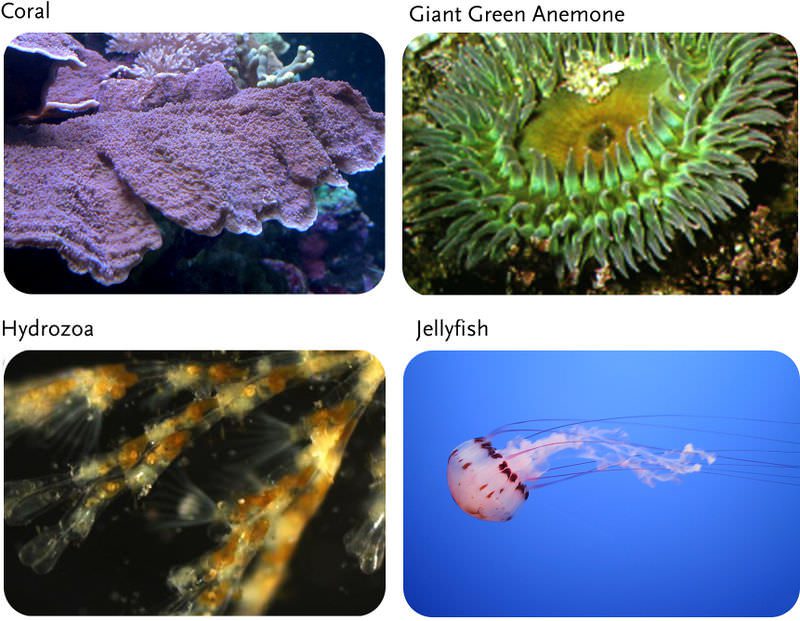
Class Hydrozoa
Members of Hydrozoa often live in colonies and demonstrate both polyp and medusa stages. They are known for their complex, interconnected zooids performing specialized roles.
Example: Hydra – a well-known freshwater hydrozoan that primarily exists in the polyp form.
Class Scyphozoa
Referred to as the "true jellyfish", these organisms largely exhibit the medusa form in their life cycle. They are characterized by a dome-shaped umbrella and marginal tentacles, and the process of strobilation further supports their medusa development.
Example: Moon jellyfish (Aurelia aurita) – displays clear medusa stages along with its graceful, translucent structure.
Class Anthozoa
Unlike other cnidarians, Anthozoans are exclusively polyps, meaning they do not alternate between polyp and medusa forms. They form complex colonies that are essential for constructing coral reefs.
Example: Sea anemones and corals (Acropora sp.), which create one of the most biodiverse ecosystems on Earth.
Class Cubozoa
Known for their cube-shaped medusae and sophisticated sensory apparatus, these organisms are both visually striking and dangerous. Their medusa stage features distinct eyes and active predatory behavior.
Example: Box jellyfish, renowned for their potent venom and well-developed visual systems.
Phylum Platyhelminthes
Overview
The phylum Platyhelminthes encompasses flatworms – a diverse group of invertebrates displaying pronounced bilaterally symmetry and a distinctly flattened body. Being triploblastic, these organisms possess three germ layers but remain acoelomate, meaning they lack a true body cavity. Their anatomy, generally simple, is marked by an absence of specialized respiratory or circulatory systems. Platyhelminthes can either lead free-living lifestyles or adopt parasitic relations, with many species sharing both male and female reproductive organs (hermaphroditism).
Characteristics
- Symmetry: Bilateral symmetry, allowing directional movement and a distinct head-tail region.
- Body Structure: Dorsoventrally flattened, promoting efficient diffusion of gases and nutrients.
- Tissue Complexity: Triploblastic with three germ layers (ectoderm, mesoderm, endoderm) yet lacking a body cavity.
- Digestive System: Simple digestive tract, usually with one opening (in some cases both ingestion and excretion occur via a single orifice).
- Nervous System: A centralized network with nerve cords and a rudimentary brain-like structure.
- Reproduction: Many species are hermaphroditic, facilitating cross-fertilization or self-fertilization.
Classification and Examples
Class Turbellaria
This class largely comprises free-living flatworms, commonly found in aquatic and terrestrial settings. They are distinguished by their active ciliary locomotion and regenerative abilities.
Example: Planarian (Dugesia) – a well-studied turbellarian known for its exceptional regenerative capacity.
Class Trematoda
Known as flukes, members of the Trematoda are primarily parasitic and have complex life cycles that often involve multiple hosts. They are equipped with suckers and hooks, which facilitate attachment to host tissues.
Example: Liver fluke (Fasciola hepatica) – an endoparasite that significantly impacts agriculture and veterinary health.
Class Cestoda
This class includes tapeworms, which are exclusively parasitic. They possess long, segmented bodies called proglottids and lack a digestive system, absorbing nutrients directly through their tegument.
Example: Beef tapeworm (Taenia saginata) – a notorious parasite that infects humans and can cause significant health issues.
Phylum Nematoda
Overview
Nematoda, commonly referred to as roundworms, represent a phylum characterized by elongated, cylindrical, and unsegmented bodies. They are pseudocoelomate, which means that while they do not possess a true coelom, they have a fluid-filled cavity that functions similarly. These organisms also display bilateral symmetry and have a complete digestive tract, ensuring a clear demarcation between the mouth and anus. Nematodes have a resilient, multi-layered collagenous cuticle that aids in protection and environmental adaptation. Their groups encompass both free-living and parasitic lifestyles, significantly impacting ecosystems and human health.
Characteristics
- Symmetry: Bilateral symmetry, promoting directional locomotion.
- Body Structure: Unsegmented, cylindrical bodies with a tough, collagen-rich cuticle.
- Coelom: Pseudocoelomate structure supporting internal organs without a true body cavity.
- Digestive System: Complete digestive system with distinct mouth and anus.
- Nervous System: Consists of a nerve ring around the pharynx and longitudinal nerve cords.
- Reproduction: Primarily sexual reproduction, with some species exhibiting hermaphroditism.
Classification and Examples
Class Adenophorea (Aphasmidia)
Members of this group are mainly free-living nematodes and are characterized by the absence of specialized sensory organs called phasmids. Their sensory systems may include varied amphids, though these are typically less pronounced in function. They often display simple excretory systems and are prevalent in diverse ecosystems.
Example: Vinegar eel (Turbatrix aceti) – a free-living nematode often found in fermented liquids.
Class Secernentea (Phasmidia)
This class includes many parasitic species that possess distinct phasmid organs, along with well-developed excretory systems. These organisms are of significant medical and veterinary importance due to their parasitic nature.
Example: Ascaris lumbricoides – a prominent parasitic roundworm that infects humans, and hookworms such as Ancylostoma, which are crucial in understanding parasitic diseases.
Detailed Comparison Table
| Phylum | Key Characteristics | Representative Classes | Notable Examples |
|---|---|---|---|
| Cnidaria | Radial symmetry, diploblastic, presence of cnidocytes, dual body forms (polyp/medusa) | Hydrozoa, Scyphozoa, Anthozoa, Cubozoa | Hydra, Moon jellyfish, Sea anemones, Box jellyfish |
| Platyhelminthes | Bilateral symmetry, dorsoventrally flattened, triploblastic, acoelomate, often hermaphroditic | Turbellaria, Trematoda, Cestoda | Planaria, Liver fluke, Beef tapeworm |
| Nematoda | Cylindrical, unsegmented, pseudocoelomate, complete digestive system, protective cuticle | Adenophorea, Secernentea | Vinegar eel, Ascaris lumbricoides, Ancylostoma |
Conclusion and Final Thoughts
In summary, the three phyla – Cnidaria, Platyhelminthes, and Nematoda – display distinctly different evolutionary pathways and anatomical adaptations. Cnidarians, with their radial symmetry and cnidocytes, have evolved simple yet efficient systems to capture prey and defend themselves in aquatic environments. Their dual body forms offer both stationary and mobile life strategies. Platyhelminthes, or flatworms, offer an intermediate evolutionary stage with bilateral symmetry and a flattened body plan that facilitates various modes of life, from free-living to parasitic lifestyles. Their lack of a body cavity and centralized organ systems mark an important divergence in complexity compared to other invertebrates. Finally, Nematoda, or roundworms, are ubiquitous, highly adaptable organisms featuring a complete digestive system and a robust cuticle that provides environmental resilience. Their simplicity in design yet complexity in life cycles, particularly among parasitic species, underscores their ecological and health-related significance.
These classifications not only provide insight into the distinct evolutionary narratives of each phylum but also reinforce the importance of morphological and functional characteristics in understanding animal biodiversity. Each phylum demonstrates unique adaptations that have enabled them to survive and thrive in various environments across the globe.
References
- Cnidaria - Byju's
- Marine Invertebrates - MarineBio Conservation Society
- Cnidarians Overview - LibreTexts
- Platyhelminthes Classification - GeeksforGeeks
- Nematoda Characteristics - Microbe Notes
Recommended Related Queries
Last updated February 25, 2025