
Unlock World-Class Travel Safety: Mastering ISO 31030 for Corporate Risk Management
Your essential guide and assessment tool for embedding the global standard in travel risk management training.
As a corporate travel risk management (TRM) consultant, you understand the critical importance of equipping security personnel with the knowledge and tools to protect travelling employees. Especially for those new to the field, the ISO 31030:2021 standard, "Travel risk management — Guidance for organizations," serves as the cornerstone of a robust and compliant TRM program. It provides a globally recognized framework for developing, implementing, evaluating, and continually improving how organizations manage travel-related risks, ensuring they meet their duty of care obligations.
This resource provides a comprehensive multiple-choice assessment designed specifically for your training sessions. It not only tests understanding of the key components of ISO 31030 but also reinforces the standard's significance in building resilient and responsible corporate travel practices. The exam is structured to follow the standard's sections, allowing trainees to easily reference the official ISO 31030 document for deeper learning and clarification.
Key Highlights of ISO 31030
- Comprehensive Framework: ISO 31030 offers a structured and holistic approach to managing risks associated with organizational travel, covering policy, program development, threat identification, risk assessment, treatment, and continuous improvement.
- Duty of Care Fulfilment: Adhering to the standard helps organizations demonstrably meet their legal and ethical duty of care obligations towards their travelers, reducing liability and enhancing reputation.
- Global Best Practice: It represents an international consensus on best practices, providing a benchmark for organizations of all sizes to evaluate and enhance their existing TRM policies and procedures.
ISO 31030:2021 Knowledge Assessment Exam
Purpose and Instructions
This exam is designed to evaluate understanding of the ISO 31030:2021 standard. It highlights the critical elements necessary for effective corporate travel risk management. Please answer each multiple-choice question based on the principles and guidance outlined in the standard. Each section indicates the relevant clause(s) or topic area within ISO 31030 for reference.
Visual representing concepts in corporate travel risk training.
Section 1: Introduction, Scope, and Principles
Testing Area: ISO 31030 Clauses 1-4 (Scope, Normative References, Terms and Definitions, Principles)
This section assesses foundational knowledge: the standard's purpose, applicability, key terminology, and the underlying principles guiding effective travel risk management.
- What is the primary objective of ISO 31030:2021?
A) To dictate specific travel insurance requirements globally.
B) To provide guidance for organizations on managing risks to the organization and its travelers.
C) To replace all national travel advisory systems.
D) To certify individual travelers for high-risk trips.
Correct Answer: B - ISO 31030 is applicable to which types of organizations?
A) Only large multinational corporations with over 1000 employees.
B) Primarily non-profit and governmental organizations.
C) Organizations of all sizes and sectors involved in planning or undertaking travel.
D) Only organizations operating in designated high-risk countries.
Correct Answer: C - Which related ISO standard provides the general framework and principles for risk management that ISO 31030 builds upon?
A) ISO 9001 (Quality Management)
B) ISO 27001 (Information Security)
C) ISO 45001 (Occupational Health and Safety)
D) ISO 31000 (Risk Management – Guidelines)
Correct Answer: D - According to ISO 31030 principles, travel risk management should be:
A) Handled exclusively by the security department in isolation.
B) Integrated into the organization's overall governance and risk management framework.
C) A static process reviewed only after major incidents.
D) Primarily focused on cost reduction for travel bookings.
Correct Answer: B - The term "Duty of Care" in the context of ISO 31030 refers to the organization's:
A) Obligation to provide the cheapest travel options.
B) Responsibility to take reasonable steps to ensure the safety, security, and wellbeing of its travelers.
C) Requirement to book travel only through approved agencies.
D) Mandate to monitor travelers' personal activities during trips.
Correct Answer: B
Section 2: Understanding the Organizational Context and Leadership
Testing Area: ISO 31030 Clauses 4 & 5 (Context of the Organization, Leadership)
This section focuses on the importance of understanding internal and external factors influencing travel risks and the crucial role of leadership commitment in establishing and maintaining an effective TRM program.
- When establishing the context for travel risk management (Clause 4), an organization should consider:
A) Only the financial budget allocated for travel security.
B) Internal factors (e.g., traveler demographics, organizational culture) and external factors (e.g., geopolitical climate, health epidemics).
C) Primarily the preferences of senior executives for travel destinations.
D) Only the technological tools available for traveler tracking.
Correct Answer: B - According to Clause 5 (Leadership), top management demonstrates commitment to TRM by:
A) Delegating all responsibility to a junior administrative assistant.
B) Ensuring the TRM policy and objectives are established and compatible with the strategic direction.
C) Minimizing communication about travel risks to avoid alarming employees.
D) Conducting TRM reviews only when legally mandated.
Correct Answer: B - A key responsibility of leadership in ISO 31030 is to:
A) Personally approve every international trip request.
B) Ensure the availability of necessary resources for the TRM program.
C) Negotiate the best rates with airlines and hotels.
D) Write the travel risk assessment reports themselves.
Correct Answer: B
Section 3: Planning the Travel Risk Management Framework
Testing Area: ISO 31030 Clause 6 (Planning)
This part examines the process of planning the TRM framework, including defining the scope, setting objectives, identifying stakeholders, and establishing the risk management process itself.
- Effective planning in ISO 31030 involves setting TRM objectives that are:
A) Vague and non-measurable to allow flexibility.
B) Focused solely on preventing all travel to perceived high-risk areas.
C) Consistent with the TRM policy, measurable, monitored, and communicated.
D) Determined independently by the finance department based on budget.
Correct Answer: C - Identifying and engaging relevant stakeholders is crucial during planning. Who might be considered a key internal stakeholder?
A) Competitor organizations.
B) Local government officials at the travel destination.
C) Employees who travel, their managers, HR, Legal, and Security departments.
D) News media outlets reporting on travel incidents.
Correct Answer: C - The planning phase should establish the criteria for:
A) Selecting preferred hotel chains based on loyalty points.
B) Determining acceptable levels of travel risk (risk appetite/tolerance).
C) Deciding the color scheme for TRM policy documents.
D) Choosing the software used for expense reporting.
Correct Answer: B
Section 4: Support and Resources
Testing Area: ISO 31030 Clause 7 (Support)
This section tests understanding of the resources, competence, awareness, communication, and documentation needed to support the TRM program effectively.

Training is a key support element in travel risk management.
- According to Clause 7, ensuring personnel involved in TRM are competent requires:
A) Hiring only former military or intelligence personnel.
B) Providing appropriate education, training, or experience, and evaluating effectiveness.
C) Assuming anyone in a security role is automatically competent in TRM.
D) Requiring a minimum of 20 years of general work experience.
Correct Answer: B - Effective communication within the TRM program involves:
A) Sharing information only on a need-to-know basis, limiting traveler awareness.
B) Establishing processes for internal and external communication regarding travel risks, policies, and procedures.
C) Communicating only through formal written reports issued annually.
D) Relying solely on government travel advisories without internal dissemination.
Correct Answer: B - What type of documented information does ISO 31030 require an organization to maintain?
A) Only records of travel expenses exceeding a certain threshold.
B) Information necessary for the effectiveness of the TRM system (e.g., policy, risk assessments, incident reports).
C) Personal diaries of all traveling employees.
D) Marketing materials from travel providers.
Correct Answer: B - Awareness training for travelers should typically cover:
A) Only how to book flights and hotels.
B) Potential travel risks, organizational policies, emergency procedures, and points of contact.
C) Advanced negotiation tactics for securing upgrades.
D) Detailed technical specifications of security equipment.
Correct Answer: B
Section 5: Operational Planning and Control
Testing Area: ISO 31030 Clause 8 (Operation)
This core section covers the operational aspects: risk assessment for specific travel, risk treatment strategies (avoid, mitigate, transfer, accept), incident management, and emergency preparedness.
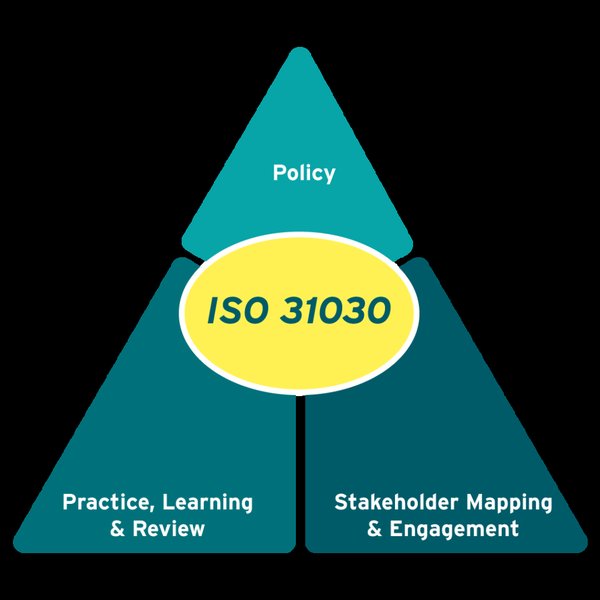
Conceptual model illustrating risk management elements often addressed in ISO standards.
- The travel risk assessment process described in Clause 8 should primarily aim to:
A) Justify predetermined travel decisions.
B) Systematically identify threats/hazards, analyze their likelihood and impact, and evaluate the level of risk.
C) Create complex statistical models irrelevant to practical safety.
D) Focus only on risks related to transportation delays.
Correct Answer: B - Which of the following is an example of a risk treatment measure (mitigation)?
A) Cancelling all travel to a specific region (Avoidance).
B) Providing pre-travel security briefings and secure transportation (Mitigation).
C) Purchasing travel insurance (Transfer).
D) Proceeding with travel despite high risks without controls (Acceptance - potentially irresponsible).
Correct Answer: B - An effective incident management process should include:
A) Procedures only for major catastrophic events, ignoring minor incidents.
B) Clear roles, responsibilities, communication protocols, and support mechanisms for travelers during an incident.
C) A policy of waiting 24 hours before responding to any reported issue.
D) Assigning blame immediately after an incident occurs.
Correct Answer: B - Traveler tracking technology is used operationally primarily to:
A) Monitor employee productivity while abroad.
B) Locate travelers quickly in case of emergencies or critical events.
C) Verify expense claims submitted by travelers.
D) Enforce adherence to planned tourist activities.
Correct Answer: B - What types of threats and hazards should be considered during the risk assessment process?
A) Only security-related threats like crime and terrorism.
B) Only health-related risks like disease outbreaks.
C) A broad range including security, safety (e.g., road accidents), health, environmental, political, and potentially cyber risks.
D) Only risks directly mentioned in government travel advisories.
Correct Answer: C
Visualizing TRM Program Components
An effective Travel Risk Management (TRM) program, guided by ISO 31030, integrates various elements. The mindmap below illustrates the interconnected nature of these components, showing how policy development, risk assessment, mitigation strategies, communication, and review work together to protect travelers and the organization.
(Likelihood & Impact)"] id3c["Risk Evaluation"] id3d["Risk Treatment
(Avoid, Mitigate, Transfer, Accept)"] id4["Operational Controls"] id4a["Pre-Travel Briefings"] id4b["Travel Tracking"] id4c["Secure Transport/Accommodation"] id4d["Health Support"] id4e["Communication Protocols"] id5["Support & Resources"] id5a["Competent Personnel"] id5b["Training & Awareness"] id5c["Documentation"] id5d["Technology/Tools"] id6["Incident Management"] id6a["Emergency Response Plan"] id6b["Communication Channels"] id6c["Assistance Services"] id7["Monitoring & Review"] id7a["Performance Evaluation"] id7b["Incident Analysis"] id7c["Program Audits"] id7d["Continual Improvement"]
Understanding how these areas interact is crucial for implementing a comprehensive and resilient TRM strategy.
Relative Emphasis in ISO 31030 Implementation
While all components of ISO 31030 are important, organizations often find certain areas require more initial focus or present greater challenges during implementation. The radar chart below provides a conceptual assessment of the relative emphasis typically placed on different facets of the standard. This is an illustrative analysis, not based on quantitative data, reflecting common priorities and complexities encountered.
Areas like 'Risk Assessment Process' and 'Incident Response' often demand significant attention due to their complexity and direct impact on traveler safety. 'Leadership Buy-in' is foundational, while 'Communication' and 'Technology' act as crucial enablers across the program.
Section 6: Performance Evaluation and Improvement
Testing Area: ISO 31030 Clauses 9 & 10 (Performance Evaluation, Improvement)
The final section assesses understanding of how to monitor, measure, analyze, and evaluate the TRM program's performance, and how to implement continual improvements based on findings.
- Performance evaluation of the TRM program (Clause 9) should include:
A) Only tracking the number of trips completed without incident.
B) Monitoring TRM objectives, analyzing incident data, collecting feedback, and conducting audits.
C) Comparing travel costs against the previous year's budget.
D) Measuring employee satisfaction with hotel choices.
Correct Answer: B - According to Clause 10 (Improvement), when a nonconformity (e.g., failure to follow policy) occurs, the organization should:
A) Ignore it unless it results in a major incident.
B) React to the nonconformity, evaluate the need for action to eliminate the cause, implement action, and review its effectiveness.
C) Immediately discipline the individual involved without investigating the root cause.
D) Rewrite the entire TRM policy from scratch.
Correct Answer: B - Continual improvement of the TRM program is driven by:
A) Keeping the program exactly the same year after year for consistency.
B) Reducing the budget allocated to travel risk management annually.
C) Learning from incidents, incorporating feedback, adapting to changing risk environments, and regularly reviewing program effectiveness.
D) Implementing new technologies regardless of their relevance or effectiveness.
Correct Answer: C - Management reviews of the TRM program should ensure its continuing:
A) Complexity and bureaucratic nature.
B) Suitability, adequacy, and effectiveness in managing travel risks.
C) Focus on restricting employee travel as much as possible.
D) Independence from other organizational risk management processes.
Correct Answer: B - Which activity is essential for demonstrating the effectiveness of the TRM program to stakeholders?
A) Hiding any negative incident reports.
B) Regularly reporting on performance metrics, incident trends, and improvements made.
C) Claiming zero risks exist due to the program.
D) Focusing reports solely on cost savings achieved.
Correct Answer: B
Key Responsibilities in an ISO 31030 Framework
Implementing ISO 31030 requires coordinated effort across different parts of the organization. The table below summarizes typical responsibilities, although specific roles may vary based on organizational structure.
| Role / Department | Key ISO 31030 Related Responsibilities |
|---|---|
| Top Management | Demonstrate leadership & commitment; Ensure policy/objectives alignment; Provide resources; Ensure integration with business processes. |
| TRM Manager / Security Dept. | Develop & implement TRM program; Conduct risk assessments; Oversee mitigation strategies; Manage incident response; Coordinate training; Monitor performance. |
| Human Resources (HR) | Support Duty of Care policies; Communicate policies; Assist with traveler well-being & health support; Contribute to pre-deployment checks. |
| Legal Department | Advise on legal/regulatory compliance (Duty of Care, privacy); Review policies & third-party contracts. |
| Travelers | Understand & comply with policies; Attend training; Report incidents promptly; Take reasonable care for their own safety/security. |
| Line Managers | Approve travel based on risk assessment; Ensure travelers receive necessary briefings/support; Support compliance. |
Foundational Risk Principles: ISO 31000 Insights
ISO 31030 builds upon the broader risk management principles established in ISO 31000. Understanding these foundational concepts is beneficial for grasping the context of travel-specific risk management. The video below provides an overview of the ISO 31000 framework.
Key takeaways from ISO 31000 that apply to ISO 31030 include the importance of integrating risk management into all organizational activities, tailoring the approach to the specific context, involving stakeholders, and pursuing continual improvement.
Frequently Asked Questions (FAQ) about ISO 31030
Q1: Is ISO 31030 a certifiable standard? ▼
No, ISO 31030 is a guidance standard, not a requirement standard like ISO 9001 or ISO 27001. Organizations cannot be "certified" against ISO 31030. However, they can align their travel risk management programs with its guidance to demonstrate best practices and due diligence in fulfilling their duty of care.
Q2: How does ISO 31030 help meet "Duty of Care" obligations? ▼
ISO 31030 provides a structured framework for identifying travel-related risks, implementing appropriate mitigation measures (like training, communication, security support, health precautions), and establishing response plans. By following this comprehensive guidance, organizations can demonstrate they have taken reasonable steps to protect their travelers, which is the essence of fulfilling duty of care.
Q3: Does implementing ISO 31030 require expensive technology? ▼
Not necessarily. While technology (like traveler tracking apps, risk intelligence platforms, communication tools) can significantly enhance a TRM program, the core of ISO 31030 focuses on processes, policies, risk assessment methodologies, training, and communication. Organizations can implement the standard effectively by focusing on these foundational elements first, scaling technology investments as needed and appropriate for their size and risk exposure.
Q4: How long does it typically take to align with ISO 31030? ▼
The timeline varies greatly depending on the organization's size, complexity, existing TRM maturity, resources allocated, and the scope of its travel activities. Some organizations may already have many components in place and only need refinement, which could take a few months. Others starting from scratch might take a year or more to fully develop, implement, and embed all aspects of the guidance.
Recommended Further Exploration
- What are the practical steps for implementing ISO 31030 in a medium-sized enterprise?
- How can ISO 31030 be integrated with existing ISO 31000 risk management frameworks?
- How do you develop effective travel risk assessment criteria based on ISO 31030 guidance?
- Can you provide case studies of organizations successfully applying ISO 31030 principles?
References
Last updated May 5, 2025