
Unveiling the Financial Blueprint of Ithy.com: A Look into its Potential Business Mechanics
Exploring how this multi-AI platform might generate revenue and manage costs in the evolving tech landscape.
Understanding the financial model of a technology company like Ithy.com, particularly one operating at the cutting edge of artificial intelligence, requires piecing together information about its services, target audience, and the economic realities of its operational infrastructure. While specific, publicly disclosed financial statements for Ithy.com are not readily available as of May 2025, we can synthesize a comprehensive overview based on its known characteristics and industry parallels.
Key Highlights: Ithy.com's Financial Standing
- Ithy.com is an advanced AI platform that distinguishes itself by utilizing a "Mixture-of-Agents" architecture, integrating multiple Large Language Models (LLMs) to produce comprehensive, article-quality responses.
- Publicly confirmed, detailed financial data for Ithy.com is limited. Much of the understanding of its financial model is based on its technological approach, potential market positioning, and common practices for AI-driven businesses.
- Potential financial strategies could encompass a range of models including subscription tiers, enterprise-level solutions, a freemium structure, or even a "success fee" model, alongside considerations stemming from its open-source aspects.
Decoding Ithy.com's Core Offering and Technical Foundation
Ithy.com operates as an AI-powered platform designed to deliver high-quality, in-depth answers by aggregating and synthesizing outputs from multiple LLMs. This "Mixture-of-Agents" approach means that user queries are processed by several AI models in parallel, with their diverse perspectives then combined into a single, coherent, and often extensive response. This methodology aims to overcome the limitations of single-model outputs, offering enhanced depth, nuance, and reliability.
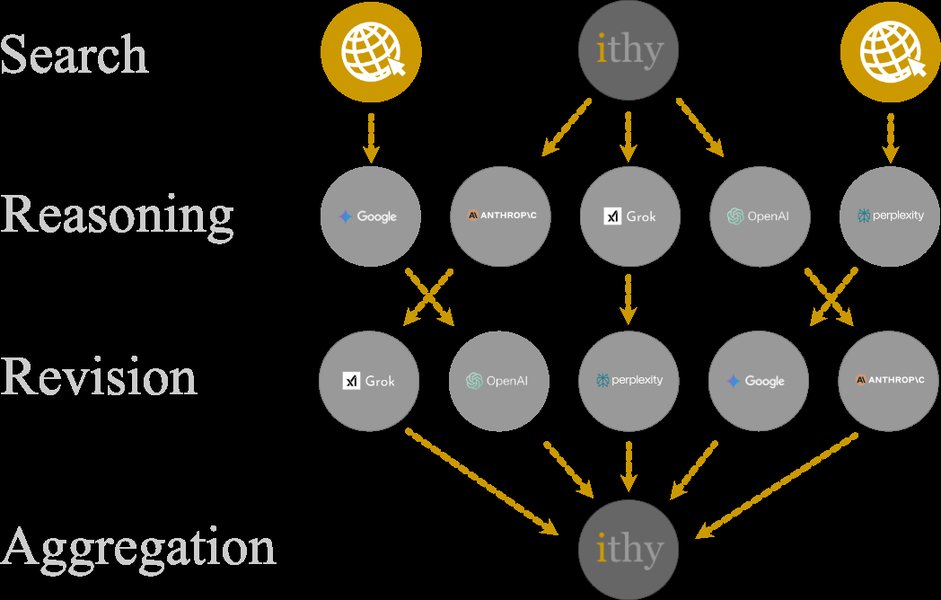
Conceptual representation of Ithy.com's multi-agent AI architecture.
Key Technological Attributes
The platform's technical underpinnings are crucial to understanding its potential operational costs and value proposition:
- Multi-LLM Integration: The core strength lies in its ability to invoke multiple reference models. This allows for a richer, more corroborated output than a single LLM might provide.
- Asynchronous Programming: To manage the complexity and latency of calling multiple APIs, Ithy.com reportedly employs asynchronous programming, crucial for efficiency and scalability.
- Content Generation: The output is often described as "article-like" or "research-oriented," suggesting a focus on quality and comprehensiveness suitable for professional or academic use.
- Open-Source Connection: An open-source project named "Ithy" on platforms like GitHub shares characteristics with Ithy.com, such as the Mixture-of-Agents approach. This could imply a development model that leverages community contributions or an ethos of transparency.
The platform's capabilities have found resonance in various fields. For instance, financial advisors have reportedly used Ithy.com for generating longer-form content and detailed analyses, indicating a potential market in professional services requiring robust information synthesis.
Exploring Potential Financial Avenues for Ithy.com
Without explicit financial disclosures, we can explore several plausible financial models that Ithy.com might employ or evolve towards, based on its technology and market trends for AI platforms.
Common AI Platform Monetization Strategies
Many AI platforms leverage a combination of the following to generate revenue:
- Subscription Fees: A tiered subscription model is common, offering varying levels of access, features, usage limits, or API calls. Users or businesses pay recurring fees (monthly/annually).
- Enterprise Licensing: Providing white-label or customized AI solutions to corporate clients. This could involve tailoring Ithy.com's multi-LLM capabilities for specific industry needs, such as financial analysis, legal research, or content creation at scale.
- Freemium Model: Offering basic access to core features for free to attract a broad user base, while monetizing advanced features, higher usage quotas, or premium support.
- API Access: Selling API access to developers or businesses who wish to integrate Ithy.com's multi-LLM processing power into their own applications or workflows.
- Consulting or Custom Development: Leveraging in-house expertise to offer specialized consulting services on AI integration or custom development projects based on their multi-LLM architecture.
The "Success Fee" Model
One specific model mentioned in some analyses (though not broadly corroborated across all provided information) is a "success fee" structure. In this model, Ithy.com would charge users or clients based on successful outcomes or transactions facilitated by the platform. For example, if Ithy.com's information directly leads to a quantifiable positive result for a business, a fee could be levied. This model aims to align the platform's revenue with the value it delivers. However, such models can sometimes face scrutiny regarding:
- Transparency: Clearly defining and measuring "success" can be complex, potentially leading to opacity.
- Conflicts of Interest: If the platform's revenue is tied to specific outcomes, it might raise questions about the neutrality of the information or services provided.
It's important to note this is one reported potential model and may not be the primary or sole financial strategy for Ithy.com.
Impact of Open-Source Aspects
The existence of an "Ithy" open-source AI project, which emphasizes multi-model collaboration, could also influence its financial strategy. Open-source projects often sustain themselves through:
- Community Contributions and Donations: Direct financial support from users and developers.
- Grants and Sponsorships: Funding from foundations or corporations that support open-source initiatives.
- Paid Support or Premium Features: Offering an open-source core with optional paid services, support tiers, or enterprise-grade features built on top.
- Strategic Partnerships: Collaborating with other organizations to integrate or co-develop solutions.
An open-source approach could foster rapid innovation and wider adoption, potentially creating a large user base that could be monetized through ancillary services or enterprise offerings.
Cost Structure Considerations
Running a sophisticated AI platform like Ithy.com inherently involves significant operational costs. Key expense categories likely include:
- Cloud Computing and Infrastructure: The most substantial cost is often the computational resources required to run multiple LLMs, process data, and serve user queries. This includes server costs, data storage, and network bandwidth.
- LLM API Usage Fees: If Ithy.com relies on third-party LLMs, accessing these models via APIs incurs costs, often based on usage volume (e.g., tokens processed).
- Research and Development (R&D): Continuous investment in AI research is vital to improve the models, the aggregation algorithms, and the overall quality of the platform. This includes salaries for AI researchers and engineers.
- Platform Maintenance and Development: Ongoing software engineering for the platform itself, including UI/UX design, backend development, security, and updates.
- Customer Support and Marketing: Costs associated with acquiring and retaining users, including marketing campaigns, sales efforts, and customer support services.
- Talent Acquisition and Retention: Hiring and retaining skilled AI professionals, software engineers, and data scientists is competitive and expensive.
The multi-LLM architecture, while a key differentiator for quality, likely translates to higher computing and API costs compared to single-LLM platforms.
Comparative Analysis of Potential Financial Model Characteristics
To visualize how Ithy.com's financial model might compare to other established models, the radar chart below assesses several key characteristics. These are speculative ratings based on the platform's nature and common industry practices, as definitive data for Ithy.com is not public.
This chart illustrates that Ithy.com's potential profile involves high cost intensity and scalability (due to its AI nature) but may face challenges in transparency if certain models like success fees are pursued. Its revenue diversification and innovation speed could be high, leveraging its multi-LLM approach.
Visualizing Ithy.com's Potential Financial Ecosystem
The following mindmap outlines the interconnected components that likely form Ithy.com's financial and operational ecosystem, from its core technology to its market interactions and cost structures.
Financial & Operational Ecosystem"] id1["Core Technology"] id1a["Mixture-of-Agents (Multi-LLM)"] id1b["Asynchronous Processing"] id1c["AI-driven Content Synthesis"] id2["Service Offering"] id2a["Comprehensive & Detailed Answers"] id2b["Article-Quality Reports"] id2c["Niche Use Cases
(e.g., Financial Advisory Support, Research)"] id3["Potential Revenue Streams"] id3a["Subscription Tiers"] id3b["Enterprise Solutions / Licensing"] id3c["Freemium Model"] id3d["API Access Sales"] id3e["Success Fees (Reported Possibility)"] id3f["Open-Source Driven Funding
(Grants, Donations, Paid Support)"] id4["Key Cost Drivers"] id4a["Cloud Infrastructure & Compute"] id4b["Third-Party LLM API Costs"] id4c["Research & Development (AI)"] id4d["Platform Engineering & Maintenance"] id4e["Marketing, Sales & Customer Support"] id4f["Talent Acquisition"] id5["Market Positioning & Considerations"] id5a["Differentiator: Quality & Depth (Multi-LLM)"] id5b["Competition from other AI Tools"] id5c["Scalability through Automation"] id5d["Influence of Open-Source Ethos"]
This mindmap illustrates how Ithy.com's advanced technology underpins its service offerings, which in turn opens up various avenues for revenue generation, balanced against significant operational costs. Its market position will likely be defined by the quality derived from its multi-LLM approach.
Comparative Table of Potential Revenue Models
To further understand the implications of different financial strategies, the table below compares potential revenue models and their suitability or considerations for a platform like Ithy.com.
| Revenue Model | Description | Potential Applicability to Ithy.com | Pros | Cons |
|---|---|---|---|---|
| Subscription Plans | Users pay recurring fees (monthly/annually) for access to features, usage tiers, or premium content. | Offering advanced multi-LLM features, higher query limits, or specialized content generation tools under various subscription plans. | Predictable recurring revenue, fosters user commitment, allows for tiered feature access. | Can be a barrier to entry for some users, faces competition from free or lower-cost alternatives. |
| Enterprise Licensing | Providing tailored or white-label versions of the platform to businesses for internal use or integration. | Customizing the multi-LLM engine for specific industries (e.g., finance, legal, R&D) requiring high-quality, synthesized information. | Potentially high contract values, deep integration with client workflows, strong B2B relationships. | Long sales cycles, significant customization effort, higher support demands. |
| Freemium Model | Offering basic services for free to attract a large user base, with premium features or higher usage available for a fee. | Allowing free access to basic multi-LLM queries, upselling power users or businesses to paid tiers for advanced capabilities. | Low barrier to entry, potential for viral growth, large pool for upselling. | High cost of supporting free users, challenges in converting free users to paid. |
| "Success Fee" Model | Charging fees based on the successful outcomes or transactions facilitated or enabled by the platform. | If Ithy.com can demonstrably contribute to specific valuable outcomes for users (e.g., improved research leading to a grant). | Aligns platform incentives with user value, potential for high revenue on significant successes. | Difficult to define and measure "success" consistently, potential for perceived opacity or conflicts of interest, regulatory scrutiny. |
| Open-Source Driven Monetization | Core platform is open-source, revenue from donations, grants, paid support, consulting, or premium managed services. | If the GitHub "Ithy" project is central, this model would leverage community support and offer specialized services around it. | Fosters community engagement and innovation, builds trust, can lower direct development costs. | Revenue can be unpredictable, reliance on community or grant funding, monetizing open-source can be challenging. |
| API Access Sales | Selling access to Ithy.com's multi-LLM processing capabilities via an API for developers and businesses. | Allowing third parties to integrate Ithy's advanced synthesis capabilities into their own products or services. | Scalable revenue stream, enables new use cases and partnerships. | Requires robust API infrastructure, documentation, and support; competitive API marketplace. |
Each of these models, or a hybrid approach, presents distinct opportunities and challenges for Ithy.com. The optimal strategy would depend on its specific market focus, technological advantages, and long-term vision.
Frequently Asked Questions (FAQ)
What is Ithy.com's primary service?
Ithy.com is an AI-powered platform that provides comprehensive, article-like answers to user queries by leveraging a "Mixture-of-Agents" architecture. This means it integrates and synthesizes information from multiple Large Language Models (LLMs) to deliver detailed and well-rounded responses.
Are there publicly available financial reports for Ithy.com?
As of May 2025, detailed, publicly disclosed financial reports or official statements on Ithy.com's specific financial model are not readily available in the provided information. Much of the understanding is synthesized from its technological capabilities, market positioning, and common business practices in the AI industry.
How does Ithy.com's technology influence its potential business model?
Ithy.com's use of multiple LLMs and a "Mixture-of-Agents" approach allows it to offer higher quality and more comprehensive outputs. This premium offering could justify subscription fees, enterprise licensing, or specialized service charges. However, this advanced technology also implies higher operational costs (computing, API access, R&D), which must be covered by its revenue model.
What are the main costs associated with running an AI platform like Ithy.com?
Key costs include cloud computing resources for running AI models, fees for accessing third-party LLM APIs, significant investment in research and development to enhance AI capabilities, platform maintenance and software engineering, marketing and customer acquisition expenses, and salaries for highly skilled AI professionals and engineers.
Recommended Further Exploration
- How do multi-LLM AI platforms typically monetize their services?
- What are the challenges in creating a sustainable financial model for open-source AI projects?
- Explore the business models of successful AI-driven content generation tools.
- What are the ethical considerations of 'success fee' models in technology platforms?
References
Last updated May 8, 2025