
The Transformative Revelations of the James Webb Space Telescope
Peering into the Universe's Deepest Secrets and Shaping Our Cosmic Understanding
Key Highlights from Webb's Astounding Discoveries
- Unprecedented Glimpses into the Early Universe: Webb has consistently broken its own records by detecting the most distant and earliest galaxies, some existing merely hundreds of millions of years after the Big Bang, profoundly altering our understanding of cosmic evolution.
- Revolutionary Exoplanet Characterization: The telescope has made groundbreaking discoveries regarding exoplanet atmospheres, including the detection of water vapor, methane, and carbon dioxide on distant worlds like K2-18 b, offering promising hints of potential habitability.
- Detailed Views of Star and Galaxy Formation: Webb's infrared capabilities provide unparalleled resolution of stellar nurseries, galactic structures, and the intricate interplay of gas and dust, shedding new light on how stars and galaxies are born and evolve.
The James Webb Space Telescope (JWST), a collaborative effort by NASA, ESA, and CSA, has fundamentally reshaped our perception of the cosmos since it began its science operations in July 2022. Designed to observe the universe with unprecedented precision, depth, and resolution in the infrared spectrum, Webb has delivered a continuous stream of breathtaking images and profound scientific data. Its discoveries span from the most ancient galaxies at the edge of the observable universe to the atmospheric compositions of exoplanets and the intricate processes of star formation within our own galaxy. The telescope's capabilities have not only confirmed long-standing theories but have also unveiled entirely new phenomena, challenging existing models and opening new avenues of astrophysical research. The impact of Webb's observations extends across various domains of astronomy, from cosmology and galaxy evolution to planetary science and the search for life beyond Earth.
Unveiling the Cosmic Dawn: Early Universe Discoveries
Pushing the Boundaries of Time and Distance
One of the primary scientific goals of the James Webb Space Telescope was to observe the first galaxies that formed after the Big Bang. In this regard, Webb has far exceeded expectations, repeatedly breaking its own records for detecting the most distant and earliest galaxies. These observations are crucial for understanding how the universe evolved from its "dark ages" into the complex tapestry of galaxies we see today.
The Most Distant Galaxies Ever Imaged
Webb has spotted galaxies that existed just 280 million years after the Big Bang, such as JADES-GS-z14-0, and others as early as 300 to 500 million years post-Big Bang. These "cosmic miracles," as some scientists have dubbed them, appear as tiny, compact objects bursting with new stars. The light from these ancient galaxies has been traveling for approximately 13.5 to 13.6 billion years to reach Webb, providing an invaluable window into the universe's infancy. The detection of such bright and well-formed galaxies at such early epochs suggests that galaxy formation processes were more rapid and efficient than previously thought, leading to new hypotheses about the rise of obscured Active Galactic Nuclei (AGN) and the overall growth of cosmic structures.
This radar chart illustrates the James Webb Space Telescope's performance across key observational capabilities, highlighting its strengths in studying the early universe, exoplanet atmospheres, and stellar evolution. Each axis represents a crucial aspect of astronomical research, and the datasets showcase Webb's profound impact compared to theoretical expectations and previous observatories. The chart demonstrates how Webb's advanced instrumentation allows for unprecedented sensitivity and resolution across various scientific frontiers, driving unexpected and groundbreaking discoveries.
Challenging Theories of Galaxy Evolution
The existence of massive, well-developed galaxies so early in cosmic history challenges conventional models of galaxy formation and evolution. Previously, astronomers believed that large galaxies would take much longer to assemble. Webb's observations suggest that the universe transitioned out of its "dark ages" sooner than anticipated, with star formation and black hole growth occurring at an unexpectedly rapid pace. This has led to the discovery of new classes of galaxies and supermassive black holes in the early universe, some weighing billions of solar masses, which defy prior understanding of how such massive objects could have formed so quickly after the Big Bang.

An artistic representation of how the James Webb Space Telescope observes the earliest galaxies in the universe.
Probing Exoplanet Atmospheres and the Search for Life
Beyond Our Solar System
Webb's unparalleled infrared capabilities make it an ideal instrument for characterizing the atmospheres of exoplanets, which are planets orbiting stars outside our solar system. This is a crucial step in the ongoing search for life beyond Earth.
Hints of Habitability on K2-18 b
Among the most exciting discoveries is the detection of methane and carbon dioxide, and even tentative hints of dimethyl sulfide (DMS) – a molecule often associated with biological activity on Earth – in the atmosphere of K2-18 b. This exoplanet, located in its star's habitable zone, is a "hycean" world, meaning it is potentially covered in a water ocean. While DMS detection is still tentative and requires further confirmation, these findings represent a significant step towards identifying potentially habitable worlds and understanding their atmospheric chemistry. Webb's ability to discern such intricate molecular signatures in distant exoplanet atmospheres is truly revolutionary.
Atmospheric Composition of Gas Giants and Icy Worlds
Beyond K2-18 b, Webb has provided detailed insights into the atmospheres of various exoplanets, including gas giants. It has captured new details of auroras on Jupiter and even found water ice in a band of icy bodies at the edge of a distant star system, HD 181327. These observations are helping scientists understand how extrasolar planets form and evolve, as well as the conditions that might support the formation of water, a key ingredient for life.
Revealing the Intricacies of Star and Planetary System Formation
From Cosmic Nurseries to Dying Stars
Webb's observations of star-forming regions and planetary nebulae offer unprecedented views into the life cycles of stars and the formation of new worlds.
The Pillars of Creation and Cosmic Cliffs
Webb has revisited iconic structures like the Pillars of Creation and the Carina Nebula (dubbed the "Cosmic Cliffs"), capturing them with astonishing clarity. These regions are stellar nurseries where new stars are born from dense clouds of gas and dust. Webb's infrared vision allows it to pierce through these opaque clouds, revealing embedded protostars and the intricate structures sculpted by stellar winds and radiation. These images are not just aesthetically stunning; they provide critical data on the processes of star formation, including the dynamics of gas and dust and the interplay between young stars and their environment. A new 3D visualization derived from Webb data of the Cosmic Cliffs has transformed this ethereal landscape into an immersive experience of gas, dust, and stars.

The Cosmic Cliffs in the Carina Nebula, a spectacular star-forming region captured by the James Webb Space Telescope.
Unmasking Cosmic Tornadoes and Dying Stars
The telescope has also unmasked the true nature of phenomena like the "Cosmic Tornado" (Herbig-Haro 49/50), revealing it as a chance alignment of a protostellar outflow with a distant spiral galaxy. Previously, its helical appearance led to uncertainty about its nature. Webb's higher resolution has unveiled fine features of shocked regions in the outflow and identified the "fuzzy object" at its tip as a distant spiral galaxy. Furthermore, Webb has taken the most detailed image of planetary nebula NGC 1514, bringing its dusty rings into full focus thanks to its unique mid-infrared camera, providing new insights into the dying stages of stars.
Understanding Trans-Neptunian Objects (TNOs)
Closer to home, Webb has revolutionized our understanding of Trans-Neptunian Objects (TNOs) – icy planetoids beyond Neptune and Pluto. These distant objects offer a window into the early history of our solar system. Webb's observations are providing new details about their composition and distribution, helping scientists reconstruct the formation and evolution of our planetary neighborhood.
Expanding Our Knowledge of Black Holes and Galaxy Dynamics
The Engines of Cosmic Evolution
Black holes, especially supermassive black holes at the centers of galaxies, play a critical role in galaxy evolution. Webb is providing unprecedented views into their activity.
Hidden Black Holes in the Early Universe
Webb has unveiled a hidden population of supermassive black holes in the early universe that were previously undetectable. These black holes are powering quasars – incredibly luminous objects – and are growing at an unexpected rate. The findings suggest that black hole growth in the early universe was more prevalent and vigorous than theoretical models predicted, impacting the evolution of their host galaxies.
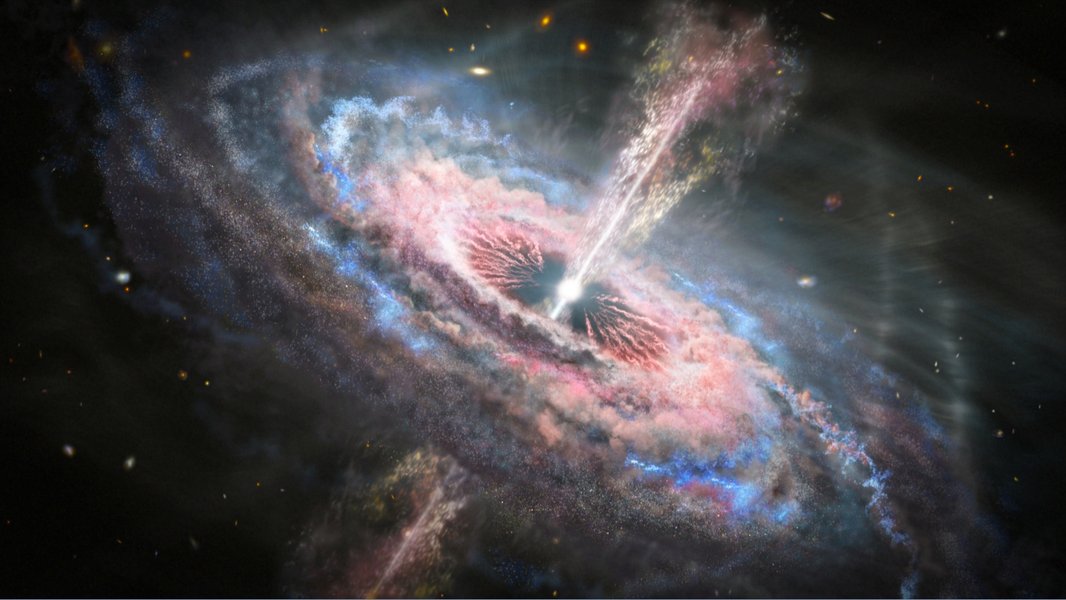
A galaxy hosting a quasar, as observed by the James Webb Space Telescope, revealing a hidden black hole.
Galaxies in Collision and Evolution
The telescope has also provided stunning images of galaxies in various stages of interaction and evolution, such as the Phantom Galaxy (M74) and NGC 2283. These observations offer insights into how galaxies merge, how their central black holes influence star formation, and how spiral arms are formed and maintained. The intricate layers of interstellar dust and gas revealed by Webb, sculpted by magnetic fields, are helping astronomers understand the complex dynamics within galaxies.
Comparing Webb and Hubble: A Synergistic Approach
Complementary Views of the Cosmos
While the James Webb Space Telescope is often referred to as the successor to the Hubble Space Telescope, they are, in fact, complementary instruments. Hubble primarily observes in visible and ultraviolet light, while Webb specializes in infrared.
| Feature | Hubble Space Telescope | James Webb Space Telescope (JWST) |
|---|---|---|
| Primary Observation Wavelengths | Visible, Ultraviolet (UV), Near-Infrared (limited) | Infrared (Near-Infrared, Mid-Infrared) |
| Mirror Size | 2.4 meters (7.9 feet) | 6.5 meters (21.3 feet) |
| Operating Temperature | Ambient space temperature (~20°C) | Extremely cold (~-223°C or -370°F) for infrared sensitivity |
| Location | Low Earth Orbit (LEO) | Lagrange Point 2 (L2), ~1.5 million km from Earth |
| Primary Scientific Goals | Understanding cosmic expansion, galaxy evolution, stellar life cycles, solar system observations | First stars and galaxies, exoplanet atmospheres, star and planetary system formation, distant universe |
| Ability to Pierce Dust | Limited | Excellent (due to infrared capabilities) |
The synergy between Hubble and Webb is evident in composite images, where Hubble's visible light data provides a different perspective on structures also observed by Webb in infrared. This combination allows scientists to gain a more complete understanding of cosmic phenomena. For instance, observations of galaxy clusters often combine data from both telescopes to showcase the full extent of the universe's complexity.
The Future of Webb's Observations
Continuing the Quest for Cosmic Knowledge
The James Webb Space Telescope is now on the cusp of its fourth year of operations, with its next cycle of observations (Cycle 4, running from July 2025 to June 2026) already announced. This planning ensures that Webb continues to focus its unparalleled capabilities on the most pressing questions in astrophysics. While budgetary uncertainties present challenges, the scientific community is committed to maximizing the telescope's transformative potential. Each year, new programs are chosen to ensure a diverse range of groundbreaking observations, from charting the growth of the universe to scrutinizing individual exoplanets. The steady stream of discoveries from Webb is expected to continue for many years, leading to new hypotheses, new studies, and entirely new questions about the universe that scientists will eagerly pursue.
Frequently Asked Questions (FAQ)
What is the James Webb Space Telescope (JWST)?
What are some of the most significant discoveries made by JWST?
How does JWST differ from the Hubble Space Telescope?
Has JWST found signs of life on other planets?
Conclusion
The James Webb Space Telescope has, in a remarkably short period, transformed our understanding of the universe. Its unparalleled ability to gather infrared light has allowed us to peer further back in time, revealing the earliest galaxies and the rapid processes of cosmic evolution. Simultaneously, it has provided exquisite detail on nearby stellar nurseries, the life cycles of stars, and the atmospheric compositions of exoplanets, some of which show promising hints of potential habitability. The discoveries made by Webb are not just incremental; they are fundamental shifts in our knowledge, challenging long-held theories and sparking new questions. As Webb continues its observations, it promises to unveil even more profound secrets of our universe, ensuring that the cosmos remains an endless source of wonder and scientific inquiry.
Recommended Further Exploration
- How has JWST impacted exoplanet research?
- Deep dive into JWST's early universe galaxy discoveries
- The role of infrared astronomy in understanding the universe
- Future missions complementing the James Webb Space Telescope