
Unlocking Hyper-Efficient Pathfinding: The Genius of Jump Point Search
Discover how JPS dramatically accelerates A* on grid maps by intelligently skipping redundant steps.
Key Insights into Jump Point Search
- A* Optimization: Jump Point Search (JPS) is a highly specialized and optimal enhancement of the A* search algorithm, specifically designed for uniform-cost grid environments.
- Symmetry Breaking: Its core strength lies in pruning the search space by eliminating redundant symmetric paths and "jumping" over intermediate nodes, significantly reducing computational overhead.
- Focus on "Jump Points": JPS identifies critical "jump points" – nodes at obstacles, forced turns, or the goal – and only considers these for expansion, rather than every single neighbor.
The Jump Point Search (JPS) algorithm represents a significant leap forward in pathfinding efficiency, particularly within structured environments like uniform-cost grids. Developed by Daniel Harabor and Alban Grastien, JPS optimizes the well-known A* search algorithm by strategically reducing the number of nodes that need to be evaluated. This intelligent pruning is achieved by exploiting the inherent symmetries found in grid-based maps, allowing JPS to "jump over" large sections of the grid that would otherwise be laboriously traversed by traditional pathfinding methods.
The Genesis of JPS: Enhancing A* Search
At its heart, JPS is not a standalone algorithm but a sophisticated enhancement to A*. A* is renowned for its optimality and efficiency in finding the shortest path between two points in a graph, but on uniform-cost grids, it can be computationally intensive as it examines every accessible neighbor of a node. JPS addresses this by introducing a mechanism that drastically reduces the number of nodes added to the open list—the set of nodes to be evaluated—thereby speeding up the search process by an order of magnitude or more.
The innovation of JPS lies in its ability to recognize and bypass "uninteresting" nodes. In a grid where movement costs are uniform (e.g., each horizontal/vertical move costs 1, and each diagonal move costs √2), many intermediate nodes along a straight or diagonal path do not offer unique information for finding the shortest route. JPS capitalizes on this by defining specific rules to identify "jump points," which are the only nodes truly necessary to consider for optimal path construction.
Why Grids Pose a Challenge for Traditional A*
Standard A* can be slow on grids due to the "symmetry problem." When exploring from a node, A* considers all valid neighbors, often leading to multiple equivalent paths to the same destination. This redundancy inflates the number of nodes processed and the size of the priority queue, leading to performance bottlenecks. JPS intelligently breaks these symmetries by only expanding nodes that are critical decision points.
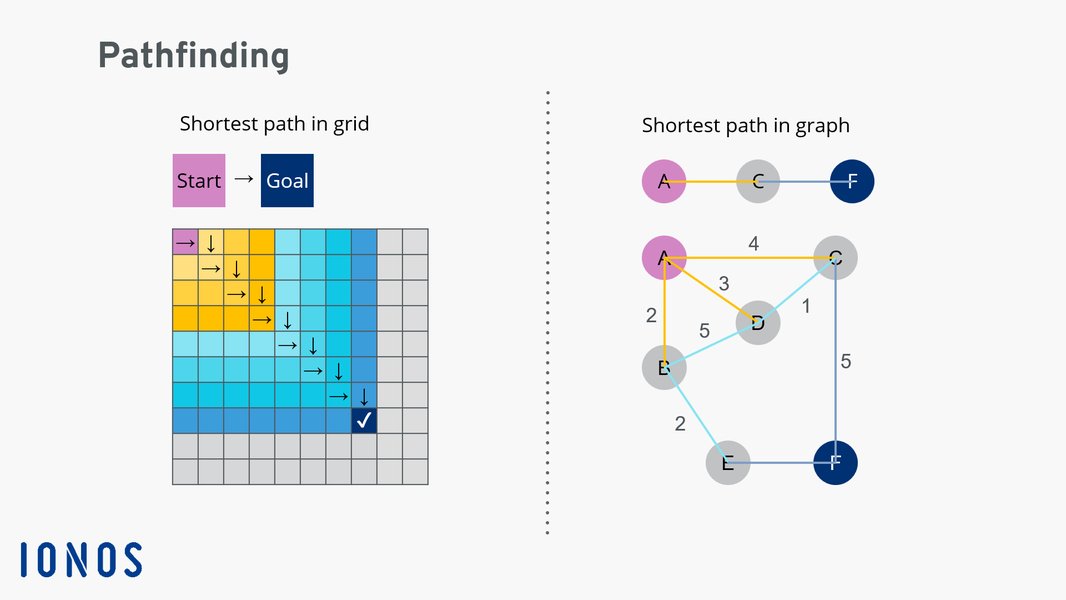
A typical grid graph illustrating nodes and potential connections, fundamental to pathfinding algorithms.
Dissecting the JPS Mechanism: How It Works
The operational efficiency of JPS stems from its unique method of identifying and expanding jump points. Instead of a step-by-step exploration, JPS recursively "jumps" along straight or diagonal lines, only stopping when it encounters a significant feature on the map. This approach is significantly more efficient than checking every adjacent cell.
The Concept of Jump Points
A "jump point" is a node that is strategically important for determining the optimal path. These are typically:
- The goal node itself.
- Nodes where continuing straight is no longer optimal due to an obstacle that "forces" a turn.
- Nodes from which a "forced neighbor" exists, meaning a neighbor that can only be reached optimally by passing through the current jump point.
JPS systematically searches for these points, bypassing all intermediate nodes. For instance, if you're moving horizontally across a clear corridor, JPS doesn't visit each cell; it "jumps" directly to the end of the corridor or to the next significant point where a decision must be made.
Recursive Scanning and Pruning Rules
The algorithm employs a recursive scanning process. When moving from a parent node to a child node, JPS determines if the child node is a jump point successor. This involves checking for "forced neighbors"—neighbors that become newly accessible or require a change in direction due to the current node's position relative to obstacles. If such a neighbor is found, the current node is identified as a jump point and added to the open list for A* to process.
The pruning rules are central to JPS's efficiency. They dictate which directions from a node are worth exploring, effectively discarding paths that cannot be optimal. For example, when moving diagonally, JPS checks for forced neighbors not only in diagonal directions but also in the orthogonal (horizontal/vertical) directions. This ensures that no optimal path is missed while drastically reducing the number of nodes considered.
Integration with A* Priority Queue
While JPS modifies the node expansion process, it still relies on A*'s core structure, including its priority queue. Instead of adding all neighbors to the queue, JPS only adds the identified jump points. This keeps the priority queue significantly smaller, reducing the overhead of insertion and extraction operations and contributing directly to the observed speed improvements.
Advantages and Considerations of JPS
The benefits of JPS are substantial, especially for applications where pathfinding on grids is a primary concern. However, it also comes with specific considerations regarding its applicability.
Unparalleled Speed on Uniform-Cost Grids
The most compelling advantage of JPS is its speed. By focusing on jump points and eliminating redundant exploration, it can find optimal paths much faster than A*, often by an order of magnitude. This makes it ideal for real-time applications such as video games and robotics, where quick path calculation is crucial.
This radar chart visually compares Jump Point Search (JPS) and the traditional A* algorithm across several critical performance metrics. JPS excels in computational efficiency and symmetry reduction power due to its intelligent pruning of search space. Both algorithms maintain optimal pathfinding capabilities. However, JPS presents higher implementation complexity compared to A* and has limited adaptability to weighted grids, where movement costs vary, unlike A* which handles them more natively. This highlights JPS's specialized nature as an optimization for specific grid environments.
Preservation of Optimality
Despite its aggressive pruning, JPS guarantees the same optimal (shortest) path as A*. The pruning rules are carefully designed to ensure that no part of the optimal path is ever discarded, making JPS a reliable choice where path quality is paramount.
Considerations and Limitations
While powerful, JPS is not a silver bullet for all pathfinding scenarios:
- Uniform-Cost Grids: Its primary benefits are realized on uniform-cost grids. It does not inherently support weighted maps where movement costs vary between cells (e.g., different terrain types).
- Implementation Complexity: The rules for identifying jump points and forced neighbors can be more intricate to implement compared to a basic A* algorithm, which might deter beginners.
- Homogeneous Agent Size: JPS is generally designed for agents of uniform size. Adapting it for agents with varying sizes or shapes might require further modifications.
- Performance Variability: In certain highly dense or chaotic maps, or on very small grids, the overhead of calculating jump points might diminish JPS's performance advantage over a highly optimized A* implementation.
Understanding JPS in Action
To further illustrate the mechanics of JPS, consider its operational flow compared to A*:
This mindmap illustrates the foundational concepts, operational flow, advantages, and limitations of the Jump Point Search (JPS) algorithm. It highlights JPS as an A* optimization primarily for uniform-cost grids, emphasizing its mechanism of symmetry breaking through the identification and selective expansion of "jump points." The diagram also touches upon its benefits, such as speed and optimality, while acknowledging its constraints and areas of ongoing research for further enhancement.
A Comparative Look: JPS vs. A*
The following table summarizes the key distinctions and similarities between JPS and the traditional A* algorithm on uniform-cost grids.
| Feature | Jump Point Search (JPS) | A* Search Algorithm |
|---|---|---|
| Primary Goal | Optimize A* for uniform-cost grids by reducing expanded nodes. | Find the shortest path in a graph. |
| Node Expansion Strategy | Only expands "jump points" (critical nodes) and the goal. | Expands all accessible neighbors of the current node. |
| Symmetry Handling | Actively prunes symmetric paths, reducing redundancy. | Explores symmetric paths, leading to potential redundancy. |
| Performance on Uniform Grids | Significantly faster (often orders of magnitude). | Efficient, but slower than JPS on large uniform grids. |
| Optimality | Preserves A*'s optimality (guarantees shortest path). | Guarantees shortest path. |
| Applicability to Weighted Grids | Less suitable in its basic form. | Naturally supports varying edge costs. |
| Implementation Complexity | More complex due to specific pruning rules. | Relatively simpler to implement. |
This table highlights how JPS specifically targets the inefficiencies of A* on grid maps by introducing intelligent pruning and focusing on jump points, leading to superior performance in its niche.
Real-World Applications and Future Directions
JPS finds significant utility in fields where efficient pathfinding on grid-based environments is critical. Its ability to process large maps quickly makes it a preferred choice for:
- Video Game AI: For character movement, enemy navigation, and overall game logic in tile-based or grid-based games.
- Robotics: For autonomous robot navigation in structured environments, especially in manufacturing or warehousing.
- Geographic Information Systems (GIS): Though less common, its principles could apply to simplified grid representations of terrain.
The academic community continues to explore enhancements and extensions to JPS. These include pre-computing jump points to further minimize online search times, developing "Bounded JPS" (BJPS) to limit jump distances on very open maps, and integrating JPS with hierarchical pathfinding techniques for even larger-scale environments. There's also ongoing research to adapt JPS principles to more complex scenarios, including those with varying costs or robot path planning that considers factors beyond simple grid traversal, such as turning angles and posture adjustments.
A practical demonstration of Jump Point Search in action, showcasing its accelerated pathfinding compared to standard A*. This video provides a clear visual example of how JPS efficiently navigates a grid, illuminating its core mechanics and performance benefits.
This video provides a valuable visual demonstration of how Jump Point Search operates in a real-time environment. It clearly shows the algorithm "jumping" over unnecessary nodes, directly illustrating the efficiency gains over traditional A* pathfinding. The demo effectively highlights JPS's ability to navigate complex grid layouts by focusing on key decision points, making its optimization strategy intuitive and easy to grasp.
Frequently Asked Questions (FAQ)
What is the core difference between JPS and A*?
Does JPS always find the shortest path?
On what types of maps does JPS perform best?
Are there any limitations to using JPS?
Can JPS be combined with other pathfinding techniques?
Conclusion
Jump Point Search stands as a testament to intelligent algorithm design, offering a powerful solution for accelerating pathfinding on uniform-cost grid environments. By strategically breaking symmetries and focusing on "jump points," JPS achieves remarkable efficiency gains over traditional A* while maintaining optimality. Its impact is particularly significant in fields like game development and robotics, where rapid and accurate path calculation is paramount. As research continues to explore its extensions and applications, JPS remains a cornerstone for advanced grid-based navigation.
Recommended Further Reading
- How to implement Jump Point Search in popular programming languages?
- A detailed comparison of JPS with other modern pathfinding algorithms in game AI.
- What are the advanced variants and optimizations of Jump Point Search?
- How does Jump Point Search address challenges in robotic navigation?
Referenced Search Results
 harablog.wordpress.com
 cdn.aaai.org