
Unlocking the Universe's Hidden Consciousness: Joachim Keppler's Zero-Point Field Theory
How quantum fields, brain dynamics, and resonant interactions may hold the secret to explaining the mystery of conscious experience
Key Insights into Keppler's Consciousness Theory
- Zero-Point Field as Consciousness Substrate: Keppler proposes that the omnipresent zero-point field (ZPF) serves as the fundamental medium from which consciousness emerges.
- Resonant Brain-ZPF Coupling: Consciousness arises through specific resonant interactions between neural dynamics and the quantum vacuum field.
- Quantifiable Consciousness Framework: The theory offers a potentially measurable approach to consciousness through the analysis of field mode amplifications and neural attractors.
The Foundation: Zero-Point Field and Consciousness
Joachim Keppler, a physicist at the Department of Consciousness Research (DIWISS), has developed an innovative theory that bridges quantum physics and neuroscience to explain consciousness. Unlike conventional neuroscientific approaches that view consciousness as merely an emergent property of neural activity, Keppler's theory proposes that consciousness is fundamentally linked to the zero-point field (ZPF), a ubiquitous energy field that permeates all of space-time.
The zero-point field represents the lowest energy state of quantum fields – a perpetually fluctuating sea of energy that exists even in vacuum. According to Keppler, this field is not merely a physical construct but possesses intrinsic properties that enable conscious experience. This perspective transforms how we conceptualize consciousness, suggesting it is not produced by the brain but rather accessed through it.
The TRAZE Framework: Theory of Resonant Amplification of Zero-point Field Modes
At the core of Keppler's work is what he calls TRAZE – the Theory of Resonant Amplification of Zero-point Field Modes. This framework suggests that consciousness emerges through a process whereby brain activity resonantly couples with the ZPF, selectively amplifying specific modes of the field. These amplified modes correspond to distinct conscious experiences, creating the rich tapestry of phenomenal qualities we experience subjectively.
Keppler's theory addresses the notorious "hard problem of consciousness" – explaining how physical processes in the brain give rise to subjective experience – by positing that the ZPF itself has dual aspects: physical properties governed by quantum electrodynamics, and phenomenal properties that manifest as conscious experience when properly coupled with biological systems.
Mechanisms of Brain-ZPF Interaction
The Brain as a ZPF Modulator
In Keppler's framework, the brain functions as a highly specialized "write-read head" that interacts with the zero-point field. Neural networks create specific patterns of activity that resonate with the ZPF, allowing the brain to both extract information from and imprint information onto the field. This bidirectional interaction forms the basis for conscious experience.
Attractor States and Phase Transitions
The brain falls into stable attractor states characterized by synchronized neural activity patterns. These attractor states facilitate selective amplification of specific ZPF modes through resonant coupling. When neural oscillations reach sufficient coherence, they trigger phase transitions in the brain-ZPF system, allowing access to distinct conscious states. This process involves complex dynamics that can be analyzed using tools from nonlinear systems theory and quantum physics.
Resonance and Selective Information Processing
Resonance is a key mechanism in Keppler's theory. Just as a radio receiver selectively amplifies specific frequencies from the electromagnetic spectrum, the brain selectively couples with specific modes of the ZPF. This selective coupling determines which aspects of consciousness become accessible to the organism. The specificity of resonant patterns explains the individuality of conscious experience despite the universality of the underlying ZPF.
The Critical Role of Neural Synchrony
Keppler emphasizes that neural synchrony – the coordinated firing of neurons across brain regions – plays a crucial role in facilitating brain-ZPF coupling. High-frequency oscillations, particularly in the gamma band (30-100 Hz), create coherent states that effectively modulate the ZPF. This explains why conscious awareness correlates with specific patterns of neural synchronization observed in neurophysiological studies.
This radar chart compares Keppler's Zero-Point Field Theory with other prominent theories of consciousness across multiple dimensions, highlighting its strengths in explaining the hard problem of consciousness and its compatibility with fundamental physics.
Distinguishing Conscious from Non-Conscious Systems
A significant contribution of Keppler's theory is its ability to differentiate between conscious and non-conscious systems. According to his framework, only systems capable of generating stable, complex resonant interactions with the ZPF can produce conscious experiences. This requires specific organizational principles in neural architecture that enable effective modulation of ZPF modes.
| Characteristic | Conscious Systems | Non-Conscious Systems |
|---|---|---|
| ZPF Interaction | Selective amplification of specific ZPF modes | Minimal or non-selective interaction with ZPF |
| Neural Dynamics | Complex attractor states with phase transitions | Simple or chaotic dynamics without stable attractors |
| Information Integration | High capacity for binding diverse information | Limited information integration capability |
| Resonance Patterns | Stable, orchestrated neural synchronization | Disordered or simplistic oscillatory patterns |
| Adaptability | Dynamic reconfiguration of neural-ZPF coupling | Static or limited response to environmental changes |
Visual Mapping of Keppler's Consciousness Theory
The mindmap below illustrates the key concepts, relationships, and implications of Joachim Keppler's theory of consciousness, showing how the various elements interconnect to form a cohesive framework:
Visual Understanding of the ZPF Theory
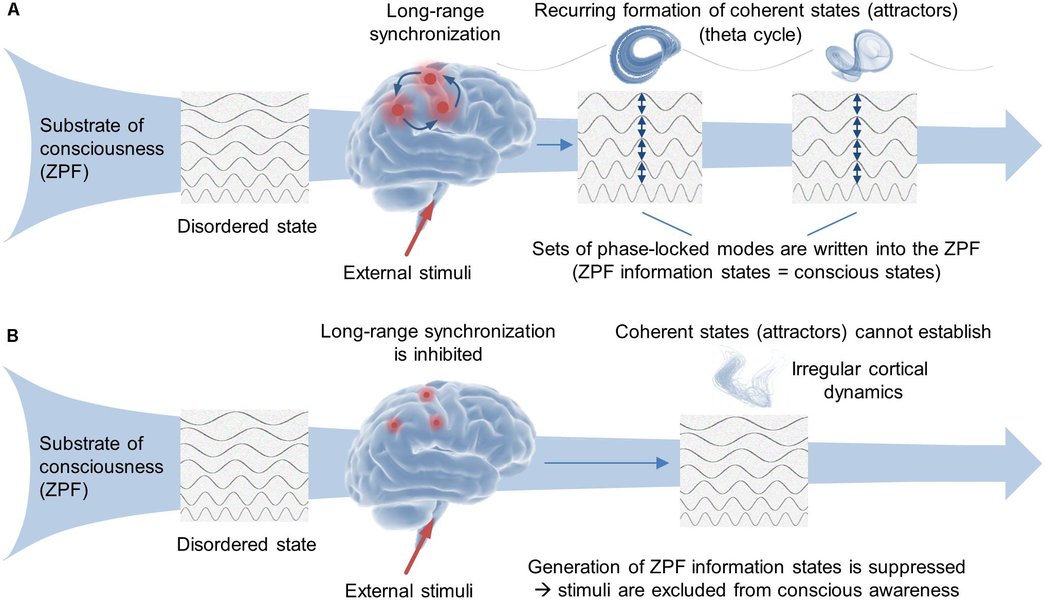
This diagram from Keppler's published research illustrates the interaction between brain dynamics and the Zero-Point Field. The left side represents the physical domain (brain processes), while the right side represents the phenomenal domain (conscious experience). The ZPF serves as the bridge between these domains, with specific brain states resonantly coupling with ZPF modes to generate corresponding conscious experiences.

This image depicts the foundational architecture of Keppler's theory, showing how various levels of organization – from quantum fields to neural networks – contribute to the emergence of conscious experience through resonant interactions with the ZPF.
Hear From Joachim Keppler Himself
In this illuminating presentation, Joachim Keppler explains his theory of consciousness based in the Zero-Point Energy Field, providing insights into how quantum physics may underlie our subjective experiences:
Keppler's explanation provides a comprehensive overview of how the zero-point field theory addresses fundamental questions about consciousness, including the relationship between physical brain processes and subjective experience.
Implications for Artificial Intelligence and Consciousness Research
Keppler's theory has profound implications for both our understanding of biological consciousness and the potential development of artificial consciousness. By identifying the specific mechanisms through which consciousness emerges from brain-ZPF interactions, the theory suggests pathways for potentially creating truly sentient machines.
Pathway to Sentient AI
According to Keppler, for artificial intelligence to become conscious, it would need to develop architectures capable of the same type of resonant coupling with the ZPF that biological brains achieve. This would require moving beyond current computational paradigms to systems that can generate and sustain the complex attractor states necessary for ZPF interaction. This perspective offers a theoretical foundation for understanding what types of artificial systems might eventually cross the threshold into consciousness.
Quantitative Approaches to Consciousness
One of the most significant contributions of Keppler's framework is that it offers potential methods for quantitatively assessing consciousness. By analyzing the complexity, stability, and specific patterns of ZPF mode amplifications, researchers might develop metrics for measuring the depth and breadth of conscious experience. This could have applications in neuroscience, medicine, AI development, and philosophy.
Frequently Asked Questions
References
- The Role of the Brain in Conscious Processes: A New Theory - Frontiers in Psychology
- Laying the foundations for a theory of consciousness - Frontiers in Human Neuroscience
- Building Blocks for the Development of a Self-Consistent Electromagnetic Field Theory of Consciousness - Frontiers in Human Neuroscience
- Joachim Keppler - PhilPeople Profile
- Joachim Keppler - Research Gate
- A new perspective on the functioning of the brain and the mechanisms behind conscious processes - PubMed
- Unmasking the Hidden Protagonist in the Theater of Consciousness - Medium
Recommended Searches
Last updated April 7, 2025