
Unlock Vendor Potential: Crafting a Compelling Request for Proposal (RFP)
Your essential guide to building an RFP that attracts the best bids, even without access to specific internal documents.
While I cannot access external documents or links, including the specific SharePoint URL you provided, I can provide a comprehensive guide to structuring the key points of a Request for Proposal (RFP). This response synthesizes best practices and common components found in effective RFPs, based on expert sources available up to May 2nd, 2025.
Essential RFP Insights
- Clarity is King: Clearly define your project's objectives, scope, and evaluation criteria to avoid ambiguity and attract relevant proposals.
- Structure for Success: A well-organized RFP with distinct sections helps vendors understand your needs and simplifies your evaluation process.
- Transparency Builds Trust: Outline your evaluation process and criteria upfront to ensure fairness and manage vendor expectations effectively.
Deconstructing the RFP: Key Components
Creating a powerful RFP involves detailing several critical areas. Each section serves a specific purpose, guiding potential vendors and ensuring you receive proposals that genuinely meet your requirements.
1. Introduction and Organizational Background
Setting the Stage
This initial section provides context for potential bidders. It should offer a concise overview of your organization and the reason for issuing the RFP.
- Company Overview: Briefly describe your organization's mission, history, size, and market position. Mention key locations or operational areas if relevant.
- Project Context: Explain the background leading to this project or service need. What business problem are you trying to solve or opportunity are you trying to capture?
- Purpose of the RFP: Clearly state why you are seeking proposals and what you hope to achieve through this procurement process.
2. Project Objectives and Desired Outcomes
Defining Success
Clearly articulate the specific goals and aims of the project. This helps vendors understand what success looks like and how their solution contributes to it.
- Specific Goals: List the primary objectives the project must achieve. Use measurable terms where possible (e.g., increase efficiency by X%, reduce costs by Y%).
- Desired Outcomes: Describe the expected results or benefits upon successful project completion.
- Success Criteria: Outline the key performance indicators (KPIs) or metrics that will be used to measure the project's success.
3. Detailed Scope of Work (SOW)
Outlining the Requirements
This is arguably the most critical section, detailing precisely what work is required. Ambiguity here can lead to scope creep and mismatched expectations.
- Tasks and Responsibilities: Itemize the specific tasks the vendor is expected to perform. Be exhaustive.
- Deliverables: List all tangible outcomes or products the vendor must provide (e.g., reports, software, hardware, completed installations).
- Technical Specifications: Detail any required technologies, platforms, methodologies, standards, or integrations.
- Performance Requirements: Specify performance levels, quality standards, or service level agreements (SLAs) that must be met.
- Boundaries and Exclusions: Clearly state what is not included in the scope to prevent misunderstandings.
- Regulatory Compliance: Mention any industry standards, laws, or regulations that must be adhered to.
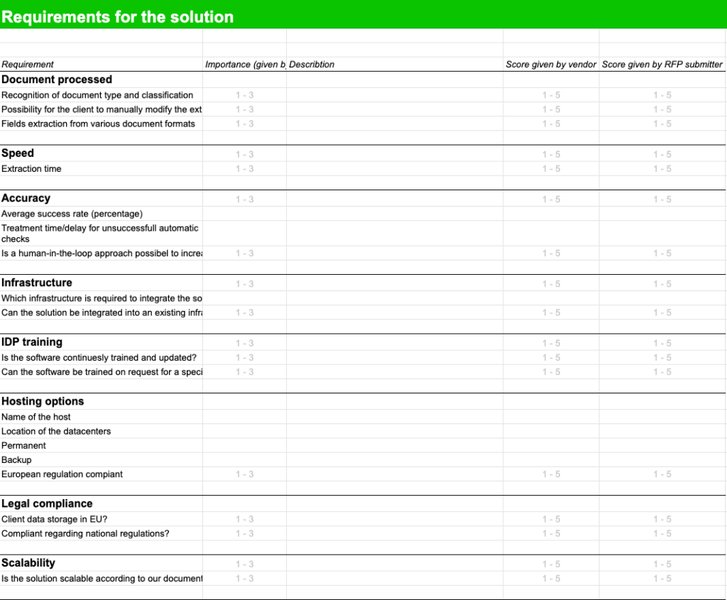
Example showing a detailed requirements section within an RFP template.
4. Project Timeline and Key Milestones
Mapping the Schedule
Provide a clear schedule for the entire RFP process and the project itself. This helps vendors assess their capacity and plan their resources.
- RFP Process Dates: Include deadlines for vendor questions, proposal submission, vendor selection notification, and contract finalization.
- Project Start and End Dates: Specify the anticipated start date and the target completion date for the project.
- Key Milestones: Break down the project into major phases or milestones with associated deadlines.
5. Budget and Financial Considerations
Addressing the Costs
While sometimes optional, providing budget information helps filter proposals and ensures vendors submit financially realistic bids.
- Budget Range (Optional): Indicate an estimated budget or range for the project. This helps vendors determine feasibility.
- Pricing Structure Request: Specify how vendors should present their pricing (e.g., fixed price, time and materials, detailed cost breakdown).
- Payment Terms: Outline the proposed payment schedule and conditions (e.g., upon milestone completion, net 30).
Evaluating Vendor Proposals
Defining how you will assess submissions is crucial for a fair and effective selection process. Clarity here benefits both your organization and the potential vendors.
6. Vendor Qualifications and Requirements
Seeking the Right Expertise
Specify the minimum qualifications, experience, and capabilities you expect from potential vendors.
- Experience: Define required years of experience, industry expertise, or specific project background.
- Certifications/Skills: List any necessary certifications, technical skills, or licenses.
- References and Case Studies: Request references from past clients and examples of similar projects completed.
- Team Information: Ask for details about the proposed project team, including key personnel resumes and roles.
- Financial Stability: You may request information to assess the vendor's financial health, especially for large or long-term projects.
7. Evaluation Criteria and Process
Ensuring Fair Assessment
Transparency in evaluation builds confidence. Outline precisely how proposals will be judged.
- Criteria List: Detail the factors you will use to evaluate proposals (e.g., understanding of requirements, technical approach, experience, cost, timeline, innovation, references).
- Weighting (Optional but Recommended): Assign relative weights or importance to each criterion (e.g., Technical Solution 40%, Cost 30%, Experience 20%, Timeline 10%).
- Evaluation Steps: Describe the process (e.g., initial screening, detailed review, interviews/presentations, final selection).
- Evaluation Timeline: Provide an estimated timeframe for the evaluation and selection process.
Visualizing RFP Component Importance
Different sections of an RFP carry varying levels of strategic importance depending on the project's nature. The radar chart below offers an opinionated perspective on the typical relative importance of key RFP components for a standard technology or service procurement. Understanding these nuances helps in allocating appropriate effort when drafting each section.
This chart illustrates that while the 'Scope of Work' often requires the most drafting effort and holds high strategic importance, clearly defined 'Evaluation Criteria' are also crucial strategically, though perhaps less time-consuming to write. Balancing effort and strategic focus across all sections is key.
Navigating the RFP Process
Beyond the core content, providing clear instructions and managing communication effectively are vital for a smooth RFP process.
8. Proposal Format and Submission Instructions
Guiding the Response
Provide explicit instructions on how vendors should prepare and submit their proposals.
- Required Format: Specify the desired structure (e.g., section order, page limits). Provide a template if applicable.
- Content Requirements: List all mandatory information or documents to be included (e.g., technical proposal, cost proposal, company profile, references, certifications).
- Submission Method: Detail how proposals should be delivered (e.g., email address, online portal link, physical address).
- Submission Deadline: Clearly state the final date and time for proposal submission (including time zone). Late submissions are typically rejected.
9. Terms and Conditions
Setting Legal Expectations
Include any standard legal or contractual terms that will apply to the project and the selected vendor.
- Contractual Requirements: Outline key terms expected in the final contract (e.g., confidentiality, intellectual property rights, data security, insurance requirements).
- Legal Disclaimers: Include standard disclaimers (e.g., RFP does not commit to award a contract, costs of proposal preparation are borne by the vendor).
- Termination Clauses: Briefly mention conditions under which the contract could be terminated.
- Dispute Resolution: Outline the preferred process for resolving disagreements.
10. Communication Protocol and Contact Information
Managing Questions
Establish a clear channel for vendor inquiries to ensure all potential bidders receive the same information.
- Point of Contact: Designate a single person or email address for all RFP-related questions.
- Q&A Period: Specify a deadline for submitting questions.
- Response Distribution: Explain how answers will be shared (e.g., distributed to all registered bidders via email or posted on a website) to maintain fairness. Mention if amendments (addenda) to the RFP might be issued.
- Pre-Proposal Conference (Optional): Indicate if a meeting (virtual or in-person) will be held for potential bidders.
Structuring Your RFP: A Visual Map
A mind map can help visualize the interconnected components of a comprehensive RFP. This structure ensures all critical areas are addressed logically, flowing from general context to specific requirements and procedural details.
This map visually lays out the essential sections, helping ensure a thorough and well-organized document that guides vendors effectively.
Understanding the RFP Process Further
The following video provides a helpful overview of the Request for Proposal process, explaining its purpose and key elements. Watching it can offer additional context and reinforce the importance of the components discussed above.
This tutorial covers the fundamentals of what an RFP is and why organizations use them, aligning well with the need to structure key information effectively when soliciting proposals for projects or services.
Key RFP Section Summary
The table below summarizes the primary purpose of each key section within a standard RFP structure. Understanding the function of each part helps in crafting a clear and effective document.
| Section Number | Section Title | Primary Purpose |
|---|---|---|
| 1 | Introduction & Background | Provide context about the organization and the reason for the RFP. |
| 2 | Project Objectives | Define the specific goals and desired outcomes of the project. |
| 3 | Scope of Work (SOW) | Detail the specific tasks, deliverables, and requirements expected from the vendor. |
| 4 | Timeline & Milestones | Outline the schedule for the RFP process and the project execution. |
| 5 | Budget & Financials | Communicate budget constraints (if applicable) and required pricing format. |
| 6 | Vendor Qualifications | Specify the required expertise, experience, and credentials for bidders. |
| 7 | Evaluation Criteria | Explain how proposals will be assessed to ensure transparency and fairness. |
| 8 | Proposal Submission | Provide clear instructions on proposal format, content, and delivery. |
| 9 | Terms & Conditions | Outline key legal and contractual expectations. |
| 10 | Communication Protocol | Establish rules for vendor questions and information dissemination. |
Frequently Asked Questions (FAQ) about RFPs
What is the main purpose of an RFP?
The main purpose of a Request for Proposal (RFP) is to solicit detailed proposals from potential vendors for a specific project, service, or product. It allows an organization to compare different solutions, approaches, and costs from various suppliers in a structured way to make an informed purchasing decision.
Should I always include a budget in my RFP?
Including a budget or budget range is generally recommended but not always mandatory. It helps vendors understand your financial constraints and submit realistic proposals. It can save time for both parties by filtering out vendors whose solutions are significantly outside the budget. However, some organizations omit it to encourage innovative pricing or to avoid anchoring vendor bids.
How detailed should the Scope of Work be?
The Scope of Work (SOW) should be as detailed as necessary to clearly define the project's requirements, tasks, deliverables, and boundaries. More detail generally leads to more accurate proposals and reduces the risk of scope creep later. Use bullet points, numbered lists, and clear language. Avoid ambiguity.
What's the difference between an RFP, RFI, and RFQ?
RFI (Request for Information): Used early in the process to gather general information about vendor capabilities and solutions when the problem or solution isn't fully defined.
RFQ (Request for Quotation): Used when the requirements are very specific and well-defined, primarily focusing on soliciting price quotes for standardized goods or services.
RFP (Request for Proposal): Used for more complex projects where the solution isn't predetermined. It solicits detailed proposals covering technical approach, methodology, qualifications, and cost.
Recommended Next Steps
To deepen your understanding or address specific needs, consider exploring these related topics:
- How can I write clear and objective evaluation criteria for my RFP?
- What are the best practices for managing vendor questions during an RFP process?
- Can I see examples of effective Scope of Work sections for different project types in RFPs?
- Are there significant differences between RFP templates used for government versus private sector projects?
References
The information provided is based on general best practices and insights synthesized from various sources, including:
Last updated May 2, 2025