
Theories of Knowledge Transfer from Academic Research to Industry
Understanding the pathways of innovation and collaboration
Key Takeaways
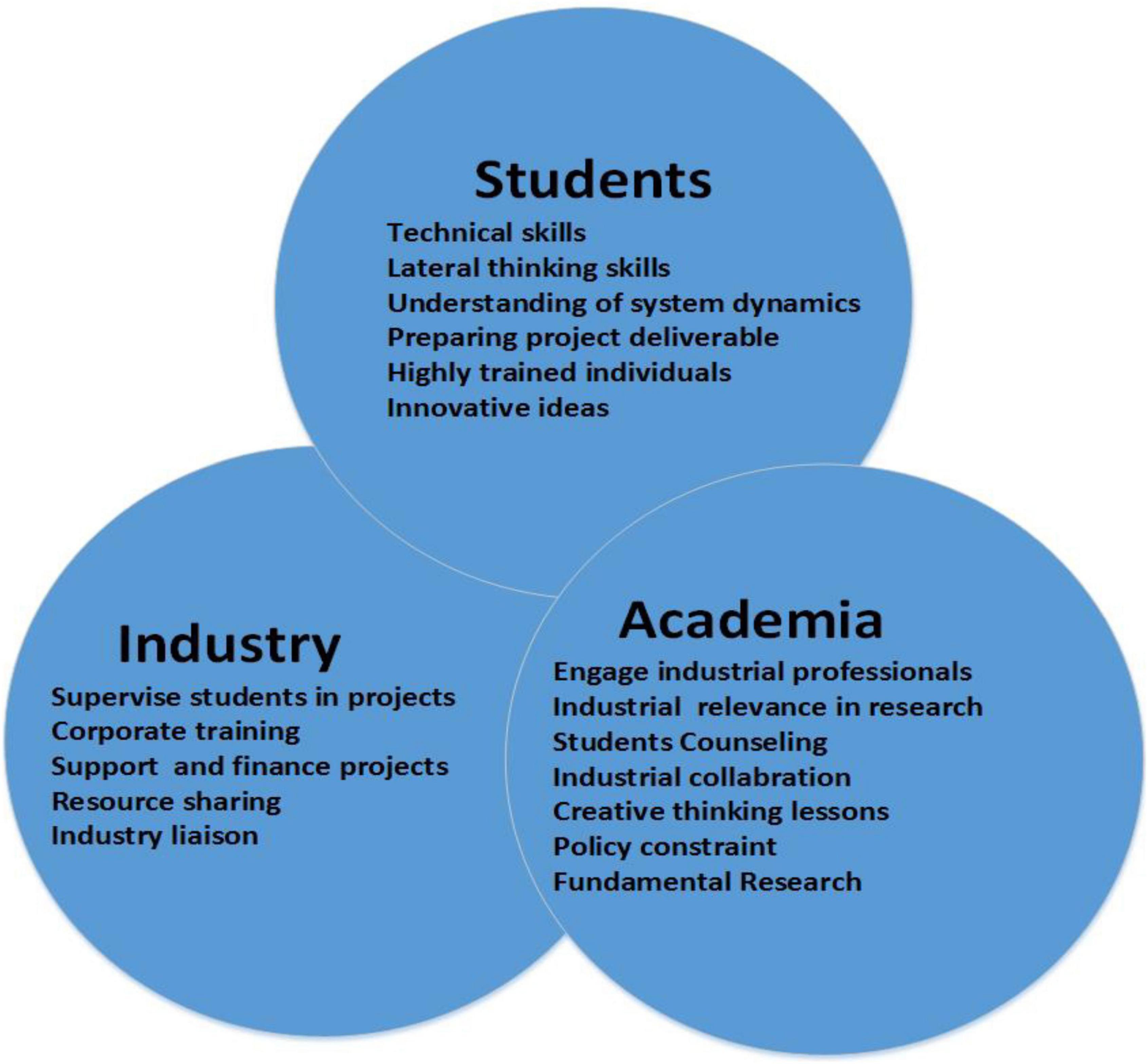
- Collaborative frameworks like the Triple Helix model emphasize the interplay between academia, industry, and government.
- Interactive and iterative models recognize the bidirectional flow of knowledge, moving beyond simplistic linear perspectives.
- Absorptive capacity and network theories highlight the importance of organizational capabilities and relationships in effective knowledge transfer.
1. Triple Helix Model
Interplay Between Academia, Industry, and Government
The Triple Helix Model, developed by Henry Etzkowitz and Loet Leydesdorff, posits that innovation and economic development arise from the dynamic interactions among university, industry, and government. This model transcends traditional boundaries, fostering a collaborative environment where these three sectors work synergistically to drive technological advancements and commercialization of research. Universities act not only as knowledge creators but also as active participants in economic activities, while government policies and industrial strategies shape the research agenda and facilitate the transfer of knowledge.
2. SECI Model (Nonaka and Takeuchi's Knowledge Conversion Model)
Stages of Knowledge Conversion
The SECI Model outlines a cyclical process of knowledge creation and transfer through four distinct modes:
-
Socialization: Sharing tacit knowledge through direct interaction and shared experiences.
-
Externalization: Articulating tacit knowledge into explicit concepts.
-
Combination: Systematizing and integrating different pieces of explicit knowledge.
-
Internalization: Absorbing and embodying explicit knowledge back into tacit forms.
This model emphasizes the continuous and dynamic nature of knowledge transformation, highlighting the importance of both tacit and explicit knowledge in the transfer process.
3. Linear Models of Innovation
Knowledge Push and Pull Dynamics
Linear models conceptualize knowledge transfer as a straightforward, unidirectional process from basic academic research to applied industrial innovation. The Knowledge Push Model suggests that discoveries in academia drive industrial advancements, whereas the Knowledge Pull Model posits that industry demands and needs spur academic research activities. While these models provide a foundational understanding, they are often criticized for oversimplifying the complex and reciprocal nature of real-world knowledge flows.
4. Interactive and Iterative Models
Bidirectional and Collaborative Knowledge Flows
Moving beyond linear perspectives, interactive and iterative models recognize that knowledge transfer is a two-way street. The Coupled Systems Model and Mode 2 Knowledge Production emphasize collaborative engagement between academia and industry, where both sectors mutually influence and co-develop innovations. This approach underscores the importance of feedback loops, joint problem-solving, and the co-creation of knowledge in fostering sustainable innovation ecosystems.
5. Absorptive Capacity Theory
Organizational Ability to Utilize External Knowledge
Absorptive Capacity refers to an organization's ability to recognize, assimilate, and apply external knowledge. Originating from management literature, this theory highlights that both academic institutions and industrial firms must cultivate their internal capabilities to effectively absorb and integrate new ideas. Firms with higher absorptive capacity are better positioned to leverage academic research for competitive advantage, facilitating more effective knowledge transfer and innovation.
6. Knowledge Spillover and Regional Innovation Systems
Impact of Geographical Proximity and Networks
Knowledge spillover theory focuses on how academic research benefits nearby or related industries through unintended knowledge diffusion. The Regional Innovation Systems framework expands on this by examining how geographical proximity, social networks, and institutional ties enhance the flow of knowledge from universities to local industries. Informal interactions such as conferences, professional networks, and consulting relationships play a crucial role in facilitating these spillovers, thereby driving regional economic growth and technological advancement.
7. Social Network and Boundary-Spanning Theories
Role of Networks and Intermediaries in Knowledge Transfer
Social Network Theory emphasizes the significance of personal relationships and networks in the effective transfer of knowledge. Trust, shared norms, and informal interactions between academic researchers and industry professionals are critical for successful collaborations. Boundary Spanners, individuals who operate at the interface between academia and industry, play a pivotal role in bridging gaps in language, culture, and incentives, thereby facilitating smoother and more effective knowledge flows.
8. Open Innovation Paradigm
Leveraging External and Internal Ideas for Innovation
Introduced by Henry Chesbrough, the Open Innovation Paradigm advocates for the utilization of both external and internal ideas to advance technologies and drive innovation. In this context, knowledge transfer between academia and industry is integral to open innovation strategies, where companies collaborate with universities to access cutting-edge research and foster new technological developments. This approach promotes a more permeable innovation system, enabling organizations to enhance their innovation capabilities by tapping into diverse sources of knowledge.
9. Entrepreneurial University Model
Universities as Active Participants in Economic Development
The Entrepreneurial University Model highlights the transformation of universities into proactive, entrepreneurial entities that engage in technology transfer through mechanisms such as patenting, licensing, spin-offs, and incubators. This model emphasizes the alignment of academic research with market needs, reconfiguring traditional academic incentives to encourage the commercialization of research outputs. By fostering an entrepreneurial culture, universities can more effectively bridge the gap between academic research and industrial application.
10. Cultural Historical Activity Theory (CHAT)
Understanding Contextual Barriers in Knowledge Transfer
CHAT examines the barriers to knowledge flow by considering various elements such as knowledge sources, receivers, context, and the nature of transferred knowledge. It posits that human activities are mediated by tools and the community context, thereby influencing the effectiveness of knowledge transfer. This theoretical framework helps in identifying and addressing the contextual and cultural factors that impede or facilitate the movement of knowledge from academia to industry.
11. Resource-Based View
Organizational Capabilities in Knowledge Integration
The Resource-Based View (RBV) emphasizes the internal capabilities of organizations to absorb and integrate external knowledge. According to RBV, the unique resources and capabilities of a firm determine its ability to capture and utilize academic research effectively. By enhancing their internal knowledge management systems and fostering a culture of continuous learning, organizations can improve their absorptive capacity, thereby facilitating more effective knowledge transfer and innovation.
12. University-Industry Knowledge Transfer (UIKT)
Formal and Informal Mechanisms of Knowledge Exchange
UIKT encompasses both formal mechanisms such as patents, licenses, and royalties, and informal mechanisms including social interactions, consulting, and researcher mobility. This dual approach ensures that both explicit and tacit knowledge are effectively transferred from academia to industry. Mobility of researchers and interorganizational collaborations are particularly crucial for transferring tacit knowledge, which is often embedded in individual expertise and organizational practices.
Summary of Theories
| Theory/Model | Key Concepts | Key Proponents | Application in Knowledge Transfer |
|---|---|---|---|
| Triple Helix Model | Interactions among university, industry, government | Henry Etzkowitz, Loet Leydesdorff | Fostering collaborative innovation ecosystems |
| SECI Model | Socialization, Externalization, Combination, Internalization | Ikujiro Nonaka, Hirotaka Takeuchi | Facilitating knowledge creation and transformation |
| Absorptive Capacity Theory | Recognize, assimilate, apply external knowledge | Cohen and Levinthal | Enhancing organizational ability to utilize academic research |
| Open Innovation Paradigm | Use of external and internal ideas for innovation | Henry Chesbrough | Collaborating with universities for technological advancements |
| Entrepreneurial University Model | Active engagement in technology transfer | Various scholars | Commercializing research through patents and spin-offs |
| Social Network Theory | Role of personal relationships and networks | Various scholars | Building trust and facilitating informal knowledge exchanges |
| Knowledge Spillover | Unintended diffusion of knowledge to nearby industries | Various economic theories | Enhancing regional innovation through proximity |
Conclusion
The transfer of knowledge from academic research to industry is a multifaceted process governed by various theories and models that seek to explain the mechanisms, pathways, and dynamics involved. From the collaborative frameworks like the Triple Helix Model to the cyclical processes outlined in the SECI Model, each theory provides unique insights into how knowledge can be effectively transferred and utilized to foster innovation and economic growth. Interactive and iterative models, alongside concepts like absorptive capacity and social networks, highlight the importance of bidirectional flows and organizational capabilities in facilitating successful knowledge transfer. Additionally, paradigms such as Open Innovation and the Entrepreneurial University Model underscore the evolving nature of academia-industry collaborations, emphasizing the need for proactive engagement and commercialization of research outputs. Understanding these theories equips policymakers, academic institutions, and industry practitioners with the tools necessary to design and implement effective knowledge transfer strategies that bridge the gap between research and practical application.
References
Last updated February 14, 2025