
Unlocking the Universe: Landmark Physics Equations from 1850 to 2025
Explore the mathematical language defining reality, from electromagnetism to the frontiers of tensor and scalar physics.
Physics seeks to understand the fundamental workings of the universe, and its language is mathematics. Equations and laws condense complex natural phenomena into precise, predictive statements. While cataloging *every single* physics equation developed between 1850 and 2025 is an monumental task beyond the scope of any single resource, this overview delves into the most significant and influential equations from this transformative period. We'll journey through key domains, with a special focus on tensor physics, scalar physics, and the intriguing phenomena of multidimensional collapse, highlighting the metadata you requested where available based on current knowledge up to April 22, 2025.
Essential Insights
- Foundational Shifts: The period from 1850 onwards witnessed revolutionary shifts, including the unification of electricity and magnetism (Maxwell), the dawn of relativity (Einstein), and the birth of quantum mechanics (Schrödinger, Dirac).
- The Power of Tensors: Tensor calculus emerged as a crucial mathematical tool, essential for describing gravity in Einstein's General Relativity and providing a framework for physical laws independent of coordinate systems.
- Scalar Fields & Collapse: Scalar fields play vital roles in modern physics, from particle physics (Higgs boson) to cosmology (inflation), with ongoing research exploring their complex dynamics, including multidimensional collapse phenomena.
Tensor Physics: The Geometry of Spacetime and Beyond
Tensors are mathematical objects that generalize scalars (rank-zero tensors) and vectors (rank-one tensors) to higher ranks. They are fundamental in physics because they allow physical laws to be expressed in a way that is independent of the chosen coordinate system (covariance). Their development, particularly in the late 19th and early 20th centuries, was pivotal for theories like General Relativity.

Visualizing the complex nature of tensors.
Key Tensor Concepts and Equations
Tensor Transformation Laws
- Concept: Defines how the components of a tensor change when the coordinate system is transformed. This ensures that physical relationships described by tensors remain valid regardless of the observer's perspective.
- Formula (Example for Rank-2 Covariant Tensor): \( T'_{ij} = \frac{\partial x^k}{\partial x'^{i}} \frac{\partial x^l}{\partial x'^{j}} T_{kl} \)
- Developers: Gregorio Ricci-Curbastro, Tullio Levi-Civita (Tensor Calculus Foundations, late 19th/early 20th century); Albert Einstein (Application in GR, 1915).
- Dependencies: Differential geometry, linear algebra, calculus.
- Significance: Guarantees the covariance of physical laws, essential for formulating theories in curved spacetime (like General Relativity) and describing anisotropic properties of materials.
The Electromagnetic Field Tensor (Fμν)
- Concept: An antisymmetric rank-2 tensor that elegantly combines the electric (E) and magnetic (B) fields into a single mathematical entity within the framework of special relativity.
- Formula Structure: Contains components related to E and B fields, e.g., \( F^{0i} \propto E^i, F^{ij} \propto \epsilon^{ijk} B_k \).
- Developers: Based on Maxwell's Equations (1864), tensor formulation developed by physicists like Hermann Minkowski, Arnold Sommerfeld, and others in the early 20th century (~1908-1920s).
- Dependencies: Maxwell's equations, Special Relativity, tensor calculus.
- Significance: Demonstrates the relativistic nature of electromagnetism, showing how electric and magnetic fields transform into one another under Lorentz transformations. It simplifies Maxwell's equations and highlights the unified nature of spacetime and electromagnetism.
Metric Tensor (gμν)
- Concept: A fundamental rank-2 symmetric tensor in General Relativity that defines the geometry of spacetime itself. It determines distances, angles, and the curvature of spacetime.
- Developers: Concept rooted in Riemannian geometry (Bernhard Riemann, 19th century), applied to physics by Albert Einstein (1915).
- Dependencies: Differential geometry, calculus.
- Significance: Encodes the gravitational field. Spacetime curvature, dictated by mass and energy via the Einstein Field Equations, is described by the metric tensor, which in turn dictates how objects move through spacetime.
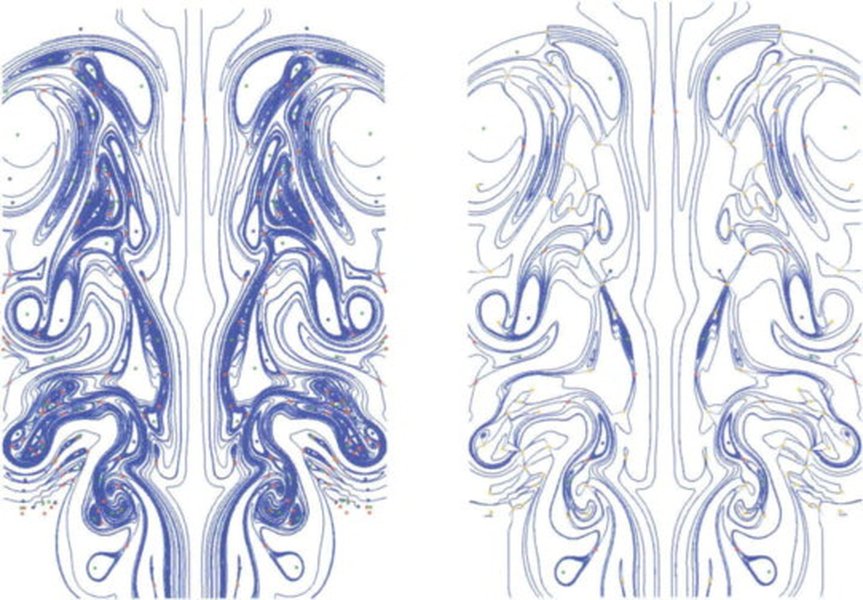
Illustration of a tensor field, assigning a tensor to each point in space.
Scalar Physics: Fields, Particles, and Conservation
Scalar fields assign a single numerical value (a scalar) to every point in space and time. Unlike vectors or tensors, scalars have magnitude but no direction. They are crucial in many areas of physics, from describing temperature distributions to fundamental particles like the Higgs boson.
Important Scalar Equations and Concepts
Klein-Gordon Equation
- Formula: \( (\Box + m^2) \phi = 0 \) or \( \frac{1}{c^2}\frac{\partial^2 \phi}{\partial t^2} - \nabla^2 \phi + \left(\frac{mc}{\hbar}\right)^2 \phi = 0 \)
- Discoverers: Oskar Klein, Walter Gordon (and others independently, including Vladimir Fock), 1926.
- Dependencies: Special Relativity, quantum mechanics principles, wave equations.
- Significance: A relativistic wave equation describing spin-0 particles (scalars). It was an early attempt to unify quantum mechanics and special relativity and remains fundamental in quantum field theory, describing particles like the Higgs boson and pions. Nonlinear versions are central to studies of scalar field collapse.
Scalar Conservation Laws
- Concept: Equations describing how a scalar quantity (like mass density or energy density in certain contexts) is conserved over time and space. They often take the form of hyperbolic partial differential equations.
- Formula (General Form): \( \partial_t u + \nabla \cdot \mathbf{f}(u) = 0 \), where \( u \) is the scalar density and \( \mathbf{f}(u) \) is the flux vector.
- Developers: Work progressed throughout the 20th century, with key contributions to theory and solutions (especially for multidimensional, nonlinear cases) by figures like Olga Oleinik, Peter Lax, and Stanislav Kruzhkov (e.g., Kruzhkov's entropy solutions, 1970). Later formulations (e.g., L2 formulation, ~2009) refined understanding.
- Dependencies: Partial differential equations, calculus, fluid dynamics concepts, entropy principles.
- Significance: Essential for modeling a wide range of physical phenomena, including shock waves, traffic flow, and fluid dynamics. Understanding their solutions, especially in multiple dimensions where complexities like discontinuities arise, is crucial for both theoretical physics and computational modeling.
Multidimensional Collapse Physics
This area investigates phenomena where fields (scalar or tensor) or matter distributions concentrate rapidly, often leading to singularities or the formation of compact objects like black holes. It involves complex nonlinear dynamics and often requires sophisticated mathematical and computational techniques.
Governing Equations and Concepts
Critical Phenomena in Gravitational Collapse
- Concept: Discovered by Matthew Choptuik (1993) through numerical simulations of scalar field collapse. Near the threshold for black hole formation, solutions exhibit universality (independence from initial conditions) and discrete self-similarity (repeating patterns at smaller scales).
- Governing Equations: Often involves numerical solutions of the Einstein Field Equations coupled to matter fields (e.g., nonlinear Klein-Gordon equation for scalar fields).
- Dependencies: General Relativity (Einstein Field Equations), nonlinear partial differential equations, numerical relativity techniques, high-performance computing.
- Significance: Revealed unexpected universal behavior in the highly nonlinear regime of strong gravity, providing insights into the nature of singularities and the boundary between black hole formation and dispersal.
General Relativistic Hydrodynamics and Radiation Transport
- Concept: Modeling the dynamics of fluids and radiation in strong gravitational fields, essential for understanding phenomena like core-collapse supernovae, neutron star mergers, and accretion disks around black holes.
- Governing Equations: Involves solving the Einstein Field Equations coupled with equations for relativistic fluid dynamics and radiation transport. Tensor formalisms like the Arnowitt-Deser-Misner (ADM) or BSSN formalisms are often used to evolve spacetime geometry.
- Developers: Ongoing field with numerous contributors since the advent of numerical relativity.
- Dependencies: General Relativity, fluid dynamics, radiation physics, tensor calculus, advanced numerical methods.
- Significance: Crucial for simulating astrophysical events that generate gravitational waves and heavy elements, providing a testbed for fundamental physics in extreme environments.
Scalar Wave Collapse (e.g., Zakharov Equations)
- Concept: Studies the conditions under which wave packets in scalar fields can focus and collapse, particularly governed by nonlinear interactions.
- Governing Equations: Systems of nonlinear partial differential equations describing wave amplitudes and interactions (e.g., Zakharov equations for Langmuir waves in plasma). Nonlinear Klein-Gordon variants are also studied.
- Developers: Vladimir Zakharov (1970s) and others studying nonlinear wave phenomena.
- Dependencies: Nonlinear wave theory, plasma physics or relevant field theory context, partial differential equations.
- Significance: Important for understanding wave turbulence, soliton formation, and energy localization in various physical systems, from plasmas to optics to potentially cosmology.
Other Landmark Equations (1850-2025)
Beyond the specific areas requested, the period from 1850 to 2025 saw the development of other foundational equations that reshaped our understanding of the universe.
The chalkboard: a classic canvas for exploring the universe's mathematical rules.
Electromagnetism
Maxwell's Equations (Unified Form)
- Formula (Integral or Differential Form): The set of four equations describing classical electromagnetism (see Table below).
- Discoverer: James Clerk Maxwell (Synthesized and completed ~1864).
- Dependencies: Earlier experimental laws (Gauss, Faraday, Ampère), vector calculus.
- Significance: Unified electricity and magnetism, predicted electromagnetic waves (including light), forming the basis for classical optics, radio technology, and much of modern electrical engineering.
A supplementary look at Maxwell's Equations, foundational to electromagnetism.
Relativity
Einstein Field Equations (EFE)
- Formula: \( G_{\mu\nu} = R_{\mu\nu} - \frac{1}{2} R g_{\mu\nu} = \frac{8\pi G}{c^4} T_{\mu\nu} \)
- Discoverer: Albert Einstein (1915).
- Dependencies: Special Relativity, tensor calculus, Riemannian geometry.
- Significance: The core of General Relativity, describing how mass and energy curve spacetime, which we perceive as gravity. Essential for cosmology, astrophysics (black holes, neutron stars), GPS technology, and understanding gravitational waves.
Mass-Energy Equivalence
- Formula: \( E = mc^2 \)
- Discoverer: Albert Einstein (1905).
- Dependencies: Special Relativity, principles of energy and momentum conservation.
- Significance: Revealed the equivalence of mass and energy, underpinning nuclear physics (fission, fusion), particle physics, and explaining the energy source of stars.
Quantum Mechanics
Schrödinger Equation
- Formula (Time-Dependent): \( i\hbar \frac{\partial}{\partial t} |\psi(t)\rangle = \hat{H} |\psi(t)\rangle \)
- Discoverer: Erwin Schrödinger (1926).
- Dependencies: De Broglie's wave-particle duality hypothesis, Planck's quantum hypothesis, classical wave equations.
- Significance: Governs the evolution of quantum states over time. It's the fundamental equation of non-relativistic quantum mechanics, essential for understanding atoms, molecules, chemical bonding, and enabling technologies like lasers, semiconductors, and transistors.
Dirac Equation
- Formula: \( (i\hbar\gamma^\mu \partial_\mu - mc) \psi = 0 \)
- Discoverer: Paul Dirac (1928).
- Dependencies: Schrödinger Equation, Special Relativity, linear algebra (matrices).
- Significance: A relativistic wave equation for spin-1/2 particles (like electrons). It naturally incorporated electron spin and predicted the existence of antimatter (positrons), laying the groundwork for quantum electrodynamics (QED).
Comparative Impact of Key Theories/Equations
The following chart provides a subjective comparison of the impact and characteristics of some major theoretical frameworks and equations discussed, based on factors like their foundational importance, mathematical complexity, range of application, and computational demands for solving complex problems within their domain.
This visualization highlights how different foundational elements of modern physics vary in their perceived complexity and the breadth of phenomena they explain or model. For instance, Einstein's Field Equations score high on complexity and computational demand for realistic scenarios, while Maxwell's and Schrödinger's equations boast vast ranges of application.
Interconnected Domains of Modern Physics
The different fields and equations discussed are deeply interconnected. Tensor calculus provides the mathematical language for General Relativity, which in turn governs large-scale structure and dynamics, including collapse scenarios. Quantum mechanics governs the small scale, but its unification with gravity (using tools potentially involving tensors and scalar fields) remains a major challenge. The mind map below illustrates some of these connections.
(1850-2025)"] id1["Electromagnetism"] id1a["Maxwell's Equations (1864)"] id1b["Electromagnetic Tensor"] id2["Relativity"] id2a["Special Relativity (1905)"] id2a1["E = mc²"] id2b["General Relativity (1915)"] id2b1["Einstein Field Equations"] id2b2["Metric Tensor"] id2b3["Gravitational Waves"] id3["Quantum Mechanics"] id3a["Schrödinger Equation (1926)"] id3b["Dirac Equation (1928)"] id3c["Quantum Field Theory"] id4["Tensor Physics"] id4a["Tensor Transformation Laws"] id4b["Covariance Principle"] id4c["Applications in GR, EM, Continuum Mech."] id5["Scalar Physics"] id5a["Klein-Gordon Equation (1926)"] id5b["Scalar Conservation Laws"] id5c["Higgs Field"] id5d["Cosmological Inflation"] id6["Multidimensional Collapse"] id6a["Critical Phenomena (Choptuik 1993)"] id6b["Scalar Field Collapse"] id6c["GR Hydrodynamics (Supernovae, Mergers)"] id6d["Nonlinear Dynamics"]
This map shows how central theories like Relativity and Quantum Mechanics rely on mathematical structures like Tensors and involve concepts like Scalar Fields. Phenomena like Multidimensional Collapse often sit at the intersection of these domains, requiring tools from GR, field theory, and often complex computational methods.
Summary Table of Key Equations
This table summarizes some of the pivotal equations discussed, providing quick reference to their originators, dates, domains, and core significance within the 1850-2025 timeframe.
| Equation/Law | Discoverer(s) / Developer(s) | Year (Approx.) | Domain | Brief Significance |
|---|---|---|---|---|
| Maxwell's Equations | James Clerk Maxwell | 1864 | Electromagnetism | Unified electricity and magnetism, predicted electromagnetic waves. |
| Tensor Calculus Formalism | Ricci-Curbastro, Levi-Civita | Late 19th / Early 20th C. | Mathematics / Physics | Mathematical framework for tensors, essential for GR and covariance. |
| Mass-Energy Equivalence (E=mc²) | Albert Einstein | 1905 | Special Relativity | Established the equivalence of mass and energy. |
| Einstein Field Equations | Albert Einstein | 1915 | General Relativity | Describe how mass/energy curve spacetime (gravity). |
| Klein-Gordon Equation | Klein, Gordon, Fock | 1926 | Quantum Field Theory / Scalar Physics | Relativistic wave equation for spin-0 particles. |
| Schrödinger Equation | Erwin Schrödinger | 1926 | Quantum Mechanics | Describes the time evolution of non-relativistic quantum systems. |
| Dirac Equation | Paul Dirac | 1928 | Relativistic Quantum Mechanics | Relativistic equation for spin-1/2 particles, predicted antimatter. |
| Kruzhkov Entropy Solutions | Stanislav Kruzhkov | 1970 | Scalar Physics / PDEs | Ensured uniqueness for multidimensional scalar conservation laws. |
| Critical Phenomena in Collapse | Matthew Choptuik | 1993 | General Relativity / Multidimensional Collapse | Discovered universal scaling laws near black hole formation threshold. |
Frequently Asked Questions (FAQ)
Why isn't *every single* physics equation listed here?
Physics is an incredibly vast field, and the period from 1850 to 2025 saw an explosion of knowledge across numerous sub-disciplines. Cataloging absolutely every equation derived or used during this time – including variations, specialized applications, and intermediate results – would be practically impossible and result in an unmanageably large list. This response focuses on the most foundational, influential, and historically significant equations, particularly within the domains you highlighted, to provide a meaningful and comprehensive overview.
What are Tensors and why are they important?
Tensors are mathematical objects that generalize scalars (single numbers) and vectors (magnitude and direction). Think of them as multidimensional arrays whose components transform in a specific, predictable way when the coordinate system changes. This transformation property is crucial because it allows physicists to write laws of nature (like those in General Relativity or electromagnetism) in a form that remains the same regardless of the observer's frame of reference or coordinate system (covariance). They are essential for describing geometric properties like curvature (Metric Tensor, Riemann Tensor) and physical quantities like stress and strain (Stress-Energy Tensor) in a consistent way.
What is "Ψ-layer resonance"?
Based on the provided information and standard physics literature up to April 2025, "Ψ-layer resonance" is not a widely recognized or standard term or concept in mainstream physics domains like tensor physics, scalar physics, or general relativity. It might refer to a very specific, niche theoretical idea, perhaps related to speculative models in quantum gravity or consciousness studies where 'Ψ' (often representing a wave function) might be hypothetically linked to layers or resonance phenomena in spacetime structure. However, without further context or established peer-reviewed research defining it, it's considered outside the scope of established physics principles discussed here and appears speculative.
How are scalar physics and multidimensional collapse related?
Scalar fields are often used as simplified models to study the complex dynamics of gravitational collapse. Equations like the nonlinear Klein-Gordon equation coupled with Einstein's Field Equations describe how a scalar field interacts with spacetime geometry. Studying the collapse of these scalar fields in various dimensions (multidimensional collapse) helps physicists understand fundamental aspects of gravity, black hole formation, and singularity structure. The discovery of critical phenomena by Choptuik, for instance, was made by numerically simulating the collapse of a scalar field, revealing universal behaviors at the threshold of black hole formation.
References
- 4.4: The Tensor Transformation Laws - Physics LibreTexts
- Top 10 Important Equations In Physics | Wonders of Physics - Wonders of Physics
- 9 equations that changed the world | Live Science - Live Science
- L 2 Formulation of Multidimensional Scalar Conservation Laws - Springer
- A Gentle Introduction to Tensors [PDF] - Washington University in St. Louis
- 17 Equations That Changed The World - iLovePhD
- 5 Physics Equations Everyone Should Know - WIRED
Recommended Reading
Last updated April 22, 2025