
Unlock Scalability: Building Event-Driven Microservices with Laravel and Kafka
Discover how Laravel's elegance combines with Kafka's power for robust, real-time applications.
Embarking on a microservices architecture journey with Laravel offers significant advantages in building complex applications. When coupled with Apache Kafka, a distributed streaming platform, this architecture transforms into a highly scalable, resilient, and event-driven system capable of handling real-time data flows efficiently. Let's explore how Laravel projects leverage Kafka to orchestrate communication between independent services.
Key Insights
- Decoupled Communication: Kafka acts as a central message broker, enabling microservices built with Laravel to communicate asynchronously, reducing dependencies and improving fault tolerance.
- Event-Driven Power: This combination facilitates event-driven architectures, where services react to events (like user creation or order placement) published to Kafka topics, leading to more responsive and scalable systems.
- Enhanced Scalability & Resilience: Both Laravel microservices and Kafka clusters can be scaled independently, and Kafka's message persistence ensures data isn't lost if a consuming service is temporarily unavailable.
Why Choose Laravel for Microservices?
Leveraging a Familiar Framework for Distributed Systems
Laravel, a popular PHP framework known for its elegant syntax and extensive features, is well-suited for developing microservices. Its modular structure, built-in support for creating APIs, and rich ecosystem simplify the process of breaking down a monolithic application into smaller, manageable services. Key reasons include:
- Modularity: Laravel's design encourages building applications in distinct modules, which aligns naturally with the microservice concept.
- API Development: It provides robust tools for building RESTful APIs, a common method for synchronous communication between services or interaction with front-end clients.
- Developer Productivity: The framework's clear syntax, extensive documentation, and tools like Artisan commands boost development speed.
- Ecosystem: A vast collection of packages and a large community provide solutions for common challenges in distributed systems.
- Lumen Option: For performance-critical services requiring minimal overhead, Laravel offers Lumen, a lightweight micro-framework optimized for speed.
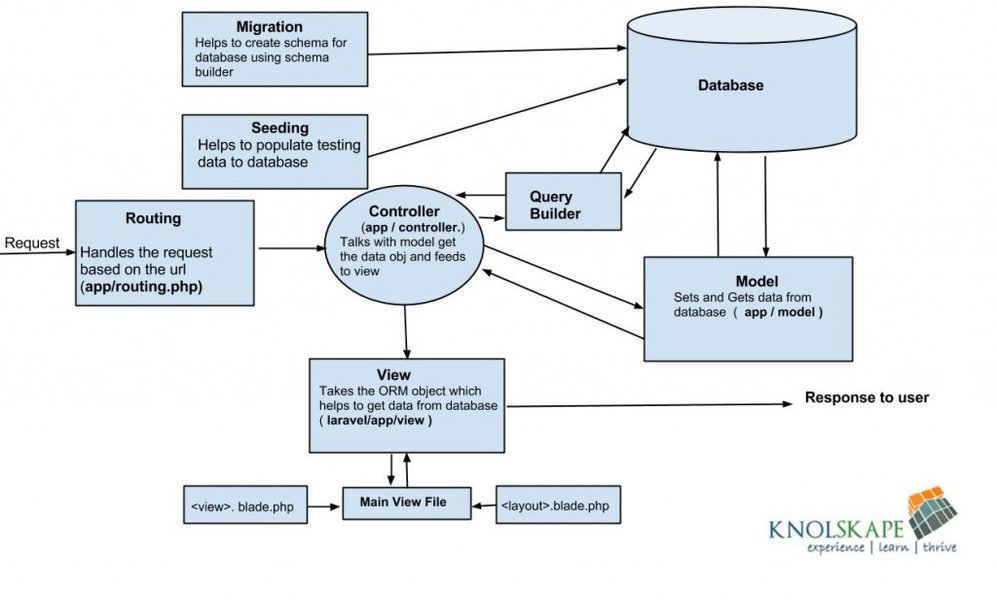
A typical Laravel application architecture, adaptable for microservice components.
The Role of Apache Kafka in Laravel Microservices
Enabling Asynchronous, Event-Driven Communication
Apache Kafka is more than just a message queue; it's a distributed streaming platform designed for high-throughput, fault-tolerant, real-time data processing. In a Laravel microservices context, Kafka typically serves as the central nervous system for asynchronous communication.
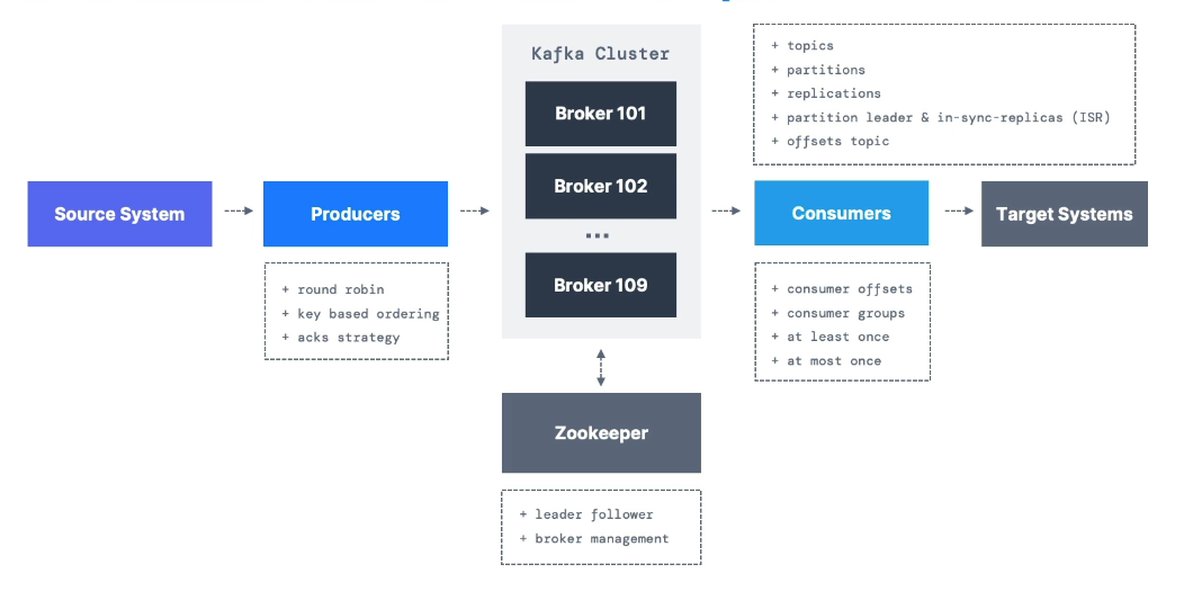
Core components of Apache Kafka: Producers, Consumers, Topics, Brokers, and Zookeeper.
Why Integrate Kafka?
- Asynchronous Messaging: Services (Producers) publish messages (events) to Kafka topics without needing to know about or wait for the services that will process them (Consumers). This decoupling improves system resilience, as the failure of one service doesn't cascade.
- Event-Driven Architecture (EDA): Kafka is fundamental to building EDAs. Services react to business events (e.g.,
OrderPlaced,UserRegistered) published on Kafka, enabling complex workflows without direct service-to-service calls. - Scalability: Kafka clusters are inherently distributed and horizontally scalable. You can scale your messaging backbone independently of your application services.
- Durability and Reliability: Kafka persists messages to disk and replicates them across brokers, ensuring messages aren't lost even if brokers or consumers fail. Messages can often be replayed if needed.
- High Throughput: Kafka is designed to handle massive volumes of messages with low latency, making it suitable for real-time data pipelines, logging aggregation, and analytics streams.
- Fault Tolerance: The distributed nature of Kafka provides high availability. If one broker fails, others take over its load.
Integrating Kafka into Your Laravel Project
Tools and Techniques
Integrating Kafka producers and consumers into Laravel microservices can be achieved using various methods. The choice often depends on the complexity required and familiarity with Kafka internals.
Using Laravel Packages
Several community packages simplify Kafka integration:
mateusjunges/laravel-kafka: A popular and well-maintained package that provides an abstraction layer over the underlying Kafka client (oftenphp-rdkafka). It offers Artisan commands for creating producers and consumers, configuration options, and integration with Laravel's features. This is often the recommended starting point.- Other packages may exist, offering different levels of abstraction or specific features.
These packages typically require the rdkafka PHP extension, a high-performance C library binding for Kafka.
Directly Using rdkafka Extension
For more control or specific use cases not covered by abstraction packages, you can use the rdkafka PHP extension directly within your Laravel services. This requires a deeper understanding of Kafka concepts like configuration, partitions, and consumer groups.
Leveraging Kafka Connect and Debezium
For Change Data Capture (CDC) scenarios, where you want to stream database changes to other services, Kafka Connect with the Debezium connector is a powerful combination. Debezium monitors database transaction logs (like MySQL's binlog) and publishes change events to Kafka topics. Laravel microservices can then consume these events to react to data changes in other services without direct database access or polling.
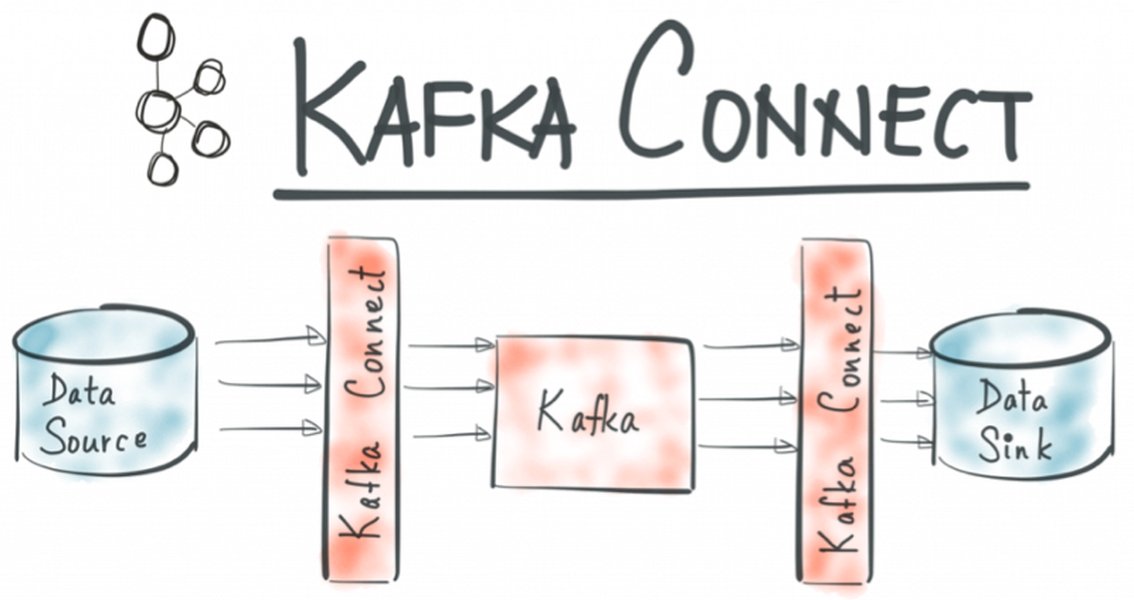
Using Debezium and Kafka Connect for real-time database synchronization between microservices.
Example: Publishing an Event (Conceptual)
Using a package like laravel-kafka, publishing might look something like this within a Laravel controller or service:
// Assuming configuration is set up
use Junges\Kafka\Facades\Kafka;

class UserController extends Controller
{
    public function store(Request $request)
    {
        // ... validate request and create user ...
        $user = User::create($request->validated());

        // Publish a UserCreated event to Kafka
        $message = Kafka::publishOn('user-events') // Topic name
                       ->withMessageKey('user-' . $user->id)
                       ->withBody(['user_id' => $user->id, 'email' => $user->email, 'event_type' => 'UserCreated']);

        $message->send(); // Asynchronously send the message

        return response()->json($user, 201);
    }
}
Example: Consuming Events (Conceptual)
A Kafka consumer might be implemented as a long-running Laravel Artisan command:
// Example using mateusjunges/laravel-kafka consumer setup
namespace App\Kafka\Consumers;

use Junges\Kafka\Contracts\KafkaConsumerMessage;
use Junges\Kafka\Facades\Kafka;

class UserEventConsumer
{
    public function __invoke(KafkaConsumerMessage $message)
    {
        $topic = $message->getTopicName();
        $partition = $message->getPartition();
        $body = $message->getBody(); // Decoded message body (e.g., array)

        if ($topic === 'user-events' && isset($body['event_type']) && $body['event_type'] === 'UserCreated') {
            // Process the UserCreated event
            // e.g., Send a welcome email, update analytics service
            Log::info("Processing UserCreated event for user_id: " . $body['user_id']);
            // Call a service method: app(WelcomeEmailService::class)->send($body['user_id'], $body['email']);
        }

        // Messages are typically auto-committed based on configuration
    }
}

// Configuration in config/kafka.php would map this class to the 'user-events' topic
// and an artisan command like <code>php artisan kafka:consume --topics=user-events --consumer=App\Kafka\Consumers\UserEventConsumer would run it.
Visualizing the Architecture
Understanding the Flow
A mindmap helps visualize the key components and relationships in a Laravel microservices architecture powered by Kafka.
laravel-kafka Package"]
id2b2["rdkafka Extension"]
id2b3["Kafka Connect / Debezium"]
id2c["Communication Patterns"]
id2c1["Asynchronous (Kafka)"]
id2c2["Synchronous (REST API)"]
id2d["Supporting Tools"]
id2d1["API Gateway"]
id2d2["Service Discovery (e.g., Zookeeper, Consul)"]
id2d3["Containerization (Docker)"]
id3["Benefits"]
id3a["Scalability (Independent)"]
id3b["Resilience & Fault Tolerance"]
id3c["Decoupling / Loose Coupling"]
id3d["Event-Driven Capabilities"]
id3e["Real-time Processing"]
id3f["Technology Flexibility (Polyglot)"]
id4["Challenges & Considerations"]
id4a["Complexity (Distributed System)"]
id4b["Schema Management (e.g., Schema Registry)"]
id4c["Idempotency (Message Handling)"]
id4d["Error Handling / Dead Letter Queues"]
id4e["Monitoring & Observability"]
id4f["Testing Distributed Systems"]
id4g["Security (Kafka & Inter-service)"]
id5["Use Cases"]
id5a["E-commerce (Order Processing, Inventory)"]
id5b["Notifications System"]
id5c["Real-time Analytics"]
id5d["Data Synchronization / CDC"]
id5e["Logging Aggregation"]
This mindmap illustrates how Laravel and Kafka fit together, highlighting the key concepts, implementation methods, advantages, challenges, and common applications of this architectural style.
Comparing Architectural Aspects
Microservices vs. Monolith
This radar chart provides a comparative view of a typical Laravel Monolith versus a Laravel + Kafka Microservices architecture across several key dimensions. The ratings are subjective and represent general tendencies rather than precise measurements.
As the chart suggests, the microservices approach generally offers superior scalability, resilience, decoupling, and real-time capabilities, but often comes with increased operational complexity and potentially challenges in maintaining strict data consistency compared to a monolith. Initial development speed might also be slower due to the setup overhead.
Common Use Cases and Patterns
Where Laravel and Kafka Shine Together
The combination of Laravel microservices and Kafka is particularly effective in various scenarios:
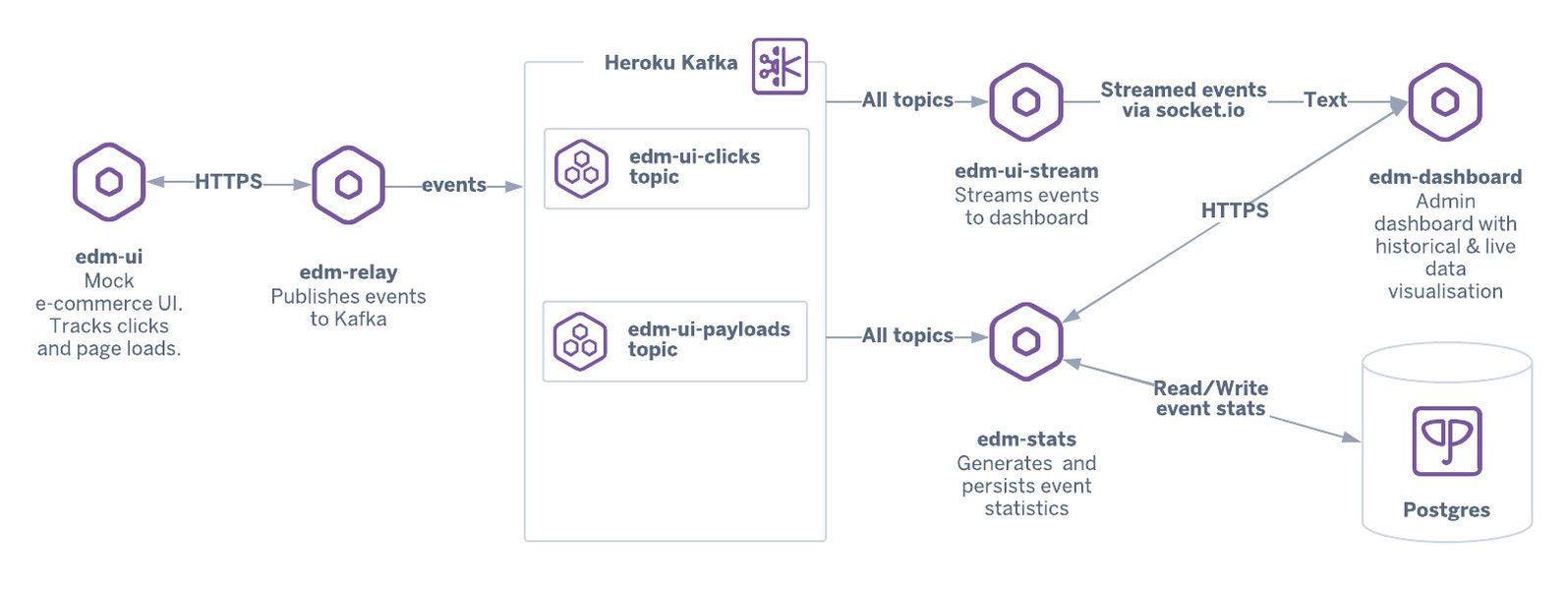
Event-driven microservices communicating asynchronously via Kafka topics.
| Use Case | Description | Kafka's Role |
|---|---|---|
| E-commerce Order Processing | When an order is placed, multiple downstream actions are needed (payment processing, inventory update, shipping notification, analytics update). | The order service publishes an OrderPlaced event. Inventory, Shipping, Notification, and Analytics services consume this event asynchronously to perform their tasks without blocking the order service. |
| Real-time Notifications | Sending various notifications (email, SMS, push) based on events occurring in different parts of the system (e.g., user registration, password reset, new message). | Core services publish notification request events (e.g., SendWelcomeEmail) to a Kafka topic. A dedicated Notification microservice consumes these events and handles the actual sending logic, decoupling it from the core business flow. |
| Data Synchronization (CDC) | Keeping data consistent across multiple microservices that own different parts of the data (e.g., user profile updates needing reflection in an analytics service). | Using Debezium and Kafka Connect, database changes in one microservice's database are captured and published as events to Kafka. Other interested microservices consume these events to update their local data stores or caches. |
| Real-time Analytics & Dashboards | Processing streams of events from various microservices to generate live analytics or update dashboards. | Microservices publish relevant business events (e.g., ProductViewed, AddToCart, PurchaseCompleted) to Kafka topics. An Analytics service consumes these streams, processes them (potentially using stream processing frameworks), and updates reporting databases or dashboards. |
| Log Aggregation | Collecting logs from multiple distributed microservice instances for centralized analysis and monitoring. | Each microservice instance sends its logs to a specific Kafka topic. A central logging system (like ELK Stack or Splunk) consumes these logs from Kafka for storage, searching, and analysis. |
This table highlights how Kafka acts as the asynchronous communication backbone, enabling loose coupling and scalability for various common microservice patterns within a Laravel ecosystem.
Video Tutorial: Laravel Kafka Integration
Practical Example
This video provides a practical tutorial on integrating Apache Kafka with a Laravel application, demonstrating how to set up producers and consumers within the Laravel framework to build a RESTful API interacting with the Kafka ecosystem. It covers fundamental concepts useful for understanding how Kafka works within a PHP/Laravel context, relevant for microservice communication.
Best Practices and Challenges
Navigating the Complexities
While powerful, building and operating a microservices architecture with Kafka involves complexities:
- Schema Management: Ensure message formats (schemas) are consistent between producers and consumers. Tools like Confluent Schema Registry help manage and enforce schemas, preventing compatibility issues.
- Idempotent Consumers: Kafka guarantees at-least-once message delivery in most configurations. Consumers must be designed to handle duplicate messages gracefully (idempotency) without causing unintended side effects.
- Error Handling: Design strategies for handling messages that fail processing. This often involves retry mechanisms and potentially Dead Letter Queues (DLQs) for messages that repeatedly fail.
- Monitoring and Observability: Comprehensive monitoring of Kafka brokers (performance, disk usage, network), topics (lag, throughput), producers, and consumers is crucial for operational health. Tools like Prometheus, Grafana, and specialized Kafka monitoring solutions are essential.
- Security: Secure the Kafka cluster (authentication, authorization, encryption in transit using SSL/TLS) and ensure secure communication between microservices and Kafka.
- Testing: Testing distributed systems is inherently more complex. Strategies include integration testing with real (or embedded) Kafka instances and contract testing.
- Operational Overhead: Managing a Kafka cluster and numerous microservices requires more sophisticated deployment, configuration management, and operational expertise compared to a monolith.
Frequently Asked Questions (FAQ)
When should I use Kafka vs. synchronous REST APIs between Laravel microservices?
Use Kafka (asynchronous communication) when:
- Immediate response is not required (e.g., sending notifications, updating analytics).
- You want to decouple services, improving resilience (sender doesn't need receiver to be available).
- You need to broadcast events to multiple interested consumers.
- High throughput and durability of messages are critical.
- You are implementing an event-driven architecture.
Use synchronous REST APIs when:
- The calling service needs an immediate response or data from the called service to proceed (e.g., fetching user details for display).
- The interaction is a simple request/response pattern.
- The overhead of setting up and managing Kafka is not justified for the specific interaction.
Often, a hybrid approach is used, leveraging both synchronous and asynchronous communication where appropriate.
What's the difference between Kafka and a traditional message queue like RabbitMQ or Redis Streams?
While all can be used for messaging, Kafka is fundamentally a distributed, partitioned, replicated commit log or streaming platform. Key differences:
- Data Retention: Kafka retains messages for a configurable period (even after consumption), allowing replayability. Traditional queues often remove messages once consumed.
- Consumer Model: Kafka consumers track their own progress (offset) within partitions, allowing multiple consumer groups to read the same data independently. RabbitMQ typically pushes messages to consumers.
- Ordering: Kafka guarantees message order within a partition. RabbitMQ guarantees order within a queue if specific conditions are met.
- Throughput: Kafka is generally optimized for very high throughput scenarios involving large data streams.
- Use Cases: Kafka excels at event streaming, log aggregation, real-time pipelines, and event sourcing. RabbitMQ is often favored for traditional task queues and complex routing scenarios. Redis Streams offer persistence and consumer groups but are often used within the Redis ecosystem.
Do I need a separate database for each microservice?
The "Database per Service" pattern is a core principle of microservices architecture. Ideally, each microservice should own its data and be solely responsible for accessing and modifying it. Other services should interact with that data only through the owning service's API (or by consuming events published by it via Kafka).
Benefits:
- Loose Coupling: Services aren't tied together by a shared database schema. Changes to one service's database don't directly break others.
- Independent Scaling: Each service's database can be scaled independently based on its specific needs.
- Technology Flexibility: Each service can choose the database technology best suited for its task (e.g., SQL for transactional data, NoSQL for user profiles).
Challenges:
- Data Consistency: Maintaining consistency across services requires patterns like Sagas or event-driven approaches (often using Kafka).
- Joins: Querying data across service boundaries becomes more complex, often requiring API composition or materialized views built from consumed events.
While sharing a database initially might seem simpler, it often leads to tight coupling and negates many benefits of microservices in the long run. Using Kafka for event-driven data propagation is a common way to manage data consistency challenges in a database-per-service model.
Which Laravel Kafka package is best?
The mateusjunges/laravel-kafka package is frequently cited and appears to be a popular and actively maintained choice within the Laravel community as of early 2025. It provides a good balance of abstraction and features for integrating Kafka producers and consumers into Laravel applications.
When choosing a package, consider:
- Active maintenance and community support.
- Compatibility with your Laravel and PHP versions.
- Required features (e.g., support for specific Kafka versions, SASL authentication, Schema Registry integration).
- Ease of use and documentation quality.
It's always recommended to check the latest GitHub activity, open issues, and community feedback before selecting a package for a production project.
Recommended Reading
Explore further with these related topics:
- How can the event sourcing pattern be implemented using Laravel and Kafka?
- What are the best practices for managing Kafka Schema Registry in a Laravel microservices environment?
- How does inter-service communication using Kafka compare to using gRPC in Laravel microservices?
- What are effective monitoring and alerting strategies for Laravel applications using Kafka for microservices?
References
Last updated May 4, 2025