
Unlocking AI's Inner Thoughts: A Deep Dive into Latent Space Reasoning
Exploring how frontier AI models are learning to 'think' beyond words in compressed, abstract spaces.
Artificial intelligence is rapidly evolving, moving beyond simple pattern recognition towards more complex cognitive tasks. A key innovation driving this progress is latent space reasoning. Instead of processing information sequentially through explicit steps (like words in a sentence), AI models are learning to perform reasoning within a compressed, abstract internal representation of data—the latent space. This approach holds immense promise for enhancing the capabilities of the most advanced AI systems, known as frontier machine learning models.
Highlights: The Essence of Latent Space Reasoning
- Beyond Tokens: Latent space reasoning allows AI models to manipulate internal, continuous representations, enabling more flexible and efficient exploration of complex problems compared to traditional token-by-token methods like Chain-of-Thought (CoT).
- Powering Frontier AI: This technique is crucial for frontier models (the most advanced AI systems) across various types—LLMs, vision, generative models—enhancing their ability to handle multi-step logic, fuse diverse data types, and adapt dynamically.
- Efficiency and Depth: By operating in a compressed space, models can potentially reduce computational overhead and memory requirements while exploring multiple reasoning paths simultaneously, leading to deeper insights and more robust solutions.
Decoding the Concepts: Latent Space and Reasoning
What is a Latent Space?
Imagine trying to understand the essence of thousands of different dog breeds. Instead of memorizing every detail of every breed, you might form abstract concepts like "size," "fluffiness," or "temperament." A latent space in machine learning works similarly. It's a lower-dimensional, compressed vector space created by an AI model (often using deep neural networks like autoencoders) to represent high-dimensional data (like images, text, or sound) in a more manageable and meaningful way.
In this space, data points are mapped based on their essential characteristics. Similar data points (e.g., images of similar dog breeds) are positioned closer together, while dissimilar ones are further apart. This abstract representation strips away noise and redundancy, preserving only the key features that define the data's underlying structure and relationships.
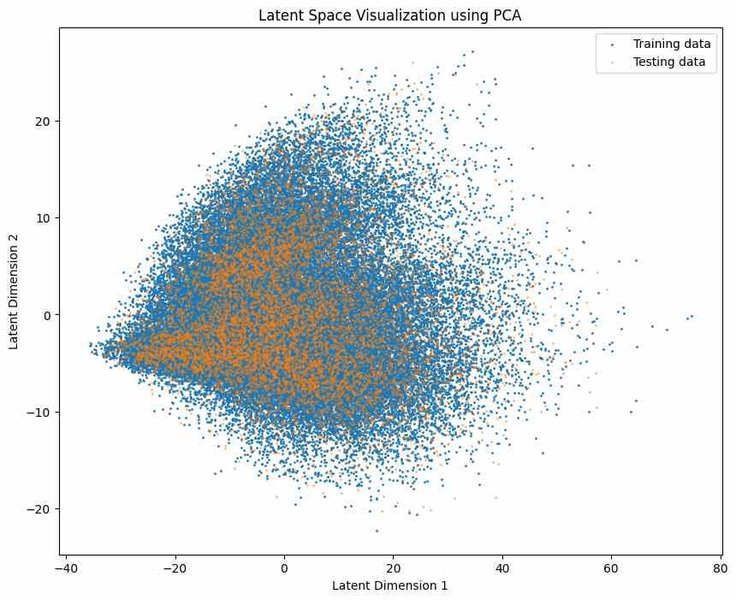
A conceptual visualization of data points being mapped into a lower-dimensional latent space.
What is Latent Space Reasoning?
Latent space reasoning is the process of performing cognitive operations—like inference, deduction, planning, and problem-solving—directly within this compressed latent space, rather than relying solely on explicit symbolic manipulation or generating sequences of text tokens. Instead of "thinking out loud" step-by-step, the model manipulates these internal, continuous vector representations.
This allows the model to:
- Explore multiple potential solutions or reasoning paths simultaneously, akin to a breadth-first search, without committing prematurely to one path.
- Perform computations more efficiently by compressing "thought processes" into internal loops or transformations of latent vectors.
- Handle abstract concepts and relationships that might be difficult to express clearly or concisely in natural language.
- Potentially reduce errors like hallucination, which can occur when models are forced to generate explicit intermediate reasoning steps.
Frontier AI Models: Pushing the Boundaries
Frontier machine learning models represent the cutting edge of AI development. These are typically large-scale models that significantly surpass the capabilities of existing state-of-the-art systems across a wide variety of tasks. Developed by organizations like OpenAI, Google DeepMind, Anthropic, and Microsoft (often collaborating through initiatives like the Frontier Model Forum), these models exhibit characteristics such as:
- Massive scale (parameters and training data).
- Multi-modal capabilities (processing text, images, audio, etc.).
- Advanced zero-shot and few-shot learning abilities.
- Potential for emergent capabilities and complex reasoning.
- Emphasis on safety, alignment, and continuous learning.
Latent space reasoning is becoming an increasingly important technique for unlocking the full potential of these powerful but complex frontier models, enabling more sophisticated and efficient processing.
Visualizing the Landscape: Latent Space Reasoning Concepts
This mindmap illustrates the key concepts associated with latent space reasoning and its connection to frontier AI models, applications, advantages, and challenges.
Comparing Reasoning Approaches
Latent space reasoning offers distinct advantages and trade-offs compared to other AI reasoning paradigms like explicit Chain-of-Thought (CoT) prompting in LLMs or traditional Symbolic AI. The radar chart below provides a comparative overview based on several key dimensions. Note that these scores represent qualitative assessments rather than precise quantitative measurements.
As the chart suggests, latent space reasoning excels in efficiency, handling complexity, and flexibility. However, interpreting the model's internal reasoning steps (interpretability) can be more challenging compared to explicit CoT or symbolic methods. It often requires substantial data for training the underlying representations.
Applications Across Frontier Model Types
Latent space reasoning isn't a monolithic concept; its implementation and benefits vary depending on the type of frontier model.
1. Large Language Models (LLMs)
The Coconut Method and Beyond
Perhaps the most prominent application is in enhancing the reasoning capabilities of LLMs. Techniques like the Coconut (Continuous Cognitive Unit) method, developed by Meta AI, explicitly train LLMs to reason within their continuous latent space. Instead of generating only text tokens, Coconut alternates between "language mode" (generating text) and "latent mode." In latent mode, the model's final hidden state (a vector representing its internal "thought") is fed back as input for the next step. This allows the LLM to:
- Perform internal refinement and exploration without generating verbose intermediate steps.
- Encode multiple alternative reasoning paths as continuous vectors, effectively performing a breadth-first search in the latent space.
- Improve performance on complex tasks requiring planning, multi-step deduction, or backtracking, potentially outperforming standard CoT prompting.
- Reduce computational costs associated with generating long reasoning chains.
Other related approaches involve recurrent depth mechanisms, where models iterate computation within latent space to refine understanding before producing an output.
This video explains the Coconut paper, detailing how LLMs can be trained to reason in continuous latent space.
2. Vision and Multi-Modal Models
Fusing Senses and Understanding Space
For models processing visual or multi-modal data (text, images, video, audio), latent spaces provide a crucial substrate for:
- Modality Fusion: Creating shared latent spaces where different types of data can be represented coherently, allowing the model to draw connections between, say, an image and its textual description.
- Spatial and 3D Reasoning: Models like Neural Radiance Fields (NeRFs) or Inverse Graphics Autoencoders use latent representations to understand and reconstruct 3D scenes from 2D images, enabling reasoning about object permanence, spatial relationships, and viewpoint changes.
- Zero-Shot Learning: By learning generalizable latent representations, models can perform tasks they weren't explicitly trained on, such as answering questions about an image (Visual Question Answering) without specific VQA training examples.
3. Generative Models (GANs, VAEs, Diffusion)
Creativity and Control
Generative models intrinsically rely on latent spaces. They learn a mapping from a simpler latent distribution (often Gaussian noise) to the complex distribution of the target data (e.g., realistic images).
- Meaningful Interpolation: Traversing paths within the latent space allows for smooth transitions between generated outputs (e.g., morphing one face into another).
- Controlled Generation: Manipulating specific dimensions or regions of the latent space can provide fine-grained control over the attributes of the generated output.
- Novelty and Coherence: Sampling from the latent space enables the generation of entirely new, yet plausible, data samples that adhere to the learned patterns. Frontier generative models use sophisticated latent spaces to create highly realistic and diverse outputs across various domains.
4. Algorithmic and Mathematical Reasoning
Executing Procedures Internally
Research explores using latent spaces for tasks requiring formal reasoning:
- Neural Algorithmic Reasoning: Models, particularly Graph Neural Networks (GNNs), can learn to execute algorithms by manipulating latent representations of the input data through iterative steps that mimic algorithmic operations.
- Mathematical Deduction: Neural networks can be trained to perform approximate deduction sequences in latent space, predicting transformations or relationships between mathematical formulas based on their embeddings.
Summary Table: Latent Space Reasoning Applications
The following table summarizes how latent space reasoning is applied across different frontier model types:
| Frontier Model Type | Key Latent Space Reasoning Application | Mechanism / Example | Primary Benefits |
|---|---|---|---|
| Large Language Models (LLMs) | Complex problem solving, planning, deduction | Continuous latent thought (Coconut), Recurrent Depth, Multi-path exploration | Efficiency, Deeper Reasoning, Flexibility, Reduced Hallucination |
| Vision & Multi-modal Models | Fusing data types, 3D/Spatial understanding | Shared latent spaces, NeRFs, Inverse Graphics Autoencoders | Coherent Integration, Zero-Shot Capabilities, Scene Understanding |
| Generative Models (GANs, VAEs, Diffusion) | Novel data generation, Controlled synthesis | Mapping noise to data via latent space, Latent space traversal/manipulation | High-Quality Generation, Creativity, Controllability |
| Algorithmic / Mathematical Models | Executing algorithms, Formal deduction | GNNs performing iterative updates on latent states, Embedding transformations | Abstract Procedure Execution, Approximate Reasoning |
Challenges and Future Directions
Despite its potential, latent space reasoning faces challenges:
- Interpretability: Understanding *why* a model made a decision based on manipulating abstract vectors is difficult compared to following explicit text-based reasoning. Developing methods for interpreting latent space operations is an active area of research.
- Resolution Loss: Compression into lower dimensions can sometimes make subtly different inputs indistinguishable in the latent space.
- Out-of-Distribution Generalization: Models might struggle with inputs significantly different from those seen during training, as these may map to unfamiliar regions of the latent space.
- Training Complexity: Designing and training models capable of effective latent space reasoning often requires sophisticated architectures and training procedures.
Researchers are exploring techniques like using softmax aggregators to improve distinguishability, decaying latent spaces to handle new data ranges, and developing hybrid approaches that combine latent reasoning with explicit symbolic methods to leverage the strengths of both paradigms.
Frequently Asked Questions (FAQ)
What exactly is a latent space in AI?
A latent space is a compressed, lower-dimensional representation (often a vector space) learned by an AI model from high-dimensional input data. It captures the essential, underlying features and relationships within the data, discarding noise and redundancy. Similar data points are mapped close together in this space, making it useful for tasks like pattern recognition, generation, and reasoning.
How does latent space reasoning differ from methods like Chain-of-Thought (CoT)?
Chain-of-Thought (CoT) relies on generating explicit, step-by-step reasoning in natural language (tokens) to solve a problem. Latent space reasoning, in contrast, performs computations and manipulations directly on the model's internal, continuous vector representations (the latent space) without necessarily generating intermediate text. This can be more computationally efficient and allows for parallel exploration of multiple reasoning paths, whereas CoT is typically sequential.
What defines a "frontier" machine learning model?
Frontier models are the most advanced, large-scale machine learning models that significantly exceed the capabilities of currently available state-of-the-art models. They often exhibit broad competence across many tasks, possess multi-modal capabilities, and push the boundaries of AI performance. The definition is relative and evolves as AI progresses. Organizations like OpenAI, Google, Anthropic, and Microsoft are key developers of such models.
What are the main advantages of using latent space reasoning?
Key advantages include:
- Efficiency: Potentially lower computational cost and memory usage compared to generating long explicit reasoning chains.
- Complexity Handling: Better suited for abstract, non-linear, or multi-step reasoning problems.
- Flexibility: Enables exploration of multiple hypotheses or reasoning paths simultaneously.
- Multi-modal Integration: Provides a framework for fusing and reasoning across different data types (text, image, etc.).
- Reduced Verbosity: Avoids generating potentially unnecessary intermediate textual steps.
Are there any significant challenges or limitations to latent space reasoning?
Yes, major challenges include:
- Interpretability: It's often hard to understand the model's reasoning process as it occurs within abstract vector manipulations.
- Brittleness: Performance might degrade if inputs are outside the distribution seen during training or if the latent space loses resolution.
- Training Difficulty: Designing and training models for effective latent reasoning can be complex.
- Potential for Error Propagation: Errors in the latent representation can propagate through subsequent reasoning steps.
Recommended Reading
- Explore specific implementations like the Coconut method for LLM reasoning.
- How is latent space utilized in multi-modal AI models?
- What are the latest advancements in ensuring the interpretability of latent space representations?
- Compare the performance of latent space reasoning versus symbolic AI for complex problem-solving.
References
Last updated May 1, 2025