
Unveiling the Distinct Worlds of Lanthanum Vanadate (LaVO₄) and Bismuth Vanadate (BiVO₄)
A comprehensive look into the unique physical characteristics and applications of these versatile vanadate compounds.
Key Insights into Vanadate Properties
- Crystal Structure Diversity: Both LaVO₄ and BiVO₄ exhibit multiple crystal phases, with the monoclinic scheelite phase being crucial for BiVO₄'s photocatalytic activity and LaVO₄ showing stable monoclinic and metastable tetragonal forms impacting its optical and electronic properties.
- Band Gap Dictates Application: BiVO₄'s narrow band gap (~2.3-2.4 eV) enables strong visible light absorption, making it a premier photocatalyst for water splitting and pollutant degradation, while LaVO₄'s wider band gap (3.2-3.6 eV) lends itself to luminescence and optoelectronic applications.
- Tailored Morphologies and Stability: Synthesis methods allow for precise control over the morphology of both compounds, enhancing their specific applications. Both are noted for their high chemical and thermal stability, contributing to their robustness in diverse environments.
Deciphering the Physical Landscape of Bismuth Vanadate (BiVO₄)
BiVO₄ is a prominent n-type semiconductor, widely recognized for its bright yellow color and exceptional photocatalytic capabilities under visible light. Its non-toxic nature and stability make it a cornerstone for sustainable environmental applications.
Crystalline Forms and Structural Nuances
BiVO₄ predominantly crystallizes into three synthetic forms: monoclinic scheelite, tetragonal zircon, and tetragonal scheelite. The monoclinic scheelite phase stands out as the most stable and scientifically investigated due to its superior photocatalytic efficiency. The unique structural distortion in this phase, influenced by the stereoactive lone pair of Bi 6s states, significantly enhances its optical performance.
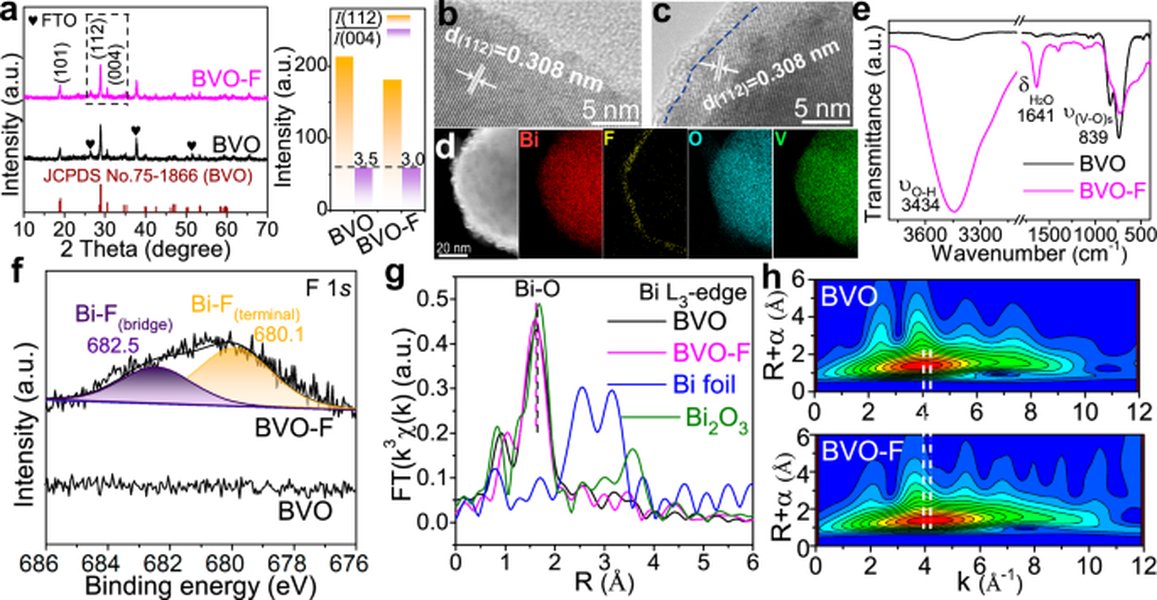
Monoclinic BiVO₄ structure illustrating its distorted crystal lattice.
Optical Properties and Band Gap Dynamics
A hallmark of BiVO₄ is its narrow band gap, typically ranging from 2.3 to 2.4 eV. This characteristic allows it to effectively absorb a significant portion of the visible light spectrum, making it an excellent candidate for photocatalytic processes such as hydrogen generation and the degradation of organic pollutants. The optical band gap can vary slightly across its different crystal phases, with monoclinic scheelite generally having the smallest.
The electronic structure of monoclinic scheelite BiVO₄ features a valence band primarily composed of Bi 6s and O 2p states, while V 3d orbitals dominate the conduction band. This specific orbital coupling ensures a direct band gap, even though the band extrema are not at the Brillouin zone center, which is crucial for its photoactivity.
Morphological Engineering and Enhanced Performance
BiVO₄ can be synthesized in various microstructures, including dumbbells, rods, ellipsoids, spheres, and cake-like shapes, often through surfactant-free hydrothermal methods. The ability to tailor its morphology, influenced by factors like precursor molar ratios and pH, allows for optimized surface area and enhanced photocatalytic performance. High-index crystal facets, in particular, have been shown to significantly boost water splitting and oxygen evolution reactions.
Stability and Other Physical Attributes
BiVO₄ is celebrated for its high photostability, robust corrosion resistance, and ferroelasticity. These properties, coupled with its non-toxicity, ensure its long-term viability in demanding environmental applications. Despite its promising attributes, challenges such as the rapid recombination of photogenerated electron-hole pairs persist, which are being addressed through strategies like metal and non-metal doping (e.g., Ag, Ag₂O, Cu₂O) and the formation of heterojunctions with other oxides (e.g., rGO, TiO₂, FeVO₄, WO₃, MoO₃, LaVO₄).
Exploring the Physical Characteristics of Lanthanum Vanadate (LaVO₄)
LaVO₄ is another vital vanadate compound, valued for its unique optical and electronic properties, making it suitable for applications in optoelectronic devices, solid-state scintillators, and laser host materials.
Crystal Structure and Polymorphism
LaVO₄ primarily crystallizes in two polymorphic forms: the thermodynamically stable monoclinic (P2₁/c space group, monazite-type) and the metastable tetragonal (zircon-type) phases. The latter can be stabilized under ambient conditions, particularly through hydrothermal synthesis. In the monoclinic phase, La³⁺ ions coordinate with nine oxygen atoms in a distorted polyhedron, while V⁵⁺ ions are tetrahedrally coordinated by oxygen. Doping elements like Sr²⁺ or Li⁺ can influence the ratio of these phases, thereby altering the material's overall properties.
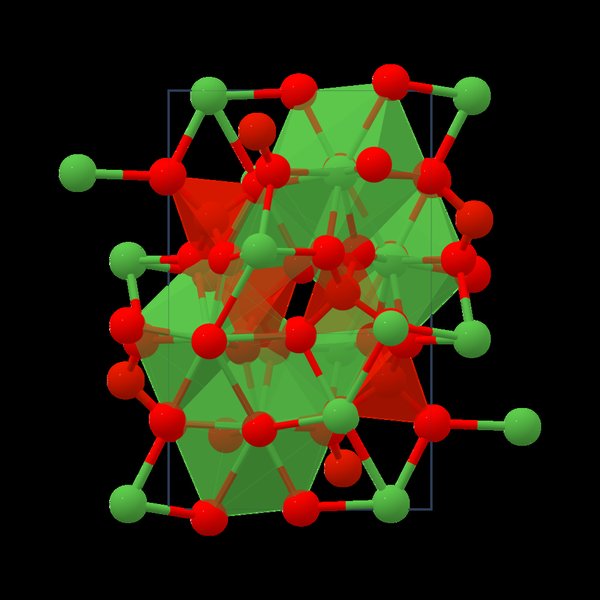
LaVO₄ crystal structure, monoclinic phase.
Optical Behavior and Luminescence Potential
LaVO₄ typically exhibits an indirect band gap in its monoclinic phase and a direct band gap in its tetragonal phase, with band gap energies ranging from approximately 3.2 to 3.6 eV. This wide band gap positions LaVO₄ as a significant semiconductor for optical applications. It demonstrates strong photoluminescence when doped with rare earth ions such as Eu³⁺ or Tb³⁺, emitting intense red or green light, respectively. This luminescence makes it highly valuable for phosphors and laser materials. Pressure and temperature variations can also induce significant changes in its optical properties due to phase transitions.

Luminescent properties of LaVO₄ nanocrystals.
Electronic and Dielectric Properties
LaVO₄ is generally non-magnetic but possesses intriguing dielectric properties, particularly along certain crystallographic directions, making it relevant for electronic device applications. The material's density is approximately 4.703 g/cm³, consistent with its compact crystal arrangement, which supports its use in dense ceramic systems.
Stability and Synthesis Control
LaVO₄ is known for its physical and chemical stability, showing resistance to high pressures (up to 25 GPa) and good corrosion resistance. Its synthesis methods, including hydrothermal, sol-gel, and solid-state techniques, allow for control over morphology, yielding structures like rods, nanowires, and microspheres. Doping with various elements also helps tune its microstructure and phase distribution, enhancing its overall performance for specific applications.
Comparative Analysis: LaVO₄ vs. BiVO₄
While both LaVO₄ and BiVO₄ are vanadate-based compounds with diverse applications, their distinct cation elements (Lanthanum vs. Bismuth) lead to significant differences in their physical properties and optimal uses. This comparison highlights their unique strengths and the reasons for their varied applications.
| Property | LaVO₄ (Lanthanum Vanadate) | BiVO₄ (Bismuth Vanadate) |
|---|---|---|
| Primary Crystal Structures | Monoclinic (P2₁/c, stable), Tetragonal (Zircon-type, metastable) | Monoclinic scheelite (most stable and photoactive), Tetragonal scheelite, Tetragonal zircon, Orthorhombic |
| Density (g/cm³) | ~4.703 | ~6.15–6.25 (Monoclinic phase), ~8.8 (general) |
| Band Gap (eV) | 3.2–3.6 (Indirect in mono, Direct in tetra) | ~2.3–2.4 (Direct, visible light active) |
| Optical Properties | UV absorption (250-270 nm, 300-320 nm), strong photoluminescence with rare-earth dopants, medium birefringence | Strong visible light absorption, effective photocatalytic activity, Refractive Index ~2.2-2.6 |
| Coordination | La³⁺ 9-coordinate to oxygen, V⁵⁺ 4-coordinate | Bi³⁺ 8-coordinate to oxygen in monoclinic scheelite, stereoactive lone pair affects structure |
| Typical Applications | Laser host materials, solid-state scintillators, optoelectronic devices, phosphors, dielectric materials | Photocatalysis (water splitting, pollutant degradation), photoelectrochemical cells, environmental remediation |
| Stability | Thermally and chemically stable, good corrosion resistance, stable under high pressure | High photostability, corrosion resistance, non-toxic, ferroelasticity |
| Morphology Control | Rods, nanowires, nanorods, microspheres, bundles via hydrothermal/sol-gel methods | Dumbbell, rod, ellipsoid, sphere, cake-like forms via hydrothermal synthesis; influenced by precursor ratios |
Assessing Material Performance: A Radar Chart Perspective
To further illustrate the comparative performance and typical application strengths of LaVO₄ and BiVO₄, the following radar chart provides a visual overview across several key physical attributes. This chart highlights the relative prominence of each material in specific areas, reflecting their intrinsic properties and common uses.
Understanding the Interplay: A Mindmap of Properties and Applications
The mindmap below visually organizes the key physical properties of LaVO₄ and BiVO₄ and their corresponding applications. This diagram illustrates how the intrinsic characteristics of each material drive its utility in different technological domains, highlighting their unique contributions to materials science.
(Stable & Photoactive)"] id_bi1_2["Tetragonal Zircon/Scheelite"] id_bi2["Optical Properties"] id_bi2_1["Narrow Band Gap (~2.3-2.4 eV)"] id_bi2_2["Strong Visible Light Absorption"] id_bi2_3["Direct Band Gap Semiconductor"] id_bi3["Electronic & Photocatalytic"] id_bi3_1["n-type Semiconductor"] id_bi3_2["Excellent Photocatalytic Activity"] id_bi3_3["Water Splitting & Pollutant Degradation"] id_bi3_4["Electron-Hole Recombination (Challenge)"] id_bi4["Morphology"] id_bi4_1["Dumbbells, Rods, Spheres"] id_bi4_2["Tailored by Synthesis"] id_bi5["Stability"] id_bi5_1["Non-toxic"] id_bi5_2["High Photostability"] id_bi5_3["Corrosion Resistance"] id_bi6["Density"] id_bi6_1["~6.15-6.25 g/cm#quot;³#quot; (Monoclinic)"] LaVO4["LaVO₄"] id_la1["Crystal Structure"] id_la1_1["Monoclinic (P2#sub;1#endsub;/c, Stable)"] id_la1_2["Tetragonal (Zircon-type, Metastable)"] id_la1_3["La#sup;3+#endsup; 9-coordinate"] id_la2["Optical Properties"] id_la2_1["Wide Band Gap (3.2-3.6 eV)"] id_la2_2["Indirect (Mono) & Direct (Tetra) Band Gap"] id_la2_3["Strong Photoluminescence (with Dopants)"] id_la2_4["UV Absorption"] id_la3["Electronic & Dielectric"] id_la3_1["Non-magnetic"] id_la3_2["Useful Dielectric Properties"] id_la3_3["Suitable for Electronic Devices"] id_la4["Applications"] id_la4_1["Laser Host Materials"] id_la4_2["Solid-state Scintillators"] id_la4_3["Optoelectronic Devices"] id_la5["Stability"] id_la5_1["Thermally & Chemically Stable"] id_la5_2["High Pressure Resistance"] id_la6["Density"] id_la6_1["~4.703 g/cm#quot;³#quot;"]
Frequently Asked Questions about Vanadate Compounds
What are the primary applications of BiVO₄?
How does doping affect the properties of LaVO₄?
Why is monoclinic scheelite BiVO₄ particularly effective for photocatalysis?
Are LaVO₄ and BiVO₄ stable materials?
Conclusion
Lanthanum Vanadate (LaVO₄) and Bismuth Vanadate (BiVO₄) are inorganic compounds belonging to the vanadate family, each possessing a unique set of physical properties that dictate their diverse applications. BiVO₄ is primarily recognized for its potent photocatalytic capabilities under visible light, driven by its narrow band gap and tunable morphology, making it a critical material for environmental applications like water splitting and pollutant degradation. In contrast, LaVO₄, with its wider band gap and excellent luminescent properties when doped with rare-earth ions, is highly valued in optoelectronics, laser technology, and as a host material for phosphors. Both materials exhibit remarkable chemical and thermal stability, underscoring their robust nature for long-term use in advanced technological applications. Understanding these distinct characteristics is crucial for leveraging their full potential in materials science and engineering.
Recommended Further Exploration
- Explore the advanced photocatalytic mechanisms and enhancement strategies for BiVO₄.
- Investigate how rare earth doping profoundly influences the luminescent properties of LaVO₄.
- Delve into the cutting-edge field of crystal facet engineering and its impact on metal oxide photocatalysts.
- Understand the various synthesis techniques and characterization methods for vanadate nanomaterials.