
Unlocking the Guitar Fretboard: Your Comprehensive Guide to Mastery
Navigate the Neck with Confidence and Unleash Your Musical Potential
Key Insights for Fretboard Mastery
- Systematic Approach: Break down the fretboard into manageable sections, such as learning notes string by string or focusing on specific frets and octaves, rather than attempting to memorize everything at once.
- Pattern Recognition: Utilize patterns like major and minor pentatonic shapes, octave shapes, and intervals to understand the relationships between notes across the fretboard, which significantly speeds up memorization.
- Consistent Practice and Application: Dedicate regular, focused practice sessions (e.g., 15 minutes daily) and integrate fretboard knowledge into your actual playing through exercises, songs, and improvisation to solidify your understanding and develop muscle memory.
Mastering the guitar fretboard is a transformative journey for any guitarist, from novice to seasoned player. It’s the essential foundation that unlocks deeper musical understanding, enhances improvisation, improves songwriting, and significantly boosts your overall playing speed and fluidity. While it might seem like a daunting task, with the right strategies and consistent effort, you can demystify the neck and gain a comprehensive command of every note. This guide will walk you through proven methods, practical exercises, and valuable tips to help you effectively learn and internalize the guitar fretboard.
Why Fretboard Knowledge is Crucial
The Undeniable Advantages of Knowing Your Notes
Many guitarists get by through memorizing chord shapes and scale patterns without truly understanding the underlying notes. While this can work for basic playing, it severely limits your musical growth. Knowing the notes on the fretboard provides several profound benefits:
- Enhanced Improvisation: When you know where every note is, you can freely express musical ideas, play in any key, and create solos that truly resonate with the underlying harmony.
- Deeper Music Theory Understanding: Fretboard knowledge makes music theory concepts like intervals, scales, and chords much more tangible and easier to apply directly to your instrument. It bridges the gap between abstract theory and practical application.
- Faster Learning of Songs and Chords: Instead of relying solely on tabs or rote memorization of shapes, you can understand why certain notes work together, allowing you to learn new songs and construct chords more intuitively and efficiently.
- Improved Communication with Other Musicians: Speaking the language of notes enables clearer communication during jams, band practices, or when discussing musical ideas with other instrumentalists.
- Creative Freedom: By eliminating guesswork, you gain the confidence to explore the entire neck, leading to more unique and expressive playing.
Fundamental Principles for Effective Memorization
Building a Solid Foundation
Before diving into specific techniques, it's vital to grasp the core principles that underpin successful fretboard memorization:
Understanding the Guitar's Layout
The guitar fretboard consists of 6 strings, traditionally tuned E-A-D-G-B-E from thickest (low E) to thinnest (high E). Each fret represents a half-step (semitone). Moving up one fret increases the pitch by a half-step, and moving down decreases it. After 12 frets, the notes repeat, meaning the 12th fret notes are an octave higher than the open strings.
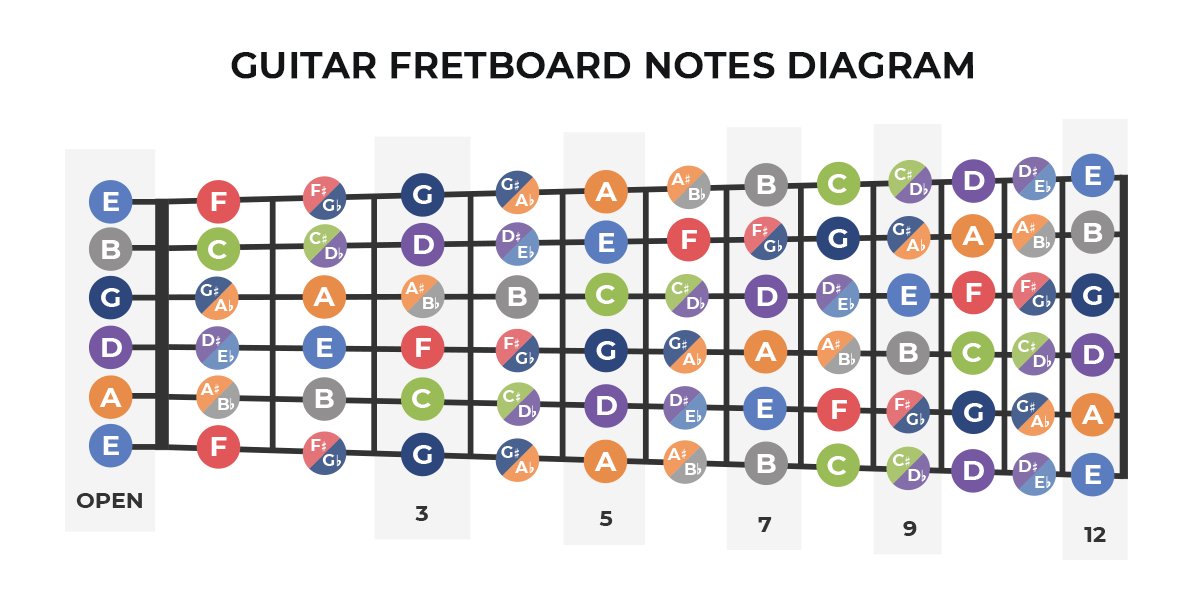
A comprehensive guitar fretboard diagram illustrating notes from the open strings up to the 12th fret.
The Musical Alphabet and Sharps/Flats
The musical alphabet consists of seven natural notes: A, B, C, D, E, F, G. Between most of these notes, there are sharps (#) and flats (b). For example, between A and B, you have A# (A sharp) or Bb (B flat). The crucial exceptions are between B and C, and E and F, where there is no sharp or flat in between (they are naturally a half-step apart). Knowing this chromatic scale is fundamental:
E, F, F#/Gb, G, G#/Ab, A, A#/Bb, B, C, C#/Db, D, D#/Eb, E... (repeats)
Patience and Consistency
Fretboard mastery isn't an overnight achievement. It requires consistent, deliberate practice. Short, regular sessions (e.g., 10-15 minutes daily) are far more effective than infrequent, long ones. Don't get overwhelmed; break it down into small, digestible chunks.
Effective Methods for Fretboard Memorization
Strategic Approaches to Learn Every Note
1. Learn String by String
This is one of the most common and accessible starting points. Begin by mastering the notes on one string before moving to the next. The low E string and A string are often recommended first because they are used frequently for root notes in chords and scales.
- Low E String (6th String): Start from the open E, then F (1st fret), F#/Gb (2nd fret), G (3rd fret), and so on, up to the 12th fret (E). Practice naming the notes aloud as you play them.
- A String (5th String): Repeat the process for the A string (open A, A#/Bb, B, C, etc.).
- Applying Octaves: Once you know the E and A strings, you can use octave shapes to find notes on other strings. For example, an octave of a note on the 6th string is two strings down and two frets up (e.g., G on 3rd fret E-string, G on 5th fret D-string). The B string is an exception for this pattern, as its octave on the high E string is three frets up.
2. Utilize Landmark Frets and Fret Markers
Guitar necks typically have dot markers at the 3rd, 5th, 7th, 9th, and 12th frets. These act as visual anchors to help you orient yourself quickly.
- 5th Fret Rule: On a standard-tuned guitar, the 5th fret of any string has the same note name as the open string below it (e.g., 5th fret of E string is A, same as open A string). The exception is the G string, where the 4th fret is B (same as open B string).
- 12th Fret: The 12th fret is a crucial landmark as all notes repeat an octave higher here. Knowing the notes up to the 12th fret effectively means you know the entire fretboard (as patterns simply repeat).
3. Memorize Octave Shapes
Octave shapes are incredibly powerful for navigating the fretboard. Once you find a note, knowing its octave shapes allows you to instantly locate the same note in different positions across the neck. There are a few primary octave shapes to learn:
- Notes on the E and D strings are two strings down and two frets across.
- Notes on the A and G strings are two strings down and two frets across.
- Notes on the D and B strings are two strings down and three frets across (due to the B string tuning).
- Notes on the G and high E strings are two strings down and three frets across.

Practice filling in the notes on a blank fretboard diagram to reinforce visual memory.
4. Learn Through Intervals
Understanding intervals (the distance between two notes) is a highly musical and practical way to learn the fretboard. Instead of rote memorization of individual notes, you learn the relationships between them.
- Octaves First: As mentioned, octaves are the easiest interval to spot and use as anchors.
- Perfect 5ths and 4ths: The guitar is largely tuned in perfect 4ths (E-A, A-D, D-G, B-E), with the exception of the G-B interval which is a major 3rd. Learning the shapes for 5ths and 4ths will allow you to quickly find notes relative to a root note.
- Triads and Chord Shapes: Learn how major and minor triads (root, 3rd, 5th) are structured across the neck. When you play a G major chord, for instance, identify all the G, B, and D notes within that shape.
5. Use the Circle of Fifths (or Fourths)
While often associated with music theory, the Circle of Fifths (or its inverse, the Circle of Fourths) can be a powerful tool for fretboard navigation, especially since the guitar is tuned largely in fourths.
6. Integrate with Scales and Arpeggios
Instead of just memorizing scale patterns visually, consciously name the notes as you play through them. For example, when playing a C major scale, identify C, D, E, F, G, A, B, C across different positions on the fretboard. This makes your scale practice dual-purpose.
Practical Exercises and Drills
Making Knowledge Stick Through Active Learning
Passive learning (just looking at diagrams) is less effective. Active engagement is key. Here are some exercises:
- Call and Play: Randomly call out a note (e.g., "F#") and find it on as many strings and frets as possible. Start slow, then increase your speed.
- Flashcard Drills: Create flashcards with note names on one side and fretboard positions on the other.
- Note Naming During Practice: As you play songs, solos, or exercises, consciously name the notes you are playing, especially the root notes of chords or the key notes of melodies.
- Fretboard Trainer Apps/Tools: Websites and apps like GuitarOrb's Fretboard Trainer or MusicTheory.net's Fretboard Identification exercise can provide interactive practice and instant feedback.
- Writing it Down: Draw blank fretboard diagrams and fill in the notes. This engages a different part of your brain and reinforces visual memory.
- "Find All 'X' Notes" Exercise: Pick a single note (e.g., "A") and challenge yourself to find every "A" note on the entire fretboard, from open strings up to the highest fret.
Leveraging Technology for Fretboard Learning
Modern tools can significantly accelerate your fretboard journey. Here's a radar chart illustrating the perceived effectiveness of various learning methods, based on common guitarist experiences:
This radar chart illustrates the perceived effectiveness of various methods in learning the guitar fretboard. "Applying to Songs & Solos" often ranks highest because it provides practical, real-world context, reinforcing theoretical knowledge with muscle memory. "Octave Shapes & Patterns" is also highly effective due to the guitar's inherent symmetry. While "Fretboard Trainer Apps" are useful for drill and immediate feedback, they are typically best used as supplementary tools rather than standalone solutions.
Common Pitfalls to Avoid
Steering Clear of Ineffective Practices
Many guitarists make common mistakes that hinder their fretboard learning:
- Relying Solely on Tablature: Tabs tell you where to put your fingers but not what notes you're playing. This bypasses true understanding.
- Ignoring the "Why": Understanding the musical theory behind why notes are arranged the way they are (intervals, scales) is more effective than pure rote memorization.
- Trying to Learn Everything at Once: This leads to overwhelm and frustration. Break it down!
- Inconsistent Practice: Sporadic practice yields poor results. Short, daily sessions are far superior.
- Not Using Your Ears: Connect the visual note on the fretboard with its sound. Play a note, name it, and listen to it.
- Neglecting Higher Frets: While the lower register is important, don't ignore notes above the 12th fret. Remember, it's just a repetition of the first 12 frets an octave higher.
A Structured Learning Pathway
A Step-by-Step Approach for Guitarists
Here’s a suggested sequence to tackle the fretboard systematically:
- Memorize Open String Notes: E-A-D-G-B-E. Say them aloud often.
- Learn Natural Notes on Low E and A Strings: Focus on E, F, G, A, B, C, D on both the 6th and 5th strings.
- Understand the Chromatic Scale: Internalize the sequence of all 12 notes (A, A#, B, C, C#, D, D#, E, F, F#, G, G#) and how sharps/flats work.
- Identify Landmark Frets: Know the notes at the 3rd, 5th, 7th, 9th, and 12th frets on all strings.
- Master Octave Shapes: Practice finding octaves of any given note across different strings.
- Apply to D, G, B, High E Strings: Use your knowledge of the low E, A strings, and octave shapes to fill in the rest of the fretboard.
- Integrate with Scales and Chords: As you learn scale patterns and chord shapes, identify the specific notes within them.
- Consistent Drills: Regularly use call-and-play exercises and online trainers.
The Role of Practice Routines
Integrating Fretboard Learning into Your Daily Schedule
The key to success is making fretboard study a consistent part of your practice routine. Even 5-15 minutes a day can make a significant difference over time.
This video provides a no-nonsense exercise for memorizing the guitar fretboard, emphasizing practical application over abstract theory.
This video from "How To MEMORIZE Your Guitar FRETBOARD: The No-Nonsense Exercise That Actually Works." offers a direct and actionable exercise for integrating fretboard knowledge into your practice. It highlights the importance of not just knowing the notes intellectually, but making them accessible through physical movement and muscle memory. It advocates for simple, repetitive drills that build intuition and speed, moving beyond just visual memorization to a more integrated understanding of the guitar neck.
Fretboard Learning Methods at a Glance
Comparing Popular Strategies and Their Focus
| Method | Primary Focus | Benefits | Considerations |
|---|---|---|---|
| String-by-String | Linear note memorization | Simple starting point, builds sequential understanding. | Can be slow if not combined with other methods. |
| Landmark Frets (Dots) | Visual navigation, quick reference points | Fast orientation, complements other methods. | Requires understanding of open string notes. |
| Octave Shapes | Pattern recognition across strings | Highly efficient, connects notes globally. | B string exception needs special attention. |
| Interval Recognition | Understanding relationships between notes | Deep musical understanding, aids improvisation. | Requires basic music theory knowledge. |
| Scale/Arpeggio Application | Contextual learning within musical forms | Practical, integrates theory with playing. | Less effective for initial rote memorization. |
| Fretboard Trainers/Apps | Gamified recall and speed drills | Immediate feedback, makes practice fun. | Supplement, not a replacement for guitar in hand. |
| Mnemonic Devices | Memory aids for string tuning | Quick recall of open strings. | Limited to initial memorization, not full fretboard. |
This table summarizes various effective methods for learning the guitar fretboard, highlighting their primary focus, benefits, and important considerations. Combining several of these approaches often leads to the most robust and lasting understanding of the guitar neck.
Frequently Asked Questions
Why is it so hard to memorize the fretboard?
How long does it take to memorize the fretboard?
Should I learn sharps and flats immediately?
Can I learn the fretboard without learning music theory?
Is there a specific order to learn the strings?
Conclusion
Memorizing the guitar fretboard is not merely an academic exercise; it's a fundamental step towards becoming a more complete and confident guitarist. By adopting a systematic approach, breaking down the task into manageable segments, utilizing pattern recognition, and consistently applying your knowledge in musical contexts, you will gradually transform the seemingly chaotic arrangement of notes into a logical and intuitive landscape. This journey will enhance your improvisational skills, deepen your theoretical understanding, and ultimately unlock a new level of creative freedom in your playing. Embrace the process, be patient with yourself, and enjoy the profound rewards of truly knowing your instrument.
Recommended Further Exploration
- How do guitar fretboard intervals enhance musical understanding?
- What are effective visualization techniques for guitar fretboard mastery?
- How can I apply music theory concepts directly to the guitar fretboard?
- What are efficient daily practice routines for memorizing the guitar fretboard?
