
Unlock the Secrets of Poker: From Basic Rules to Winning Strategies
Master the fundamentals of poker, starting with Texas Hold'em, and build a foundation for advanced play.
Poker is a fascinating card game blending skill, strategy, psychology, and a bit of luck. While many variations exist, Texas Hold'em is the most popular and serves as an excellent starting point for beginners. This guide will walk you through the essential rules and foundational strategies, paving the way for you to eventually tackle higher-level concepts.
Essential Poker Insights for Beginners
- Master Hand Rankings: Knowing the hierarchy of poker hands is non-negotiable. Memorize them from Royal Flush down to High Card to make informed decisions.
- Position is Power: Where you sit relative to the dealer significantly impacts your strategy. Acting later allows you to gather more information before deciding your move.
- Play Tight, Play Smart: Especially when starting, be selective about the hands you play. Focusing on strong starting hands reduces costly mistakes and builds a solid foundation.
Understanding the Core Concepts of Poker
Before diving into the complexities of strategy, it's crucial to grasp the absolute basics of how poker is played, particularly Texas Hold'em.
The Objective: Winning the Pot
The primary goal in a hand of poker is to win the "pot," which consists of all the chips bet by players during that hand. There are two main ways to win the pot:
- By holding the best-ranking poker hand at the "showdown" (the final phase where remaining players reveal their cards).
- By making a bet or raise that causes all other players to "fold" (give up their hands), thereby winning the pot uncontested, regardless of your hand strength.
Poker Hand Rankings: Know What Beats What
Understanding the hierarchy of poker hands is fundamental. Mistaking hand strength is a common and costly error for beginners. The standard poker hand rankings, from highest (best) to lowest, are:
- Royal Flush: A, K, Q, J, 10, all of the same suit (e.g., Spades). The best possible hand.
- Straight Flush: Five cards in sequence, all of the same suit (e.g., 9, 8, 7, 6, 5 of Hearts).
- Four of a Kind: Four cards of the same rank (e.g., four Queens).
- Full House: Three cards of one rank and two cards of another rank (e.g., three Kings and two 7s).
- Flush: Any five cards of the same suit, but not in sequence (e.g., K, 10, 8, 4, 2 of Diamonds).
- Straight: Five cards in sequence, but not all of the same suit (e.g., 7, 6, 5, 4, 3 of mixed suits).
- Three of a Kind: Three cards of the same rank, plus two unrelated side cards (e.g., three Jacks).
- Two Pair: Two cards of one rank, two cards of another rank, plus one unrelated side card (e.g., two Aces and two 6s).
- One Pair: Two cards of the same rank, plus three unrelated side cards (e.g., two 10s).
- High Card: If no player has any of the above hands, the hand with the highest-ranking single card wins (Ace is high).
Memorize these rankings thoroughly. They are the bedrock upon which all poker decisions are built.
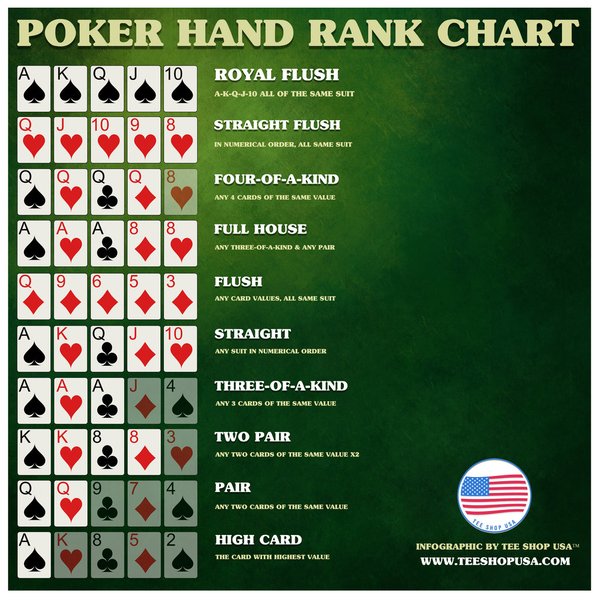
Visual guide to standard poker hand rankings, from Royal Flush to High Card.
Essential Poker Terminology
Poker has its own language. Familiarizing yourself with these basic terms is essential:
- Blinds: Forced bets made by two players before cards are dealt (Small Blind and Big Blind) to stimulate action.
- Button: A marker indicating the nominal "dealer" for the current hand. Position rotates clockwise each hand.
- Hole Cards: The private cards dealt face down to each player (two in Texas Hold'em).
- Community Cards: Cards dealt face up in the middle of the table that all players can use (Flop, Turn, River in Hold'em).
- Check: To pass the action to the next player without betting, only possible if no bet has been made yet in the current round.
- Bet: To make the first wager in a betting round.
- Call: To match the amount of the current bet or raise.
- Raise: To increase the amount of the current bet.
- Fold: To discard your hand and forfeit any chance of winning the current pot.
- Pot: The total amount of chips wagered by players in a hand.
- Showdown: The final phase of a hand where remaining players reveal their hole cards to determine the winner.
Texas Hold'em Gameplay: A Step-by-Step Guide
Texas Hold'em is played in a structured sequence of dealing cards and betting rounds. Understanding this flow is key to following the action and making strategic decisions.

Typical setup for a Texas Hold'em game, showing player positions relative to the dealer button and blinds.
The Setup and Initial Deal
Posting the Blinds
Before any cards are dealt, two players post mandatory bets. The player immediately clockwise to the Button posts the Small Blind, and the next player posts the Big Blind (usually double the Small Blind). These ensure there's money in the pot from the start.
Dealing the Hole Cards
Each player receives two private cards, dealt face down. These are your "hole cards," and only you should see them.
The Betting Rounds
A hand of Texas Hold'em proceeds through up to four betting rounds. In each round, players act in clockwise order.
Pre-Flop
This is the first betting round, occurring immediately after the hole cards are dealt. Action starts with the player to the left of the Big Blind. They can choose to:
- Fold: Give up their hand.
- Call: Match the amount of the Big Blind.
- Raise: Increase the bet amount.
Betting continues around the table until everyone has either folded or put the same amount of chips into the pot.
The Flop
After the pre-flop betting round, three community cards are dealt face-up in the center of the table. This is called "the Flop." These cards are shared by all remaining players. A second betting round begins, starting with the first active player clockwise from the Button.
The Turn
Following the flop betting round, a fourth community card (the "Turn" or "Fourth Street") is dealt face-up. A third betting round occurs, following the same format as the flop betting round.
The River
After the turn betting round, a fifth and final community card (the "River" or "Fifth Street") is dealt face-up. The final betting round takes place, starting again with the first active player clockwise from the Button.
The Showdown
If two or more players remain after the final betting round, the "Showdown" occurs. The player who made the last aggressive action (bet or raise) usually shows their hand first. Remaining players reveal their hands in turn. The player who can make the best five-card poker hand using any combination of their two hole cards and the five community cards wins the pot.
Foundational Strategy for Aspiring Players
Knowing the rules is just the first step. Basic strategy helps you navigate the game more effectively and avoid common beginner mistakes.
Starting Hand Selection: Be Selective
Not all starting hands are created equal. Beginners should focus on playing only the strongest starting hands, especially from early positions. Playing fewer, stronger hands reduces difficult decisions post-flop and minimizes losses.
What Makes a Good Starting Hand?
- High Pairs: Aces (AA), Kings (KK), Queens (QQ), Jacks (JJ).
- High Cards: Ace-King (AK), Ace-Queen (AQ), Ace-Jack (AJ), King-Queen (KQ). Especially strong if "suited" (same suit).
- Medium Pairs: Tens (TT), Nines (99), Eights (88).
Playing weaker hands like unsuited low cards or small connectors often leads to trouble.
The Importance of Position
Your position relative to the dealer Button is crucial. Acting later in a betting round is advantageous because you see how your opponents act before making your own decision.
- Early Position (EP): Immediately after the blinds. Act first post-flop. Play very tightly (only premium hands).
- Middle Position (MP): Between early and late positions. Can play slightly more hands than from EP.
- Late Position (LP): The Button and the player just before it (Cutoff). Act last post-flop. This is the most profitable position, allowing you to play a wider range of hands and potentially steal blinds or control the pot size.
Basic Betting Principles
Bet Sizing
When you decide to bet or raise, the amount matters. A standard pre-flop raise is often 2.5 to 4 times the Big Blind. Post-flop bets are typically between half the pot and the full pot size, depending on your goal (value betting or bluffing).
Understanding Pot Odds (Basic Introduction)
Pot odds compare the amount you need to call to the amount already in the pot. This helps determine if calling a bet is mathematically worthwhile based on your chances of improving your hand. While complex calculations are advanced, being aware that decisions should relate the cost of calling to the potential reward is a key beginner concept.
Bankroll Management: Protect Your Funds
Never play with money you cannot afford to lose. Good bankroll management involves only risking a small percentage of your total poker funds in any single game or session. This prevents you from going broke after a few unlucky hands and allows you to withstand the natural variance of the game.
Adopt a Tight-Aggressive (TAG) Style
For beginners, the recommended style is often "Tight-Aggressive" (TAG):
- Tight: Be selective with the starting hands you play. Fold most weak or marginal hands.
- Aggressive: When you do play a hand, play it assertively with bets and raises, rather than passively checking and calling. This puts pressure on opponents and gives you more ways to win the pot (either by having the best hand or by making opponents fold).
Observe Your Opponents
Pay attention to how others play. Do they play many hands (loose) or few (tight)? Are they aggressive or passive? Noticing patterns can give you valuable clues about the strength of their hands.
Visualizing Key Beginner Poker Skills
Success in poker, especially early on, relies on developing several core skills. The radar chart below illustrates the relative importance of these skills for a player mastering the fundamentals. While all are necessary, some have a higher immediate impact on preventing basic errors and building a solid foundation.
This chart highlights that fundamentals like Bankroll Management and knowing Hand Rankings are critically important from the start. While skills like Aggression and Observation are vital, they build upon a solid understanding of the basics.
Mapping Poker Fundamentals
To help visualize the core components of learning basic poker, especially Texas Hold'em, here is a mindmap outlining the key areas covered:
(Royal Flush -> High Card)"] id1c["Key Terminology
(Blinds, Button, Check, Bet, Call, Raise, Fold)"] id2["Gameplay Sequence"] id2a["Setup
(Blinds, Hole Cards)"] id2b["Betting Rounds"] id2b1["Pre-Flop"] id2b2["Flop (3 Cards)"] id2b3["Turn (1 Card)"] id2b4["River (1 Card)"] id2c["Showdown
(If necessary)"] id3["Beginner Strategy"] id3a["Starting Hand Selection (Tight)"] id3b["Positional Awareness (Late is Great)"] id3c["Bankroll Management"] id3d["Tight-Aggressive Style (TAG)"] id3e["Basic Betting (Sizing)"] id3f["Observation"] id4["Next Steps"] id4a["Practice (Low Stakes)"] id4b["Study Resources"] id4c["Moving to Advanced Concepts"]
This mindmap provides a structured overview, connecting the rules, gameplay flow, and essential beginner strategies you need to master.
Visual Learning: Poker Basics Explained
Sometimes, watching the game explained visually can solidify understanding. This video provides a clear introduction to the basic rules and flow of Texas Hold'em, perfect for beginners.
This PokerStars Learn video covers the essential elements discussed above, including hand rankings, betting rounds, and the objective of the game, offering a dynamic way to reinforce the fundamentals.
Simplified Starting Hand Guide by Position
As mentioned, your position dictates how selective you should be with your starting hands. This table offers a simplified guide for beginners playing typical full-ring (9-10 players) or 6-max games.
| Position | Description | Example Hands to Consider Playing | General Approach |
|---|---|---|---|
| Early Position (EP) | First 2-3 players to act after the blinds | AA, KK, QQ, JJ, AK (suited or unsuited) | Play only the strongest premium hands. Avoid speculative hands. |
| Middle Position (MP) | Players between Early and Late Position | Hands from EP + TT, 99, AQ, AJ, KQ (suited often preferred) | Slightly wider range than EP, but still quite selective. Be cautious if there's a raise before you. |
| Late Position (LP) | Button (BTN) and Cutoff (CO - player before Button) | Hands from MP + 88, 77, ATs, KJs, QJs, JTs, suited connectors (e.g., 98s, 87s), some suited Aces (Axs) | Play the widest range of hands. Use position to potentially steal blinds or see flops more cheaply. More opportunities for bluffing or semi-bluffing. |
| Blinds (SB/BB) | Small Blind and Big Blind | Similar to EP/MP if facing a raise. Can defend BB wider vs. single late position raise. | Difficult positions to play from post-flop as you act first. Be cautious, but consider defending the BB with playable hands if odds are good. |
Note: This is a highly simplified guide. Actual hand selection depends on many factors including opponent tendencies, stack sizes, and the specific game dynamics. Use this as a starting point for developing discipline.
Transitioning to Higher-Level Poker
Once you have a firm grasp of the fundamentals – rules, hand rankings, positions, basic betting, and bankroll management – you can start exploring more advanced concepts. Moving up in stakes or playing against better opponents requires a deeper understanding of strategy.
Key Areas for Advanced Study
- Hand Reading and Ranges: Moving beyond your own cards to think about the possible hands (range) your opponents might hold based on their actions.
- Pot Odds and Equity Calculation: Making more precise mathematical decisions about calling bets based on your probability of winning the pot (equity) versus the pot odds offered.
- Implied Odds: Considering potential future winnings if you hit your hand, beyond just the current pot size.
- Bluffing and Semi-Bluffing: Learning when and how to bet or raise with weaker hands to make opponents fold better ones. Semi-bluffing involves betting with hands that have potential to improve (like draws).
- Advanced Aggression: Understanding concepts like continuation betting (c-betting), double barreling, and check-raising.
- Exploitative Play vs. Game Theory Optimal (GTO): Learning to adjust your strategy to exploit specific weaknesses in your opponents, versus playing a balanced, theoretically sound strategy that's hard to exploit.
- Table Image and Metagame: Understanding how your opponents perceive you and how that influences their play against you, and adjusting your play based on game history and dynamics.
- Reading Tells: Observing physical cues or betting patterns that might give away information about an opponent's hand strength (more relevant in live poker).
Improving requires dedicated study and practice. Consider using resources like advanced poker training sites (e.g., Advanced Poker Training, Upswing Poker), joining study groups, reviewing your hand histories critically, and playing consistently, gradually moving up in stakes as your skills and bankroll allow.
Frequently Asked Questions (FAQ)
What is the single most important thing for a beginner to learn?
While several concepts are crucial, mastering hand rankings and understanding the importance of position are arguably the most vital first steps. Knowing which hands beat which prevents fundamental errors, and recognizing the power of position helps you make better decisions by acting with more information.
How much money do I need to start playing poker?
You can start learning with very little or even no money by playing on free-play sites or apps. When you decide to play for real money, start at the lowest available stakes (micro-stakes online, e.g., $0.01/$0.02 blinds, or low-buy-in home games/tournaments). Proper bankroll management is key: only play with money you can afford to lose, and typically have at least 20-30 buy-ins for cash games or 50-100 buy-ins for tournaments at the stake level you're playing.
What's the most common mistake beginners make?
The most common beginner mistake is playing too many hands (playing "loose"). Beginners often feel the need to be involved in every pot or play weak starting hands out of boredom or hope. Being selective about which hands you play pre-flop is crucial for avoiding difficult and costly situations later in the hand.
Is poker mostly luck or skill?
Poker involves elements of both. In the short term (a single hand or session), luck plays a significant role (the cards you're dealt). However, over the long term, skill predominates. Skilled players make better decisions regarding hand selection, betting, bluffing, reading opponents, and managing their bankroll, which leads to profitability over time despite short-term variance.
Recommended Further Exploration
- What are the best starting hands in Texas Hold'em for each position?
- How do I calculate pot odds and equity in poker?
- Effective bankroll management strategies for poker players.
- Introduction to Game Theory Optimal (GTO) poker strategy.
References
Last updated April 29, 2025