
Unlocking the Power of Trees and Graphs in DSA: Your Definitive Learning Path
Mastering these fundamental data structures is crucial for problem-solving and excelling in technical interviews.
Key Insights into Learning Trees and Graphs
- Foundational First: Always begin with a strong understanding of basic data structures (arrays, linked lists, stacks, queues) and Big-O notation before delving into trees and graphs.
- Trees Before Graphs: Adopt a progressive learning approach by mastering trees first, as they are a more structured, specialized subset of graphs, which simplifies the transition to the broader concept of graphs.
- Hands-on Practice is Paramount: Implement concepts, solve a diverse range of coding problems, and leverage visualization tools to solidify your understanding and develop robust problem-solving skills.
Learning trees and graphs in Data Structures and Algorithms (DSA) is a cornerstone for any aspiring computer scientist or software engineer. These non-linear data structures are indispensable for modeling complex relationships and optimizing algorithms across various applications, from file systems and network routing to social networks and AI. A structured and comprehensive approach is key to mastering these concepts effectively.
This guide outlines a proven, step-by-step learning path, integrating insights from leading educational resources and best practices. It emphasizes a logical progression from foundational concepts to advanced problem-solving, ensuring a deep theoretical understanding coupled with practical implementation skills.
Phase 1: Establishing Core DSA Foundations
Before embarking on the journey of trees and graphs, it is imperative to establish a robust understanding of fundamental data structures and algorithmic analysis. This foundational knowledge serves as the bedrock upon which more complex concepts are built.
Revisiting Linear Data Structures
Familiarize yourself with linear data structures such as arrays, linked lists (singly, doubly, circular), stacks, and queues. Understand their characteristics, common operations (insertion, deletion, search), and their respective time and space complexities. This background provides a comparative context for appreciating the advantages of non-linear structures.
Grasping Big-O Notation and Algorithm Analysis
A solid comprehension of Big-O notation is essential for evaluating the efficiency of any algorithm. Learn how to analyze time and space complexity, which will enable you to compare different solutions and select the most optimal approach when working with trees and graphs. This analytical skill is critical for both theoretical understanding and practical problem-solving.
Phase 2: Deep Dive into Tree Data Structures
Trees are hierarchical data structures that represent relationships in a structured, parent-child manner. They are a specialized type of graph without cycles, making them an excellent starting point due to their more constrained and organized nature.
Understanding Tree Fundamentals
Begin by defining what a tree is: a non-linear data structure consisting of nodes connected by edges, where there is a distinguished node called the root, and each node can have child nodes. Learn key terminology such as parent, child, sibling, leaf node, depth, height, and subtree. Visualizing these concepts through diagrams is highly beneficial.
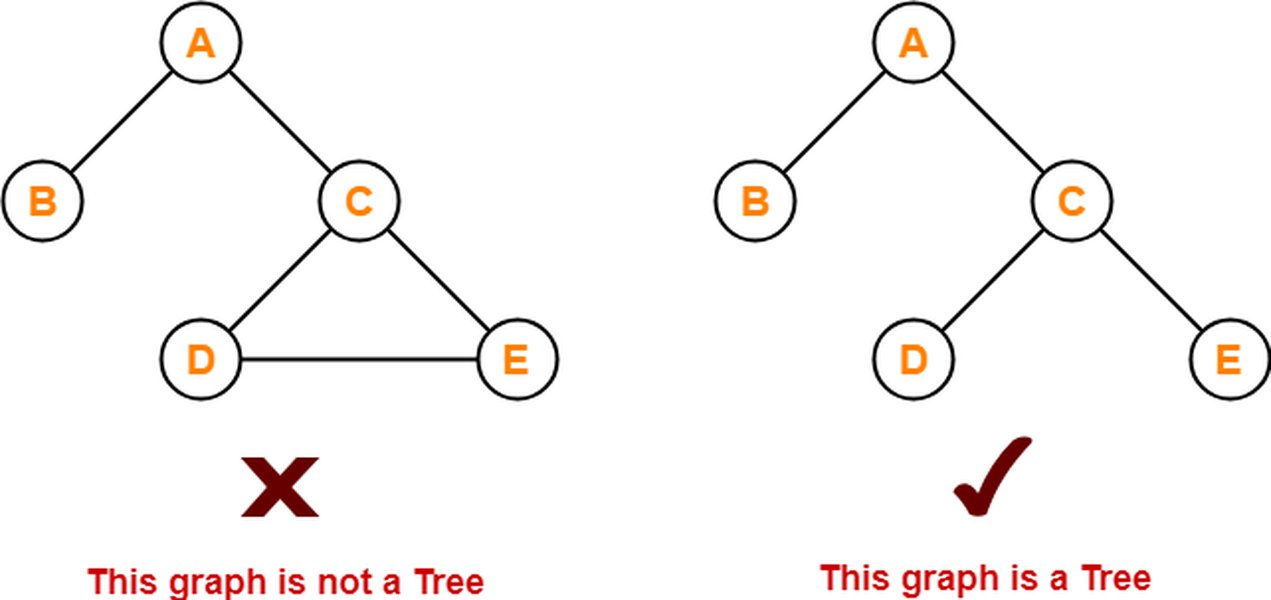
An illustrative example of a tree data structure.
Exploring Diverse Tree Types
Delve into various types of trees, understanding their unique properties and applications:
- Binary Trees: Each node has at most two children (left and right).
- Binary Search Trees (BSTs): A specialized binary tree where for every node, all values in its left subtree are less than the node's value, and all values in its right subtree are greater. This property facilitates efficient searching.
- Full Binary Trees: Every node has either zero or two children.
- Complete Binary Trees: All levels are completely filled, except possibly the last level, which is filled from left to right.
- Self-Balancing Trees (AVL, Red-Black Trees): Advanced BSTs that automatically adjust their structure to maintain balance, ensuring logarithmic time complexity for operations even with frequent insertions and deletions.
- Heaps: A complete binary tree that satisfies the heap property (max-heap or min-heap), commonly used for priority queues.
- Tries (Prefix Trees): Specialized trees used for efficient retrieval of keys in a dataset of strings.
- Segment Trees and Fenwick Trees (BIT): Advanced trees for range queries on arrays.
Mastering Tree Traversal Algorithms
Learn the fundamental ways to visit every node in a tree. For binary trees, these include:
- In-order Traversal: Visits the left subtree, then the root, then the right subtree. For BSTs, this yields sorted data.
- Pre-order Traversal: Visits the root, then the left subtree, then the right subtree. Useful for creating a copy of the tree or expressing prefixes.
- Post-order Traversal: Visits the left subtree, then the right subtree, then the root. Useful for deleting a tree or expressing postfixes.
- Level-order Traversal (BFS): Visits nodes level by level, starting from the root.
Practice implementing both recursive and iterative versions of these traversals.
Implementing Basic Tree Operations
Gain hands-on experience by implementing core operations on trees, particularly BSTs:
- Insertion: Adding a new node while maintaining the tree's properties.
- Deletion: Removing a node and restructuring the tree.
- Search: Finding a specific node efficiently.
- Height/Depth Calculation: Determining the maximum depth of a tree or a specific node.
This table summarizes key characteristics of different tree types:
| Tree Type | Key Characteristics | Common Applications |
|---|---|---|
| Binary Tree | Each node has at most two children. | Expression parsing, Huffman coding. |
| Binary Search Tree (BST) | Ordered structure (left < parent < right); efficient search. | Data storage, dictionary implementation. |
| AVL Tree / Red-Black Tree | Self-balancing BSTs; maintain O(log N) operations. | Database indexing, operating systems. |
| Heap | Complete binary tree satisfying heap property; efficient min/max retrieval. | Priority queues, heap sort, Dijkstra's algorithm. |
| Trie (Prefix Tree) | Nodes represent characters; efficient string search/prefix matching. | Autocomplete, spell checkers, IP routing. |
A great way to visualize these concepts and reinforce your understanding is through interactive videos. Here is a relevant video that introduces tree data structures:
This video provides an introduction to tree data structures, covering fundamental concepts and their importance in algorithms. It serves as an excellent starting point for understanding the hierarchical nature of trees before delving into their various types and operations.
Phase 3: Transitioning to Graph Data Structures
Once you are proficient with trees, the transition to graphs becomes smoother. Graphs are a more generalized non-linear data structure capable of representing complex interconnected relationships, allowing for cycles and multiple paths between nodes.
Understanding Graph Fundamentals
Define a graph as a collection of vertices (nodes) and edges (connections between pairs of vertices). Differentiate between directed graphs (edges have a specific direction) and undirected graphs (edges are bidirectional). Understand weighted graphs (edges have associated values/costs) versus unweighted graphs. Key terminology includes adjacency, path, cycle, and connected components.
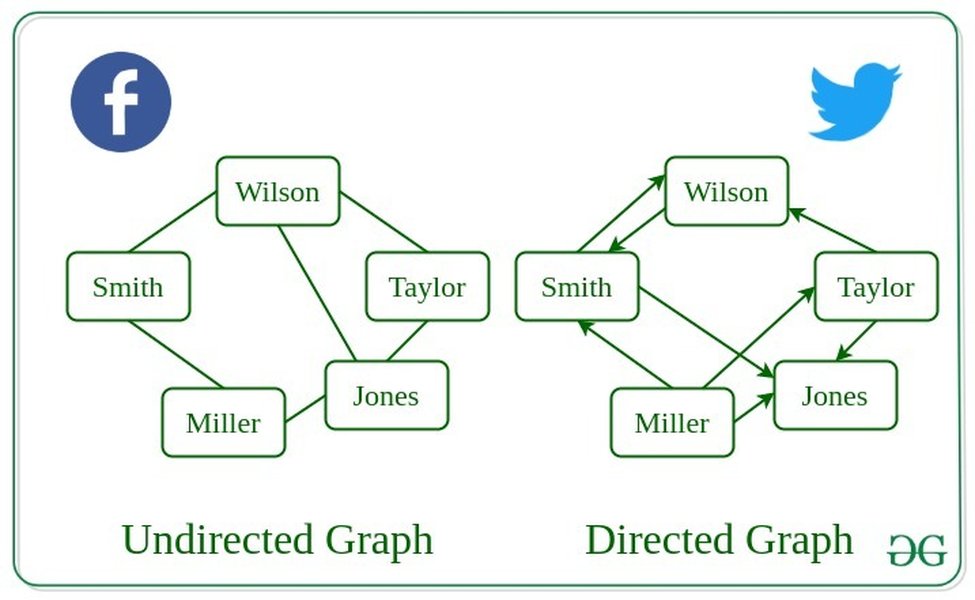
Diverse applications of graph data structures.
Graph Representations
Learn the primary ways to represent graphs in memory, each with its own trade-offs regarding space and time complexity for different operations:
- Adjacency Matrix: A 2D array where
matrix[i][j]indicates an edge between vertexiand vertexj. Suitable for dense graphs. - Adjacency List: An array of lists (or linked lists), where
list[i]contains all vertices adjacent to vertexi. More space-efficient for sparse graphs.
Mastering Graph Traversal Algorithms
The two most fundamental graph traversal algorithms are:
- Breadth-First Search (BFS): Explores a graph level by level, useful for finding the shortest path in an unweighted graph, or finding all reachable nodes from a source.
- Depth-First Search (DFS): Explores as far as possible along each branch before backtracking, useful for cycle detection, topological sorting, and finding connected components.
Implement both recursive and iterative versions of BFS and DFS.
Essential Graph Algorithms
Progress to learning crucial graph algorithms and their applications:
- Shortest Path Algorithms:
- Dijkstra's Algorithm: Finds the shortest path from a single source to all other vertices in a graph with non-negative edge weights.
- Bellman-Ford Algorithm: Finds the shortest paths from a single source to all other vertices, even with negative edge weights (and detects negative cycles).
- Floyd-Warshall Algorithm: Finds all-pairs shortest paths in a weighted graph.
- Minimum Spanning Tree (MST) Algorithms: For finding a subset of edges that connects all vertices in a connected, undirected graph with minimum total edge weight, without cycles.
- Prim's Algorithm
- Kruskal's Algorithm
- Topological Sort: A linear ordering of vertices in a Directed Acyclic Graph (DAG) such that for every directed edge
u -> v, vertexucomes before vertexvin the ordering. - Cycle Detection: Algorithms to determine if a graph contains a cycle.
- Strongly Connected Components (SCCs): Algorithms like Tarjan's or Kosaraju's for finding maximal subgraphs in a directed graph where every vertex is reachable from every other vertex within that subgraph.
Understanding the distinctions between trees and graphs is crucial. This mindmap visually outlines their key differences and relationships.
Phase 4: Hands-On Implementation and Problem-Solving
Theoretical knowledge without practical application is incomplete. This phase focuses on actively implementing data structures and algorithms, and solving a wide array of coding problems.
Coding Implementations from Scratch
Implement tree and graph data structures and their algorithms in your preferred programming language (e.g., Python, C++, Java). This includes building binary trees, BSTs, and graph representations (adjacency list/matrix), followed by implementing traversals (BFS, DFS) and more complex algorithms like Dijkstra's or Kruskal's.
Solving Coding Problems
Actively solve problems on platforms like LeetCode, HackerRank, CodeChef, or InterviewBit. Filter problems specifically tagged for "Trees" and "Graphs." Start with easier problems and gradually increase difficulty. Focus on understanding the problem's underlying structure and how a tree or graph solution can be applied. Pay attention to edge cases and optimize for time and space complexity.
Visualization and Debugging
Utilize visualization tools (online visualizers or even drawing diagrams by hand) to trace the execution of algorithms on sample trees and graphs. This greatly aids in understanding complex processes. Practice debugging your code thoroughly to identify and fix errors, which is a critical skill for mastery.
Phase 5: Continuous Learning and Advanced Topics
DSA is a vast field. After grasping the core concepts, continuously learn, refine, and explore advanced topics to deepen your expertise.
Exploring Advanced Tree and Graph Algorithms
Delve into more specialized algorithms and concepts as needed for specific problem domains or advanced challenges:
- Tree: Splay Trees, Treaps, KD-trees (for spatial data), B-Trees/B+ Trees (for database indexing).
- Graph: Max Flow Min Cut, Bipartite Matching, Eulerian and Hamiltonian Paths/Cycles, Network Flow algorithms.
Understanding Trade-offs and Optimizations
Develop a keen eye for identifying the most efficient data structure and algorithm for a given problem. Understand the trade-offs between different implementations in terms of time and space complexity, and how to optimize solutions for performance.
Regular Practice and Revision
Consistency is key. Regularly review concepts, re-solve challenging problems, and participate in coding contests to apply your knowledge under timed constraints. Join online communities or forums to discuss problems and learn from peers.
The following radar chart illustrates a subjective progression of mastery across various aspects of tree and graph learning, from foundational understanding to advanced application. It visually represents the journey from basic concepts to advanced problem-solving, with higher values indicating a stronger grasp or more advanced engagement.
Frequently Asked Questions (FAQ)
Conclusion
Mastering trees and graphs in DSA is a challenging yet highly rewarding endeavor. By following a structured learning path—starting with foundational DSA concepts, progressively moving through tree fundamentals and types, transitioning to graph representations and algorithms, and consistently engaging in hands-on problem-solving—you can build a robust understanding. The ability to effectively analyze, design, and implement solutions involving these data structures is a hallmark of a proficient programmer and is indispensable for tackling complex real-world problems and excelling in technical interviews.
Recommended Further Exploration
- How to implement self-balancing trees like AVL and Red-Black trees?
- What are advanced graph algorithms for network flow and bipartite matching?
- Best practices for solving tree and graph problems on LeetCode?
- Applications of trees and graphs in machine learning and AI?