
Unraveling Reproductive Asymmetry: The Unique Case of Female Dominance in Lemurs
A Deep Dive into the Social Dynamics and Evolutionary Enigma of Madagascar's Primates
In the vast and diverse world of primates, reproductive asymmetry—the differing reproductive strategies between males and females—is a fundamental aspect of their social structures. Typically, this asymmetry manifests in ways that favor male dominance, often linked to physical superiority or intense male-male competition. However, lemurs, the fascinating primates endemic to Madagascar, present a remarkable exception to this pervasive pattern. Their social dynamics are notably characterized by widespread female dominance, a trait that sets them apart from nearly all other mammalian and primate species. This unique characteristic, where females consistently hold hierarchical power over males, challenges conventional understandings of primate social evolution and reproductive strategies.
Key Insights into Lemur Reproductive Asymmetry
- Female Dominance is Widespread: Unlike most primates where males typically dominate, the majority of lemur species exhibit a social structure where females are dominant over males. This female precedence impacts access to resources, mating opportunities, and overall group dynamics.
- Absence of Sexual Dimorphism: Female lemurs are generally not larger or physically more imposing than males. This lack of significant sexual size dimorphism, coupled with female dominance, is a puzzling aspect that distinguishes lemurs from other female-dominant mammals like spotted hyenas, where females are often physically superior.
- High Reproductive Costs Drive Female Priority: A leading hypothesis suggests that the high energetic costs of reproduction for female lemurs, combined with the seasonal scarcity of food resources in Madagascar's environment, has driven the evolution of female dominance. This enables females to secure priority access to food, which is crucial for successful gestation and lactation.
The Enigma of Female Dominance in Lemurs
A Divergence from Typical Primate Social Structures
Lemurs exhibit a social organization that fundamentally diverges from that of most other primates. In nearly all 108 lemur species, females consistently dominate males. This phenomenon, often referred to as "female social dominance" (FSD), is defined by the females' ability to consistently elicit submissive behavior from males. This is a rare occurrence in the mammalian kingdom, where male dominance or co-dominance is the norm. The unique ecological conditions and evolutionary history of Madagascar are believed to have played a crucial role in shaping these distinctive social structures.
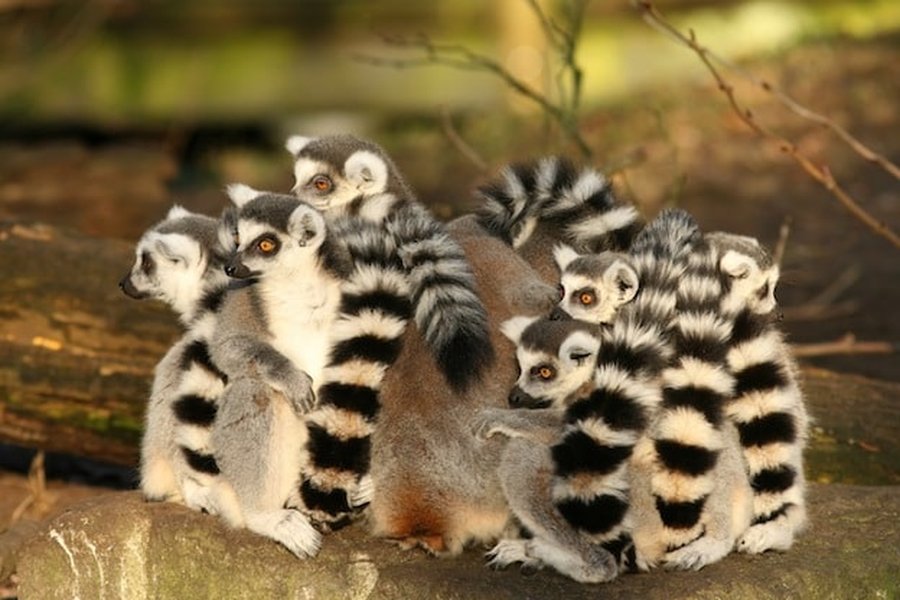
A group of ring-tailed lemurs, illustrating the social cohesion typical of their species.
Defining Female Dominance
Female dominance in lemurs means that females have priority access to vital resources, such as food. They will use aggression to maintain their hierarchical position, often ensuring they do not have to share valuable resources. This dominance is not necessarily based on physical superiority; in fact, female lemurs are often not larger or stronger than their male counterparts. This challenges typical explanations for dominance observed in other species where physical prowess often dictates rank.
Contrast with Other Primates and Mammals
In most other primate societies, males are dominant unless females form powerful coalitions to displace them. For instance, in many mammals, dominant females, such as spotted hyenas, are physically larger and heavier than males. The lemur case is a significant puzzle because female lemurs are not physically larger than males, nor do they possess specialized weaponry like antlers or larger fangs that would give them a physical edge. This lack of sexual size dimorphism, combined with female dominance, makes lemurs a fascinating subject for primatologists.
Hypotheses Explaining Female Dominance
Ecological and Physiological Underpinnings
Decades of research have yielded several hypotheses attempting to explain the unique female dominance in lemurs, though no single consensus has been reached. The prevailing view centers on the concept of "cost asymmetry" in reproduction and the high energy demands placed on female lemurs in their challenging environment.
The Energy Conservation Hypothesis
One prominent theory, the "energy conservation hypothesis," postulates that female lemurs face exceptionally high energetic costs associated with reproduction (pregnancy, lactation, and maternal care), coupled with the seasonal scarcity of food resources in Madagascar. To ensure successful reproduction and offspring survival, females benefit significantly from priority access to food. Males, on the other hand, are selected to defer to females to avoid the high costs of escalated fighting over resources, especially when their nutritional status is better or the cost of conflict outweighs the benefit of the contested resource.
This hypothesis suggests that while males and females may have similar fighting abilities due to sexual monomorphism, their nutritional requirements are asymmetrical. The female's imperative to conserve energy for reproduction makes access to food a higher stake for her, leading to a situation where males are "selected to defer" to avoid costly conflicts.
The Role of Hormones
While some theories initially suggested that higher androgen (male hormone) levels in females might contribute to their dominance, more recent research indicates that female dominance in ring-tailed lemurs is not primarily based on high androgen levels or physical superiority. However, there is ongoing research exploring the complex interplay of hormones, behavior, and seasonal fluctuations in aggression, particularly in species like blue-eyed black lemurs. The female masculinization hypothesis, for instance, proposes that certain hormonal profiles might influence female behavior without necessarily implying higher overall androgen levels compared to males.
The intricate mechanisms behind female dominance are still being thoroughly investigated, encompassing not just physical and hormonal factors but also social learning and behavioral development from infancy.
Social Organization and Behavioral Traits
Beyond Dominance: The Fabric of Lemur Societies
Lemur social structures are complex and diverse, ranging from solitary individuals to bonded pairs and larger, multi-male/multi-female groups. The ring-tailed lemur (Lemur catta), one of the most studied species, typically lives in groups of 3 to 27 individuals, with an average of 13-18. These groups are characterized by a female-dominated hierarchy.
This radar chart illustrates the stark differences in social and reproductive traits between lemurs and other primates. Lemurs score highly on female dominance, reproductive cost asymmetry, and male deference, reflecting their unique evolutionary path.
The chart above visually represents how lemurs score highly on attributes such as Female Dominance, Reproductive Cost Asymmetry, and Male Deference, which are less pronounced in typical primate societies. This highlights the distinctiveness of lemur reproductive strategies and social structures.
Social Learning and Innovation
Interestingly, studies show that socially well-connected lemurs are more likely to acquire new behavioral innovations. Individuals that display useful new behaviors often gain higher status within their groups. This suggests that intelligence and adaptability also play a role in social dynamics, contributing to the complexity of their hierarchies.
Communication and Bonding
Lemurs communicate extensively through scents and vocalizations, more so than visual signals. Grooming is also a crucial social behavior that reinforces bonds within the group. The order of grooming within a family group can even indicate who the leaders are, further emphasizing the close-knit nature of their social structures.
Dr. Christine Drea discusses the fascinating phenomenon of female dominance in lemurs, delving into both the proximate and ultimate factors that contribute to this unique social structure. Her insights provide a comprehensive overview of how female lemurs "rule" their societies and the evolutionary implications of this behavior.
This video features Dr. Christine Drea, a leading primatologist, discussing the profound implications of female dominance in lemurs. Her research sheds light on the mechanisms and evolutionary drivers behind this unusual trait, offering a deeper understanding of lemur social complexities. The video is highly relevant as it directly addresses the scientific inquiry into why female lemurs exhibit such strong social precedence.
Reproductive Strategies and Male Deference
The "Why" Behind Male Submission
The reproductive strategies of lemurs are intrinsically linked to their female-dominated social structure. Female lemurs exert significant control over mating choices, often chasing off males that do not interest them. Dominant females can also influence which other females within their group get to mate.
| Aspect of Reproductive Asymmetry | Typical Primates | Lemurs |
|---|---|---|
| Dominance Hierarchy | Males often dominate; female coalitions may shift power. | Females consistently dominate males. |
| Sexual Size Dimorphism | Males are often larger with specialized weaponry. | Little to no sexual size dimorphism; females not physically superior. |
| Reproductive Costs | Shared or varied, but often less acutely tied to female dominance over resources. | Extremely high for females (pregnancy, lactation); drives need for priority access to food. |
| Male Reproductive Investment | Varies, but males often compete intensely for mating access. | Lower relative to females; males defer to females to avoid conflict. |
| Resource Competition | Can be intense, males often have priority access to mates/food. | Females gain priority access to food, especially during scarcity. |
| Mating Control | Males often compete for and control access to females. | Females actively choose mates and control mating opportunities within the group. |
This table summarizes key differences in reproductive asymmetry, highlighting how lemurs diverge from typical primate patterns. The female-dominated hierarchy and the mechanisms enabling it are core distinguishing features.
Male Deference and Nutritional Status
A key aspect of lemur reproductive asymmetry is male deference. This refers to males submitting to females even in the absence of overt aggression from the female. Research suggests that this deferential behavior in males may be linked to their nutritional status. Well-fed males appear less willing to risk aggression from females to obtain resources compared to nutritionally stressed males. This supports the idea that female dominance in lemurs evolved as a behavioral solution to intersexual feeding competition, especially in environments with unpredictable food availability and high reproductive costs for females.
Reproductive Timing and Development
Lemurs exhibit strong breeding seasonality, likely as an adaptation to the seasonal availability of food. Female ring-tailed lemurs typically become reproductively active around 2.5 years of age, with higher success rates for females aged 3 to 4 years. The intense energy demands of reproduction, particularly during gestation and lactation, further underscore the importance of female priority access to resources.
The "Lemur Syndrome" and Its Implications
A Unique Evolutionary Trajectory
The combination of female dominance, lack of sexual dimorphism, relatively small group sizes, and even adult sex ratios despite polygyny has been collectively termed the "lemur syndrome." This syndrome suggests that male-male competition for mates might be relaxed, leading to lower variance in male reproductive success compared to other polygynous primates where males compete intensely and exhibit significant physical differences.
The unique evolutionary trajectory of lemurs, following a single colonization event of Madagascar more than 50 million years ago, has allowed for the development of social structures and reproductive strategies distinct from their mainland primate relatives. This makes lemurs an invaluable model for understanding convergent evolution and the diverse pathways of social organization within primates.
Frequently Asked Questions (FAQ)
Why is female dominance so rare in mammals?
Do all lemur species exhibit female dominance?
How do female lemurs maintain their dominance without physical superiority?
What are the reproductive costs for female lemurs?
Conclusion
Lemurs truly stand out in the primate world for their unique pattern of reproductive asymmetry, primarily characterized by widespread female dominance. Unlike most other primates and mammals, female lemurs consistently hold hierarchical power over males, despite often lacking physical superiority. This phenomenon is largely explained by the extreme energetic costs of reproduction for females in Madagascar's highly seasonal and often resource-limited environment. Female dominance ensures priority access to crucial food resources, which is vital for successful gestation and lactation. Males, in turn, defer to females to avoid costly conflicts, a behavior influenced by their own nutritional status. This distinctive social structure, coupled with the absence of significant sexual dimorphism, makes lemurs a fascinating case study in evolutionary biology, highlighting the diverse pathways that natural selection can take in shaping social dynamics and reproductive strategies.
Recommended Further Reading
- Explore the evolutionary pressures that led to female dominance in lemurs.
- Delve into how lemur social structures compare to those of other primate species globally.
- Understand the critical role of Madagascar's seasonal food availability in shaping lemur social dynamics.
- Investigate the complex interplay of hormones and social hierarchies in primates, including lemurs.
References
 primatologistinthemakingsite.wordpress.com
Last updated May 21, 2025