
Lenovo ThinkSystem SR780a V3: Unraveling its GPU Capabilities
Does this AI powerhouse support both NVIDIA and AMD OAM GPUs? We investigate the facts.
The statement "The SR780a V3 supports both NVIDIA and AMD OAM GPUs" is False.
The Lenovo ThinkSystem SR780a V3 server is a high-performance machine specifically engineered for demanding Artificial Intelligence (AI) and High-Performance Computing (HPC) workloads. Its design prioritizes cutting-edge technology, particularly in its graphics processing unit (GPU) compatibility. A thorough review of its specifications reveals a clear focus on a particular GPU vendor.
Highlights
- NVIDIA Exclusive: The ThinkSystem SR780a V3 is specifically designed to support high-performance NVIDIA Tensor Core GPUs, including models like the H100, H200, and B200.
- No AMD OAM Support: Official documentation and specifications for the SR780a V3 do not list support for AMD Open Accelerator Module (OAM) GPUs. While other Lenovo servers in different product lines might support AMD GPUs, the SR780a V3 is tailored for NVIDIA's ecosystem.
- Optimized for AI/HPC: The server's architecture, including its advanced liquid cooling system (Lenovo Neptune™) and high-speed interconnects (NVLink, PCIe 5.0), is optimized to maximize the performance of up to eight NVIDIA GPUs.
Decoding GPU Compatibility: SR780a V3's NVIDIA Focus
Understanding the specific GPU support of a server like the SR780a V3 is crucial for organizations planning to deploy it for intensive computational tasks. The server's design choices reflect a strategic alignment with specific GPU architectures to deliver optimal performance.
The Verdict: NVIDIA-Centric Design for the SR780a V3
Contrary to the proposition that the SR780a V3 supports both NVIDIA and AMD OAM GPUs, the available technical documentation from Lenovo consistently indicates that this server model is engineered to harness the power of NVIDIA GPUs. There is no mention of support for AMD OAM GPUs in the specific product guides or datasheets for the SR780a V3. This targeted approach ensures optimized performance, cooling, and interconnectivity for the supported NVIDIA hardware.
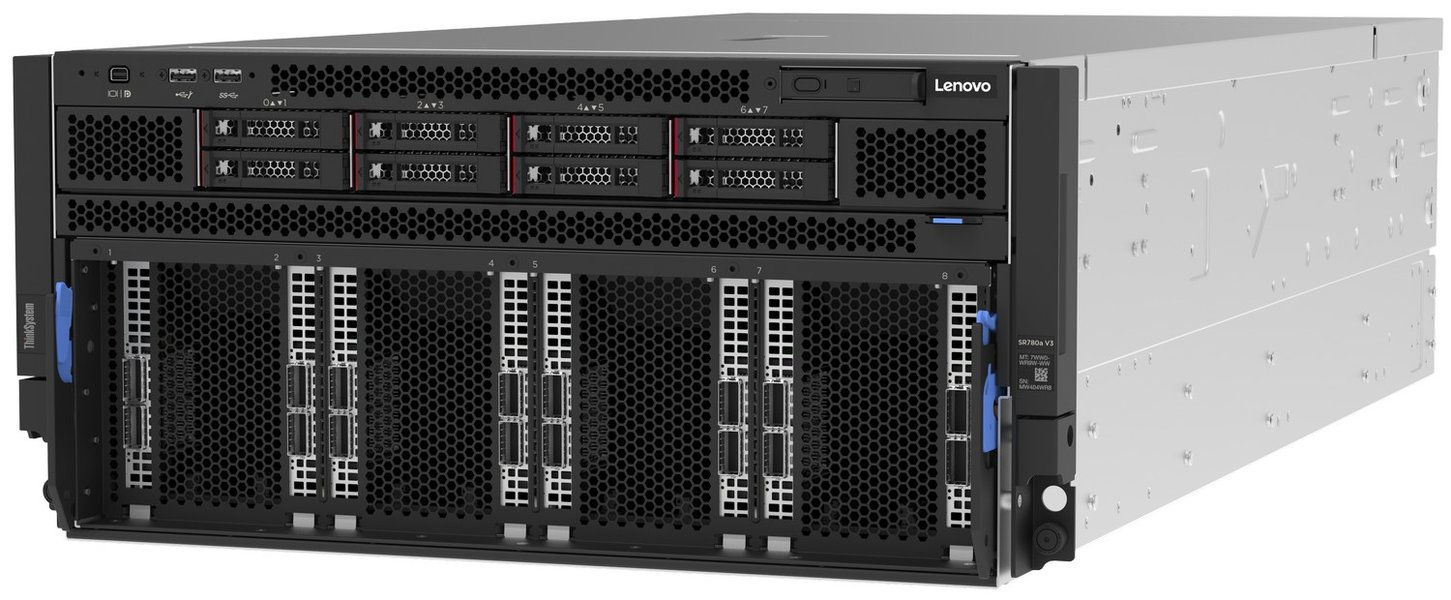
The Lenovo ThinkSystem SR780a V3, engineered for high-end AI and HPC workloads with a focus on NVIDIA GPU integration.
Supported NVIDIA GPU Models
The SR780a V3 is built to accommodate up to eight high-performance NVIDIA GPUs, leveraging their capabilities for parallel processing. Specific models supported include:
- NVIDIA H100 Tensor Core GPUs (SXM5 form factor)
- NVIDIA H200 Tensor Core GPUs (SXM5 form factor)
- NVIDIA B200 Tensor Core GPUs (planned support, SXM form factor)
These GPUs are interconnected using NVIDIA NVLink technology, which provides high-bandwidth, direct GPU-to-GPU communication, crucial for scaling performance in large AI models and complex simulations.
Why Not AMD OAM GPUs for the SR780a V3?
The exclusion of AMD OAM GPU support in the SR780a V3 is likely a strategic design choice by Lenovo. Optimizing a server platform for multiple distinct high-power GPU architectures (like NVIDIA's SXM and AMD's OAM) can introduce complexities in terms of motherboard design, power delivery, cooling solutions, and firmware/software validation. By focusing on the NVIDIA HGX platform for the SR780a V3, Lenovo can provide a highly tuned and reliable solution for workloads that benefit most from NVIDIA's architecture and software ecosystem (e.g., CUDA-accelerated applications).
Architectural Deep Dive: Engineered for Peak Performance
The SR780a V3's commitment to high performance extends beyond its GPU support, encompassing its processing capabilities, innovative cooling, and robust memory and storage options.
Processing Powerhouse: Intel Xeon Scalable Processors
At the heart of the SR780a V3 are two 5th Generation Intel Xeon Scalable processors. These CPUs provide substantial general-purpose compute power to complement the specialized acceleration offered by the GPUs. Key features include:
- Up to 56 cores per processor.
- High Thermal Design Power (TDP) support, indicating robust performance capabilities.
- Support for a large memory footprint and fast memory speeds.
Cooling Prowess: Lenovo Neptune™ Liquid Cooling
One of the standout features of the SR780a V3 is its Lenovo Neptune™ liquid cooling technology. This advanced cooling system is critical for managing the significant heat generated by both the CPUs and the eight high-power NVIDIA GPUs. Effective cooling ensures that components can operate at their peak performance levels for extended periods without thermal throttling. The liquid cooling solution in the SR780a V3 typically covers CPUs, GPUs, and sometimes NVLink switches, maintaining optimal operating temperatures even under full load.
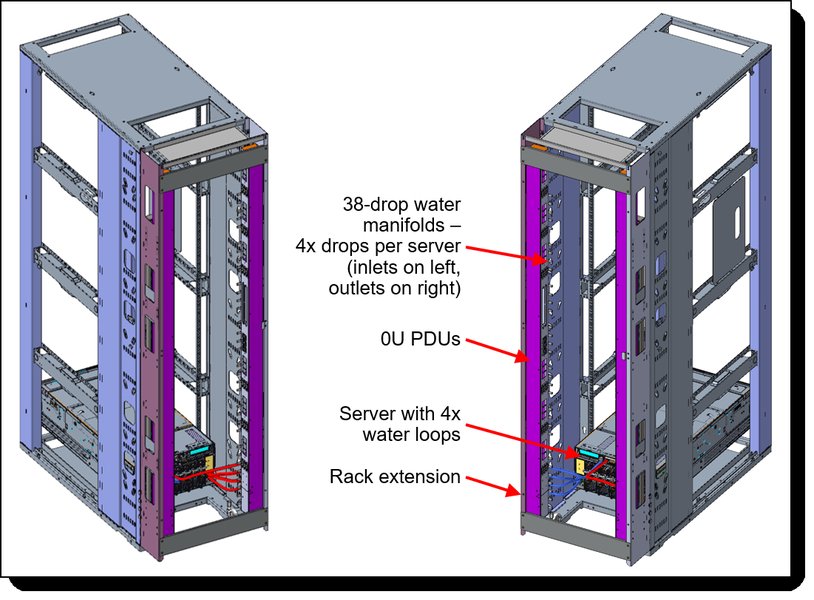
Lenovo Neptune™ liquid cooling infrastructure within the SR780a V3, vital for sustained GPU performance.
Memory and Storage Capabilities
To support data-intensive AI and HPC applications, the SR780a V3 offers substantial memory and storage capacity:
- Memory: 32 DDR5 DIMM slots, supporting up to 4TB of RAM at speeds up to 5600MHz. This large and fast memory subsystem is essential for handling large datasets and complex models.
- Storage: Support for up to 8 hot-swap PCIe 5.0 NVMe drives at the front. NVMe drives offer extremely high-speed storage, reducing I/O bottlenecks for data loading and checkpointing.
High-Speed Connectivity
The SR780a V3 emphasizes high-speed data pathways:
- NVIDIA NVLink: Provides up to 900 GB/s of GPU-to-GPU communication bandwidth, enabling efficient scaling across multiple GPUs.
- PCIe 5.0: Offers high-speed connectivity between CPUs, GPUs, and networking adapters. The server includes front-accessible PCIe 5.0 FHHL slots for high-speed networking cards (e.g., InfiniBand or Ethernet up to 400 Gb/s).
Lenovo's Broader GPU Ecosystem: Where AMD Fits In
While the SR780a V3 is focused on NVIDIA GPUs, Lenovo does offer other server models within its ThinkSystem portfolio that cater to users seeking AMD GPU acceleration.
Alternative Models for AMD GPU Support
For customers requiring AMD Instinct™ MI-series OAM GPUs (such as the MI300X), Lenovo provides alternative server platforms. Models like the Lenovo ThinkSystem SR680a V3 and SR685a V3 are designed to support these AMD accelerators. This demonstrates Lenovo's commitment to providing a diverse range of GPU-accelerated solutions, allowing customers to choose the platform that best aligns with their specific workload requirements, software ecosystem preferences, and performance needs. It is important to consult the specific documentation for each server model to confirm its GPU compatibility.
SR780a V3 Feature Comparison Radar Chart
The following radar chart provides a visual comparison of the Lenovo ThinkSystem SR780a V3 against a generic "Current-Gen AI Server" and an "Older-Gen HPC Server" across several key performance and feature dimensions. This helps illustrate the SR780a V3's strengths, particularly its NVIDIA GPU support and advanced cooling, while also highlighting its focused GPU compatibility.
As illustrated, the SR780a V3 excels in NVIDIA GPU support, cooling efficiency, and multi-GPU scalability, reflecting its specialized design. Its AMD OAM GPU support score is low, aligning with its NVIDIA-exclusive architecture.
Visualizing the SR780a V3 Ecosystem: A Mindmap
This mindmap provides a hierarchical overview of the Lenovo ThinkSystem SR780a V3's key components, its technological focus, and its primary applications. It helps to visualize how different elements, such as its exclusive NVIDIA GPU support and advanced cooling, contribute to its role as a leading AI and HPC server.
2x 5th Gen Intel Xeon Scalable"] id1_2["GPU Support
Up to 8x NVIDIA GPUs
(H100, H200, B200)"] id1_2_1["NVIDIA Exclusive Design"] id1_2_2["NO AMD OAM GPU Support"] id1_3["Cooling
Lenovo Neptune™ Liquid Cooling"] id1_3_1["CPUs, GPUs, NVLink Switches"] id1_4["Memory
Up to 4TB DDR5 (5600MHz)"] id1_5["Storage
Up to 8x PCIe 5.0 NVMe"] id1_6["Connectivity"] id1_6_1["NVIDIA NVLink (900 GB/s)"] id1_6_2["PCIe 5.0 Slots"] id1_6_3["High-Speed Networking (up to 400Gb/s)"] id2["Target Workloads"] id2_1["Artificial Intelligence (AI)"] id2_1_1["Large Language Model (LLM) Training"] id2_1_2["Generative AI"] id2_1_3["Deep Learning / Machine Learning"] id2_2["High-Performance Computing (HPC)"] id2_2_1["Scientific Simulations"] id2_2_2["Complex Data Analysis"] id3["Form Factor"] id3_1["5U Rack Server"] id4["Operating Systems"] id4_1["RHEL, Ubuntu, Alma Linux, Rocky Linux, ESXi"]
The mindmap highlights the SR780a V3's core architecture, centered around Intel Xeon CPUs and NVIDIA GPUs, supported by robust cooling, memory, and storage, all tailored for demanding AI and HPC tasks.
Key Specifications at a Glance
Here's a summary of the Lenovo ThinkSystem SR780a V3's key specifications, providing a quick overview of its capabilities:
| Component | Specification |
|---|---|
| Form Factor | 5U Rack Server |
| Processors | 2x 5th Gen Intel Xeon Scalable processors (up to 56 cores per CPU) |
| GPU Support | Up to 8x NVIDIA H100, H200, or B200 Tensor Core GPUs (SXM5) |
| GPU Interconnect | NVIDIA NVLink (up to 900 GB/s) |
| Memory | Up to 4TB DDR5 RAM across 32 DIMM slots (up to 5600MHz) |
| Cooling | Lenovo Neptune™ direct-to-chip (D2C) liquid cooling for CPUs, GPUs, and NVLink Switches |
| Storage | Up to 8x front-accessible hot-swap PCIe 5.0 NVMe drives |
| Expansion Slots | Multiple PCIe 5.0 slots for high-speed networking (e.g., InfiniBand, Ethernet up to 400Gbps) |
| Networking | Support for high-speed network adapters, including GPU Direct RDMA |
| Power Supply | Redundant, hot-swap power supplies |
| Supported OS | RHEL, Ubuntu, Alma Linux, Rocky Linux, VMware ESXi |
| Dimensions (approx.) | Height: 219 mm (8.6 in), Width: 447 mm (17.6 in), Depth: 942 mm (37.1 in) |
| Max Weight (approx.) | 90 kg (198 lbs) |
Frequently Asked Questions (FAQ)
Why does the SR780a V3 only support NVIDIA GPUs and not AMD OAM GPUs?
The Lenovo ThinkSystem SR780a V3 is specifically engineered and optimized for the NVIDIA HGX platform, which includes NVIDIA H100, H200, and B200 GPUs using the SXM form factor and NVLink interconnect. This focused design allows Lenovo to maximize performance, reliability, and efficiency for workloads best suited to NVIDIA's architecture and CUDA software ecosystem. Supporting multiple distinct high-power GPU architectures like NVIDIA SXM and AMD OAM in a single, highly optimized platform presents significant design and validation challenges related to motherboard layout, power delivery, cooling, and firmware. Lenovo offers other server models, such as the SR680a V3 and SR685a V3, that are designed to support AMD Instinct OAM GPUs, providing customers with a choice based on their specific needs.
What is special about the Lenovo Neptune™ liquid cooling in the SR780a V3?
Lenovo Neptune™ liquid cooling is an advanced thermal management solution that uses direct-to-chip (D2C) liquid cooling. In the SR780a V3, it is applied to critical heat-generating components like the CPUs, the eight NVIDIA GPUs, and often the NVLink switches. This is crucial because these components, especially high-end GPUs, can generate hundreds of watts of heat each. Liquid cooling is significantly more efficient than traditional air cooling in dissipating such high thermal loads. This allows the components to operate at their maximum sustained performance levels without thermal throttling, which is vital for long-running AI training jobs and intensive HPC simulations. It can also contribute to better energy efficiency and potentially quieter operation compared to purely air-cooled systems of similar power.
What are the primary use cases for the ThinkSystem SR780a V3?
The ThinkSystem SR780a V3 is designed for the most demanding computational tasks. Its primary use cases include:
- Artificial Intelligence (AI): Training large language models (LLMs), deep learning, machine learning model development, generative AI applications, and complex AI inference.
- High-Performance Computing (HPC): Scientific research, complex simulations (e.g., in physics, engineering, meteorology), financial modeling, and data analytics requiring massive parallel processing power.
Essentially, any application that can leverage the immense parallel processing capabilities of up to eight high-end NVIDIA GPUs, combined with powerful CPUs and high-speed memory and networking, is a good fit for the SR780a V3.
How does the SR780a V3 handle networking for distributed AI training?
The SR780a V3 supports high-speed networking crucial for distributed AI training, where multiple servers work together. It offers several PCIe 5.0 expansion slots that can be populated with high-performance network interface cards (NICs), such as NVIDIA ConnectX (InfiniBand or Ethernet) adapters, supporting speeds up to 400 Gb/s. These adapters often feature GPU Direct RDMA (Remote Direct Memory Access) technology, which allows GPUs in different servers to exchange data directly over the network, bypassing the CPU and system memory. This significantly reduces latency and improves bandwidth for inter-node communication, which is critical for scaling out AI training workloads across multiple SR780a V3 systems.
Recommended Further Exploration
- What are the specific advantages of the NVIDIA HGX H100 platform in AI servers?
- How does Lenovo Neptune liquid cooling compare to other server cooling technologies for data centers?
- Which Lenovo ThinkSystem servers are designed to support AMD Instinct MI300X GPUs?
- Explore the role of NVLink and PCIe 5.0 in maximizing GPU performance for HPC workloads.
References
Last updated May 12, 2025