

Key Insights into Linguistic Phenomena
- Prototype Theory posits that categories are organized around a "best example," rather than rigid definitions, influencing how we perceive and use words.
- Homophones, Homographs, and Homonyms describe words with identical sounds, spellings, or both, but distinct meanings, often leading to confusion and enriching linguistic play.
- Polysemy and Metonymy are mechanisms through which words acquire multiple related meanings, with polysemy extending a word's sense and metonymy involving a conceptual association.
- Collocations refer to words that frequently occur together, forming natural-sounding phrases crucial for fluency and natural language use.
The English language, with its vast vocabulary and nuanced expressions, is a fascinating landscape for linguistic study. Understanding how words relate to each other, how they acquire and express meaning, and how they are used in typical patterns is fundamental to mastering the language. This exploration delves into several key concepts: prototype theory, homophones, homonyms, polysemy, metonymy, and collocations, each offering a unique lens through which to appreciate the complexity and richness of English.
Understanding Prototypes: The Core of Categorization
Prototype theory, primarily developed by cognitive psychologist Eleanor Rosch, offers a revolutionary perspective on how we categorize information and, consequently, how we understand word meanings. Unlike traditional views that suggest categories have strict, binary boundaries (an item either belongs or it doesn't), prototype theory proposes that categories are structured around a central, "best" example—the prototype. Other members of the category are then recognized based on their resemblance to this prototype, with varying degrees of membership.
The Essence of Prototype Theory
At its heart, prototype theory suggests that our mental concepts are not defined by a rigid checklist of necessary and sufficient conditions, but rather by typical instances. For example, when asked to think of "bird," most people would likely picture a robin or a sparrow—a small, feathered, flying creature. A chicken, while technically a bird, is often considered less "bird-like" because it deviates from this prototypical image (e.g., it doesn't fly like a robin).
This graded membership means that some category members are more central or typical than others. This approach helps explain the fuzziness of category boundaries and the fluidity of linguistic meaning. It acknowledges that language reflects our cognitive processes, which often involve approximation and similarity rather than absolute definitions.
Prototype theory has had significant repercussions in two main areas of linguistics: lexical semantics (the study of word meanings) and syntax. It has been applied to understand semantic change and the structure of polysemy networks, demonstrating how meanings can branch out from a core concept.
Figure 1: A Mindmap illustrating the interconnectedness of various linguistic phenomena, from prototype theory to collocations.
Homophones, Homographs, and Homonyms: The Play of Words
These three terms often cause confusion, but they describe distinct ways in which words can share similar forms while having different meanings. Understanding their nuances is key to appreciating the intricacies of the English lexicon.
Homophones: Sounding Alike
Homophones are words that sound the same but have different meanings and often different spellings. The prefix "homo-" means "same," and "-phone" means "sound."
- Examples:
- "See" (to perceive with eyes) and "sea" (a large body of saltwater).
- "To" (preposition), "too" (also, excessively), and "two" (the number).
- "Write" and "right".
Homophones are a common source of spelling errors for English learners and even native speakers, highlighting the often-inconsistent relationship between English orthography and pronunciation.
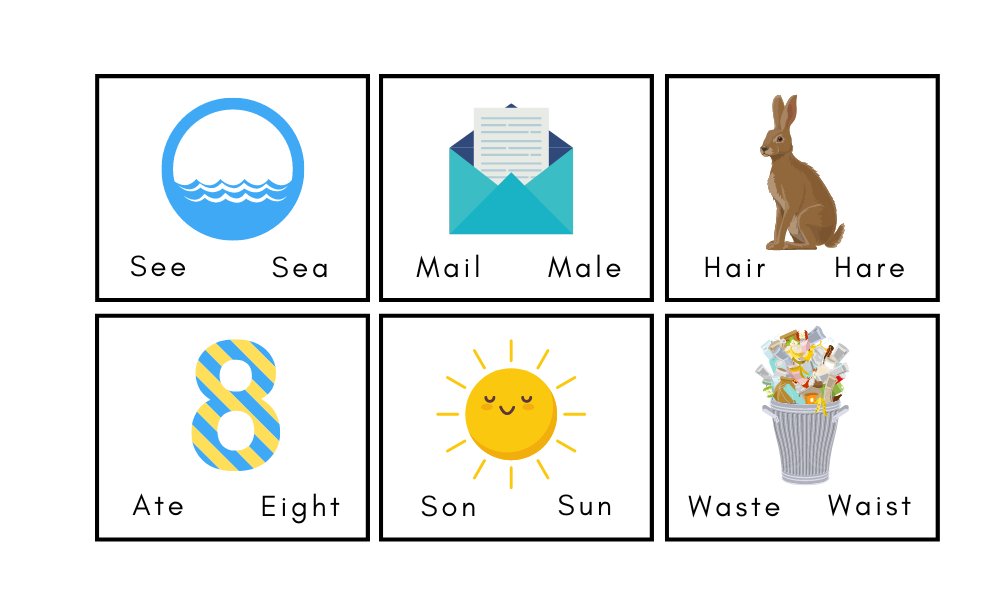
Figure 2: Visual examples of homophones illustrating words that sound the same but have different spellings and meanings.
Homographs: Spelled the Same
Homographs are words that are spelled the same but have different meanings and may or may not be pronounced differently. The suffix "-graph" refers to writing.
- Examples where pronunciation differs:
- "Bass" (a type of fish, pronounced /bæs/) and "bass" (a low musical tone or instrument, pronounced /beɪs/).
- "Read" (present tense, /riːd/) and "read" (past tense, /rɛd/).
- Examples where pronunciation is the same:
- "Fair" (equitable) and "fair" (a carnival).
- "Tire" (a rubber wheel) and "tire" (to become exhausted).
Homographs can be particularly tricky as their meaning often depends entirely on context, and sometimes even their pronunciation changes.
Homonyms: The Overlap
In its strictest sense, a homonym is a word that is both a homophone and a homograph—meaning it has the same spelling and the same pronunciation but different meanings. The suffix "-nym" refers to "name." However, "homonym" is often used more broadly as an umbrella term for words that sound alike or are spelled alike but have different meanings, encompassing both homophones and homographs.
- Strict Examples:
- "Bank" (the edge of a river) and "bank" (a financial institution).
- "Bat" (a nocturnal flying mammal) and "bat" (a piece of sports equipment).
The distinction between these terms is important for clear communication and precise linguistic analysis.
Polysemy and Metonymy: Expanding Word Meanings
Polysemy and metonymy are two crucial mechanisms through which words acquire and extend their meanings, contributing to the richness and flexibility of language.
Polysemy: Multiple Related Meanings
Polysemy occurs when a single word has multiple meanings that are related conceptually. These meanings often stem from a shared core concept and extend through metaphor or other forms of semantic extension. It's a fundamental principle of English lexis, where a lexeme can have a full range of senses that interact.
- Examples:
- The word "head" can refer to the anatomical part, the leader of an organization, the top of something, or the foam on a beer. All these meanings are conceptually linked to the idea of a primary, top, or leading part.
- "Foot" can refer to a body part, the base of a mountain, or the unit of measurement.
Polysemy allows for semantic economy, as a relatively small number of words can convey a wide array of concepts through context-dependent interpretation.
Metonymy: Meaning by Association
Metonymy is a figure of speech in which a word or phrase is substituted for another with which it is closely associated. Unlike polysemy, where meanings are extensions of a single core concept, metonymy involves replacing a word with a contiguous or related concept.
- Examples:
- "The White House announced..." where "White House" stands for the US administration.
- "The pen is mightier than the sword," where "pen" represents writing and "sword" represents military force.
- "Hollywood" referring to the American film industry.
Metonymy often leads to polysemy over time. For instance, the word "chicken" originally referred to the animal, but through metonymy (referring to the meat by the animal it comes from), it also came to mean the meat itself, thus becoming polysemous.
Both polysemy and metonymy are vital in interpreting complex specialized terms, especially in academic and popular science literature, as they allow for the succinct representation of elaborate ideas.
Collocations: The Natural Pairings of Language
Collocations are pairs or groups of words that frequently occur together. They sound "right" to native speakers, whereas other combinations, though grammatically correct, may sound unnatural or awkward. Mastering collocations is crucial for achieving fluency and sounding like a native speaker.
What Makes a Collocation?
Collocations are not just any two words that appear next to each other; they are conventional pairings that have become established through common usage. They can be strong (fixed, where only one word collocates, like "take a photo") or weaker (more flexible, like "strong coffee" or "rich history").
- Types of Collocations:
- Adjective + Noun: strong tea, heavy rain, rich history.
- Noun + Noun: a surge of anger, a pang of nostalgia, piece of advice.
- Verb + Noun: make a decision, do homework, take a photo.
- Adverb + Adjective: utterly appalled, widely believed.
- Verb + Adverb: talk loudly.
The Importance of Learning Collocations
For language learners, memorizing individual words is not enough. Understanding collocations allows speakers to use language more naturally and accurately. Instead of saying "do a photo" (which is grammatically incorrect), a fluent speaker knows to say "take a photo." This knowledge enhances both comprehension and production, making communication more effective and less effortful.
The following table summarizes the key distinctions and relationships between these linguistic concepts:
| Concept | Primary Characteristic | Relationship to Other Concepts | Example |
|---|---|---|---|
| Prototype Theory | Categories based on "best example" (prototype) with graded membership. | Influences how polysemy networks form; challenges classical categorization. | A robin is a prototypical "bird"; a chicken is less so. |
| Homophone | Same sound, different spelling and/or meaning. | Can be a component of a homonym. | "To," "too," "two" |
| Homograph | Same spelling, different sound and/or meaning. | Can be a component of a homonym. | "Bass" (fish) vs. "bass" (instrument) |
| Homonym | Same sound and spelling, different meaning. (Broadly, any word with same form, different meaning). | Encompasses both homophones and homographs in its broader definition. | "Bank" (river) vs. "bank" (financial) |
| Polysemy | One word, multiple related meanings derived from a core sense. | Often develops from metonymy or metaphor. | "Head" (body part, leader, top of a pin). |
| Metonymy | Substitution of a word with a closely associated concept. | Can be a source of polysemy; creates new conceptual mappings. | "The crown" for royalty. |
| Collocation | Words that frequently go together, sounding natural. | Essential for idiomatic language; influenced by cultural and historical usage. | "Make a decision," "strong coffee." |
Table 1: Summary of Linguistic Concepts, their Characteristics, and Interrelationships.
To further illustrate the concept of collocations, here's a video that provides numerous examples to help build your vocabulary and improve your fluency.
Figure 5: A YouTube video offering 43 essential English collocations, crucial for enhancing natural language use and vocabulary development.
This video is highly relevant as it directly addresses collocations, one of the key concepts discussed. It provides practical examples that learners can use to improve their fluency and make their English sound more natural. Understanding these common word pairings is an integral part of mastering the idiomatic nuances of the language, going beyond mere grammatical correctness to achieve authentic expression. The visual and auditory format of the video reinforces the written explanations, making the learning experience more comprehensive and engaging.
Navigating the Semantic Landscape: Conclusion
The journey through prototypes, homophones, homonyms, polysemy, metonymy, and collocations reveals the dynamic and intricate nature of language. Prototype theory challenges rigid categorization, demonstrating how our minds organize concepts around typical examples. Homophones, homographs, and homonyms highlight the playful yet complex relationship between sound, spelling, and meaning. Polysemy and metonymy illustrate how words semantically expand, allowing for economy and richness in expression by leveraging related concepts. Finally, collocations underscore the importance of conventional word pairings for natural and fluent communication. Together, these linguistic phenomena provide a deeper appreciation for the subtle yet powerful ways in which we use and understand language.
Frequently Asked Questions (FAQ)
What is the main difference between polysemy and homonymy?
How does prototype theory impact our understanding of language learning?
Why are collocations important for English learners?
Can metonymy lead to polysemy?
Recommended Further Exploration
- How does cognitive linguistics explain human categorization?
- What are the most effective strategies for learning advanced English collocations?
- How do words change their meanings over time through semantic processes?
- What mechanisms does language use to resolve ambiguity in word meanings?