
Decoding BIM Documentation: What Separates Level of Development (LOD) from Level of Information (LOI)?
Unraveling the crucial distinctions between geometric detail and data richness in your Building Information Models.
Highlights: Key Takeaways
- Focus Distinction: Level of Development (LOD) primarily defines the geometric detail and reliability of a BIM element's visual representation, while Level of Information (LOI) specifies the completeness and accuracy of non-graphical data associated with that element.
- Scope Difference: LOD provides a holistic measure of an element's maturity, encompassing both its visual (geometric) and informational aspects, often using a scale like LOD 100-500. LOI focuses specifically on the metadata and attributes (e.g., specifications, cost, manufacturer).
- Complementary Roles: LOD and LOI work together to define the overall usefulness of a BIM model. High LOD ensures visual accuracy for coordination and construction, while high LOI provides the necessary data for procurement, analysis, and facility management. Often, LOD is considered to encompass both Level of Geometry (LOG) and LOI.
Introduction to LOD and LOI in BIM
Building Information Modeling (BIM) has revolutionized the Architecture, Engineering, and Construction (AEC) industry by enabling the creation of intelligent, data-rich digital representations of buildings and infrastructure. Central to effective BIM implementation is clear communication about the content and reliability of these models. Two fundamental concepts that facilitate this clarity are the Level of Development (LOD) and the Level of Information (LOI). While related and often used together, they address distinct aspects of BIM documentation, ensuring models are fit for purpose throughout the project lifecycle.
Deep Dive into Level of Development (LOD)
Defining the Geometric Maturity
Level of Development (LOD) primarily refers to the degree of completeness, detail, and reliability of the graphical or geometric representation of a building element within the BIM model. It acts as a "maturity meter," indicating how thoroughly the element's geometry (its shape, size, location, quantity, and orientation) has been defined and how reliable that geometric information is for various uses.
LOD is crucial for understanding the visual and spatial accuracy of model components at different project stages. It helps stakeholders gauge whether the model's geometry is suitable for tasks like conceptual analysis, design coordination, clash detection, or fabrication.
The Standard LOD Framework
A widely adopted framework, often based on specifications from the American Institute of Architects (AIA) and the BIM Forum, defines LOD on a progressive scale, typically from 100 to 500:
- LOD 100 (Conceptual): Elements are represented with generic symbols or masses. Their existence is conceptual, and geometric information like size or precise location is not defined. Useful for initial space planning and massing studies.
- LOD 200 (Approximate Geometry): Elements are modeled as generic objects with approximate quantities, size, shape, location, and orientation. Non-geometric information may also be attached. Suitable for schematic design and preliminary cost estimation.
- LOD 300 (Precise Geometry): Elements are modeled with specific assemblies, accurate quantities, size, shape, location, and orientation. This level is suitable for detailed design development, coordination, and construction documentation.
- LOD 350 (Coordination & Detailing): Includes details necessary for coordination between disciplines, such as connections and interfaces with other building systems. It builds upon LOD 300 to resolve potential clashes.
- LOD 400 (Fabrication & Assembly): Elements are modeled with fabrication-level detail, including specific assembly information, tolerances, and installation requirements. This level provides sufficient detail for manufacturing or prefabrication.
- LOD 500 (As-Built & Operations): Elements are modeled as constructed, representing the verified as-built condition. This level includes information relevant to facility management and operations, such as maintenance schedules and performance data.
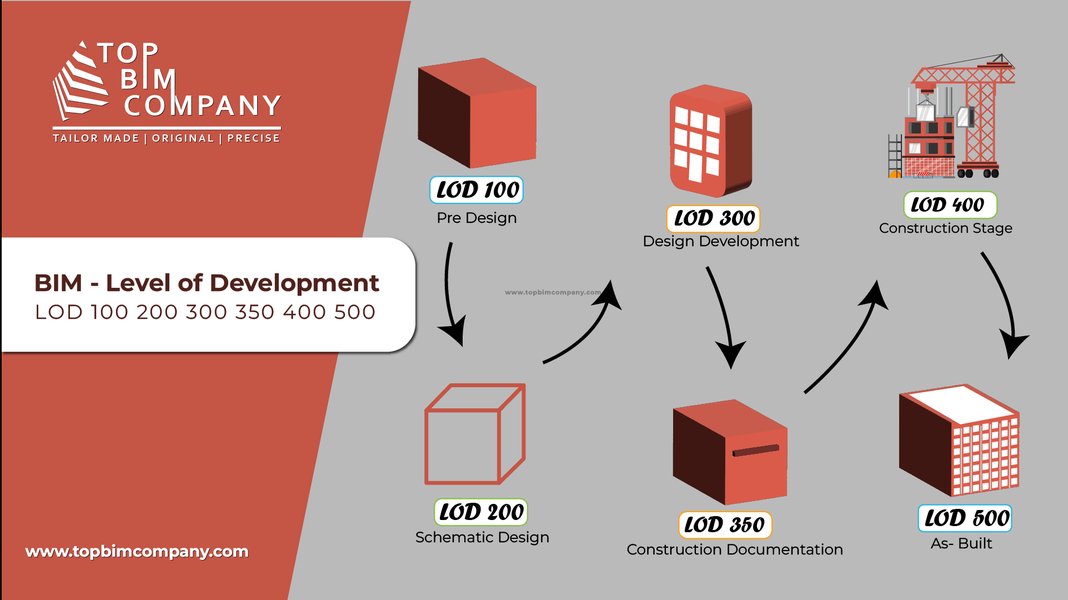
Visual representation of increasing geometric detail across LOD levels.
Purpose and Application of LOD
The primary purpose of LOD is to standardize communication about the model's geometric reliability. By specifying the required LOD at different project milestones in a BIM Execution Plan (BEP), teams can:
- Manage expectations regarding model accuracy.
- Ensure the model is suitable for intended downstream uses (e.g., clash detection requires at least LOD 300/350).
- Reduce ambiguity and potential errors arising from misinterpreting model detail.
- Define the scope of modeling effort required at each stage.
Understanding Level of Information (LOI)
Focusing on Non-Graphical Data Richness
Level of Information (LOI), in contrast to LOD, specifically addresses the quality, quantity, and reliability of non-graphical data associated with a BIM element. While LOD deals with "what it looks like" and "where it is," LOI deals with "what it is" and "what it does." It concerns the metadata, properties, and attributes embedded within or linked to the model elements.
LOI ensures that the BIM model is not just a collection of geometries but a rich database supporting analysis, decision-making, and management throughout the building's lifecycle.
Examples of LOI Data
The non-graphical information encompassed by LOI can be extensive and varies depending on the element and project requirements. Examples include:
- Identification: Type marks, asset tags, classification codes (e.g., OmniClass, Uniclass).
- Technical Specifications: Material properties, performance characteristics (e.g., U-value, fire rating), dimensions, weight.
- Procurement Data: Manufacturer name, model number, supplier details, cost, lead times.
- Operational Data: Installation date, warranty information, maintenance schedules, spare parts lists, operational manuals.
- Sustainability Data: Embodied carbon, recycled content, energy efficiency ratings.
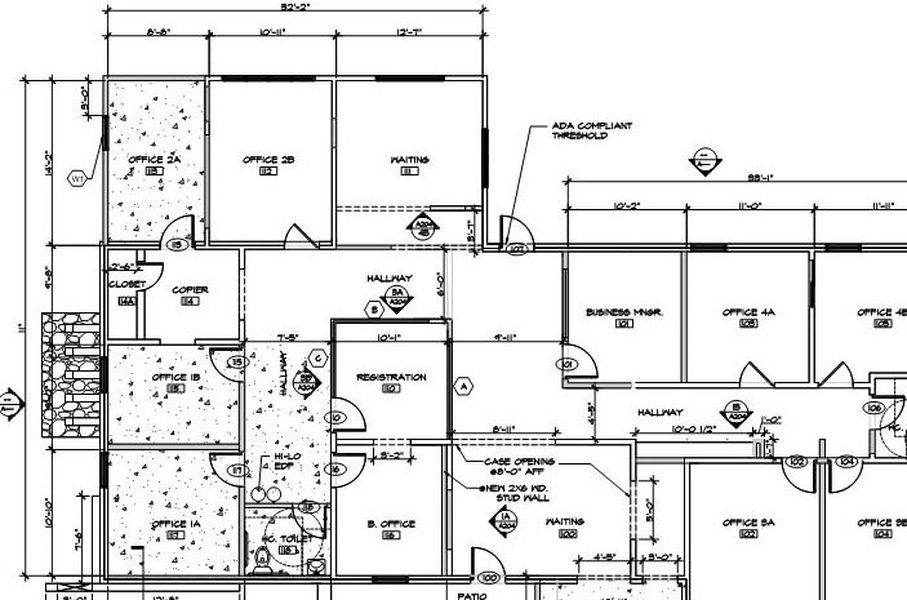
Construction documents integrate graphical representations with detailed specifications and notes, reflecting the need for both geometry (LOD) and information (LOI).
Purpose and Application of LOI
High-quality LOI is essential for leveraging the full potential of BIM beyond visualization and coordination. Its key purposes include:
- Supporting accurate quantity take-offs and cost estimation.
- Enabling performance analyses (e.g., structural, energy, lighting).
- Facilitating procurement and scheduling processes.
- Providing essential data for facility management (FM) and asset tracking.
- Ensuring compliance with project requirements and regulations.
- Streamlining handover processes from construction to operations.
Comparing LOD and LOI: Key Distinctions
Graphical vs. Non-Graphical Emphasis
The fundamental difference lies in their primary focus. LOD is primarily concerned with the geometric aspect—the visual representation's detail and accuracy. LOI is exclusively focused on the non-graphical information content—the data richness and reliability attached to those geometric elements.
Scope and Interrelation
While distinct, LOD and LOI are often intertwined. Some interpretations view LOD as a broader concept that includes both geometric detail and informational content. A common framework suggests:
LOD = LOG (Level of Geometry) + LOI (Level of Information)
In this view, LOG specifically addresses the geometry, while LOI addresses the associated data. Together, they constitute the overall Level of Development. However, it's important to recognize that they can develop independently. An element might have detailed geometry (high LOG/LOD) but sparse information (low LOI), or vice versa, depending on project needs.
Summary Table of Differences
This table summarizes the core distinctions between LOD and LOI:
| Aspect | LOD (Level of Development) | LOI (Level of Information) |
|---|---|---|
| Primary Focus | Graphical representation (geometric detail, accuracy, reliability) | Non-graphical data (informational content, attributes, metadata) |
| What it Describes | The maturity and reliability of an element's visual and spatial definition | The completeness, quality, and reliability of the data attached to an element |
| Scope | Often considered holistic, encompassing both geometry (LOG) and information (LOI) according to a defined scale (e.g., 100-500) | Specifically targets the non-visual, informational aspect |
| Key Question Answered | How detailed and reliable is the element's geometric representation? | How complete and reliable is the information associated with the element? |
| Primary Use Cases | Design visualization, coordination, clash detection, spatial analysis, fabrication detailing | Quantity take-off, cost estimation, procurement, scheduling, performance analysis, facility management |
Visualizing the Relationship: LOD & LOI in Context
Mapping the Concepts
Understanding how LOD and LOI fit within the broader BIM ecosystem is crucial. The following mindmap illustrates their relationship, showing how both contribute to the overall value of a BIM model by defining its geometric and informational characteristics.
Shape, Size, Location, Orientation"] LOI_subset["Level of Information (LOI)
Associated Data (often considered part of LOD)"] Scale["Scale: Typically LOD 100-500"] LOD100["100: Conceptual"] LOD200["200: Approximate Geometry"] LOD300["300: Precise Geometry"] LOD350["350: Coordination"] LOD400["400: Fabrication"] LOD500["500: As-Built"] PurposeLOD["Purpose: Coordination, Visualization, Fabrication"] LOI["Level of Information (LOI)"] FocusLOI["Focus: Non-Graphical Data Richness & Reliability"] ComponentsLOI["Components"] Metadata["Metadata & Attributes"] Specs["Specifications (Material, Performance)"] Data["Manufacturer, Cost, Maintenance Data"] ScaleLOI["Scale: Defined by project needs (Less standardized than LOD)"] PurposeLOI["Purpose: Analysis, Procurement, Facility Management"] Integration["Integration"] Complementary["LOD & LOI are Complementary"] LOIN["Evolving Concept: LOIN (Level of Information Need)
ISO 19650 - Integrates graphical & non-graphical needs"]
This map highlights that while LOD often receives attention for its defined scale and impact on visual aspects, LOI is equally critical for the data-driven benefits of BIM. The evolution towards concepts like LOIN further emphasizes the need to consider both aspects cohesively.
Relative Importance Across Project Stages
Visualizing Priorities with a Radar Chart
The emphasis on LOD versus LOI can shift throughout a project's lifecycle. While both are always relevant, their relative importance for decision-making might vary. The following radar chart provides a conceptual visualization of how the focus might change across different stages, based on typical project workflows. Note that this is an illustrative representation, and actual requirements depend heavily on specific project goals.
As illustrated, LOD often peaks in importance during design and construction phases where geometric accuracy is paramount for coordination and fabrication. LOI's importance tends to rise steadily, becoming critically important during handover and facility management, where rich data is needed for operations and maintenance.
The Evolution Towards LOIN
Level of Information Need (LOIN)
The terminology surrounding model detail and information is evolving. International standards like ISO 19650 have introduced the concept of **Level of Information Need (LOIN)**. LOIN aims to provide a clearer framework by specifying the required information (both graphical and non-graphical) needed to fulfill specific purposes at defined project stages.
Instead of focusing separately on geometry (LOD/LOG) and data (LOI), LOIN emphasizes defining the *purpose* of the information, its *delivery milestones*, and the *actors* involved. It requires specifying the required granularity of geometric information, alphanumeric information, and associated documentation together, based on clear project requirements. This shift encourages a more holistic and purpose-driven approach to defining model content, moving beyond potentially ambiguous LOD scales alone.
Practical Implications and Why the Distinction Matters
Ensuring Clarity and Efficiency in BIM Projects
Clearly defining and understanding the difference between LOD and LOI (and the emerging concept of LOIN) is vital for successful BIM implementation. It helps:
- Set Clear Expectations: All project stakeholders understand the level of detail and information they can rely on at each stage.
- Define Scope Accurately: BIM Execution Plans (BEPs) can precisely specify the required graphical and informational deliverables, preventing under- or over-modeling.
- Improve Collaboration: Reduces ambiguity and miscommunication between different disciplines and teams.
- Enhance Data Management: Ensures that the right information is available for specific tasks like cost estimation, analysis, or facility management.
- Mitigate Risks: Avoids errors and rework caused by using model elements with insufficient detail or inaccurate information.
Ultimately, a well-defined approach to both LOD and LOI ensures that the BIM model serves as a reliable and valuable asset throughout the project lifecycle and into the operational phase.
Further Insights on LOD and LOI
For a deeper visual and auditory explanation of these concepts, the following video provides a helpful overview covering LOD, LOI, and related standards:
This video discusses the concepts of LOD and LOI in BIM, including their relationship and the standards involved.
Frequently Asked Questions (FAQ)
Recommended
- How is Level of Information Need (LOIN) defined in ISO 19650?
- What are some practical examples of LOD specifications in a BIM Execution Plan (BEP)?
- Is there a difference between Level of Development (LOD) and Level of Detail (LOD) in BIM?
- How does the Level of Information (LOI) in a BIM model impact facility management and building operations?
References
Last updated May 5, 2025