

Key Insights into Low-Rank Matrix Decomposition
- Singular Value Decomposition (SVD) is the cornerstone: SVD is the most fundamental tool, enabling optimal low-rank approximations by truncating smaller singular values, thereby minimizing reconstruction error under various norms.
- Efficiency and dimensionality reduction are core benefits: Low-rank techniques efficiently compress data, reduce computational complexity, and extract latent features by focusing on the most significant components of a matrix.
- Applications span diverse ML fields: From collaborative filtering and image processing to the efficiency gains in large language models via Low-Rank Adaptation (LoRA), these methods are critical for handling high-dimensional data.
Low-rank matrix decomposition is a pivotal concept in machine learning, offering a powerful mathematical framework for understanding, simplifying, and extracting meaningful information from complex, high-dimensional datasets. At its essence, this technique involves approximating a large matrix with a product of smaller matrices that collectively possess a significantly reduced rank. The rank of a matrix quantifies the number of its linearly independent rows or columns, making a low-rank matrix one whose intrinsic dimensionality is much lower than its apparent size. This property is exploited to compress data, mitigate computational overhead, and uncover latent structures that might otherwise remain obscured.
The Core Mathematical Principles
The mathematical underpinnings of low-rank matrix decomposition are deeply rooted in linear algebra, drawing heavily on concepts such as matrix factorization, approximation theory, eigenvalues, and singular values. These principles provide the rigorous framework necessary to ensure the effectiveness and robustness of low-rank methods.
Understanding Matrix Rank and Approximation
A matrix \(A \in \mathbb{R}^{m \times n}\) is considered low-rank if its rank \(k\) is much smaller than both \(m\) and \(n\), i.e., \(k \ll \min(m, n)\). The goal of low-rank matrix approximation is to find a matrix \(A_k\) of rank \(k\) that is the "best" approximation of the original matrix \(A\). This "best" is typically defined by minimizing a chosen matrix norm, most commonly the Frobenius norm or the spectral norm, for the difference between \(A\) and its approximation \(A_k\).
Singular Value Decomposition (SVD) as the Foundation
The **Singular Value Decomposition (SVD)** stands as the most fundamental and widely used tool for low-rank matrix decomposition. SVD factorizes any matrix \(A\) into three distinct matrices:
\[ A = U \Sigma V^T \]Where:
- \(U \in \mathbb{R}^{m \times m}\) is an orthogonal matrix whose columns are the left singular vectors of \(A\).
- \(\Sigma \in \mathbb{R}^{m \times n}\) is a diagonal matrix containing the singular values of \(A\) in descending order along its diagonal. These singular values are non-negative and reflect the "strength" or importance of each corresponding singular vector pair.
- \(V^T \in \mathbb{R}^{n \times n}\) is the transpose of an orthogonal matrix \(V\), whose columns are the right singular vectors of \(A\).
The power of SVD in low-rank approximation comes from the **Eckart-Young theorem**. This crucial theorem states that by truncating the singular value decomposition—that is, by keeping only the top \(k\) largest singular values and their corresponding singular vectors—one can construct a rank-\(k\) matrix \(A_k\) that provides the optimal approximation of \(A\) in terms of minimizing the Frobenius norm:
\[ A_k = U_k \Sigma_k V_k^T \]Here, \(U_k\) consists of the first \(k\) columns of \(U\), \(\Sigma_k\) is the \(k \times k\) diagonal matrix containing the top \(k\) singular values, and \(V_k^T\) consists of the first \(k\) rows of \(V^T\). This truncated SVD yields the best rank-\(k\) approximation under both Frobenius and spectral norms, providing a strong mathematical guarantee for its efficacy.
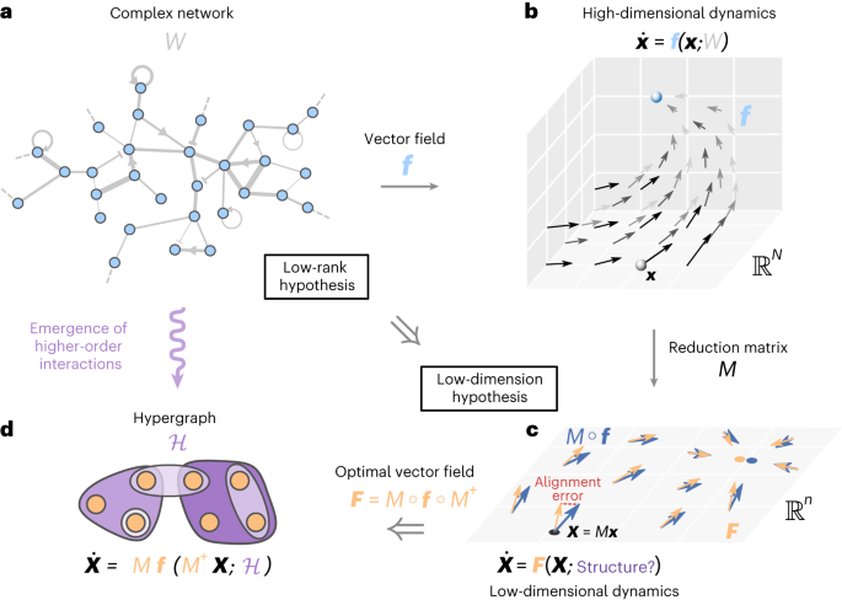
Conceptual illustration of a low-rank matrix structure, often depicting sparsity and patterns.
Other Decomposition Techniques
While SVD is preeminent, other matrix decomposition techniques also contribute to the understanding and application of low-rank concepts:
- Eigenvalue Decomposition: Primarily used for square, symmetric matrices, this technique factorizes a matrix \(A\) into \(A = Q \Lambda Q^T\), where \(Q\) is a matrix of eigenvectors and \(\Lambda\) is a diagonal matrix of eigenvalues. It is closely related to SVD and is used in methods like Principal Component Analysis (PCA) to identify dominant components.
- QR Decomposition: Factors a matrix \(A\) into an orthogonal matrix \(Q\) and an upper triangular matrix \(R\). While not directly a low-rank approximation method, it can be used in iterative algorithms for finding eigenvectors or as a precursor for other decompositions.
- Non-negative Matrix Factorization (NMF): A variant where the decomposed matrices are constrained to have non-negative elements. This is particularly useful in applications where interpretability of parts-based representations is desired, such as topic modeling or image analysis, where negative values would be physically meaningless.
Optimization and Regularization
The mathematical formulation of low-rank matrix decomposition often involves solving optimization problems. For instance, finding the optimal low-rank approximation can be posed as minimizing the reconstruction error, potentially with added regularization terms. Techniques such as singular value thresholding are employed to solve convex relaxations of the rank function, often replacing the non-convex rank function with its convex envelope, the nuclear norm (sum of singular values).
The uniqueness of these decompositions can also be a significant consideration, especially in cases like sparse low-rank decomposition, where solutions to non-convex optimization problems constrained on spheres can ensure uniqueness under specific conditions. This robustness is vital for interpretability and reliability in machine learning models.
The Power of Low-Rank Approximations: Applications in Machine Learning
The practical implications of low-rank matrix decomposition are profound, extending across numerous machine learning applications where high-dimensionality, computational efficiency, and latent structure discovery are critical challenges.
Dimensionality Reduction and Data Compression
One of the most direct applications of low-rank decomposition is dimensionality reduction. By representing data in a lower-dimensional subspace, noise is often filtered out, and the most significant features or patterns are retained. This not only makes subsequent computations more efficient but also aids in visualizing high-dimensional data and mitigating the "curse of dimensionality." Data compression is a natural consequence, as storing a low-rank approximation requires significantly less memory than the original high-dimensional matrix.
Collaborative Filtering in Recommendation Systems
Low-rank matrix factorization is at the heart of many modern recommendation systems. In collaborative filtering, user-item interaction matrices (e.g., ratings) are often sparse and high-dimensional. Decomposing such a matrix into lower-rank user-feature and item-feature matrices allows for the prediction of unobserved ratings by learning latent factors that characterize users and items. This effectively fills in missing entries and enables personalized recommendations.
Image Processing and Computer Vision
In image processing, low-rank methods can be used for tasks like image denoising, compression, and pattern extraction. An image can be viewed as a matrix of pixel values, and its low-rank approximation can capture the essential visual information while discarding noise or less important details. This is particularly useful for identifying underlying patterns like edges or textures.
Low-Rank Adaptation (LoRA) for Large Language Models (LLMs)
A cutting-edge application that highlights the efficiency gains of low-rank techniques is Low-Rank Adaptation (LoRA). In the context of fine-tuning large pre-trained models like LLMs, LoRA freezes the original, massive model weights and injects small, trainable rank-decomposition matrices into each layer. Instead of updating the entire weight matrix \(W\), LoRA learns a low-rank update matrix \(\Delta W = AB\), where \(A\) and \(B\) are much smaller matrices. This significantly reduces the number of trainable parameters, leading to substantial computational savings and faster fine-tuning without significant performance degradation.
The Workflow of Low-Rank Decomposition
The practical implementation of low-rank matrix decomposition typically involves a two-stage computational approach, especially when dealing with very large matrices where direct SVD computation might be prohibitive.
Two-Stage Computational Process
- Identify an Approximate Range: The first stage involves finding an orthonormal matrix \(Q \in \mathbb{R}^{m \times k}\) such that \(A \approx QQ^T A\). This matrix \(Q\) effectively captures the dominant column space or range of the original matrix \(A\). For very large matrices, this step is often performed using randomized algorithms, which can efficiently approximate the range with high probability.
- Form the Factorization: Once the approximate range is identified, classical deterministic methods can be applied to the compressed representation, \(Q^T A\), to compute the smaller factorization \(U, D, V\). This significantly reduces the computational burden compared to applying SVD directly to the full matrix \(A\).
Illustrative Mindmap of Low-Rank Concepts
To further contextualize the various facets of low-rank matrix decomposition, the following mindmap outlines its key components, mathematical foundations, and prominent applications in machine learning.
This mindmap visually represents the interconnectedness of concepts surrounding low-rank matrix decomposition, from its theoretical mathematical underpinnings to its diverse applications and advanced variants. It illustrates how core linear algebra concepts like SVD form the basis, leading to tangible benefits in data processing and model efficiency across various machine learning domains.
Comparative Analysis of Low-Rank Techniques
While SVD is the most fundamental, several other related techniques and concepts extend or specialize the idea of low-rank approximation. Here's a comparative overview of how different low-rank approaches address specific needs in machine learning:
| Technique | Core Principle | Primary Application | Mathematical Nuance |
|---|---|---|---|
| Singular Value Decomposition (SVD) | Factorizes \(A = U \Sigma V^T\); truncates smallest singular values for optimal rank-\(k\) approximation. | Dimensionality reduction (e.g., PCA), data compression, noise reduction. | Minimizes Frobenius/spectral norm error; guarantees best rank-\(k\) approximation. |
| Non-negative Matrix Factorization (NMF) | Decomposes a non-negative matrix into non-negative factors (\(A \approx WH\)). | Topic modeling, image feature extraction, parts-based representations. | Constraints on non-negativity for interpretability; often uses iterative optimization. |
| Low-Rank Adaptation (LoRA) | Injects trainable low-rank decomposition matrices (\(\Delta W = AB\)) into pre-trained model layers. | Efficient fine-tuning of large language models (LLMs). | Freezes base model weights; dramatically reduces trainable parameters. |
| Robust Principal Component Analysis (RPCA) | Decomposes a matrix into a low-rank component and a sparse error component. | Separating structure from sparse corruption (e.g., video surveillance, background subtraction). | Solves convex optimization problem minimizing nuclear norm + L1 norm. |
| Hierarchical Low-Rank Structures | Exploits low-rank properties in off-diagonal blocks of matrices, often in a hierarchical manner. | Fast matrix computations, compression for large-scale scientific computing. | Leverages block-wise low-rank properties for compressed representations. |
Understanding Low-Rank Adaptation (LoRA)
To further illustrate a critical application, let's explore Low-Rank Adaptation (LoRA), a technique that has significantly impacted the efficiency of training and adapting large language models. The video below provides a concise explanation of LoRA's core principles.
A 5-minute guide to Low-Rank Adaptation (LoRA), explaining its benefits for efficient and scalable model fine-tuning.
This video provides an excellent summary of LoRA, highlighting its power as a technique for making large language model fine-tuning remarkably efficient, scalable, and cost-effective. LoRA achieves this by introducing a low-rank matrix update into the pre-trained model's layers instead of updating the entire, typically enormous, weight matrix. This means that during fine-tuning, only a small number of new parameters (from the low-rank matrices) are trained, while the original pre-trained weights remain frozen. The mathematical basis for this lies in the observation that the full update to a weight matrix during adaptation often has a low intrinsic rank. By capturing this update with a low-rank decomposition, LoRA drastically reduces memory and computational requirements, making large model customization accessible and practical.
Frequently Asked Questions (FAQ)
What is the "rank" of a matrix in machine learning?
Why is Singular Value Decomposition (SVD) so important for low-rank approximation?
How does low-rank matrix decomposition help with the "curse of dimensionality"?
What is Low-Rank Adaptation (LoRA) and how does it relate to low-rank decomposition?
Can low-rank decomposition be applied to non-numerical data?
Conclusion
Low-rank matrix decomposition stands as a cornerstone in the mathematical foundation of modern machine learning. Rooted deeply in linear algebra, particularly through Singular Value Decomposition (SVD), it provides a robust and efficient framework for approximating high-dimensional data with lower-dimensional representations. This capability is not merely an academic curiosity; it translates directly into tangible benefits across a spectrum of applications, from reducing computational complexity and compressing vast datasets to extracting subtle latent features and enabling efficient adaptation of large, complex models like those in natural language processing. The continuous evolution of these techniques, exemplified by innovations such as LoRA, underscores their enduring relevance and adaptability in addressing the ever-growing demands of data-intensive machine learning challenges.
Recommended Further Reading
- Deep dive into the Eckart-Young theorem and its implications for data approximation
- Advanced randomized algorithms for large-scale low-rank matrix approximation
- Applications of non-negative matrix factorization in interpretable machine learning
- The role of nuclear norm minimization in matrix completion problems