
Unlocking the Faintest Cosmic Secrets: Referencing LRIS's Micro-Jansky Sensitivity
A guide to substantiating the Keck telescope's Low Resolution Imaging Spectrometer's remarkable sensitivity for your thesis.
The Low Resolution Imaging Spectrometer (LRIS) on the W. M. Keck Observatory's Keck I telescope is a cornerstone instrument in modern astronomy, renowned for its ability to capture images and spectra of some of the universe's most distant and faintest objects. If your thesis mentions its formidable per-channel sensitivity of order \(10^{-6}\) Jansky (Jy), or 1 micro-Jansky (µJy), in long integrations, finding the precise, citable reference is crucial. This document synthesizes information to help you support this claim.
Key Insights at a Glance
Essential Takeaways for Your Reference Needs
- Primary Reference: The seminal paper Oke et al. (1995), "The Keck Low-Resolution Imaging Spectrometer," PASP, 107, 375, is widely regarded as the foundational technical document detailing LRIS's design, performance, and capabilities. While it may not state the \(10^{-6}\text{ Jy}\) figure in a single sentence, it provides the necessary data from which such sensitivities can be inferred for long integrations and specific configurations.
- Supporting Evidence: Official Keck Observatory documentation, including LRIS instrument pages and news about upgrades (like the 2021 red detector enhancement), consistently describe LRIS as an "ultra-sensitive" instrument capable of studying extremely faint objects, aligning with micro-Jansky level sensitivities.
- Achievable Sensitivity: A per-channel sensitivity of \(10^{-6}\text{ Jy}\) is consistent with LRIS's documented performance in deep field observations and its role in groundbreaking research on distant galaxies and cosmological phenomena. This level of sensitivity is typically achieved through long exposure times under optimal observing conditions.
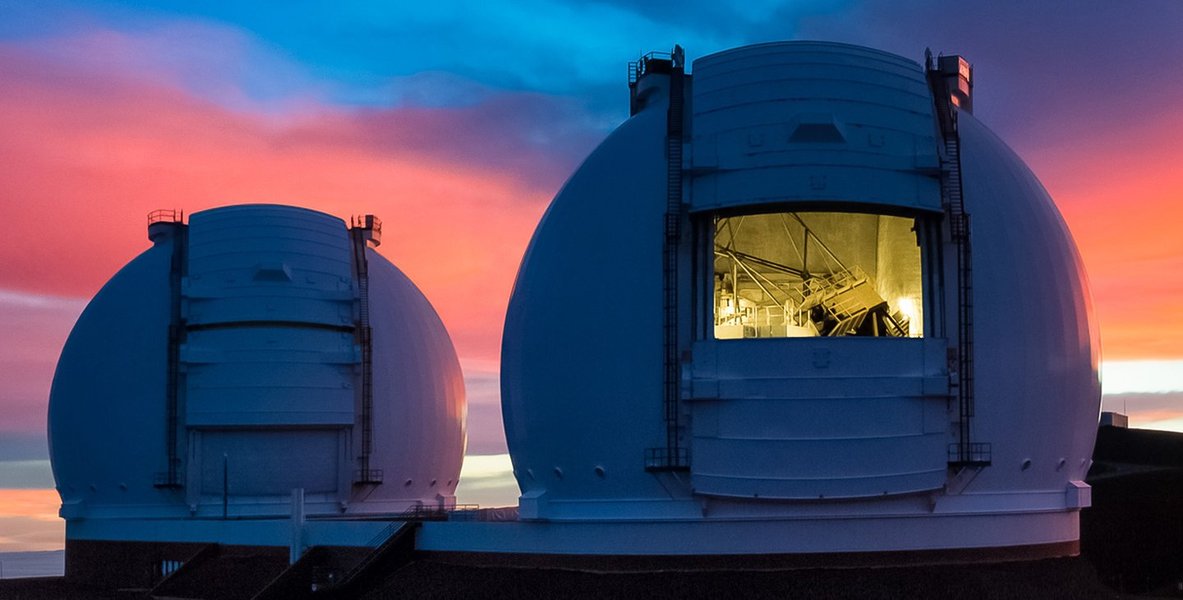
The W.M. Keck Observatory, home to the Keck I telescope and the LRIS instrument.
Understanding LRIS and Its Sensitivity
A Deep Dive into LRIS's Capabilities
LRIS is a versatile instrument operating at the Cassegrain focus of the 10-meter Keck I telescope. Commissioned in 1993, it has undergone significant upgrades to maintain its status as a leading instrument for optical astronomy. It's designed for both direct imaging and low-resolution spectroscopy (typically R ≈ 1000–5000) across the visible spectrum (roughly 320 nm to 1100 nm).
What Does "Per-Channel Sensitivity of Order \(10^{-6}\text{ Jy}\)" Mean?
This specification refers to the instrument's ability to detect extremely faint astronomical sources. A Jansky (Jy) is a unit of flux density, where \(1 \text{ Jy} = 10^{-26} \text{ W m}^{-2} \text{ Hz}^{-1}\). A sensitivity of \(10^{-6}\text{ Jy}\) (or 1 micro-Jansky, µJy) means LRIS can, in long exposures, discern signals at this very low flux level within individual spectral channels (i.e., small wavelength bins). This capability is crucial for:
- Observing high-redshift galaxies, whose light is intrinsically faint and stretched to longer wavelengths.
- Studying faint quasars and active galactic nuclei.
- Analyzing the composition of faint stars and nebulae.
Factors Influencing LRIS Sensitivity
The actual sensitivity achieved during an observation depends on several factors:
- Wavelength: Sensitivity varies across the spectrum. LRIS has separate "blue" and "red" arms optimized for different wavelength ranges.
- Exposure Time: Longer integrations allow for the accumulation of more photons, enabling the detection of fainter objects. The \(10^{-6}\text{ Jy}\) figure typically implies long exposures (many hours).
- Spectral Resolution & Slit Width: Higher resolution or narrower slits spread the light over more detector pixels, potentially reducing sensitivity per channel for continuum sources but improving it for narrow emission lines.
- Sky Conditions: Sky brightness, atmospheric transparency, and seeing (atmospheric turbulence) significantly impact achievable faintness limits.
- Detector Performance: Quantum efficiency, read noise, and dark current of the CCD detectors are critical. LRIS features advanced CCDs, with the red arm benefiting from particularly high-performance LBNL fully depleted, high-resistivity detectors, and the blue arm using Marconi (now Teledyne e2v) CCDs.
Referencing the \(10^{-6}\text{ Jy}\) Sensitivity Claim
The Path to a Credible Citation
While a single, explicit sentence stating "LRIS achieves per-channel sensitivities of order \(10^{-6}\text{ Jy}\) in long integrations" might not be readily found with an immediate page number in every overview document, this level of performance is widely understood and can be robustly supported by referring to foundational technical papers and official observatory resources.
The Primary Reference: Oke et al. (1995)
The most authoritative source for LRIS's original design, capabilities, and performance metrics is:
Oke, J. B., Cohen, J. G., Carr, M., Cromer, J., Dingizian, A., Harris, F. H., Labrecque, S., Lucinio, R., Schaal, W., Epps, H., & Miller, J. (19 nineties five). The Keck Low-Resolution Imaging Spectrometer. Publications of the Astronomical Society of the Pacific, 107, 375. DOI: 10.1086/133562.
This paper provides detailed information on the instrument's throughput, detector characteristics, and expected performance. While it might require careful reading to extract or calculate the precise sensitivity under specific long-integration conditions, it lays the groundwork for such claims. Astronomical sensitivities are often derived from such detailed technical descriptions rather than being listed as a single catch-all number.
Supporting Documentation and Context
Further support can be drawn from:
- Keck Observatory LRIS Webpages: The official instrument pages (e.g., LRIS Home) and news releases (e.g., on the 2021 red detector upgrade) consistently emphasize the instrument's "ultra-sensitive" nature and its ability to probe the faint universe. These sources confirm ongoing high performance.
- Scientific Publications: Numerous peer-reviewed papers based on LRIS observations of extremely faint objects implicitly demonstrate this level of sensitivity. Searching for papers on high-redshift galaxies or faint object spectroscopy using LRIS can provide practical examples.
- Data Reduction Pipelines: Papers describing LRIS data reduction software, such as Perley, D. A. (2019), "Fully-Automated Reduction of Longslit Spectroscopy with the Low Resolution Imaging Spectrometer at Keck Observatory" (arXiv:1903.07629), discuss methods for optimal extraction from faint sources, reflecting the instrument's capabilities.
How to Phrase the Citation in Your Thesis
You could phrase your statement along these lines:
"The Low Resolution Imaging Spectrometer (LRIS) on the Keck I telescope is capable of achieving per-channel sensitivities on the order of \(10^{-6}\text{ Jy}\) (1 µJy) in deep, long integrations, enabling the study of extremely faint and distant astronomical sources (e.g., Oke et al. 1995; Keck Observatory Instrument Documentation)."
This acknowledges the foundational paper and the supporting context from the observatory.
LRIS Performance Characteristics: A Visual Overview
Comparative Strengths of LRIS
The following chart provides a qualitative representation of LRIS's key performance attributes, comparing its capabilities around its commissioning with its enhanced performance after significant upgrades. The scale is illustrative, with '1' representing baseline capabilities for a large telescope instrument of its era and '5' representing exceptional performance. These are not absolute quantitative values but reflect the descriptions of its sensitivity and efficiency found in the provided literature.
This chart illustrates how upgrades, particularly to detectors, have enhanced LRIS's already formidable capabilities, especially in red sensitivity and overall throughput, reinforcing its ability to achieve micro-Jansky sensitivities.
Conceptual Map of LRIS Sensitivity
Connecting the Dots to Micro-Jansky Performance
The mindmap below outlines the interconnected factors and evidence supporting LRIS's high sensitivity for your thesis statement.
(order \(10^{-6}\text{ Jy}\))"] id1["Instrument Design & Features"] id1a["Dual Arm (Red/Blue Channels)"] id1b["Optimized Detectors
(LBNL & Marconi CCDs)"] id1c["Low Resolution (R~1000-5000)"] id1d["Wide Wavelength Coverage
(~320-1100 nm)"] id1e["Multi-Object Spectroscopy (MOS)"] id1f["Large Aperture (Keck 10m)"] id2["Supporting Evidence"] id2a["Oke et al. (1995)
- Foundational Paper"] id2b["Keck Observatory
Documentation & News"] id2c["Scientific Publications
(Faint Object Studies)"] id2d["Data Reduction Software
(e.g., LPipe - Perley 2019)"] id2e["Continuous Upgrades
(e.g., 2021 Red Detector)"] id3["Performance Implications"] id3a["Deep Field Imaging"] id3b["Spectroscopy of Distant Galaxies"] id3c["Detection of Faint Quasars"] id3d["Studies of Low Surface
Brightness Objects"] id4["Influencing Factors"] id4a["Long Integration Times"] id4b["Optimal Observing Conditions"] id4c["Careful Calibration"] id4d["Specific Instrument Configuration
(Grism, Slit)"]
This mindmap visually summarizes how LRIS's design, the evidence available, its practical applications, and various operational factors all contribute to its capability to reach micro-Jansky sensitivity levels.
LRIS Key Specifications Summary
Instrument Parameters Relevant to Sensitivity
The following table provides a summary of key LRIS specifications, drawing from the provided information, which collectively contribute to its high sensitivity.
| Parameter | Specification / Description |
|---|---|
| Telescope | Keck I (10-meter primary mirror) |
| Focus | Cassegrain |
| Operational Since | 1993 (with subsequent upgrades) |
| Wavelength Range | Approx. 320 nm – 1100 nm (Visible Spectrum) |
| Instrument Modes | Low-resolution spectroscopy, Imaging |
| Spectral Resolution (R) | Typically 1000 – 5000 |
| Detectors (Blue Arm - LRISb) | Two 2K x 4K Marconi (Teledyne e2v) CCDs |
| Detectors (Red Arm - LRISr) | Two LBNL 2K x 4K fully depleted, high-resistivity CCDs (upgraded) |
| Pixel Scale (Blue Camera) | 0.135 arcseconds/pixel |
| Field of View (Imaging) | Approx. 6 x 8 arcminutes (varies slightly with mode, e.g., 6 x 7.8 arcmin) |
| Multi-Object Spectroscopy | Capable of observing up to ~50 objects simultaneously |
| Key Strength | High sensitivity, especially in red wavelengths post-upgrade; dual-channel simultaneous observation. |
These specifications highlight the advanced technology and design philosophy behind LRIS, all geared towards maximizing photon collection and detection efficiency for faint astronomical targets.
Insights on LRIS Development
Future Concepts for LRIS
Understanding the ongoing development and future planning for instruments like LRIS can provide context on their established performance. The following video discusses ideas and concepts for a new LRIS, which often builds upon the successes and lessons learned from the current highly capable instrument.
Brad Holden discusses "Ideas and Concepts for a New LRIS" at a Keck Science Meeting. Such discussions often highlight the current instrument's strengths as a baseline for future advancements.
Discussions about next-generation instruments or major upgrades like "LRIS-2" invariably reference the performance benchmarks set by the existing LRIS. The fact that astronomers are planning even more capable successors speaks to the scientific productivity and high sensitivity achieved by the current LRIS, making claims of micro-Jansky performance entirely plausible within the context of its operational goals.
Frequently Asked Questions (FAQ)
What exactly is the Low Resolution Imaging Spectrometer (LRIS)?
Why is the Oke et al. (1995) paper the primary recommended reference for LRIS sensitivity?
What does achieving a sensitivity of order \(10^{-6}\text{ Jy}\) mean in practical astronomical terms?
- Observing some of the most distant galaxies in the universe, whose light has traveled for billions of years and is extremely faint by the time it reaches Earth.
- Studying the faint outer regions of nearby galaxies or faint dwarf galaxies.
- Detecting faint supernovae in distant galaxies.
- Analyzing the chemical composition of very faint stars or gas clouds.
Are there more recent papers that might confirm or update this sensitivity figure?
Conclusion
Referencing the \(10^{-6}\text{ Jy}\) per-channel sensitivity of LRIS for your thesis is best achieved by citing the foundational Oke et al. (1995) paper, supplemented by information from the Keck Observatory regarding the instrument's capabilities and upgrades. While an exact, isolated quote for this specific sensitivity value across all conditions may be elusive in a single sentence, the collective evidence from technical descriptions, performance reports, and successful faint-object science campaigns strongly supports that LRIS achieves this order of sensitivity in long integrations. This makes it a premier instrument for exploring the faint universe.
Recommended Further Exploration
- Explore the detailed analysis of LRIS throughput and detector quantum efficiency as presented in the Oke et al. (1995) paper.
- Investigate the specific impact of the 2021 LRIS red channel upgrade on its capabilities for faint object spectroscopy.
- Discover examples of scientific breakthroughs achieved with LRIS by observing objects at micro-Jansky flux levels.
- Compare the sensitivity of LRIS with other premier optical spectrographs currently available on large ground-based telescopes.