
Unlocking Your Mac's Potential: The Rise of AI Portals with Local Memory and Multi-Agent Power
Discover pioneering AI projects designed for macOS ARM that remember, adapt, and manage diverse AI capabilities locally.
The landscape of artificial intelligence is rapidly evolving, with a growing demand for personalized, private, and powerful AI solutions that operate seamlessly on user devices. For macOS ARM users, this translates to a quest for all-purpose AI portals or assistants that not only understand and respond intelligently but also retain information locally over the long term and can leverage a variety of specialized AI models or agents. This exploration delves into leading projects by talented developers that are pushing the boundaries in this exciting domain.
Key Insights at a Glance
Essential Takeaways on Advanced AI for macOS ARM
- Local Long-Term Memory is Crucial: Projects are increasingly focusing on enabling AI agents to store and recall information directly on your Mac, ensuring privacy, offline access, and deeper personalization. This means your AI can "remember" past interactions and preferences without constant cloud reliance.
- Multi-Model & Multi-Agent Architectures Offer Versatility: The ability to utilize different AI models (e.g., for text generation, image analysis, coding assistance) or deploy multiple specialized AI agents within a single portal allows for tackling complex, multifaceted tasks far more effectively than a single, monolithic AI.
- Native macOS ARM Performance is a Game-Changer: Applications built specifically for Apple Silicon (M-series chips) deliver superior performance, efficiency, and integration with the macOS ecosystem, providing a smooth and responsive user experience for demanding AI workloads.
Pioneering AI Projects for Your macOS ARM Device
Meet the Innovators Shaping Localized and Intelligent AI Experiences
Several projects stand out for their commitment to integrating local long-term memory, multi-agent capabilities, and a native macOS ARM experience. These platforms aim to transform your Mac into a truly intelligent partner.
An AI portal provides a centralized workspace for various AI tasks and lifecycle management.
Anything-LLM by Mintplex Labs
Anything-LLM is an open-source, all-in-one desktop AI suite that empowers users to build personal AI assistants. It excels in creating intelligent document chatbots that can work with various file types.
- Local Long-Term Memory: It achieves this through built-in Retrieval-Augmented Generation (RAG) systems, allowing users to create and query local, persistent knowledge bases from their documents. This means your AI's understanding is rooted in your own data, stored on your device.
- Different AI Models/Agents: Anything-LLM supports a wide array of Large Language Models (LLMs), including open-source options like Llama 2 and Gemma, as well as commercial models via API. It includes a no-code agent builder for crafting custom agents to automate tasks and manage complex workflows.
- macOS ARM App: While primarily a desktop application, it can be run efficiently on macOS ARM devices using Docker, making it accessible for users who prefer local deployment and control.
BoltAI
BoltAI is a native macOS application designed to integrate AI assistance deeply into your daily workflows. It's built for performance and seamless integration with the Mac environment.
- Local Long-Term Memory: BoltAI emphasizes on-device processing and storage of user interactions and context, enabling features like contextual suggestions based on historical data. This local-first approach prioritizes user privacy and speed.
- Different AI Models/Agents: The app allows users to connect with various LLMs and provides tools to create AI assistants (agents) for tasks like writing, research, and automation, effectively bringing diverse AI capabilities to your fingertips.
- macOS ARM App: As a native, high-performance application, BoltAI is specifically optimized for Apple Silicon, ensuring efficient resource usage and responsiveness.
Pieces for Developers
Pieces is an AI-powered productivity tool designed to help developers and knowledge workers capture, enrich, and reuse useful materials like code snippets, notes, and project insights.
- Local Long-Term Memory: It features a "Long-Term Memory Agent" that captures, preserves, and resurfaces details from past work, all stored securely on the user's device. This on-device repository ensures data privacy and quick access to contextual information.
- Different AI Models/Agents: Pieces integrates various LLMs for tasks like code generation, analysis, and summarization. Its agent-based system helps automate developer workflows and manage knowledge effectively.
- macOS ARM App: Pieces offers a native macOS application optimized for ARM architecture, providing excellent performance and deep integration with macOS tools.
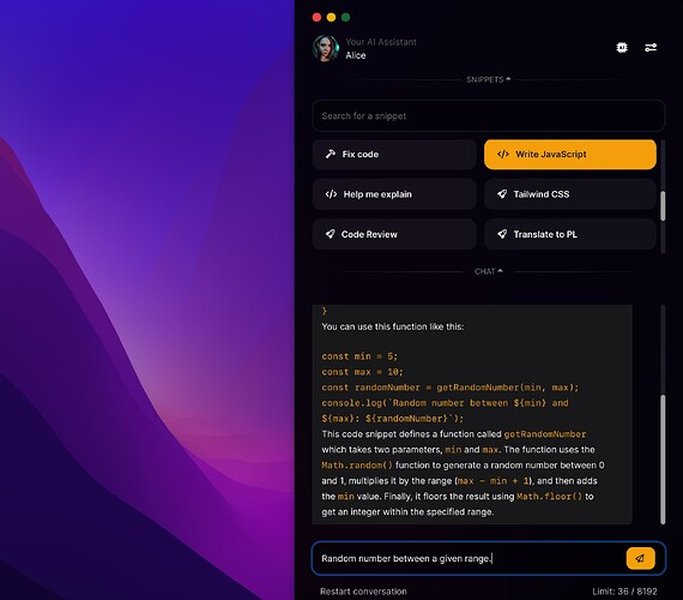
AI assistants on macOS are evolving with long-term memory and global shortcut capabilities.
Rewind.ai
Rewind is designed to give your Mac a "perfect memory." It records everything you’ve seen, said, or heard on your device and makes it searchable.
- Local Long-Term Memory: This is Rewind's core feature. All data is stored and processed locally, ensuring privacy. It creates a comprehensive, searchable archive of your digital life on your Mac.
- Different AI Models/Agents: Rewind utilizes advanced machine learning models to process, compress, and contextualize the recorded data. While not explicitly multi-agent in the traditional sense, its AI capabilities enable tasks like summarization and pattern recognition based on your personal data.
- macOS ARM App: Rewind is a native macOS application, meticulously optimized for Apple Silicon to handle its continuous recording and processing tasks efficiently without significant performance impact.
Simular AI
Simular AI is an intelligent virtual assistant software for macOS, aimed at task automation and workflow management.
- Local Long-Term Memory: It incorporates on-device processing, storing and recalling user data from previous interactions, such as file organizations and custom automations, to "remember" preferences and improve efficiency for repeated tasks.
- Different AI Models/Agents: Simular AI leverages various agents powered by advanced language models (like Deepseek) and integrates with macOS Shortcuts to enable users to build custom automated workflows.
- macOS ARM App: As a native macOS ARM application, it takes full advantage of Apple Silicon's capabilities for fast, local AI processing and smooth operation.
Core Capabilities Explored
Understanding the Technologies Powering Next-Gen AI Portals
The Power of Local Long-Term Memory
Local long-term memory allows AI systems to retain user-specific data, context, preferences, and workflow patterns directly on the user's device. This is transformative for several reasons:
- Privacy and Security: Sensitive information remains on your Mac, reducing exposure to cloud-based vulnerabilities.
- Offline Accessibility: Your AI can recall information and assist you even without an internet connection.
- Personalization: The AI adapts more deeply to your individual needs and work style over time.
- Performance: Local data access can be faster than relying on remote servers.
Frameworks like Mem0 are dedicated to providing sophisticated memory layers for AI agents, offering multi-level retention (User, Session, AI Agent) and adaptive personalization. Similarly, Kernel Memory focuses on efficient indexing and retrieval for RAG, and LangMem SDK blends short-term and long-term semantic memory.
Harnessing Diverse AI Models and Agents
The "all-purpose" nature of an AI portal often necessitates the ability to utilize multiple specialized AI models or a team of AI agents. A single model might excel at text generation but falter at code analysis or image understanding. Multi-model/agent systems offer:
- Task Specialization: Different agents or models can handle specific sub-tasks, leading to higher quality outcomes. For example, one agent might draft an email, another might analyze attached data, and a third could schedule a follow-up.
- Flexibility and Extensibility: New capabilities can be added by integrating new models or agents without overhauling the entire system.
- Complex Problem Solving: Coordinated agents can tackle more complex problems than a single agent could alone.
Frameworks like LangChain and Autogen are instrumental in building and orchestrating these multi-agent systems, allowing developers to design complex interactions and workflows between different AI components.
Seamless Experience on macOS ARM
Running AI applications natively on macOS ARM (Apple Silicon) architecture provides significant advantages:
- Optimized Performance: Native apps can fully leverage the power and efficiency of M-series chips, resulting in faster processing and lower latency for AI tasks.
- Energy Efficiency: ARM architecture is known for its power efficiency, leading to better battery life on MacBooks while running AI applications.
- Unified Memory Access: Apple Silicon's unified memory architecture can benefit AI models by allowing faster data access between the CPU, GPU, and Neural Engine.
- Enhanced Security: macOS provides a robust security framework, which, combined with local processing, enhances data protection.
Projects like Ollama facilitate running various open-source LLMs locally on a Mac, showcasing the platform's capability to handle demanding AI computations directly on the device.

Modern Macs with Apple Silicon provide a powerful platform for local AI development and execution.
Comparative Overview of Leading AI Portals for macOS ARM
Feature Snapshot of Key Projects
To help you understand the landscape better, here’s a comparative table highlighting key aspects of the discussed AI projects that meet the criteria of local long-term memory, multi-model/agent support, and a macOS ARM app.
| Project Name | Local Long-Term Memory Feature | Multi-Model/Agent Support | macOS ARM Availability | Key Strength |
|---|---|---|---|---|
| Anything-LLM | Local RAG, persistent knowledge bases from user documents | Supports various LLMs (OpenAI, Anthropic, open-source via Ollama/LM Studio), no-code agent builder | Desktop app, runnable on macOS ARM via Docker | Highly customizable, open-source, strong document integration |
| BoltAI | On-device context storage, historical interaction recall | Integrates with multiple LLMs (OpenAI, Anthropic, local models via Ollama/LM Studio), AI assistant creation | Native macOS ARM app | Deep OS integration, performance, privacy-focused native experience |
| Pieces for Developers | "Long-Term Memory Agent" for on-device storage of code, notes, project history | Integrates various LLMs for code generation/analysis, agent-based workflow automation | Native macOS ARM app | Developer-centric workflow enhancement, robust snippet management |
| Rewind.ai | Comprehensive local recording and indexing of on-screen activity, audio, and typed text | Utilizes advanced ML models for processing and contextualizing local data; summarization | Native macOS ARM app | "Perfect memory" concept, unparalleled local data capture for recall |
| Simular AI | On-device storage of preferences, file organization, custom automations | Agents powered by models like Deepseek, macOS Shortcuts integration for custom workflows | Native macOS ARM app | Task automation and workflow management focus, team collaboration features |
Visualizing the AI Portal Ecosystem
Interconnected Components of Advanced macOS AI Solutions
The development of comprehensive AI portals on macOS ARM involves several interconnected technologies and concepts. This mindmap illustrates how local memory, multi-agent systems, and native app development converge to create powerful user experiences.
on macOS ARM"] id1["Core Requirements"] id1.1["Local Long-Term Memory"] id1.1.1["Mem0 Framework"] id1.1.2["RAG Systems (e.g., Anything-LLM)"] id1.1.3["Kernel Memory"] id1.1.4["LangMem SDK"] id1.1.5["On-Device Secure Storage (e.g., Rewind.ai, Pieces)"] id1.2["Multi-Model/Agent Architecture"] id1.2.1["LangChain Framework"] id1.2.2["Autogen Framework"] id1.2.3["Specialized Agents (e.g., BoltAI assistants)"] id1.2.4["Model Orchestration (e.g., MuleSoft AI Chain concept)"] id1.2.5["Support for Diverse LLMs (OpenAI, local models via Ollama)"] id1.3["Native macOS ARM App"] id1.3.1["Apple Silicon Optimization (M1/M2/M3+)"] id1.3.2["Local Processing Power & Neural Engine"] id1.3.3["Privacy & Security Benefits of Local Execution"] id1.3.4["Seamless OS Integration (Shortcuts, Spotlight)"] id2["Leading Project Examples"] id2.1["Anything-LLM (Mintplex Labs)"] id2.2["BoltAI"] id2.3["Pieces for Developers"] id2.4["Rewind.ai"] id2.5["Simular AI"] id3["Key Considerations for Users & Developers"] id3.1["Privacy & Data Security"] id3.2["Performance & System Resource Efficiency"] id3.3["User Experience & Ease of Integration"] id3.4["Customization & Extensibility Options"] id3.5["Open Source vs. Commercial Solutions"]
This mindmap highlights that successful AI portals depend not just on individual features but on the synergy between memory systems, intelligent agent frameworks, and robust native application development tailored for the macOS ARM environment.
Feature Focus: Rating AI Portal Capabilities
A Radar Chart Comparison of Key Project Strengths
This radar chart provides an opinionated visual comparison of the leading AI projects discussed, rated across several key dimensions relevant to an all-purpose AI portal on macOS ARM. The scores (out of 10, with a minimum axis value of 2 for clarity) reflect a synthesis of their capabilities based on available information.
This chart illustrates that different projects have varying strengths. For instance, Rewind.ai excels in Local Memory Depth and Privacy Focus, while Anything-LLM stands out for its Open Source nature and Multi-Model Versatility. BoltAI offers a strong macOS Native Experience. Your ideal choice will depend on which of these factors are most important to you.
Exploring AI on Mac: Further Insights
Video Overview of AI Productivity Apps for Mac
The following video provides a broader look at AI-powered applications available for Mac that can boost productivity. While not all may meet the specific criteria of local long-term memory and multi-agent support discussed here, it offers valuable context on how AI is being integrated into the macOS ecosystem to make work easier and more efficient.
This overview can help you discover additional tools and understand the general trends in AI app development for the Mac platform, complementing the specific project deep dives provided earlier.
Frequently Asked Questions (FAQ)
Your Queries on Advanced AI Portals Answered
What are the main benefits of local long-term memory in an AI? +
Local long-term memory offers several key advantages:
- Enhanced Privacy: Your data stays on your device, significantly reducing risks associated with cloud storage and transmission.
- Personalization: The AI can learn your preferences, habits, and specific contexts over time, leading to more tailored and relevant assistance.
- Offline Access: You can access remembered information and receive AI support even without an internet connection.
- Speed: Retrieving data locally can be much faster than querying remote servers.
- Control: You have direct control over your data and the AI's memory.
Why is multi-agent or multi-model support important for an all-purpose AI portal? +
Multi-agent or multi-model support is crucial for versatility and power:
- Specialized Expertise: Different AI models excel at different tasks (e.g., one for creative writing, another for code analysis, a third for data visualization). An AI portal can leverage the best model for each specific job.
- Complex Task Handling: Complicated problems can be broken down and assigned to specialized agents that collaborate to find a solution.
- Scalability and Flexibility: It's easier to add new capabilities by integrating new models or agents rather than retraining a single monolithic model.
- Robustness: If one model or agent fails or underperforms, others can potentially compensate.
How does running AI natively on macOS ARM improve performance? +
Native macOS ARM applications offer significant performance benefits for AI:
- Optimized Hardware Utilization: Apps built for Apple Silicon (M-series chips) can directly access and efficiently use the CPU, GPU, and especially the Neural Engine, which is designed for machine learning tasks.
- Energy Efficiency: ARM architecture is inherently power-efficient, allowing complex AI tasks to run with less battery drain on MacBooks.
- Unified Memory Architecture: Apple's UMA allows the CPU, GPU, and Neural Engine to share memory efficiently, reducing data transfer bottlenecks and speeding up AI model processing.
- Lower Latency: Local processing avoids network delays associated with cloud-based AI services, leading to quicker responses.
Are these AI projects suitable for non-developers? +
Many of these projects are designed with a broad audience in mind, though some might have a steeper learning curve or features more tailored to technical users:
- User-Friendly Interfaces: Projects like BoltAI, Rewind.ai, and Simular AI aim for intuitive user experiences, making them accessible to non-developers for productivity and task automation.
- Developer-Focused Tools: Pieces for Developers is specifically tailored for coders and technical knowledge workers. Anything-LLM, while powerful, might require some technical understanding for setup and advanced customization, especially if using Docker or integrating various LLMs.
- Emerging Field: As the field of local AI matures, tools are becoming more user-friendly. However, the cutting-edge nature means some aspects might still feel experimental.
It's best to check the specific project's documentation and user reviews to gauge its suitability for your technical comfort level.
What should I consider when choosing an AI portal for my Mac? +
When selecting an AI portal for your Mac, consider these factors:
- Primary Use Case: What do you mainly want the AI to do? (e.g., manage knowledge, automate tasks, assist with writing, code development).
- Memory Requirements: How important is local, long-term, and detailed memory for your tasks?
- Model/Agent Needs: Do you need access to specific LLMs or the ability to create custom agents?
- Privacy Concerns: How critical is local data storage and processing for you?
- Ease of Use vs. Customization: Do you prefer a plug-and-play solution or a more customizable (potentially complex) platform?
- Cost: Is it a free, open-source project, or a commercial product with subscription fees?
- System Resource Impact: How much CPU, RAM, and storage will the application consume?
- Community and Support: Is there active development, good documentation, and a helpful user community?
Recommended Further Exploration
Dive Deeper into Related AI Topics
- How do Retrieval Augmented Generation (RAG) systems enhance local AI memory?
- What are the best open-source frameworks for building multi-agent AI systems?
- Compare the performance of AI models running on Apple Neural Engine versus CPU/GPU on M-series Macs.
- What are the privacy implications of using AI assistants that store data locally versus in the cloud?
References
Sources and Further Reading
Last updated May 11, 2025