

Highlights of Magna Carta's Transformative Impact
- Limiting Absolute Power: The Magna Carta fundamentally challenged the notion of a monarch being above the law, establishing a critical precedent for constitutional governance.
- Foundation for Rights: It introduced and solidified concepts like due process and protection from arbitrary rule, which became cornerstones for individual liberties in legal systems worldwide.
- Catalyst for Democracy: While not initially a democratic document, its principles of limited government and accountability significantly influenced the development of parliamentary systems and modern democratic ideals.
The signing of the Magna Carta in 1215 marks a monumental turning point in the history of governance, fundamentally altering the relationship between the ruler and the ruled. Born out of political crisis and the dissatisfaction of rebellious barons, this "Great Charter" was a direct response to the unchecked authority exercised by King John of England. While initially intended to address specific feudal grievances and protect the rights of a select few, its long-term impact resonated far beyond its immediate context, laying crucial groundwork for limited government, the rule of law, and ultimately, modern democratic principles.
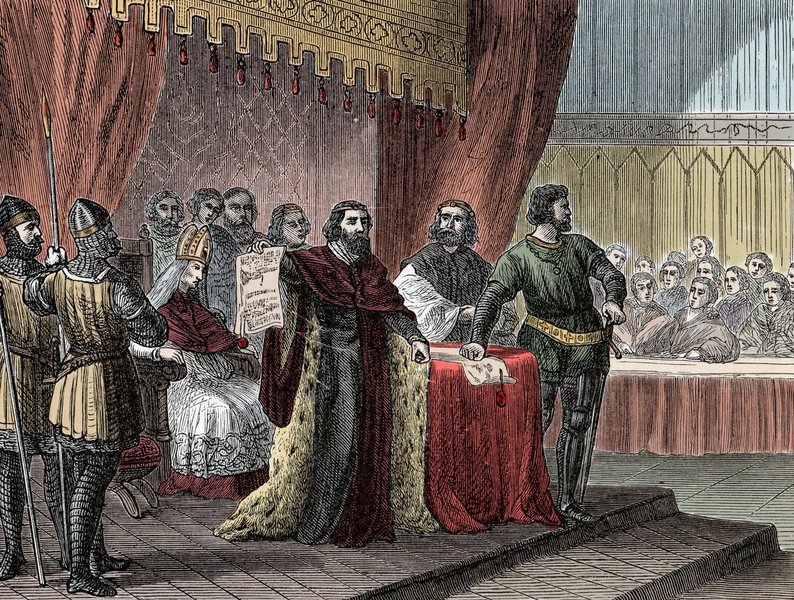
An artistic depiction of King John sealing the Magna Carta at Runnymede in 1215.
The Precedent of Royal Accountability
For centuries, European monarchs, including figures like King John, often ruled with an almost absolute authority, frequently asserting a divine right to govern without constraint. This concentration of power, however, often led to widespread discontent among the nobility and the general populace due to arbitrary taxation, injustices, and a lack of recourse against royal decrees. The historical context of King John's reign, marked by military defeats and financial struggles, exacerbated these tensions, culminating in the barons' rebellion.
The Unbearable Burden of Absolute Rule
King John's reign (1199-1216) was characterized by significant friction with his barons, who felt burdened by his relentless demands for taxes to fund his wars in France. His arbitrary actions, including seizures of property and harsh punishments, fueled a growing resentment. The barons' defiance was a direct challenge to the notion that the king was above all law, highlighting the pressing need for a mechanism to curb monarchical excesses.
A Forced Concession: The 1215 Sealing
Faced with overwhelming opposition, King John was compelled to meet the rebellious barons at Runnymede on June 15, 1215. There, he affixed his seal to the Magna Carta, a document drafted by the Archbishop of Canterbury, Stephen Langton. This act was not a voluntary concession but a strategic move to avert civil war, demonstrating that even a king could be pressured into acknowledging limitations on his power. This moment served as a powerful symbol that the monarch was not beyond the reach of the law and the will of his most powerful subjects.
Establishing the Rule of Law: A New Covenant
By agreeing to the Magna Carta, the king implicitly accepted a revolutionary principle: that even monarchs must adhere to a set of laws. This marked a profound shift from the idea of the king as the sole source of law to one where the law itself held a higher authority, binding all, including the sovereign. This agreement protected certain rights of "freemen" – though initially a limited group – laying foundational principles such as the right to a fair trial and protection from unlawful imprisonment.
Key Clauses and Their Immediate Impact
The Magna Carta contained 63 clauses, many of which dealt with specific feudal customs and grievances. However, certain clauses held broader implications that would resonate through history:
- Clause 39: "No free man shall be seized or imprisoned, or stripped of his rights or possessions, or outlawed or exiled, or deprived of his standing in any other way, nor will we proceed with force against him, or send others to do so, except by the lawful judgment of his equals or by the law of the land." This clause introduced the concept of due process and trial by peers.
- Clause 40: "To no one will we sell, to no one deny or delay right or justice." This promised access to justice without delay or arbitrary denial.
- Limited Taxation: It stipulated that certain taxes could not be levied without the "common counsel of our kingdom," foreshadowing the principle of "no taxation without representation."
These provisions, though often reissued and reinterpreted over time, began the process of enshrining legal protections that would eventually extend to a wider population. The immediate aftermath was turbulent, with King John attempting to annul the charter, leading to civil war. However, subsequent reissues by his successors solidified its status as a critical legal document.
The Enduring Influence on Modern Democracy and Constitutionalism
The Magna Carta's significance extends far beyond its medieval origins, having profoundly influenced the development of modern democracy, constitutional law, and human rights. It became a powerful symbol for those seeking to limit governmental power and assert individual liberties, inspiring legal and political movements across centuries and continents. From the American Founding Fathers to modern human rights advocates, the principles embedded in the charter have been invoked as a benchmark for just governance.
From Feudal Document to Global Symbol
While the original document primarily protected the rights of the barons and church, its fundamental assertion that the king was not above the law resonated through history. This concept evolved into the principle of limited government and constitutional monarchy. The Magna Carta directly influenced the English Bill of Rights (1689), which further curbed royal prerogative and established parliamentary supremacy. Its principles also crossed the Atlantic, inspiring the American Declaration of Independence and the U.S. Constitution, particularly regarding concepts like due process and the protection of liberties.
This mindmap illustrates the journey of the Magna Carta from its initial sealing in 1215 to its enduring status as a global symbol of liberty and constitutionalism. It highlights the key events, principles, and later interpretations that transformed a feudal document into a foundational text for modern democratic thought, emphasizing its symbolic power and continuous re-application through history.
The Magna Carta's influence underscores a continuous journey towards more equitable and accountable forms of governance. It highlights how a document born from a specific historical conflict can transcend its immediate purpose to become a universal symbol for the assertion of rights and the limitation of power.
Magna Carta: A Timeline of Impact and Evolution
The Magna Carta was not a static document; it evolved through reissues and reinterpretation, demonstrating its adaptive significance over centuries. The table below outlines key moments in its history and their impact.
| Year | Event | Significance |
|---|---|---|
| 1215 | Sealing by King John at Runnymede | First formal document to limit English monarch's power, establishing the principle that the king is not above the law. Introduced concepts of due process and justice. |
| 1216-1225 | Reissues by Henry III | Magna Carta was reissued in modified versions, solidifying its place in English law and removing some controversial clauses (like the council of 25 barons). |
| 1297 | Confirmation by Edward I | Reaffirmed as part of English statute law, extending its protections to all freemen and reinforcing the monarch's subjection to the law. |
| 17th Century | Symbol during English Civil War | Became a rallying cry for Parliamentarians against the divine right of kings, influencing acts like the Habeas Corpus Act. |
| 18th Century | Influence on American Revolution | Inspired American colonists in their fight for independence, with principles like "no taxation without representation" and due process finding expression in foundational U.S. documents. |
| Modern Era | Global Symbol of Liberty | Continues to be cited as a cornerstone of human rights, constitutionalism, and the rule of law in legal and political discourse worldwide. |
Understanding Magna Carta: A Visual Journey
To further grasp the historical weight and evolving legacy of the Magna Carta, here is a YouTube video offering a concise overview. This short video delves into the historical context, its immediate consequences, and its enduring impact on global legal and political thought, complementing the detailed analysis provided.
A concise explanation of the Magna Carta's historical significance and legacy.
This video, "Magna Carta Explained in less than 5 minutes," offers a succinct yet comprehensive overview of the document's origins, key provisions, and lasting influence. It visually reinforces the narrative of how a medieval charter became a timeless beacon for constitutional government and individual liberties, making complex historical concepts accessible and engaging.
Frequently Asked Questions
What was the primary reason King John signed the Magna Carta?
Did the Magna Carta immediately create a democracy?
What are the most significant clauses of the Magna Carta?
How did the Magna Carta influence other legal documents and nations?
Is the Magna Carta still relevant today?
Conclusion
The Magna Carta, sealed in 1215, stands as a testament to the idea that even the most powerful rulers must eventually submit to the rule of law. What began as a peace treaty between a despotic king and his rebellious barons evolved into a foundational document for constitutionalism, individual rights, and democratic principles across the globe. Its legacy is not just in its specific clauses, many of which are no longer in force, but in the enduring spirit it embodies: the assertion that power must be limited, and that justice and liberty are inherent rights, not privileges granted by a monarch. This medieval charter continues to inspire and inform modern legal and political thought, reminding us of the ongoing struggle for balanced governance and human freedom.
Recommended Further Reading
- How did the Magna Carta specifically influence the US Constitution and Bill of Rights?
- Explore the evolution of the 'rule of law' concept from Magna Carta to modern jurisprudence.
- What are the connections between Magna Carta and contemporary human rights declarations?
- Delve deeper into the political and social conditions leading to the signing of the Magna Carta.