

Key Insights into Solenoid Magnetic Fields
- Fundamental Principle: A solenoid generates a magnetic field when electric current flows through its coiled wire, behaving much like a temporary bar magnet.
- Field Strength Formula: The magnetic field strength (B) inside a long solenoid is precisely calculated using the formula \(B = \mu_0 \frac{N}{L} I\), where N is the number of turns, L is the length, I is the current, and \(\mu_0\) is the permeability of free space.
- Uniformity and Direction: The magnetic field inside an ideal solenoid is remarkably uniform and directed along its central axis, with its orientation determined by the right-hand rule.
What is a Solenoid? The Heart of Electromagnetism
A solenoid is essentially a coil of wire, typically wound into a helical or cylindrical shape. Its primary function is to produce a controlled magnetic field when an electric current passes through it. This simple yet powerful device forms the basis for numerous technological applications, from common household appliances to advanced medical equipment.
When current flows through the wire, each turn of the coil acts like a tiny loop generating its own magnetic field. The combined effect of these individual fields results in a concentrated and often uniform magnetic field within the solenoid's core. This ability to generate a magnetic field on demand makes solenoids indispensable in various engineering and scientific fields.
The Analogy to a Bar Magnet
The magnetic field produced by a solenoid bears a striking resemblance to that of a permanent bar magnet. It exhibits distinct north and south poles, with magnetic field lines emerging from the north pole and re-entering the south pole externally, and continuing internally from south to north. This characteristic allows solenoids to exert forces on magnetic materials and other current-carrying conductors, similar to how permanent magnets interact.
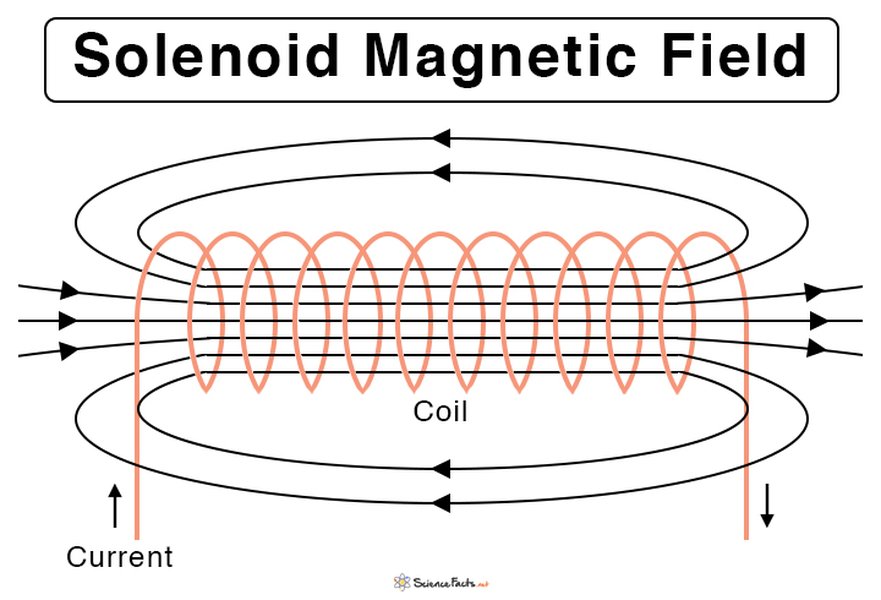
Visual representation of magnetic field lines around a solenoid, akin to a bar magnet.
Quantifying the Magnetic Field: The Solenoid Formula
The strength of the magnetic field generated inside a solenoid is not arbitrary; it can be precisely calculated using a fundamental formula derived from Ampère's Law. This formula highlights the key parameters that influence the magnetic field's magnitude.
The Core Formula
For an ideal, long solenoid (where its length is significantly greater than its diameter), the magnetic field strength (\(B\)) inside is given by:
\[ \mathbf{B} = \mu_0 \frac{N}{L} I \]Let's break down each component of this crucial formula:
- \(B\): Magnetic Field Strength – Measured in Teslas (T), this represents the intensity of the magnetic field within the solenoid.
- \(\mu_0\): Permeability of Free Space – A fundamental physical constant, its value is approximately \(4\pi \times 10^{-7} \, \mathrm{T\cdot m/A}\). This constant reflects how easily a magnetic field can be established in a vacuum.
- \(N\): Total Number of Turns – This is the total count of wire coils wrapped around the solenoid's core. More turns generally lead to a stronger magnetic field.
- \(L\): Length of the Solenoid – Measured in meters (m), this refers to the axial length over which the wire is coiled.
- \(I\): Current – Measured in Amperes (A), this is the electric current flowing through the solenoid's wire. A higher current results in a proportionally stronger magnetic field.
Understanding Turn Density (\(n\))
Sometimes, the formula is presented using the term 'turns per unit length,' denoted as \(n\), where \(n = N/L\). In this form, the equation becomes:
\[ B = \mu_0 n I \]This emphasizes that the magnetic field strength is directly proportional to the density of the coil windings, not just the total number of turns alone.
Factors Influencing Field Strength
The formula directly illustrates several key dependencies for the magnetic field's strength:
- Direct Proportionality to Current: Doubling the current (\(I\)) will double the magnetic field strength.
- Direct Proportionality to Turns per Unit Length: Increasing the number of turns (\(N\)) while keeping the length (\(L\)) constant, or decreasing the length while keeping \(N\) constant, will increase the turn density (\(N/L\)), thereby strengthening the field.
- Core Material: While the formula includes \(\mu_0\) for a vacuum or air core, inserting a ferromagnetic material (like iron) into the solenoid's core significantly amplifies the magnetic field. This is because these materials have a high relative permeability (\(\mu_r\)), effectively changing \(\mu_0\) to \(\mu = \mu_r \mu_0\).
Characteristics of the Solenoid's Magnetic Field
Beyond its quantifiable strength, the magnetic field within a solenoid possesses distinct characteristics that are crucial for its applications.
Uniformity and Direction
One of the most valuable properties of an ideal solenoid's magnetic field is its uniformity. Inside the central region of a long solenoid, the magnetic field lines are nearly parallel and equally spaced, indicating a consistent field strength and direction. This uniform field simplifies calculations and enables predictable interactions with other magnetic materials or fields.
The direction of the magnetic field along the solenoid's axis can be determined using the right-hand rule for solenoids:
- Curl the fingers of your right hand in the direction of the current flowing through the coils.
- Your outstretched thumb will then point in the direction of the magnetic field inside the solenoid, which corresponds to the solenoid's north pole.
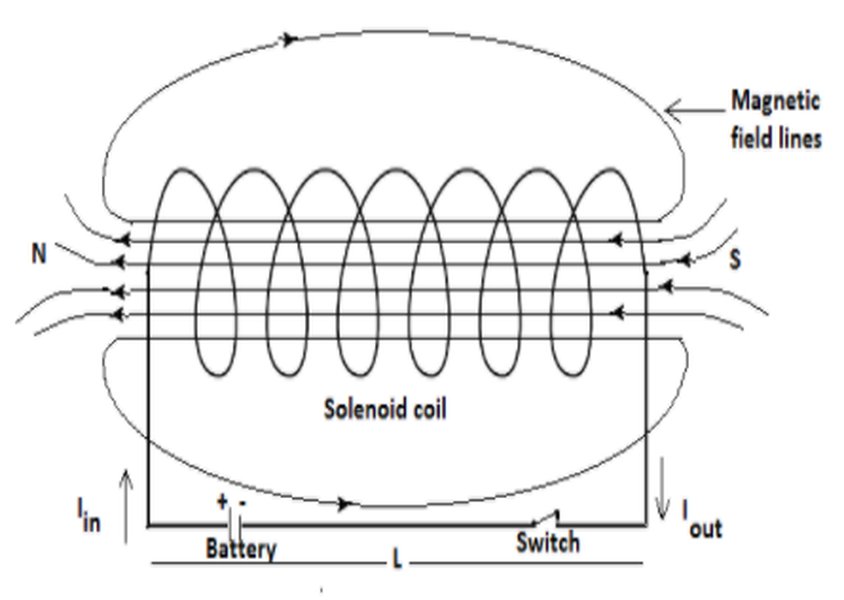
Illustration of the right-hand rule for determining the magnetic field direction in a solenoid.
External Field and Edge Effects
While the internal field is strong and uniform, the magnetic field outside an ideal solenoid is theoretically zero or negligibly weak. For finite-length solenoids, however, there are "fringe fields" near the ends where the field lines spread out and curve, making the external field non-zero but still much weaker than the internal field. The uniformity of the internal field improves significantly as the solenoid's length increases relative to its diameter.
Understanding Solenoid Components and Their Roles
A solenoid's effectiveness hinges on the interplay of its physical construction and the electrical input. Each component plays a vital role in shaping the magnetic field.
| Component/Factor | Description | Impact on Magnetic Field |
|---|---|---|
| Wire Coils (Turns, N) | The conductor wound in a helical pattern. Each loop contributes to the magnetic field. | Directly proportional; more turns mean a stronger field. |
| Solenoid Length (L) | The axial extent of the coiled wire. | Inversely proportional to turn density (N/L); longer length (for fixed N) means weaker field. |
| Electric Current (I) | The flow of charge through the wire. | Directly proportional; higher current means a stronger field. |
| Core Material | The material inside the solenoid's coil. | Ferromagnetic materials (e.g., iron) significantly amplify the field due to high permeability (\(\mu_r\)). Air/vacuum cores have \(\mu_r = 1\). |
| Solenoid Diameter | The width of the coil. | Less direct impact on central field strength, but affects inductance, resistance, and uniformity at ends. |
This table summarizes how various physical and electrical attributes of a solenoid contribute to or modify its magnetic field, highlighting the interdependencies that engineers and physicists must consider in design and application.
Applications and Practical Significance
The ability of solenoids to generate controllable magnetic fields makes them highly versatile. Their applications span across countless industries and technologies.
Everyday and Advanced Uses
- Electromagnets: Solenoids form the basis of temporary electromagnets, used in various lifting applications, relays, and switching mechanisms.
- Actuators: In devices like doorbells, car starter motors, and automatic valves (e.g., in washing machines), solenoids convert electrical energy into mechanical motion by pulling or pushing a plunger.
- Medical Imaging: Magnetic Resonance Imaging (MRI) scanners rely on powerful superconducting solenoids to generate the strong, uniform magnetic fields necessary for producing detailed images of the body's internal structures.
- Particle Accelerators: Large solenoids are used to guide and focus beams of charged particles.
- Inductors: In electronics, solenoids act as inductors, storing energy in their magnetic fields and used in filtering, tuning, and timing circuits.
Deep Dive: The Magnetic Field in a Solenoid
To further enrich your understanding, consider this video that elaborates on the magnetic field within a solenoid, explaining its formation and characteristics in an accessible manner.
This video from AKlectures provides a clear explanation of how to determine the magnetic field inside a solenoid, including the application of the right-hand rule and the factors influencing field strength. It effectively visualizes the concepts discussed, making complex physics more comprehensible.
Conceptual Map of Solenoid Magnetic Fields
This mindmap provides a structured overview of the essential concepts related to the magnetic field of a solenoid, connecting its definition, formula, characteristics, and applications.
This mindmap serves as a quick reference, organizing the multifaceted aspects of solenoid magnetic fields into an easily digestible and interconnected structure, from the basic definition to its practical applications.
Frequently Asked Questions (FAQ)
What is an ideal solenoid?
How does a ferromagnetic core affect the magnetic field?
Can a solenoid's magnetic field be reversed?
Why is the magnetic field inside a solenoid uniform?
Conclusion
The magnetic field of a solenoid is a fundamental concept in electromagnetism, offering a reliable and controllable way to generate magnetic forces. Its strength, uniformity, and direction are precisely dictated by the current, the number of turns, the length, and the core material. From simple relays to complex MRI machines, the solenoid's ability to create a predictable magnetic environment makes it an indispensable component in countless modern technologies, underpinning much of our electrical and electronic infrastructure. Understanding its principles is key to appreciating a vast array of scientific and engineering applications.
Recommended Further Exploration
- Explore detailed applications of solenoids in engineering.
- Investigate Ampere's Law and its derivation for solenoid fields.
- Learn about superconducting solenoids and their advanced uses.
- Understand the magnetic permeability of various core materials.