
The Mammalian Circulatory System: A Double Pathway for Life
Exploring the Heart, Vessels, and Their Vital Connection to Gaseous Exchange
The circulatory system is a vital network within the mammalian body responsible for transporting essential substances and removing waste products. This complex system, consisting of the heart, blood vessels, and blood, works in close concert with the gaseous exchange system, primarily the lungs, to ensure the survival and efficient functioning of the organism. Mammals possess a sophisticated type of circulatory system known as a closed, double circulatory system, which offers significant advantages in terms of metabolic efficiency.
Key Insights into the Mammalian Circulatory System
- Closed System: Blood is always contained within a network of vessels, ensuring efficient transport.
- Double Circulation: Blood passes through the heart twice in one complete circuit of the body, allowing for separate pulmonary and systemic pathways.
- Four-Chambered Heart: A completely divided heart prevents the mixing of oxygenated and deoxygenated blood, maximizing oxygen delivery to tissues.
The Interplay with the Gaseous Exchange System
One of the primary functions of the circulatory system is to facilitate the transport of respiratory gases: oxygen and carbon dioxide. This is where the close relationship with the gaseous exchange system becomes crucial. In mammals, gaseous exchange primarily occurs in the lungs, specifically within tiny air sacs called alveoli.
Oxygen Delivery and Carbon Dioxide Removal
Deoxygenated blood, rich in carbon dioxide, is pumped from the heart to the lungs. At the alveoli, carbon dioxide diffuses from the blood into the air to be exhaled, and oxygen diffuses from the inhaled air into the blood. This newly oxygenated blood then returns to the heart, ready to be pumped to the rest of the body's tissues. The circulatory system, therefore, acts as the transportation highway for these gases, ensuring that cells receive the oxygen they need for cellular respiration and that the waste product, carbon dioxide, is efficiently removed.
The efficiency of this exchange is enhanced by the extensive network of capillaries surrounding the alveoli, providing a large surface area for diffusion. The thin walls of both the alveoli and the capillaries further shorten the diffusion distance, optimizing gas transfer.
The Necessity of a Double Circulatory System in Mammals
Mammals, being endothermic (warm-blooded) and often highly active, have high metabolic demands. They require a constant and efficient supply of oxygen to their tissues to generate enough energy to maintain body temperature and fuel activities. A single circulatory system, where blood passes through the heart only once per circuit of the body (as seen in fish), would not be sufficient to meet these demands.
Single vs. Double Circulation: A Matter of Efficiency
In a single circulatory system, blood flows from the heart to the respiratory organ (gills in fish), then directly to the rest of the body, and finally back to the heart. This results in lower blood pressure in the systemic circulation after passing through the capillaries of the respiratory organ, making the delivery of oxygen to distant tissues less efficient. Also, oxygenated and deoxygenated blood can mix to some extent.
The evolution of a double circulatory system in mammals (and birds) overcomes these limitations. In a double circulatory system, there are two distinct loops:
- Pulmonary Circuit: This loop carries deoxygenated blood from the heart to the lungs for oxygenation and returns oxygenated blood to the heart.
- Systemic Circuit: This loop carries oxygenated blood from the heart to the rest of the body's tissues and returns deoxygenated blood back to the heart.
Advantages of Double Circulation
This separation of oxygenated and deoxygenated blood, facilitated by a four-chambered heart, is a key advantage of double circulation. The left side of the heart pumps oxygenated blood at high pressure to the entire body, ensuring rapid and efficient delivery of oxygen and nutrients to all tissues. The right side of the heart pumps deoxygenated blood to the lungs at a lower pressure, which is important to prevent damage to the delicate lung capillaries.
The higher pressure in the systemic circuit is essential for reaching all parts of the large mammalian body and meeting the high metabolic demands. The lower pressure in the pulmonary circuit protects the delicate lung capillaries from damage. This complete separation and dual pumping action make the mammalian circulatory system highly efficient.
The Arrangement of Blood Vessels
The blood vessels form a vast network that transports blood throughout the body. There are three main types of blood vessels:
- Arteries: These vessels carry blood away from the heart. Arteries typically carry oxygenated blood in the systemic circuit, with the exception of the pulmonary artery, which carries deoxygenated blood to the lungs. Arteries have thick, muscular, and elastic walls to withstand the high pressure of blood pumped from the heart.
- Veins: These vessels carry blood back to the heart. Veins typically carry deoxygenated blood in the systemic circuit, with the exception of the pulmonary veins, which carry oxygenated blood from the lungs to the heart. Veins have thinner walls and larger lumens than arteries. They also have valves, particularly in the limbs, to prevent the backflow of blood due to gravity.
- Capillaries: These are the smallest blood vessels, forming a network that connects arterioles (small arteries) and venules (small veins). Capillary walls are very thin, often only one cell thick, which facilitates the exchange of oxygen, nutrients, and waste products between the blood and the surrounding tissues.
Structure and Function of Blood Vessels
The structure of blood vessels is directly related to their function. Arteries, facing high pressure, have thick, elastic walls composed of three distinct layers or tunics: the tunica intima (innermost layer of endothelial cells), the tunica media (middle layer of smooth muscle and elastic fibers), and the tunica externa (outer layer of connective tissue). The thick tunica media allows arteries to stretch and recoil with each heartbeat, helping to maintain blood pressure.
Veins, carrying blood at lower pressure, have thinner walls with less smooth muscle and elastic tissue. The presence of valves is a crucial adaptation to ensure unidirectional blood flow back to the heart, especially against gravity.
Capillaries, the sites of exchange, have extremely thin walls consisting of a single layer of endothelial cells and a basement membrane. This minimal barrier allows for efficient diffusion of substances between the blood and tissue fluid.
Here is a table summarizing the key differences between arteries, veins, and capillaries:
| Feature | Artery | Vein | Capillary |
|---|---|---|---|
| Direction of Blood Flow | Away from the heart | Towards the heart | Connects arterioles and venules |
| Wall Thickness | Thickest | Thinner than arteries | Thinnest (one cell thick) |
| Elasticity and Muscle | High | Lower | Very low |
| Lumen Size | Smaller | Larger | Very small |
| Valves | Absent (except at the origin of the aorta and pulmonary artery) | Present (especially in limbs) | Absent |
| Pressure | High | Low | Low |
The Mammalian Heart: The Central Pump
The heart is the muscular organ that drives the circulation of blood. In mammals, the heart is a four-chambered structure, completely divided into a left and right side by a septum. This division is crucial for maintaining the separation of oxygenated and deoxygenated blood, a hallmark of double circulation.
Structure of the Four-Chambered Heart
The four chambers are:
- Right Atrium: Receives deoxygenated blood from the body via the vena cava.
- Right Ventricle: Pumps deoxygenated blood to the lungs via the pulmonary artery.
- Left Atrium: Receives oxygenated blood from the lungs via the pulmonary veins.
- Left Ventricle: Pumps oxygenated blood to the rest of the body via the aorta.
One-way valves between the atria and ventricles, and between the ventricles and the major arteries, ensure that blood flows in the correct direction and prevent backflow.
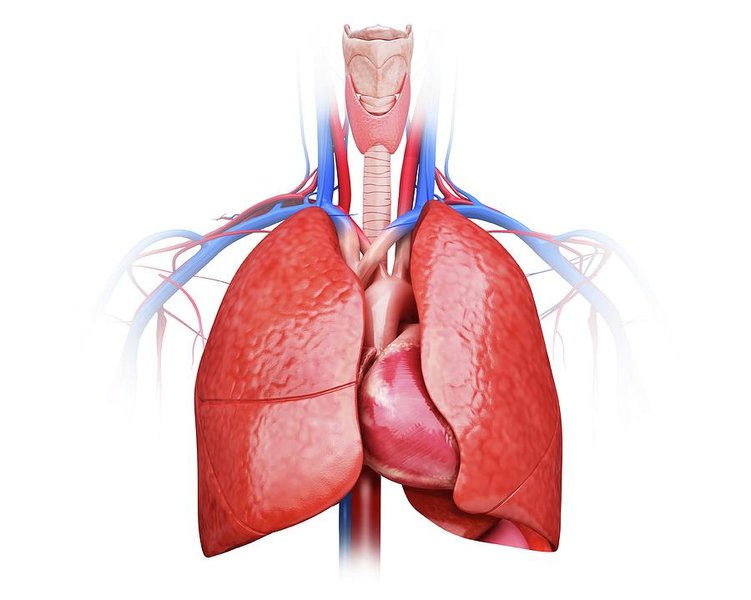
Illustration showing the human heart and lungs, highlighting their close anatomical relationship.
Coronary Circulation
The heart itself is a muscle that requires a constant supply of oxygenated blood to function. This is provided by the coronary circulatory system, a network of arteries and veins that branch from the aorta and supply the heart muscle (myocardium) with blood.
Circulatory Pathways: Pulmonary, Systemic, and Coronary
As mentioned earlier, the mammalian circulatory system is divided into three main circuits:
- Pulmonary Circuit: Blood flows from the right ventricle to the lungs and back to the left atrium. This circuit is responsible for oxygenating the blood.
- Systemic Circuit: Blood flows from the left ventricle to the rest of the body's tissues and back to the right atrium. This circuit delivers oxygen and nutrients and removes waste products.
- Coronary Circuit: This circuit supplies blood specifically to the heart muscle itself.
The coordinated pumping action of the heart ensures that blood flows through these circuits efficiently. The right side of the heart handles the pulmonary circulation, while the left side handles the systemic circulation. This division is essential for maintaining high pressure in the systemic circuit and lower pressure in the pulmonary circuit.
This video provides a visual explanation of the mammalian double circulatory system and its importance.
This video explains the concept of double circulation in mammals, emphasizing how blood passes through the heart twice during a single circuit of the body. It highlights the separation of oxygenated and deoxygenated blood and the different pressure systems in the pulmonary and systemic circuits, reinforcing the advantages of this type of circulatory system for efficient oxygen delivery.
Open vs. Closed Circulatory Systems
While mammals have a closed circulatory system, it's worth noting that some animals have an open circulatory system. In an open system, blood is not confined within vessels but instead bathes the organs directly in a cavity called a hemocoel. This hemolymph, a mixture of blood and interstitial fluid, circulates as the animal moves and the heart beats. Open systems are less efficient at transporting substances over long distances or at high pressure compared to closed systems. The higher metabolic demands of mammals necessitate the more efficient closed, double circulatory system.
The Role of the Circulatory System Beyond Gas Exchange
While gas exchange is a critical function, the circulatory system in mammals performs numerous other vital roles:
-
Nutrient Transport: Digested nutrients are absorbed from the digestive system and transported by the blood to all cells in the body.
-
Waste Removal: Metabolic waste products, such as urea, are transported by the blood to excretory organs like the kidneys for removal from the body.
-
Hormone Transport: Hormones produced by endocrine glands are transported by the blood to target cells and organs throughout the body.
-
Thermoregulation: The circulatory system helps regulate body temperature by distributing heat.
-
Immune Defense: White blood cells, part of the immune system, are transported by the blood to fight infections.
The intricate design of the mammalian circulatory system, with its powerful four-chambered heart and extensive network of specialized blood vessels, is a testament to the evolutionary adaptations required to support the high metabolic rate and complex physiology of mammals.
Frequently Asked Questions about the Mammalian Circulatory System
What is the primary function of the mammalian circulatory system?
The primary function is to transport oxygen, nutrients, hormones, and other essential substances to the body's cells and to remove waste products like carbon dioxide and urea.
Why do mammals have a double circulatory system?
Mammals have a double circulatory system to efficiently supply their high metabolic demands. This system separates oxygenated and deoxygenated blood and allows for high pressure in the systemic circulation to reach all tissues quickly.
What are the main types of blood vessels and their roles?
The main types are arteries (carry blood away from the heart), veins (carry blood towards the heart), and capillaries (sites of exchange between blood and tissues).
How does the heart ensure unidirectional blood flow?
The heart has one-way valves between its chambers and at the origin of the major arteries that prevent the backflow of blood.
What is the difference between the pulmonary and systemic circuits?
The pulmonary circuit transports blood between the heart and the lungs for gas exchange. The systemic circuit transports blood between the heart and the rest of the body's tissues.
References
Last updated May 12, 2025