
Unlocking Battery Potential: Which Manganese Phosphate Fuels LMP & LMFP Cathodes?
Delving into the optimal manganese precursors for next-generation lithium-ion battery materials.
The quest for better lithium-ion batteries constantly drives innovation in cathode materials. Lithium Manganese Phosphate (LMP, \( \text{LiMnPO}_4 \)) and Lithium Manganese Iron Phosphate (LMFP, \( \text{LiMn}_x\text{Fe}_{1-x}\text{PO}_4 \)) stand out as promising candidates, offering enhanced energy density and safety compared to traditional Lithium Iron Phosphate (LFP). A critical aspect of their production lies in selecting the right precursor materials, particularly the form of manganese phosphate used. You've listed several possibilities, and determining the most suitable one requires examining current synthesis methods and their chemical requirements.
Key Insights
Highlights on Precursor Selection
- LMP & LMFP Advantages: These materials combine the safety profile of LFP with the higher voltage and energy density potential derived from manganese, making them attractive for electric vehicles and energy storage.
- Synthesis Matters: The manufacturing process, often involving co-precipitation or solid-state reactions followed by sintering, dictates the ideal characteristics of precursor materials.
- Dibasic Hydrate Preference: Evidence points towards Manganese phosphate, dibasic ( \( \text{MnHPO}_4 \cdot 3\text{H}_2\text{O} \) ) as a particularly suitable precursor, especially for scalable, high-performance synthesis routes like ammonia-free co-precipitation.
Understanding LMP and LMFP Cathodes
The Next Step Beyond LFP
LMP and LMFP belong to the olivine family of crystal structures, similar to LFP ( \( \text{LiFePO}_4 \) ). However, the incorporation of manganese introduces significant benefits and challenges:
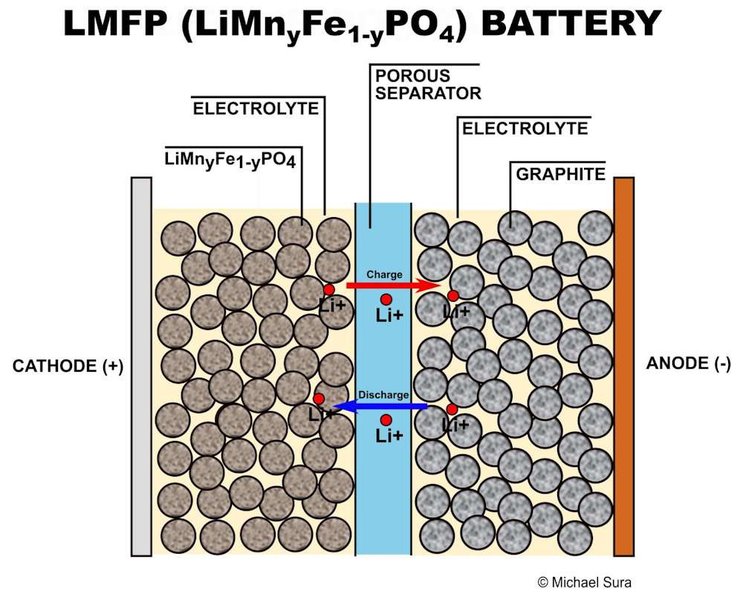
Visualizing the Difference: LFP vs. LMFP Structure
The image above illustrates the structural similarities and differences, highlighting how manganese integration impacts the material properties.
Advantages of Manganese Integration
- Higher Voltage: LMP operates at a higher voltage (~4.1V vs. Li/Li+) compared to LFP (~3.4V), contributing directly to higher energy density.
- Increased Energy Density: LMFP, as a solid solution \( \text{LiMn}_x\text{Fe}_{1-x}\text{PO}_4 \), leverages manganese's higher voltage while retaining iron's structural stability. This can result in energy densities up to 20-25% greater than standard LFP.
- Safety and Stability: Like LFP, both LMP and LMFP benefit from the strong P-O covalent bonds within the phosphate polyanion ( \( (\text{PO}_4)^{3-} \) ), which enhances thermal stability and safety compared to layered oxide cathodes (like NMC or NCA).
- Cost and Sustainability: Manganese and iron are more abundant and less costly than cobalt and nickel, making LMP and LMFP potentially more sustainable and economical options.
Challenges to Address
- Lower Ionic/Electronic Conductivity: Pure LMP suffers from inherently low lithium-ion and electronic conductivity, hindering its rate capability.
- Manganese Dissolution: In some electrolytes or conditions, manganese ions can dissolve from the cathode structure, impacting long-term cycle life.
- Structural Distortions: The Jahn-Teller distortion associated with \( \text{Mn}^{3+} \) ions can induce strain during cycling.
LMFP effectively mitigates some of LMP's drawbacks by incorporating iron, which improves structural stability and conductivity. Advanced synthesis techniques, particle size reduction (nanostructuring), carbon coating, and doping with other elements are crucial strategies employed to overcome these challenges and unlock the full potential of LMP and LMFP materials.
Synthesis Routes and Precursor Selection
Choosing the Right Starting Materials
The manufacturing process heavily influences the choice of manganese phosphate precursor. Common methods include:
- Solid-State Reaction: Involves mixing powders of lithium, manganese (and iron for LMFP), and phosphate sources, followed by high-temperature calcination/sintering. This method is straightforward but can lead to larger particles and less homogeneity.
- Co-Precipitation: Involves dissolving salts of the constituent metals (Li, Mn, Fe) and phosphate source in a solvent, then precipitating a precursor compound. This method allows for better control over particle size, morphology, and compositional homogeneity, often leading to superior electrochemical performance.
- Hydrothermal/Solvothermal Synthesis: Uses elevated temperatures and pressures in aqueous or non-aqueous solvents to synthesize the cathode material or its precursor.
Evaluating Manganese Phosphate Forms
Based on synthesis requirements documented in recent research, particularly methods aiming for high performance and scalability, we can assess the suitability of the manganese phosphate forms you listed:
1. Manganese phosphate, dibasic (Manganese hydrogen phosphate) \( \text{MnHPO}_4 \cdot 3\text{H}_2\text{O} \)
Suitability: Most Promising. This form aligns well with advanced co-precipitation methods. Research highlights the use of precursors structurally related to dibasic manganese phosphate hydrates, such as \( (\text{Mn, Fe})_5(\text{PO}_4)_2(\text{HPO}_4)_2 \cdot 4\text{H}_2\text{O} \). These precursors are advantageous because:
- They enable ammonia-free synthesis, which is more environmentally friendly and scalable.
- They facilitate the formation of homogenous LMFP solid solutions with controlled Mn:Fe ratios (e.g., 60-80% Mn).
- They can lead to materials with high surface area, good tap density, and excellent electrochemical performance, including high capacity retention (e.g., >95% after 150 cycles at C/3).
- The hydrated nature (\( \cdot 3\text{H}_2\text{O} \)) likely aids in achieving the desired olivine crystal structure and phase purity during synthesis.
Sources investigating these advanced co-precipitation routes strongly suggest the relevance of precursors derived from or similar to dibasic manganese phosphate hydrates.
2. Manganese phosphate, tribasic (Manganese phosphate) \( \text{Mn}_3(\text{PO}_4)_2 \) and \( \text{Mn}_3(\text{PO}_4)_2 \cdot 3\text{H}_2\text{O} \)
Suitability: Potentially Relevant, Less Evidenced for Advanced Methods. Tribasic manganese phosphate provides the necessary Mn and PO4 ions and might be used in traditional solid-state reaction pathways. However, contemporary research focusing on high-performance materials often favors co-precipitation routes where dibasic forms or their derivatives show more promise due to potentially better reactivity and control over precursor morphology. There's less specific evidence in recent literature highlighting tribasic forms as optimal for state-of-the-art LMP/LMFP synthesis compared to dibasic hydrates.
3. Manganese(II) Phosphate Monobasic Tetrahydrate (Manganese dihydrogen phosphate) \( \text{Mn(H}_2\text{PO}_4)_2 \cdot 4\text{H}_2\text{O} \)
Suitability: Less Likely. This dihydrogen phosphate form is not commonly cited as a preferred precursor in the synthesis literature for LMP/LMFP. The stoichiometry and structure might be less ideal for direct incorporation into the olivine lattice compared to dibasic or tribasic forms.
4. Manganese orthophosphate, \( \text{MnPO}_4 \cdot \text{H}_2\text{O} \) (serrabrancaite) & Manganese(III) phosphate monohydrate
Suitability: Less Likely for Standard LMP/LMFP. These involve Manganese in the +3 oxidation state (\( \text{Mn}^{3+} \)). While \( \text{Mn}^{3+} \) is involved in the electrochemical reaction of LMP/LMFP (\( \text{Mn}^{2+} \leftrightarrow \text{Mn}^{3+} \)), using a \( \text{Mn}^{3+} \) precursor might complicate the synthesis process which typically starts from \( \text{Mn}^{2+} \) sources (like \( \text{MnSO}_4 \) or \( \text{MnCO}_3 \) reacting with a phosphate source). Standard synthesis aims to form \( \text{LiMn}^{II}\text{PO}_4 \) initially.
5. Manganese ammonium phosphate \( \text{NH}_4\text{MnPO}_4 \cdot \text{H}_2\text{O} \)
Suitability: Undesirable. The presence of ammonium (\( \text{NH}_4^+ \)) is generally avoided. Modern synthesis methods, like the ammonia-free co-precipitation mentioned earlier, are preferred for sustainability and to prevent potential ammonia release or incorporation of nitrogen impurities during high-temperature processing, which could negatively affect battery performance and safety.
Summary Table of Manganese Phosphate Suitability
This table summarizes the assessment based on current synthesis trends for high-performance LMP/LMFP materials:
| Manganese Phosphate Form | Formula | Assessed Suitability for LMP/LMFP Synthesis | Reasoning |
|---|---|---|---|
| Manganese(II) Phosphate Monobasic Tetrahydrate | \( \text{Mn(H}_2\text{PO}_4)_2 \cdot 4\text{H}_2\text{O} \) | Low | Stoichiometry/structure less ideal; not commonly cited. |
| Manganese phosphate, dibasic | \( \text{MnHPO}_4 \cdot 3\text{H}_2\text{O} \) | High | Aligns with precursors used in high-performance, scalable co-precipitation methods (e.g., ammonia-free); hydrated form beneficial. |
| Manganese phosphate, tribasic | \( \text{Mn}_3(\text{PO}_4)_2 \) / \( \cdot 3\text{H}_2\text{O} \) | Moderate | Potentially used in solid-state methods; less evidence for optimal performance compared to dibasic-derived precursors in advanced methods. |
| Manganese orthophosphate / Mn(III) phosphate | \( \text{MnPO}_4 \cdot \text{H}_2\text{O} \) | Low | Involves Mn(III) state, potentially complicating standard synthesis starting from Mn(II). |
| Manganese ammonium phosphate | \( \text{NH}_4\text{MnPO}_4 \cdot \text{H}_2\text{O} \) | Low / Undesirable | Ammonium presence leads to impurity risks and contradicts trends towards ammonia-free synthesis. |
Visualizing Cathode Material Properties
Comparing LFP, LMP, and LMFP
To better understand the trade-offs, this chart compares key performance characteristics of LFP, LMP, and a representative high-manganese LMFP. Note that these values are illustrative and can vary significantly based on specific composition, synthesis method, particle size, coating, and testing conditions.
As shown, LMFP aims to capture a balance, offering improved energy density and voltage over LFP while maintaining good safety and cycle life, often at a competitive cost point.
Mapping the LMP/LMFP Landscape
Key Factors in Material Development
This mindmap illustrates the interconnected factors involved in developing and manufacturing LMP and LMFP cathode materials, from precursors to final performance.
(e.g., Ammonia-Free)"] id3c["Hydrothermal / Solvothermal"] id3d["Sintering / Calcination"] id4["Precursors"] id4a["Lithium Source (e.g., Li2CO3, LiOH)"] id4b["Phosphate Source (e.g., H3PO4, NH4H2PO4)"] id4c["Iron Source (for LMFP) (e.g., FeSO4, FeC2O4)"] id4d["Manganese Source"] id4d1["MnHPO4 . 3H2O (Dibasic Hydrate)
Preferred for Co-precipitation"] id4d2["Mn3(PO4)2 (Tribasic)
Possible for Solid-State"] id4d3["Other Mn Sources (MnSO4, MnCO3)"] id5["Performance Enhancement"] id5a["Carbon Coating"] id5b["Particle Size Reduction (Nanostructuring)"] id5c["Ion Doping (e.g., Mg, Ti, Zn)"] id5d["Morphology Control"]
The mindmap highlights how the choice of precursors, like the specific form of manganese phosphate, directly influences the synthesis pathway and ultimately impacts the material's properties and performance enhancements needed.
Deep Dive into LMFP Technology
Exploring CATL's M3P Chemistry
The development of LMFP is rapidly evolving, with major battery manufacturers investing in related technologies. One prominent example is CATL's "M3P" chemistry, which is widely understood to be based on LMFP technology, possibly with additional doping elements to further enhance performance. This video provides an insightful analysis of the potential composition and characteristics of such advanced manganese-based phosphate cathodes.
Understanding these commercial developments underscores the industrial relevance and potential of LMFP materials, where optimized synthesis using suitable precursors like manganese phosphate dibasic hydrate plays a crucial role.
Frequently Asked Questions (FAQ)
Clarifying Common Queries
Why is Manganese Phosphate Dibasic Hydrate preferred?
Manganese phosphate dibasic hydrate (\( \text{MnHPO}_4 \cdot 3\text{H}_2\text{O} \)) is favored, particularly in advanced co-precipitation synthesis routes, because it allows for better control over particle morphology, homogeneity, and stoichiometry in the precursor phase. This leads to final LMP/LMFP materials with improved electrochemical performance (higher capacity, better rate capability, longer cycle life). Its structure is closely related to intermediate precursors identified in scalable, high-performance, ammonia-free synthesis processes described in recent scientific literature.
What is the main advantage of LMFP over LFP?
The primary advantage of LMFP (\( \text{LiMn}_x\text{Fe}_{1-x}\text{PO}_4 \)) over LFP (\( \text{LiFePO}_4 \)) is its potential for higher energy density. This stems from the higher operating voltage of the \( \text{Mn}^{2+}/\text{Mn}^{3+} \) redox couple (~4.1V) compared to the \( \text{Fe}^{2+}/\text{Fe}^{3+} \) couple (~3.4V). By incorporating manganese, LMFP batteries can store more energy in the same weight or volume, potentially increasing the range of electric vehicles or the capacity of energy storage systems, while largely maintaining the excellent safety characteristics of LFP.
What does the 'x' in \( \text{LiMn}_x\text{Fe}_{1-x}\text{PO}_4 \) represent?
The 'x' in the formula \( \text{LiMn}_x\text{Fe}_{1-x}\text{PO}_4 \) represents the molar fraction of manganese substituted onto the iron sites within the olivine crystal structure. The value of 'x' can range from 0 (pure LFP) to 1 (pure LMP). In practical LMFP materials, 'x' is typically between 0.5 and 0.8 (i.e., 50-80% manganese content) to balance energy density gains from manganese with the stability and conductivity benefits provided by iron.
Are there other important precursors besides manganese phosphate?
Yes, absolutely. Manufacturing LMP and LMFP requires sources for all constituent elements. Besides the manganese source (like manganese phosphate dibasic hydrate, manganese sulfate, or manganese carbonate), key precursors include a lithium source (commonly lithium carbonate \( \text{Li}_2\text{CO}_3 \) or lithium hydroxide \( \text{LiOH} \)), an iron source for LMFP (such as iron(II) sulfate \( \text{FeSO}_4 \) or iron(II) oxalate \( \text{FeC}_2\text{O}_4 \)), and a phosphate source (often phosphoric acid \( \text{H}_3\text{PO}_4 \) or ammonium phosphates like \( \text{NH}_4\text{H}_2\text{PO}_4 \), though the latter introduces ammonia concerns). The purity, reactivity, and particle characteristics of all precursors are critical for successful synthesis.
References
Supporting Literature and Resources
-
Scalable ammonia-free co-precipitation synthesis of lithium manganese iron phosphate cathode material with excellent electrochemical performance - ScienceDirect
-
Recent progress in the synthesis methods of LiMnxFe1-xPO4 cathode materials for lithium-ion batteries - ScienceDirect
- Unlocking the Performance of Layered Lithium Manganese Iron Phosphate Cathode - ACS Energy & Fuels
- Lithium Manganese Iron Phosphate - Battery Design
- Modification Strategies for Enhancing the Performance of Lithium Manganese Iron Phosphate Cathodes - Chemistry–Methods
- Synthesis of high-performance LiMnPO4/C composites - RSC Publishing
- LMFP Batteries: Potential Next-Generation Mainstream Technology - Mitsui & Co. Global Strategic Studies Institute
Recommended Reading
Explore Further Insights
Last updated April 15, 2025