
Comprehensive Synthesis of Manganese(II) Hydrogen Phosphate (MnHPO₄·3H₂O)
A detailed guide to synthesizing MnHPO₄·3H₂O from various manganese precursors, evaluating their suitability, and outlining the associated chemical processes.
Key Highlights
- Manganese(II) hydrogen phosphate (MnHPO₄·3H₂O) can be synthesized from various manganese precursors, including manganese carbonate (MnCO₃), manganese sulfate hydrate (MnSO₄·H₂O), and manganese oxalate (MnC₂O₄·2H₂O).
- The synthesis method typically involves reacting the manganese precursor with phosphoric acid (H₃PO₄) under specific conditions to precipitate MnHPO₄·3H₂O.
- Manganese carbonate is often considered a suitable precursor due to its ease of reaction with phosphoric acid and the formation of carbon dioxide as a byproduct, which helps drive the reaction forward.
Introduction to Manganese(II) Hydrogen Phosphate (MnHPO₄·3H₂O)
Manganese(II) hydrogen phosphate trihydrate (MnHPO₄·3H₂O) is a chemical compound of interest in various applications, including catalysis, materials science, and as a precursor for other manganese compounds. The synthesis of MnHPO₄·3H₂O can be achieved through several routes, each utilizing different manganese precursors. This document details the synthesis methods using manganese carbonate (MnCO₃), manganese sulfate hydrate (MnSO₄·H₂O), and manganese oxalate (MnC₂O₄·2H₂O) as starting materials, and evaluates the suitability of each precursor.
Synthesis Methods Using Different Manganese Precursors
1. Synthesis from Manganese Carbonate (MnCO₃)
Manganese carbonate (MnCO₃) is a common precursor for synthesizing various manganese compounds. Its reaction with phosphoric acid is relatively straightforward. The general reaction can be represented as:
\[ \text{MnCO}_3 + \text{H}_3\text{PO}_4 \rightarrow \text{MnHPO}_4 + \text{H}_2\text{O} + \text{CO}_2 \]Detailed Procedure:
- Preparation of Reactants: Dissolve a known amount of manganese carbonate in distilled water to form a suspension. Prepare a phosphoric acid solution of known concentration.
- Reaction: Slowly add the phosphoric acid solution to the manganese carbonate suspension under constant stirring. The reaction produces carbon dioxide, which helps in mixing and driving the reaction to completion.
- Precipitation: Allow the reaction to proceed until all the manganese carbonate is dissolved. The manganese(II) hydrogen phosphate will precipitate out of the solution.
- Washing and Drying: Filter the precipitate and wash it thoroughly with distilled water to remove any unreacted acid or byproducts. Dry the washed precipitate in an oven at a low temperature (e.g., 60°C) to obtain MnHPO₄·3H₂O.
2. Synthesis from Manganese Sulfate Hydrate (MnSO₄·H₂O)
Manganese sulfate hydrate (MnSO₄·H₂O) can also be used as a precursor. The reaction involves a double displacement reaction with a phosphate salt, such as sodium phosphate (Na₂HPO₄). The general reaction is:
\[ \text{MnSO}_4 + \text{Na}_2\text{HPO}_4 \rightarrow \text{MnHPO}_4 + \text{Na}_2\text{SO}_4 \]Detailed Procedure:
- Preparation of Reactants: Dissolve manganese sulfate hydrate in distilled water. Separately, dissolve disodium hydrogen phosphate (Na₂HPO₄) in distilled water.
- Reaction: Mix the two solutions together under constant stirring. Manganese(II) hydrogen phosphate will precipitate out, along with sodium sulfate.
- Precipitation and Washing: Allow the mixture to stand for a period to ensure complete precipitation. Filter the precipitate and wash it several times with distilled water to remove the sodium sulfate byproduct.
- Drying: Dry the washed precipitate in an oven at a low temperature (e.g., 60°C) to obtain MnHPO₄·3H₂O.
3. Synthesis from Manganese Oxalate (MnC₂O₄·2H₂O)
Manganese oxalate (MnC₂O₄·2H₂O) can be used as a precursor, where it reacts with phosphoric acid to form manganese(II) hydrogen phosphate and oxalic acid.
\[ \text{MnC}_2\text{O}_4 + \text{H}_3\text{PO}_4 \rightarrow \text{MnHPO}_4 + \text{H}_2\text{C}_2\text{O}_4 \]Detailed Procedure:
- Preparation of Reactants: Prepare a suspension of manganese oxalate dihydrate in distilled water. Prepare a solution of phosphoric acid with a known concentration.
- Reaction: Add the phosphoric acid solution slowly to the manganese oxalate suspension under constant stirring. The reaction will produce oxalic acid as a byproduct.
- Precipitation: Allow the reaction to proceed until the manganese oxalate is fully reacted. The manganese(II) hydrogen phosphate will precipitate.
- Washing and Drying: Filter the precipitate, washing it thoroughly with distilled water to remove any residual oxalic acid. Dry the washed precipitate in an oven at a low temperature (e.g., 60°C) to obtain MnHPO₄·3H₂O.
Suitability Evaluation of Precursors
Each of the precursors has its advantages and disadvantages. Here’s an evaluation:
Manganese Carbonate (MnCO₃):
- Advantages: Reacts readily with phosphoric acid, producing carbon dioxide as a byproduct, which aids in the reaction process.
- Disadvantages: May require careful control of pH to prevent the formation of other manganese phosphates.
Manganese Sulfate Hydrate (MnSO₄·H₂O):
- Advantages: Relatively inexpensive and readily available.
- Disadvantages: The reaction produces sodium sulfate as a byproduct, which requires thorough washing to remove.
Manganese Oxalate (MnC₂O₄·2H₂O):
- Advantages: Can be used as a precursor for synthesizing manganese oxide nanostructures.
- Disadvantages: The oxalic acid byproduct can be hazardous and requires careful handling and thorough washing.
Considering these factors, manganese carbonate (MnCO₃) is often the most suitable precursor due to its ease of reaction and the relatively benign nature of the carbon dioxide byproduct.
Factors Influencing the Synthesis
Reaction Conditions
The synthesis of MnHPO₄·3H₂O is influenced by several factors, including pH, temperature, and reactant concentration. Maintaining the correct pH is crucial to ensure the formation of the desired manganese(II) hydrogen phosphate phase. Temperature affects the reaction kinetics and the solubility of the reactants and products. Reactant concentration influences the precipitation rate and the purity of the final product.
Purity and Characterization
The purity of the synthesized MnHPO₄·3H₂O can be assessed using various analytical techniques, such as X-ray diffraction (XRD), scanning electron microscopy (SEM), and Fourier transform infrared spectroscopy (FTIR). XRD confirms the crystalline phase of the product. SEM provides information on the morphology and particle size. FTIR spectroscopy identifies the presence of characteristic functional groups.
X-ray Diffraction (XRD): This technique is employed to confirm the formation of the rhodochrosite phase of MnCO₃.
Scanning Electron Microscopy (SEM) and Transmission Electron Microscopy (TEM): These methods reveal that nanograins smaller than 10 nm agglomerate into submicron-sized spherical particles of MnCO3.
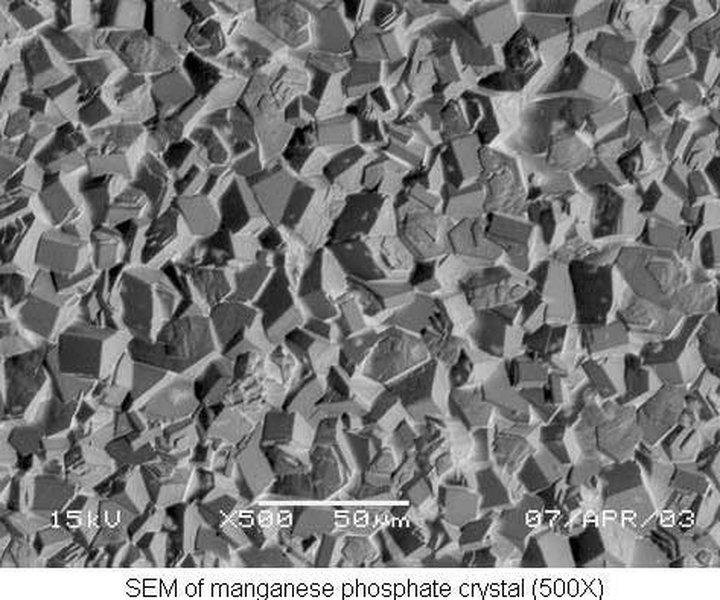
Manganese Phosphate Crystal Structure
Applications of MnHPO₄·3H₂O
Manganese(II) hydrogen phosphate trihydrate has several applications, including:
-
Precursor for Manganese Oxides: MnHPO₄·3H₂O can be thermally decomposed to produce manganese oxides, which are used in catalysis, energy storage, and other applications.
-
Coatings: Manganese phosphates are used in phosphate conversion coatings to protect steel surfaces.
-
Nutritional Supplement: Manganese compounds are used as nutritional supplements in agriculture and animal feed.
Summary of Synthesis Methods
The following table summarizes the synthesis methods, including the reactants, byproducts, and key considerations for each precursor.
| Precursor | Reactant | Reaction | Byproduct(s) | Key Considerations |
|---|---|---|---|---|
| Manganese Carbonate (MnCO₃) | Phosphoric Acid (H₃PO₄) | MnCO₃ + H₃PO₄ → MnHPO₄ + H₂O + CO₂ | Water, Carbon Dioxide | Control pH to prevent other phosphate formation |
| Manganese Sulfate Hydrate (MnSO₄·H₂O) | Disodium Hydrogen Phosphate (Na₂HPO₄) | MnSO₄ + Na₂HPO₄ → MnHPO₄ + Na₂SO₄ | Sodium Sulfate | Thorough washing to remove sodium sulfate |
| Manganese Oxalate (MnC₂O₄·2H₂O) | Phosphoric Acid (H₃PO₄) | MnC₂O₄ + H₃PO₄ → MnHPO₄ + H₂C₂O₄ | Oxalic Acid | Careful handling of oxalic acid byproduct |
FAQ Section
What is the primary use of MnHPO₄·3H₂O?
MnHPO₄·3H₂O is primarily used as a precursor for synthesizing manganese oxides, which have applications in catalysis, energy storage, and other fields. It is also used in phosphate conversion coatings.
Why is manganese carbonate often preferred over other precursors?
Manganese carbonate is often preferred because it reacts readily with phosphoric acid, producing carbon dioxide as a byproduct, which aids in driving the reaction to completion and is relatively benign.
What are the main factors to consider during the synthesis process?
The main factors to consider include pH, temperature, reactant concentration, and thorough washing of the precipitate to remove byproducts.
How can the purity of the synthesized MnHPO₄·3H₂O be assessed?
The purity can be assessed using analytical techniques such as X-ray diffraction (XRD), scanning electron microscopy (SEM), and Fourier transform infrared spectroscopy (FTIR).
What precautions should be taken when using manganese oxalate as a precursor?
When using manganese oxalate, precautions should be taken to handle the oxalic acid byproduct carefully due to its hazardous nature. Thorough washing is necessary to remove residual oxalic acid.
References
Last updated April 15, 2025