
Mangrove Projects in the Voluntary Carbon Market
Exploring Acceptance and Superior Decarbonization Capabilities
Key Takeaways
- Acceptance in VCM: Mangrove restoration and conservation projects are widely accepted in the voluntary carbon market, recognized for their significant carbon sequestration potential.
- Superior Carbon Sequestration: Scientific studies consistently demonstrate that mangroves store carbon more efficiently than terrestrial forests, particularly in their soil systems.
- Additional Ecosystem Benefits: Beyond carbon capture, mangrove projects provide critical ecosystem services such as coastal protection, biodiversity support, and socio-economic benefits to local communities.
Acceptance of Mangrove Projects in the Voluntary Carbon Market
The voluntary carbon market (VCM) has increasingly recognized the value of mangrove ecosystems in climate mitigation efforts. Mangrove restoration and conservation projects are classified under "blue carbon" initiatives, which focus on the carbon sequestration capabilities of coastal and marine ecosystems. These projects generate carbon credits, known as Verified Carbon Units (VCUs), which can be purchased by individuals, companies, and organizations seeking to offset their carbon emissions.
Integration into VCM Frameworks
Mangrove projects have been successfully integrated into various VCM frameworks, including standards set by Verra's Verified Carbon Standard and the Gold Standard. These frameworks ensure that the carbon sequestration claims of mangrove projects are credible, additional, and permanent through rigorous verification processes.
Successful Mangrove Projects
Several high-profile mangrove projects have set benchmarks in the VCM:
- Indus Delta Mangrove Restoration Project in Pakistan: Supported by Verra's Verified Carbon Standard, this project focuses on restoring mangrove areas to enhance carbon sequestration and support local livelihoods.
- Mikoko Pamoja Project in Kenya: Pioneered by Plan Vivo in 2014, this project became the first blue carbon initiative to issue carbon credits, emphasizing community-based mangrove conservation.
- Vida Manglar Project in Colombia: This extensive project conserves and restores 7,500 hectares of mangroves, with an estimated sequestration of up to 1 million metric tons of carbon over 30 years.
Benefits Beyond Carbon Sequestration
Mangrove projects offer multifaceted benefits that enhance their attractiveness within the VCM:
- Coastal Protection: Mangroves act as natural barriers against storm surges and erosion, safeguarding coastal communities.
- Biodiversity Support: These ecosystems serve as nurseries for numerous marine species, contributing to biodiversity conservation.
- Socio-Economic Advantages: Mangrove projects often engage and benefit local communities through sustainable livelihood opportunities, fostering socio-economic development.
Superior Decarbonization Capabilities of Mangroves
Mangroves are renowned for their exceptional carbon sequestration abilities, surpassing those of many terrestrial forests. This superior performance is attributed to several unique biological and environmental factors inherent to mangrove ecosystems.
Scientific Evidence Supporting Mangroves' Superior Carbon Storage
Extensive research underscores the unparalleled carbon storage capacity of mangroves:
- Higher Carbon Density: Mangroves can store up to four times more carbon per hectare than tropical rainforests. For instance, studies by Donato et al. (2011) and McLeod et al. (2011) highlight that mangroves sequester approximately 1,023 Mg (megagrams) of carbon per hectare, compared to 200-500 Mg per hectare in terrestrial forests.
- Deep Organic-Rich Soils: The anaerobic, waterlogged conditions in mangrove soils slow down decomposition rates, leading to significant accumulation of organic carbon over time.
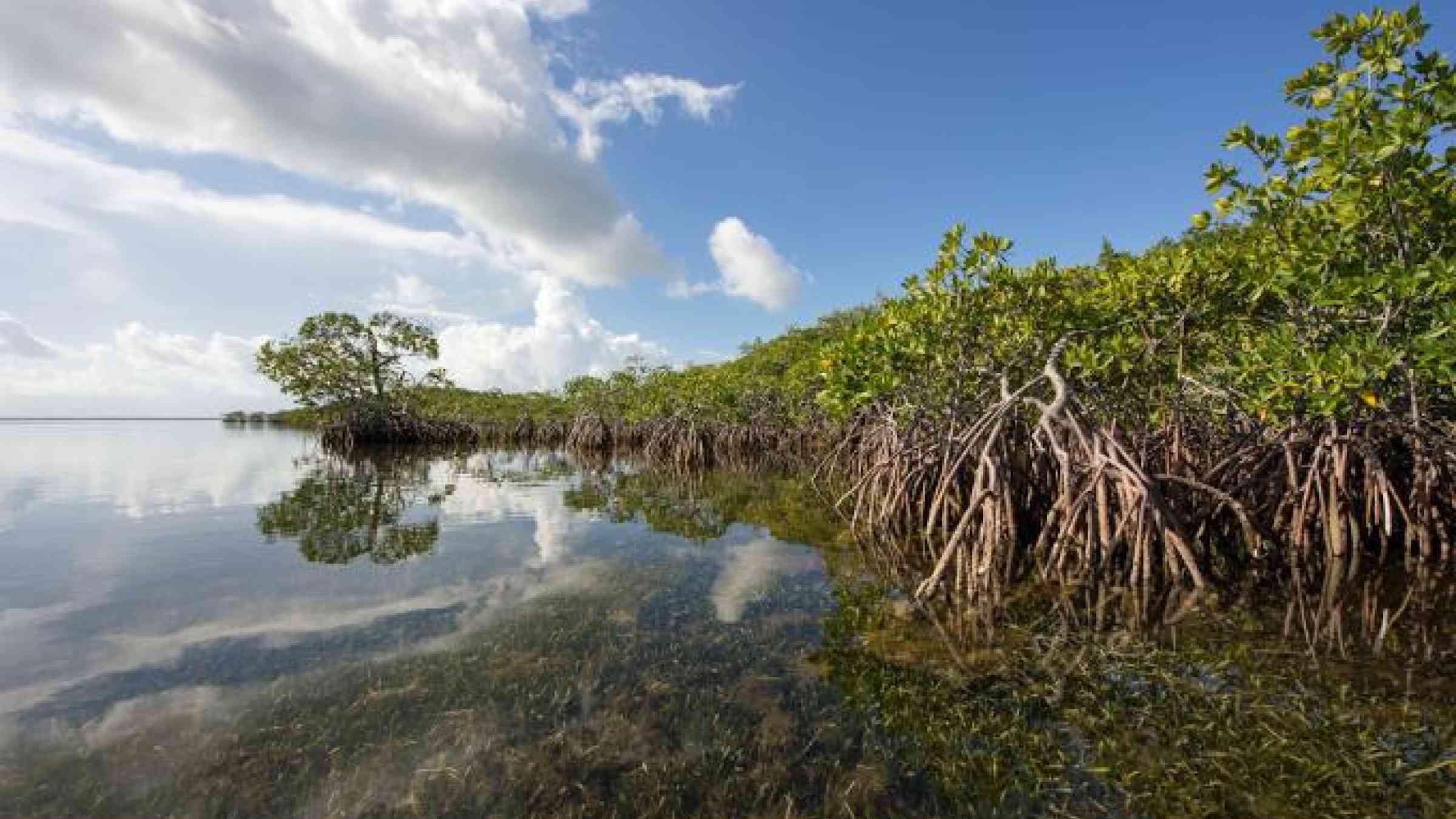
- Complex Root Systems: The intricate root structures of mangroves trap and stabilize sediments, effectively locking carbon away for centuries to millennia.
- High Productivity: Mangroves exhibit high primary productivity, facilitating continuous carbon uptake and storage.
Comparative Analysis with Terrestrial Forests
When compared to other forest types, mangroves demonstrate superior carbon sequestration in several key aspects:
| Attribute | Mangroves | Terrestrial Forests |
|---|---|---|
| Carbon Storage per Hectare | ~1,023 Mg C/ha | 200-500 Mg C/ha |
| Carbon Sequestration Rate | 2-4 times higher annually | Standard rates as per species and region |
| Soil Carbon Accumulation | Significantly higher due to anaerobic conditions | Lower, dependent on soil type and climate |
| Permanence of Carbon Storage | Lock-in for centuries to millennia | Varies, generally shorter durations |
Mechanisms Enhancing Mangroves' Carbon Sequestration
The inherent characteristics of mangroves contribute to their superior carbon sequestration capabilities:
-
Sediment Trapping: Mangroves capture and stabilize sediments through their root systems, which not only build up soil but also reduce erosion and promote long-term carbon storage.
-
Low Oxygen Conditions: The waterlogged soils of mangroves create low-oxygen environments that inhibit the decomposition of organic matter, allowing carbon to accumulate over extended periods.
-
High Biomass Production: Mangroves exhibit robust growth rates, leading to substantial biomass accumulation and carbon uptake.
Comparative Carbon Sequestration: Mangroves vs. Terrestrial Forests
A detailed comparison between mangroves and terrestrial forests reveals significant differences in their carbon sequestration potentials:
Carbon Sequestration Rates
Mangroves can sequester carbon at rates that are 2 to 4 times higher than mature tropical forests. This is primarily due to their ability to accumulate large amounts of organic matter in their soils and biomass.
Soil Carbon Storage
The soils beneath mangroves are rich in organic carbon, often storing up to five times more carbon than those found in tropical upland forests. The anaerobic conditions reduce microbial activity, slowing the decomposition process and allowing carbon to remain locked in the soil for longer periods.
Biomass Accumulation
Mangroves possess dense and complex root systems that not only facilitate sediment trapping but also contribute to higher biomass accumulation. This dense biomass directly translates to increased carbon storage within the plant structure itself.
Long-Term Carbon Permanence
The structural stability of mangroves ensures that the sequestered carbon remains stored for centuries to millennia. In contrast, terrestrial forests are more susceptible to disturbances such as wildfires, logging, and pests, which can release stored carbon back into the atmosphere.
<!-- Example of Mangrove Carbon Sequestration Mechanism -->
<div class="mangrove-carbon-sequestration">
  <h4 style="color:#7FA86E">Sediment Trapping</h4>
  <p>Mangrove roots stabilize sediments, preventing erosion and facilitating the accumulation of organic-rich soils.</p>
</div>
Conclusion
Mangrove ecosystems play a pivotal role in the voluntary carbon market due to their exceptional carbon sequestration capabilities. Scientific research consistently demonstrates that mangroves outperform many terrestrial forests in terms of carbon storage per hectare, primarily owing to their unique soil conditions and biomass accumulation. Additionally, mangrove projects offer a suite of ecosystem services that enhance their value within the VCM, including coastal protection, biodiversity conservation, and socio-economic benefits for local communities. As climate change mitigation efforts intensify, the inclusion of mangrove projects in the voluntary carbon market represents a highly effective and sustainable strategy for reducing atmospheric carbon levels.
References
Last updated January 28, 2025