
MapleStory N's Star Force Revolution: How Blockchain Changes Everything
Explore the classic enhancement system reimagined with NFTs, finite supply, and dynamic pricing in MapleStory Universe.
MapleStory, a franchise beloved by millions for over two decades, is entering a new era with MapleStory Universe. Its flagship PC MMORPG, MapleStory N, is set to launch globally on May 15, 2025, leveraging the Avalanche blockchain. This new iteration blends the classic MapleStory experience with innovative Web3 features, including a revamped approach to the iconic equipment enhancement system: Star Force. This guide delves into what Star Force is and how its mechanics are evolving within MapleStory N's unique blockchain-integrated economy.
Key Highlights of Star Force in MapleStory N
- Core Enhancement, Evolved: Star Force remains the primary way to significantly boost equipment power by adding 'stars', but it's deeply integrated with the new economic model.
- Blockchain & NFTs: Enhanced items are often tied to limited-quantity NFTs on the Avalanche blockchain, making them transparently owned, scarce, and freely tradable digital assets.
- Demand-Driven Economics: Unlike static costs in traditional MapleStory, the price to attempt Star Force enhancements in MapleStory N fluctuates based on real-time player demand, creating a dynamic market.
Understanding the Core: What is Star Force?
The Foundation of Power Progression
At its heart, Star Force is an equipment enhancement system present throughout the MapleStory franchise. Its fundamental purpose is to allow players to significantly increase the power of their gear (weapons, armor, accessories) beyond standard upgrades. This is achieved by successfully applying "stars" to an item. Each added star incrementally boosts various stats, such as Weapon Attack (WATK), Magic Attack (MATK), primary stats (STR, DEX, INT, LUK), HP, and potentially other attributes depending on the item and star count.
In traditional MapleStory, accumulating high Star Force on equipment becomes crucial for tackling high-level content, particularly in designated "Star Force Hunting Zones." These areas contain powerful monsters that require players to have a certain amount of total Star Force across their equipped items to deal optimal damage and mitigate incoming damage. Failing to meet the map's requirement results in significantly reduced damage output and increased damage taken, making Star Force a vital component of character progression.
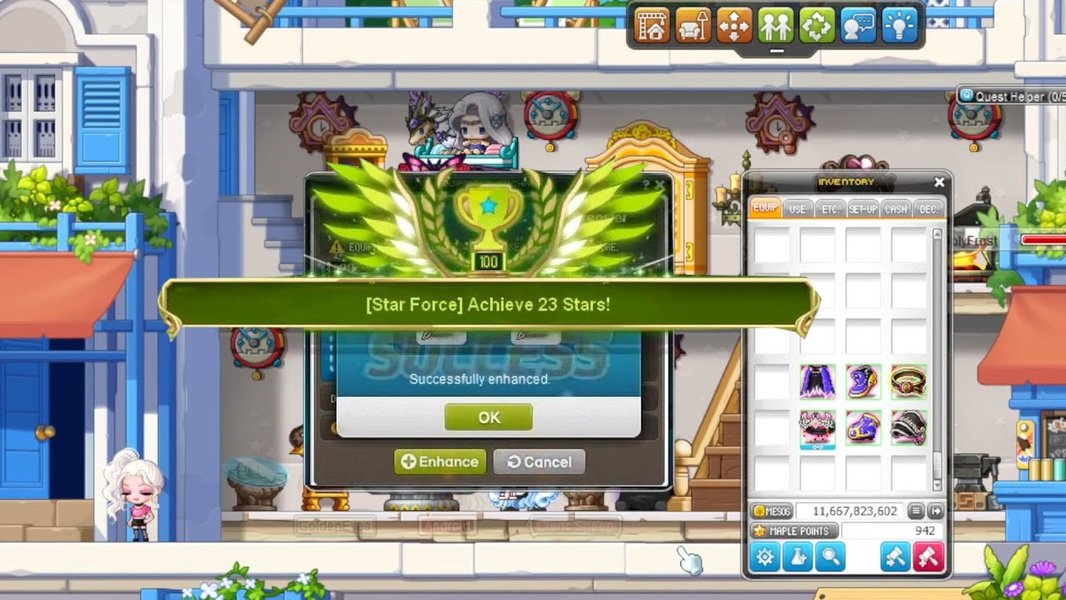
Visual example of the intense Star Forcing process, aiming for high star counts.
The MapleStory N Difference: Blockchain Integration and Economic Shifts
Moving Beyond Traditional Limits
While the core concept of adding stars for power remains, MapleStory N fundamentally changes the context and economics surrounding Star Force by integrating it with blockchain technology and real-world economic principles. This contrasts sharply with traditional MapleStory, where enhancement costs were often static (or only changed via patches/events) and items could be generated in virtually unlimited quantities.
Finite Supply and NFT Ownership
A cornerstone of MapleStory N's design is the concept of finite item quantities. Unlike previous iterations, many powerful equipment items, especially those eligible for high Star Force levels, will exist in limited numbers. These items are often tokenized as Non-Fungible Tokens (NFTs) on the Avalanche blockchain. This means:
- True Ownership: Players genuinely own their enhanced items as digital assets recorded on the blockchain.
- Provable Scarcity: The total supply of specific high-end items is limited and transparently verifiable on the blockchain.
- Free Tradability: These NFT items can be freely traded between players, potentially creating a vibrant secondary market. Enhanced items with high Star Force become valuable assets whose worth is influenced by rarity and power.
- Transparency: The creation, distribution, and enhancement history of items can be tracked, fostering trust and fairness.
Demand-Driven Enhancement Pricing: A Living Economy
Perhaps the most significant economic innovation affecting Star Force in MapleStory N is the shift away from a traditional cash shop and fixed enhancement prices. Instead, the cost to attempt a Star Force enhancement (paid using in-game currency, potentially called 'Neso') is determined by real-time player demand. As detailed in the MapleStory Universe GDC 2024 session script:
- Price Discovery Phase: When a new enhanceable item type is introduced, there's an initial phase (e.g., 7 days or first 30 enhancements) where the system gathers data on player enhancement attempts and the prices they're willing to pay. The starting price is often zero to encourage initial engagement.
- Gradual Change Phase: After the discovery phase, the enhancement price continuously adjusts based on the weighted average of recent demand. If many players are trying to Star Force items, the price increases. If demand cools off, the price decreases.
- Live Auction Effect: This creates a dynamic similar to a live auction or real-world market. Players must strategically decide *when* to attempt enhancements, potentially waiting for prices to dip or paying a premium during high-demand periods (like right after new content releases or during special events).
This system aims to curb the power inflation often seen in MMORPGs, where fixed-price enhancements can lead to a devaluation of older gear and an escalating power creep. In MapleStory N, the value of enhancements and the items themselves is intended to be more sustainable, reflecting genuine player activity and item scarcity.
Risk, Reward, and Transparency
The core risk-reward element of Star Forcing likely remains. Attempting an enhancement can lead to:
- Success: The item gains a star, increasing its stats.
- Failure: The item might stay at the same star level (some sources suggest rank drops on failure might be removed or mitigated compared to older traditional systems, though specifics for N are pending).
- Destruction: At higher star levels (typically 12+ or 15+ in traditional MapleStory), failure carries a risk of the item being destroyed completely. Safeguard mechanics might exist, potentially at extra cost.
The key difference in MapleStory N is that the probabilities, costs, and outcomes can be underpinned by blockchain's transparency, potentially allowing players to verify the fairness of the system.
Strategic Depth and Economic Gameplay
More Than Just Clicking a Button
The combination of finite supply and demand-driven pricing elevates Star Forcing in MapleStory N from a simple upgrade mechanic to a deeply strategic and economic activity. Players need to consider:
- Market Timing: Is now a good time to enhance, or should I wait for the price to potentially drop?
- Item Choice: Should I enhance a common item with lower potential value or risk enhancing a rare, high-value NFT item?
- Resource Management: Gathering the in-game currency for enhancement attempts becomes crucial, especially when prices are high.
- Community Dynamics: The actions of the entire player base directly influence enhancement costs, fostering a sense of a living, interconnected economy.
Visualizing the Shift: Star Force Factors Compared
The following chart provides a conceptual comparison between the Star Force system in traditional MapleStory and the anticipated system in MapleStory N across several key dimensions. Note that these are relative comparisons based on the design philosophy outlined for MapleStory N.
This radar chart illustrates how MapleStory N aims to significantly increase the economic dimensions and strategic considerations tied to the Star Force system compared to its traditional counterpart, leveraging blockchain for scarcity, ownership, and potentially enhanced transparency.
Accessibility and Item Tiers
Easing Players into the New Economy
Recognizing that jumping straight into a high-stakes NFT economy could be daunting, MapleStory N plans to introduce tiered items to provide a smoother progression:
- Local Items: These are beginner-focused items that are *not* limited in quantity and likely cannot be enhanced via Star Force or traded as NFTs. They serve as an introduction to the game mechanics without economic pressure.
- Unchained Items: These items bridge the gap. They might have limited quantities but perhaps broader distribution than high-end NFTs. They could potentially interact with the enhancement system in a limited way, allowing players to learn before engaging with valuable NFT assets.
- NFT Items: These are the core, limited-quantity, blockchain-based assets that fully interact with the Star Force system, demand-driven pricing, and player trading economy.
This tiered approach allows players to gradually engage with the Star Force system and the underlying economic mechanics at their own pace.
Visualizing the MapleStory N Star Force Ecosystem
A Mindmap Overview
This mindmap provides a conceptual overview of the interconnected elements that define the Star Force system within MapleStory N:
This illustrates how the traditional Star Force concept is interwoven with blockchain features and dynamic economic principles to create a novel player experience in MapleStory N.
Star Force Mechanics Compared: Traditional vs. MapleStory N
A Quick Reference Table
The following table summarizes the key distinctions between the traditional Star Force system and the anticipated system in MapleStory N:
| Feature | Traditional MapleStory Star Force | MapleStory N Star Force (Anticipated) |
|---|---|---|
| Item Supply | Effectively unlimited item generation | Finite supply for many enhanceable items (NFTs) |
| Enhancement Cost | Generally fixed meso cost (may change with patches/events), potential Cash Shop aids | Dynamic, demand-driven cost using in-game currency; fluctuates based on player activity |
| Economy Model | Inflation-prone due to item/currency generation; Cash Shop influence | Designed for sustainability; real-world economic principles (scarcity, demand); player-driven value |
| Ownership | In-game items tied to account | True digital asset ownership via NFTs on blockchain |
| Tradability | Limited by in-game systems (tradeable status, auction house) | Free tradability of NFT items on blockchain/marketplaces |
| Transparency | Success rates usually published by Nexon; item history opaque | Potential for blockchain transparency regarding supply, distribution, possibly enhancement history/rates |
| Strategic Focus | Primarily managing meso cost and risk of destruction/downgrade | Managing dynamic costs, market timing, item rarity/value assessment, alongside enhancement risk |
Visual Guide to Star Forcing Concepts
Understanding the Enhancement Process
While specific MapleStory N footage is limited, understanding the visual process of Star Forcing from traditional MapleStory can be helpful. This video provides a comprehensive guide to the mechanics, strategies, and potential pitfalls involved in the Star Force system, offering valuable context for how the process fundamentally works, even as the surrounding economy changes in MapleStory N.
A guide explaining Star Forcing mechanics and strategies in traditional MapleStory.
Frequently Asked Questions (FAQ)
Quick Answers to Common Queries
What happens if a Star Force enhancement fails in MapleStory N?
Based on traditional mechanics and potential refinements mentioned for modern MapleStory, failure outcomes could include: the item remaining at the same star level, or at higher star levels (e.g., above 12 or 15), the item being destroyed. Some MapleStory updates have introduced systems to prevent star rank drops on failure or offer safeguards against destruction (potentially at higher costs). The exact mechanics in MapleStory N, especially how they interact with demand-driven pricing and NFTs, will be fully clarified closer to launch, but the risk element is expected to remain.
Will Star Forcing in MapleStory N be "pay-to-win"?
MapleStory N aims to move away from the traditional cash shop model where players might directly buy enhancement advantages. Instead, it focuses on a player-driven economy using in-game currency earned through gameplay. While players can trade NFT items, potentially using external platforms which might involve real-world money, the enhancement *process* itself relies on in-game currency subject to dynamic pricing based on collective player actions. The goal is to create a more sustainable economy where value is tied to scarcity and demand within the game world, rather than direct cash purchases for power boosts from the developer.
How does the blockchain actually affect the Star Force process?
The blockchain (Avalanche) primarily impacts the *items* being enhanced and potentially the *transparency* of the system. It enables: 1) Finite Supply: Ensuring items are genuinely scarce. 2) NFT Ownership: Giving players verifiable ownership of their valuable enhanced gear. 3) Tradability: Allowing secure peer-to-peer trading of these assets. 4) Transparency: Potentially allowing players to verify item origins, supply counts, and possibly even enhancement success rate distributions if the developers choose to log such data on-chain. The core enhancement attempt (clicking the button, seeing success/fail/destroy) likely happens within the game client, but the economic factors (cost) and the nature of the item itself (NFT, limited) are blockchain-driven.
What currency is used for Star Force attempts in MapleStory N?
The system is designed to use an in-game currency, potentially referred to as 'Neso' based on some materials, earned through playing the game (e.g., hunting monsters, completing quests, participating in content). The cost in this currency will fluctuate based on the demand-driven pricing mechanism described earlier. The aim is to integrate the enhancement system directly into the game's internal economy loop.
Recommended Further Exploration
- How does the demand-driven economy work in MapleStory N?
- What types of NFTs will be available in MapleStory N and how can they be traded?
- Differences between Local, Unchained, and NFT items in MapleStory N
- How to prepare for the launch of MapleStory N on May 15, 2025?
References
Last updated May 5, 2025