
Mario Tobino: A Comprehensive Biography of the Italian Writer and Psychiatrist
Exploring the Life and Works of a Literary Pioneer
Key Highlights of Mario Tobino's Life and Career
- Multifaceted Career: Tobino excelled as a poet, novelist, and psychiatrist, deeply influencing Italian literature and mental health practices.
- War Experiences: His service in Libya during World War II and involvement in the Italian Resistance significantly shaped his literary themes and social consciousness.
- Literary Success: Tobino achieved widespread recognition, including the prestigious Premio Strega for "Il clandestino" and the Premio Campiello for "Per le antiche scale," solidifying his legacy as a major Italian author.
Early Life and Education
Mario Pierippolito Tobino was born in Viareggio, Tuscany, on January 16, 1910. He was the second of four children, born to Maria Biassoli Ottaviani, who came from a well-to-do family of landowners from Vezzano Ligure, and Candido Tobino, a pharmacist originally from Tellaro. His early life in Viareggio, marked by a lively and somewhat rebellious character, saw him spend his childhood alongside the children of artisans and fishermen.
Tobino's education began with some turbulence. After attending grammar school, his parents sent him to boarding school in Collesalvetti for a year to curb his exuberance and restlessness with his studies. He later attended high school in Massa, but completed his studies privately in Pisa. Even in high school, Tobino demonstrated a keen interest in authors such as Machiavelli and Dante, foreshadowing his later literary pursuits.
Medical and Psychiatric Career
Tobino enrolled at the University of Pisa to study medicine, later transferring to the University of Bologna, where he graduated in 1936. During his time in Bologna, he formed important friendships with figures such as Giuseppe Raimondi, Mario Pasi, and Aldo Cucchi, who would later appear in his works under different guises. He specialized in neurology, psychiatry, and forensic medicine. Following his graduation, Tobino served in the military, first in Florence and then as a medical officer in the Fifth Alpini in Merano. After his military service, he began working at the psychiatric hospital in Ancona.
Experiences During World War II
In June 1940, Tobino's work took him to Libya as a doctor until October 1941, when the war forced him to flee. His experiences during the war significantly influenced his writing, providing the backdrop for novels such as "Il deserto della Libia" (1952) and "Il perduto amore". These novels capture the harsh realities and emotional toll of war.
After returning to Italy, Tobino actively participated in the Resistance against the Nazi-Fascist forces in Tuscany from March to September 1944. His involvement in the partisan war deeply affected him, inspiring his novel "Il clandestino," which won the Premio Strega in 1962.
Literary Career and Major Works
Tobino's literary career began with poetry, publishing "Poesie" in 1934. However, he later shifted to narrative prose, starting with the novel "Il figlio del farmacista" and the collection of stories "La gelosia del marinaio," both published in 1942. His works are characterized by a strong autobiographical element and a deep psychological and social awareness.
One of Tobino's most notable works is "Le libere donne di Magliano" (1953), which explores the lives of women in a mental asylum. This novel, along with others set in psychiatric hospitals, reflects his deep empathy for the mentally ill and his belief in the importance of treating them with dignity and respect.
Key Novels and Their Themes
Tobino's novels often draw from his experiences and observations as a psychiatrist. His works provide insights into the lives of patients and the challenges of mental healthcare.
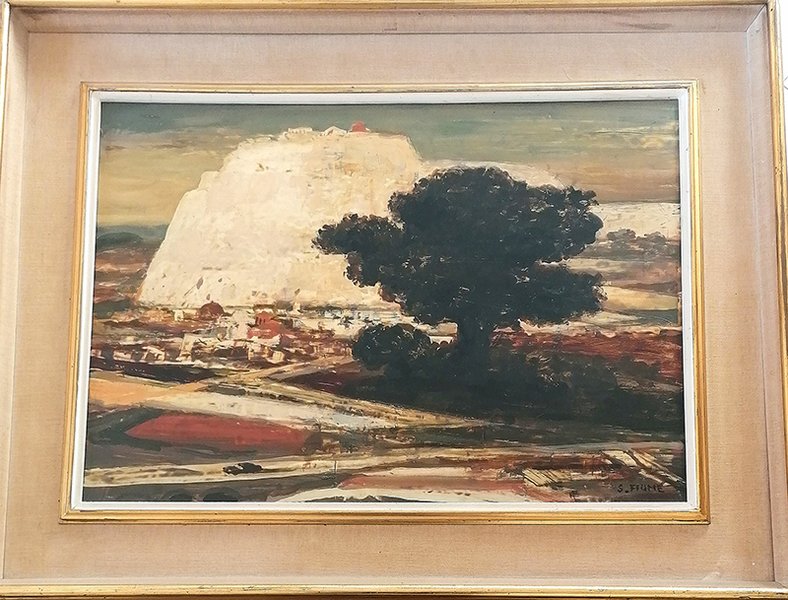
Salvatore Fiume's "Paesaggio Spagnolo," an Italian artistic contemporary of Mario Tobino
"Il clandestino" (1962), which earned him the Premio Strega, portrays the experiences of anti-fascists in Viareggio during the summer of 1943, emphasizing themes of love and brotherhood. "Per le antiche scale" (1972), which won the Premio Campiello, is a collection of stories set in a mental asylum, narrated from the perspective of a doctor, reflecting Tobino's personal experiences.
His "Bandiera nera" (1950) addresses provincial life under fascism. "La brace dei Biassoli" (1956) is a personal and heartfelt tribute to his mother.
Later Life and Legacy
In his later years, Tobino continued to write prolifically, publishing "Gli ultimi giorni di Magliano" in 1982, "La ladra" in 1984, and "Tre amici" in 1988. He received the Premio Pirandello on December 10, 1991, in Agrigento, where he passed away the following day.
Tobino's work has left a lasting impact on Italian literature and the understanding of mental illness. His unique perspective as both a psychiatrist and a writer allowed him to create deeply human and insightful narratives. He combined science and literature. Tobino's legacy is preserved by the Fondazione Mario Tobino, which promotes the study and appreciation of his works.
Mario Tobino's Awards and Recognitions
Mario Tobino received several awards and recognitions throughout his literary career, solidifying his place as a prominent figure in Italian literature. The following table summarizes some of his major awards:
| Year | Award | Work |
|---|---|---|
| 1962 | Premio Strega | Il clandestino |
| 1972 | Premio Campiello | Per le antiche scale |
| 1976 | Premio Viareggio | La bella degli specchi |
| 1991 | Premio Pirandello | Lifetime Achievement |
Views on Mental Health and Asylums

Panoramic view of Viareggio, Tobino's birthplace
Tobino's deep engagement with mental health is evident not only in his psychiatric career but also in his literary works. He spent forty years working at the Psychiatric Hospital of Lucca. He was known for his humanistic approach to treating patients, emphasizing their dignity and humanity.
Interestingly, Tobino opposed the closure of asylums following the Basaglia Law of 1978. He believed that asylums, despite their flaws, provided a necessary refuge for individuals with severe mental illnesses. Tobino expressed that his life was intertwined with the patients and that their suffering would persist even if the asylums were closed. He also said, «La cupa malinconia, l’architettura della paranoia, le catene delle ossessioni esistono anche se si chiude il manicomio».
Notable Adaptations of His Work
Mario Tobino's impactful storytelling has transcended the pages of his books, captivating audiences through cinematic adaptations. His novel, "Il deserto della Libia," served as the foundation for two films, each offering a unique interpretation of Tobino's vision. "Scemo di guerra," directed by Dino Risi, presents a satirical and poignant exploration of the absurdities of war, while "Le rose del deserto," directed by Mario Monicelli, delves into the human stories amidst the desolation of the Libyan desert.
YouTube: Mario Tobino, lo scrittore amico dei matti
The YouTube video "Mario Tobino, lo scrittore amico dei matti" offers a brief overview of Mario Tobino's life and work, highlighting his dual career as a psychiatrist and writer. The video emphasizes his commitment to improving the lives of the mentally ill and his unique perspective on mental health, reflecting his belief that literature and medicine could intersect to promote a more humane understanding of mental illness.
Frequently Asked Questions (FAQ)
What were Mario Tobino's main occupations?
Mario Tobino was primarily a psychiatrist and a writer. He worked as a psychiatrist for many years, particularly in the mental hospital in Maggiano, near Lucca. Simultaneously, he was a prolific writer, producing poems, novels, and other literary works that often reflected his experiences and insights from his psychiatric practice.
What inspired Mario Tobino's writing?
Tobino's writing was heavily influenced by his personal experiences, particularly his work as a psychiatrist and his wartime service. His novels often explore themes of mental illness, social issues, and the human condition, drawing on his observations and interactions with patients and his reflections on the political and social landscape of Italy during the 20th century.
What are some of Mario Tobino's most famous works?
Some of Mario Tobino's most famous works include "Il figlio del farmacista" (1942), "Le libere donne di Magliano" (1953), "Il clandestino" (1962), which won the Premio Strega, and "Per le antiche scale" (1972), which won the Premio Campiello. These works are celebrated for their insightful portrayal of human nature, their exploration of mental illness, and their reflection of Italian society.
How did Mario Tobino view the closure of mental asylums?
Mario Tobino was critical of the closure of mental asylums following the Basaglia Law of 1978. He believed that asylums, despite their imperfections, provided essential care and refuge for individuals with severe mental illnesses. He argued that closing these institutions would not eliminate the suffering of the mentally ill and that alternative solutions were necessary to ensure their well-being.
What is Mario Tobino's legacy?
Mario Tobino's legacy lies in his contributions to both literature and the understanding of mental illness. He is remembered as a sensitive and insightful writer who brought attention to the lives and experiences of those often marginalized in society. His works continue to be studied and appreciated for their literary merit and their humanistic perspective on mental health. The Fondazione Mario Tobino is dedicated to preserving and promoting his legacy through various cultural and educational initiatives.
References
Last updated April 13, 2025