
The Exosphere of Mars
Exploring the Outer Layer of the Martian Atmosphere
Key Takeaways
- Composition and Structure: The Martian exosphere is primarily composed of hydrogen, oxygen, and carbon dioxide, with hydrogen extending far into space.
- Atmospheric Escape: Mars' weak gravitational field and lack of a global magnetic field facilitate the escape of atmospheric particles, influencing the planet's atmospheric evolution.
- Dynamic Interactions: Seasonal changes and solar wind interactions significantly impact the density and behavior of the exosphere.
Introduction
The exosphere of Mars represents the outermost layer of its atmosphere, serving as the transitional zone between the planet's atmospheric gases and the vacuum of interplanetary space. Starting at an altitude of approximately 200 to 230 kilometers above the Martian surface, the exosphere is characterized by extremely low densities of atmospheric particles, where collisions between molecules are rare. This sparse environment allows individual particles to travel long distances without interacting with one another, making the exosphere a critical region for understanding atmospheric loss and the long-term evolution of Mars' atmosphere.
Structure and Composition
Altitude Range
The Martian exosphere begins around 200 to 230 kilometers above the surface, extending outward to where the atmosphere seamlessly transitions into the vacuum of space. Unlike Earth's exosphere, Mars' exosphere thins out more rapidly due to the planet's lower atmospheric density and smaller mass, resulting in a more extended and diffuse outer layer.
Chemical Composition
The primary constituents of Mars' exosphere include:
- Hydrogen (H): Hydrogen is the most abundant element in the Martian exosphere, especially at higher altitudes, forming an extensive "corona" observable in ultraviolet light. Its lightweight nature allows it to escape Mars' gravity more easily than heavier gases.
- Oxygen (O): Derived primarily from the dissociation of carbon dioxide (CO₂) and water vapor (H₂O) in the lower atmosphere, oxygen plays a significant role in the exosphere's composition.
- Carbon Dioxide (CO₂): While CO₂ is the dominant gas in the lower atmosphere, it diminishes in the exosphere but remains a vital component.
- Other Gases: Trace amounts of nitrogen (N₂), carbon (C), and molecular hydrogen (H₂) are also present, contributing to the overall composition.
Temperature
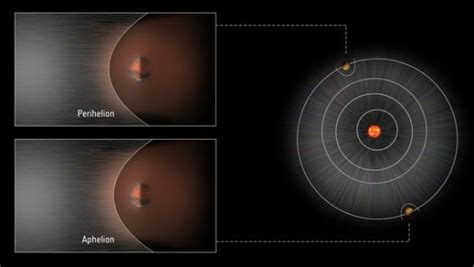
Exospheric temperatures on Mars vary, typically measured around 270 ± 5 K during perihelion seasons. Temperature fluctuations are influenced by solar activity, which heats the upper atmosphere through interactions with solar radiation and the solar wind. These temperatures are not uniform and can vary with factors such as solar radiation intensity and planetary latitude.
Atmospheric Escape Processes
Escape Mechanisms
Mars' exosphere is a battleground for several atmospheric escape processes, significantly contributing to the loss of its atmosphere over geological timescales:
- Jeans Escape: This thermally driven process primarily affects hydrogen atoms that attain velocities exceeding the escape velocity of Mars, allowing them to leave the planet's gravitational pull.
- Dissociative Recombination: Reactions involving CO₂⁺ and O₂⁺ ions lead to the formation of neutral molecules that can escape the exosphere.
- Photochemical Processes: Solar ultraviolet radiation dissociates molecules, producing particles that may achieve escape velocities.
- Sputtering: High-energy solar wind particles collide with atmospheric molecules, imparting enough energy to eject them into space.
- Collision-Induced Escape: Fast-moving oxygen atoms collide with carbon atoms, providing them with sufficient energy to escape Mars' gravity.
Escape Rates
Escape rates vary based on solar activity and other atmospheric interactions:
| Gas | Escape Rate (cm-2 s-1) |
|---|---|
| Nitrogen (N₂) | 4.8 × 10⁵ |
| Carbon (C) | 0.6 × 10⁷ to 2.2 × 10⁷ |
These rates show a strong dependence on solar activity, with increased solar flux leading to higher escape rates.
Dynamic Interactions and Variability
Seasonal Changes
Seasonal variations on Mars, driven by the sublimation and deposition of polar ice caps composed predominantly of carbon dioxide, lead to significant changes in atmospheric density and composition. As CO₂ transitions between solid and gaseous states, it affects the overall pressure and composition of the exosphere, indirectly influencing escape rates and particle densities.
Solar Activity
Variations in solar activity, including solar flares and the solar cycle, play a crucial role in heating the exosphere and enhancing atmospheric escape. Increased solar radiation and solar wind interactions during periods of high solar activity can lead to higher temperatures and greater ejection of atmospheric particles.
Interaction with Solar Wind
Mars lacks a global magnetic field, making its exosphere highly susceptible to direct interactions with the solar wind. This exposure leads to the stripping away of atmospheric particles through processes like sputtering and the generation of ion cyclotron waves. These interactions not only contribute to atmospheric loss but also influence the dynamic behavior of the exosphere.
Asymmetries in Distribution
Observations and simulations indicate latitudinal and longitudinal asymmetries in the density and composition of Mars' exosphere. Factors such as the planet's rotation, varying solar radiation exposure, and localized magnetic fields create uneven distributions of gases like hydrogen, resulting in complex spatial patterns within the exosphere.
Measurement Techniques
Spacecraft Missions
Several spacecraft missions have been pivotal in studying Mars' exosphere:
-
MAVEN (Mars Atmosphere and Volatile EvolutioN): Equipped with instruments to measure atmospheric composition, MAVEN has provided detailed data on the exosphere's structure, composition, and escape processes.
-
ExoMars Trace Gas Orbiter: Focused on detecting trace gases, it contributes to understanding the chemical processes in the exosphere.
Ground-Based Observations
High-spectral-resolution telescopes, such as the Line Emission Mapper, allow scientists to track the distribution of hydrogen and oxygen in the exosphere by observing their emissions in ultraviolet and other wavelengths.
Numerical Simulations
Advanced computer models simulate the behavior of the exosphere under various solar and atmospheric conditions, aiding in the interpretation of observational data and predicting future changes.
Scientific Significance
Atmospheric Evolution
Understanding the exosphere is essential for reconstructing the history of Mars' atmosphere. The ongoing loss of gases provides insights into how Mars transformed from a potentially wetter and warmer planet to its current cold and dry state.
Habitability and Water Loss
The escape of hydrogen from the exosphere is directly linked to the loss of water from Mars. By quantifying hydrogen escape rates, scientists can estimate the amount of water Mars may have lost over time, which has implications for the planet's past habitability and the search for life.
Analogues for Exoplanets
Mars serves as a local analogue for studying atmospheric retention and loss on unmagnetized terrestrial exoplanets. Insights gained from Mars' exosphere help scientists assess the potential habitability and atmospheric stability of exoplanets with similar characteristics.
Conclusion
The exosphere of Mars is a complex and dynamic region that plays a crucial role in the planet's atmospheric evolution and potential habitability. Its composition, dominated by hydrogen, oxygen, and carbon dioxide, coupled with the processes that drive atmospheric escape, highlight the delicate balance that determines a planet's capacity to retain its atmosphere. Seasonal variations, solar activity, and the lack of a global magnetic field continually reshape the exosphere, offering a rich field of study that not only illuminates Mars' past and present but also provides valuable lessons for understanding atmospheric dynamics on other terrestrial planets.
References
Last updated January 19, 2025