
Unlock Your Well-being: Mastering the Art of Setting Effective Boundaries
Discover how to define, communicate, and maintain personal limits for healthier relationships and a more empowered life.
Essential Insights: Key Takeaways
- Self-awareness is foundational: Understand your needs, values, emotional triggers, and limits before you can articulate them to others. This internal clarity is the bedrock of effective boundary setting.
- Communication must be clear and assertive: Express your boundaries directly, calmly, and respectfully, using "I" statements to convey your feelings and needs without blaming or accusing others.
- Consistency and preparedness are vital: Maintain your boundaries consistently to reinforce their importance. Be prepared for potential resistance or pushback and have a plan for how to respond firmly yet kindly.
Understanding the Essence of Boundaries
What Are Boundaries, Really?
Effective boundaries are the personal limits and rules you establish for yourself to define what is acceptable behavior from others and what is not. They are like invisible lines that protect your emotional, mental, physical, and spiritual well-being. These limits help you distinguish your needs, thoughts, feelings, and responsibilities from those of others. Setting boundaries is not about being selfish or unkind; rather, it's an act of self-respect and a crucial component of healthy relationships. They help create a sense of safety, reduce stress, and support emotional regulation.
Boundaries encompass various aspects of your life, including your time, energy, personal space, possessions, emotions, and beliefs. They are dynamic and can vary depending on the context, the relationship, and your personal evolution.
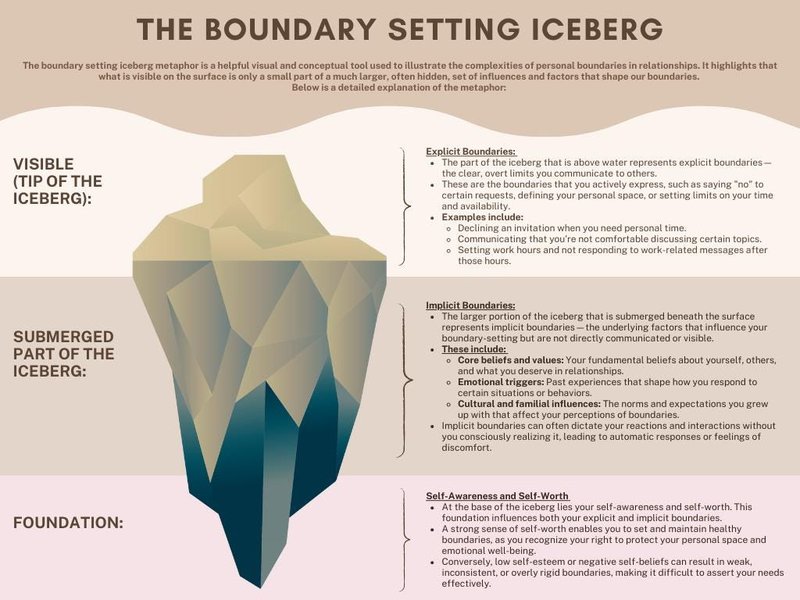
The "Boundary Setting Iceberg" illustrates how stated boundaries are often just the tip, with deeper needs, values, and past experiences lying beneath the surface.
Why Boundaries Are Your Self-Care Superpower
Setting and maintaining healthy boundaries offers a multitude of benefits that contribute significantly to your overall well-being and the quality of your relationships:
- Enhanced Mental and Emotional Health: Boundaries protect you from emotional drain, reduce stress, anxiety, and feelings of resentment or overwhelm. They foster a sense of control and emotional stability.
- Improved Relationships: Contrary to the fear that boundaries push people away, healthy boundaries actually strengthen relationships. They promote mutual respect, understanding, and clear expectations, reducing misunderstandings and conflict.
- Increased Self-Esteem and Self-Respect: When you honor your needs and limits, you send a powerful message to yourself and others that you value yourself. This boosts self-esteem and self-respect.
- Prevention of Burnout: By protecting your time and energy, boundaries help prevent burnout, especially in demanding work environments or caregiving roles.
- Greater Autonomy and Authenticity: Boundaries allow you to live in alignment with your values and priorities, fostering a sense of authenticity and personal empowerment.
- Reduced Codependency: Healthy boundaries help differentiate your responsibilities from others', preventing enmeshment and codependent patterns in relationships.
The Blueprint: How to Construct Effective Boundaries
Building and maintaining effective boundaries is a skill that can be learned and refined over time. It involves a multi-step process that starts with introspection and culminates in consistent action.
Step 1: The Art of Self-Reflection – Know Thyself
Identifying Your Needs and Limits
The journey to effective boundary setting begins with deep self-awareness. You cannot communicate what you don't understand. Take time to reflect on:
- Your Values: What principles are most important to you in life and in relationships?
- Your Priorities: What do you need to protect (e.g., family time, personal projects, rest)?
- Your Comfort Zones: What behaviors or situations make you feel uncomfortable, disrespected, drained, or anxious?
- Your Rights: Recognize that you have the right to say no, to be treated with respect, to have your own opinions, and to protect your well-being.
Recognizing Triggers and Past Beliefs
Past experiences and ingrained beliefs can significantly impact your ability to set boundaries. Reflect on:
- Situations that trigger discomfort: Notice patterns in interactions that leave you feeling depleted or resentful. These are often indicators of where boundaries are needed.
- False beliefs: Challenge beliefs such as "Setting boundaries is selfish," "I'll be rejected if I say no," or "I'm responsible for others' happiness." These can be significant roadblocks.
Step 2: Defining Your Lines – What’s Okay and What’s Not
Once you have a clearer understanding of your needs, it's time to define specific boundaries. Consider different areas of your life where boundaries might be necessary.
Exploring Different Types of Boundaries
Boundaries can manifest in various forms. Understanding these types can help you identify where you need to establish or strengthen your limits. The table below outlines common types of boundaries and provides examples of how to communicate them.
| Type of Boundary | Description | Example Communication |
|---|---|---|
| Physical Boundaries | Relate to your personal space, privacy, and body. This includes who can touch you, how close someone can stand, and your need for solitude. | "I need a bit more personal space, please." or "I'm not comfortable with hugs right now, but I appreciate the sentiment." |
| Emotional Boundaries | Protect your feelings and energy. They involve separating your emotions from others' and not taking responsibility for how others feel or react. | "I understand you're upset, but I can't take on your emotional burden right now." or "I need some time to process my own feelings before discussing this further." |
| Time Boundaries | Concern how you allocate and protect your time. This includes setting limits on work hours, social commitments, and availability. | "I'm not available for calls after 7 PM as that's my family time." or "I can help with that project, but my availability is limited to these specific hours." |
| Material Boundaries | Relate to your money and possessions. This involves deciding what you're willing to lend, share, or give away. | "I'm not comfortable lending out my car." or "I can't lend money right now, but I'm happy to support you in other ways." |
| Mental/Intellectual Boundaries | Involve respecting your own thoughts, beliefs, and opinions, as well as those of others, even when they differ. | "I appreciate your perspective, though I see things differently." or "Let's agree to disagree on this topic respectfully." |
| Digital Boundaries | Refer to limits around technology use, such as response times to emails/messages, social media engagement, and screen time. | "I turn off work notifications after hours to maintain my work-life balance." or "I'll respond to your message when I have a dedicated moment." |

Emotional boundaries help create a necessary space between your feelings and the emotional states of others.
Step 3: Voicing Your Needs – Clear and Assertive Communication
Knowing your boundaries is one thing; communicating them effectively is another. Assertive communication is key – it's about being clear, direct, and respectful, without being aggressive or passive.
The Power of "I" Statements
Use "I" statements to express your needs and feelings without blaming or accusing the other person. This makes it less likely for them to become defensive. For example, instead of saying, "You always interrupt me," try, "I feel unheard when I'm interrupted, and I need to finish my thought."
Simplicity and Directness
Keep your boundary statements simple, clear, and to the point. Avoid lengthy justifications or apologies. A straightforward statement like, "I'm not able to take on that commitment right now," is often sufficient. Explain why the boundary is important to you, if appropriate and if you feel comfortable, to foster understanding.
Step 4: The Gradual Ascent – Starting Small and Building Momentum
If setting boundaries is new or challenging for you, start small. Choose less emotionally charged situations or relationships to practice. For example, you might start by setting a boundary around your time with a colleague before tackling a more complex boundary with a close family member. Each successful attempt builds confidence and skill.
Step 5: The Steadfast Guardian – Consistency is Your Ally
Consistency is crucial for boundaries to be effective. If you set a boundary but don't consistently uphold it, others may not take it seriously. Reinforce your boundaries calmly and firmly each time they are tested. This helps others learn and adapt to your new limits. Remember, setting boundaries is an ongoing process, not a one-time event.
Step 6: Navigating the Tides – Preparing for and Handling Pushback
Not everyone will welcome your new boundaries, especially if they are used to you having porous or non-existent ones. Be prepared for potential pushback, which can range from questioning and guilt-tripping to anger or withdrawal.
Calm Reiteration
If someone challenges your boundary, calmly restate it. You don't need to over-explain or defend your boundary. A simple, "As I said, I'm not available on weekends," can be effective.
Defining Consequences (When Necessary)
Healthy boundaries often imply consequences if they are repeatedly violated. These are not punishments but rather pre-determined actions you will take to protect yourself. For example, if someone consistently calls you during your designated "no-call" hours, a consequence might be that you stop answering those calls. Communicate these consequences clearly if necessary: "If this behavior continues, I will need to [state consequence, e.g., limit our contact]."
This mindmap illustrates the interconnected pillars essential for successfully establishing and maintaining effective personal boundaries:
(Understand Needs & Limits)"] id1_1["Identify Triggers & Values"] id1_2["Reflect on Past Beliefs"] id2["Clear Communication
(Assertive, Calm, Respectful)"] id2_1["Use 'I' Statements"] id2_2["Be Direct & Specific"] id2_3["No Need for Over-Apology"] id3["Consistency
(Reinforce Your Limits)"] id3_1["Regular Practice"] id3_2["Uphold Boundaries Firmly"] id4["Define Types of Boundaries
(Physical, Emotional, Time, etc.)"] id4_1["Tailor to Specific Situations"] id5["Manage Pushback
(Stay Firm & Kind)"] id5_1["Prepare for Reactions"] id5_2["State Consequences if Needed"] id6["Self-Care & Support
(Prioritize Well-being)"] id6_1["Seek Therapy if Needed"] id6_2["Lean on Supportive Friends/Family"] id7["Benefits
(Well-being & Healthy Relationships)"] id7_1["Reduced Stress & Burnout"] id7_2["Increased Self-Respect & Autonomy"]
Understanding Boundary Dynamics
Finding Your Balance: Porous, Rigid, and Healthy Boundaries
Boundaries exist on a spectrum. Understanding different boundary styles can help you identify your patterns and strive for a healthier balance:
- Porous Boundaries: Individuals with porous boundaries often have trouble saying no, overshare personal information, become overly involved in others' problems, and may tolerate disrespect or mistreatment. They may fear rejection if they assert themselves.
- Rigid Boundaries: On the other extreme, rigid boundaries involve keeping others at a distance emotionally and physically. Individuals with rigid boundaries may avoid intimacy, seem detached, have few close relationships, and be very protective of their personal information.
- Healthy Boundaries: Healthy boundaries strike a balance. They are flexible when appropriate but firm when necessary. Individuals with healthy boundaries value their own opinions, don't compromise their values for others, share appropriately, and are aware of their personal needs. They allow for connection while maintaining a strong sense of self.

Understanding different boundary styles—porous, healthy, and rigid—can help identify areas for growth.
The radar chart below offers a visual representation of the perceived difficulty of setting boundaries in various life domains versus the potential positive impact on well-being once those boundaries are effectively established. The scales range from 1 (Low) to 10 (High).
This chart suggests that while setting boundaries in areas like family dynamics and romantic relationships can be perceived as highly difficult, the potential positive impact on one's well-being is also correspondingly high. Conversely, dedicating self-care time might be seen as less difficult to bound but still yields significant well-being benefits.
Practical Application in Daily Life
Boundaries at Work
In a professional setting, boundaries are crucial for productivity, preventing burnout, and maintaining a healthy work-life balance. Examples include:
- Defining work hours and sticking to them (e.g., "I will respond to emails between 9 AM and 5 PM").
- Saying no to additional tasks when your workload is already full.
- Protecting your focus time by minimizing interruptions.
- Clearly communicating your role and responsibilities.
Boundaries in Personal Relationships (Family, Friends, Partners)
Setting boundaries with loved ones can be challenging but is essential for healthy, respectful relationships. Examples include:
- Limiting unsolicited advice (e.g., "I appreciate your concern, but I prefer to make this decision on my own").
- Protecting your personal time and energy (e.g., "I can't make it to every social event, but I value our friendship").
- Defining acceptable ways of communicating during disagreements (e.g., "I need us to discuss this calmly without raising voices").
- Maintaining your individuality within a partnership.
Boundaries with Yourself
Often overlooked, setting boundaries with yourself is equally important. This involves self-discipline and commitment to your own well-being. Examples include:
- Limiting screen time or social media use.
- Committing to regular exercise or self-care practices.
- Avoiding negative self-talk.
- Managing perfectionistic tendencies.
Guidance on Boundary Setting: A Visual Aid
The following video offers further insights and practical tips on how to effectively set healthy boundaries in various aspects of your life. It can serve as a helpful visual guide to complement the strategies discussed.
This video, titled "How to Set Healthy Boundaries," explores the practical steps involved in identifying, communicating, and maintaining boundaries, emphasizing that it's a skill developed through practice rather than simply finding a perfect rule for every situation. It reinforces many of the concepts covered, such as the importance of understanding your own limits and communicating them clearly.
FAQs: Unpacking Your Boundary Questions
What are boundaries exactly?
Boundaries are personal limits you set to protect your emotional, physical, mental, and spiritual well-being. They define what behavior you find acceptable from others and how you expect to be treated. They are not walls to keep people out, but rather guidelines to foster respectful and healthy interactions.
Why is it so hard to set boundaries?
Setting boundaries can be difficult for several reasons: fear of rejection or conflict, guilt about saying no (especially if you're a people-pleaser), lack of practice (not being taught how in childhood), or false beliefs that it's selfish. Close relationships can make it particularly challenging due to established dynamics and emotional ties.
What if someone reacts negatively to my boundaries?
It's common for some people to resist or react negatively when you first set boundaries, especially if they are used to you not having them. Stay calm and firm. Reiterate your boundary without becoming defensive or aggressive. Remember, their reaction is their responsibility, not yours. In some cases, you may need to consider the health of the relationship if disrespect continues.
Can boundaries change over time?
Absolutely. Boundaries are not static; they can and should evolve as your life circumstances, needs, and relationships change. It's healthy to periodically reassess your boundaries to ensure they still serve you well and to adjust them as necessary.
How do I set boundaries without feeling guilty?
Feeling guilty is a common hurdle. Remind yourself that setting boundaries is an act of self-care and respect, not selfishness. Your needs are valid. Start small to build confidence. Practice self-compassion and acknowledge that it's okay to prioritize your well-being. Over time, as you see the positive effects of boundaries, the guilt often lessens.
Recommended Queries
- How can I communicate my boundaries more assertively without being aggressive?
- What are some specific examples of setting boundaries in workplace relationships?
- How do I deal with persistent boundary violations from family members?
- What is the role of self-compassion in the process of setting and maintaining boundaries?
References
Last updated May 6, 2025