
Unlocking Personality Insights: What is MBTI and Should It Dictate Your Next Hire?
A deep dive into the Myers-Briggs Type Indicator, its mechanisms, and its controversial role in recruitment.
The Myers-Briggs Type Indicator (MBTI) is one of the most widely recognized personality assessment tools globally. Many encounter it in corporate training, career counseling, or even casual online quizzes. But what exactly is it, how does it purport to define personality, and crucially, is it a reliable compass for navigating the complexities of recruitment? This exploration will delve into the core of MBTI and address its suitability for identifying the best candidates for a job.
Key Insights at a Glance
Essential Takeaways About MBTI
- Understanding Preferences: The MBTI is designed to identify an individual's preferences across four dichotomies, leading to one of 16 distinct personality types. It aims to foster self-awareness rather than measure skills or abilities.
- Controversial in Recruitment: Despite its popularity, there is a strong consensus, including from its own publisher, that the MBTI should not be used as a tool for hiring or candidate selection due to a lack of predictive validity for job performance.
- Ethical and Practical Concerns: Using MBTI for recruitment can lead to ineffective hiring decisions, introduce bias, and may carry ethical and legal risks. Its strengths lie in developmental areas like team building and communication enhancement once individuals are already part of an organization.
Deconstructing MBTI: What Is It?
Origins and Core Purpose
The Myers-Briggs Type Indicator (MBTI) is a self-report questionnaire developed by Isabel Myers and her mother, Katharine Cook Briggs, during World War II. Its theoretical foundation lies in Carl Jung's theory of psychological types, first published in the 1920s. Jung proposed that human behavior is not random but follows predictable patterns stemming from fundamental differences in how individuals prefer to use their perception and judgment.
Myers and Briggs aimed to make Jung's complex theories accessible and applicable to a broader audience. Their goal was to create a practical instrument that could help people understand their own personalities and appreciate differences in others. The MBTI aims to identify an individual's inherent preferences, providing insights into their likes, dislikes, strengths, weaknesses, potential career interests, and how they interact with the world.
An illustrative overview of the MBTI framework.
The MBTI categorizes individuals into one of 16 distinct personality "types," each denoted by a four-letter code (e.g., INTJ, ESFP). It's crucial to understand that the MBTI describes preferences, not skills, abilities, intelligence, or traits on a continuous spectrum. It suggests that individuals naturally lean towards one preference over another within each dichotomy, much like being right-handed or left-handed.
How Does MBTI Work? The Four Dichotomies
The Building Blocks of Personality Types
The MBTI assessment evaluates personality across four pairs of opposing preferences, known as dichotomies. An individual's responses to the questionnaire determine their preference on each of these scales. These preferences are not absolute; everyone uses both poles of each dichotomy at different times, but the MBTI aims to identify the one that feels more natural or comfortable.
1. Energy Orientation: Extraversion (E) vs. Introversion (I)
This dichotomy describes how individuals direct and receive their energy:
- Extraversion (E): Extraverts tend to direct their energy outward, towards people and activities. They often gain energy from interacting with others and being involved in external events. They may prefer to talk through their thoughts and ideas.
- Introversion (I): Introverts tend to direct their energy inward, towards their own thoughts and experiences. They often gain energy from spending time alone or in quiet reflection. They may prefer to process their thoughts internally before sharing.
2. Information Perception: Sensing (S) vs. Intuition (N)
This dichotomy describes how individuals prefer to gather and process information:
- Sensing (S): Sensing types prefer to focus on concrete information obtained through their five senses. They are often practical, realistic, and detail-oriented, paying attention to facts and present realities.
- Intuition (N): Intuitive types prefer to focus on patterns, possibilities, and the bigger picture. They are often imaginative, innovative, and future-oriented, looking beyond the tangible to see connections and meanings.
3. Decision Making: Thinking (T) vs. Feeling (F)
This dichotomy describes how individuals prefer to make decisions:
- Thinking (T): Thinking types tend to make decisions based on logic, objective analysis, and impersonal criteria. They value fairness, consistency, and seek rational explanations.
- Feeling (F): Feeling types tend to make decisions based on personal values, empathy, and the impact on people. They value harmony, compassion, and seek outcomes that consider the well-being of others.
4. Lifestyle Approach: Judging (J) vs. Perceiving (P)
This dichotomy describes how individuals prefer to live their outer life and approach the external world:
- Judging (J): Judging types prefer a structured, organized, and planned approach to life. They like to make decisions, have things settled, and appreciate closure. "Judging" here does not mean "judgmental" but refers to a preference for decisiveness.
- Perceiving (P): Perceiving types prefer a flexible, spontaneous, and adaptable approach to life. They like to keep their options open, gather more information before deciding, and appreciate adaptability.
The combination of these four preferences results in one of 16 unique personality types, such as ISTJ (Introversion, Sensing, Thinking, Judging) or ENFP (Extraversion, Intuition, Feeling, Perceiving). Each type is associated with a detailed description of its typical characteristics, strengths, and potential areas for development.
| Dichotomy | Preference 1 & Focus | Preference 2 & Focus | Key Question Addressed |
|---|---|---|---|
| Energy Orientation | Extraversion (E): Directs energy outward to people and things. | Introversion (I): Directs energy inward to concepts and ideas. | Where do you get your energy? |
| Information Gathering | Sensing (S): Focuses on information from the five senses; practical and present-oriented. | Intuition (N): Focuses on patterns, possibilities, and future implications; abstract and conceptual. | What kind of information do you naturally notice and trust? |
| Decision Making | Thinking (T): Makes decisions based on logic and objective analysis. | Feeling (F): Makes decisions based on values and impact on people. | How do you prefer to make decisions? |
| Outer World Approach | Judging (J): Prefers a planned, orderly way of life; likes closure. | Perceiving (P): Prefers a flexible, spontaneous way of life; likes to keep options open. | How do you prefer to deal with the outer world? |
A summary of the four dichotomies used in the MBTI framework.
MBTI in Recruitment: A Tool for Identifying the Best Candidates?
The Critical Question of Hiring Suitability
While the MBTI is widely used in organizational settings, its application in recruitment and candidate selection is highly controversial and largely discouraged by experts, including The Myers-Briggs Company, the official publisher of the MBTI.
The clear consensus is that MBTI should not be used as a primary tool to identify or select the "best" candidate for a job. Here’s why:
1. Lack of Predictive Validity for Job Performance
The most significant criticism is that MBTI results have not been shown to reliably predict job performance, success, or employee competence in specific roles. Personality preferences, as identified by the MBTI, do not equate to skills, abilities, or the likelihood of excelling in a particular job. For instance, an "Introvert" might excel in a sales role requiring extensive interaction, and an "Extravert" might thrive in a solitary research position. Job success is influenced by a multitude of factors beyond MBTI type, including cognitive abilities, experience, skills, motivation, and organizational fit.
2. Reliability and Validity Concerns for Selection Purposes
While the MBTI may offer some reliability for its intended uses (like self-awareness), its psychometric properties are often questioned when applied to hiring. Modern psychological standards for hiring assessments require rigorous validation to demonstrate that a test measures what it claims to measure and that these measurements are directly relevant to job performance. The MBTI does not meet these stringent criteria for use as a selection tool. Furthermore, individuals may receive different results if they retake the test, and the binary "either/or" categorization (e.g., you are either an Extravert or an Introvert) oversimplifies the complexity of human personality, which is better represented by traits existing on a continuum.
3. Ethical and Legal Risks
Using the MBTI to screen out applicants can lead to poor hiring decisions and expose employers to significant ethical and legal risks. If a candidate is rejected based on their MBTI type, and that type preference has no proven link to their ability to perform the job, it could be considered discriminatory. The Myers-Briggs Company explicitly states that using the MBTI for hiring is unethical and, in many cases, illegal. Hiring decisions should be based on job-related criteria, skills, and qualifications.
4. Focus on Preferences, Not Abilities
The MBTI measures preferences, not actual skills, cognitive abilities, or competencies. For example, preferring "Thinking" over "Feeling" does not mean a person lacks empathy or cannot make value-based decisions; it simply indicates their primary mode of decision-making. Similarly, preferring "Introversion" doesn't mean someone cannot interact effectively with others. Recruitment should focus on what candidates *can do* and *have done*, rather than solely on their reported preferences.
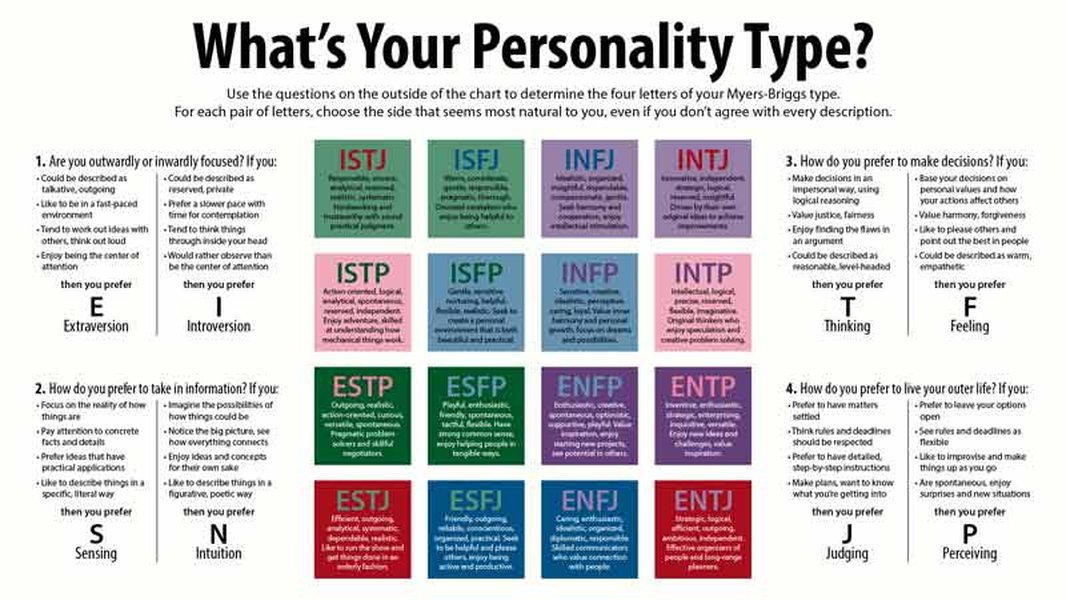
The 16 personality types derived from the MBTI dichotomies. While insightful for development, these types are not predictive of job performance.
Appropriate Uses of MBTI in an Organizational Context
Despite its limitations in recruitment, the MBTI can be a valuable tool for other HR functions, typically *after* an individual has been hired:
- Team Building: Helping team members understand each other's communication styles, work preferences, and approaches to problem-solving can foster better collaboration and reduce conflict.
- Leadership Development: Leaders can use MBTI insights to understand their own management style and how to motivate and interact more effectively with diverse team members.
- Personal Development and Self-Awareness: It can help individuals understand their strengths, potential blind spots, and areas for personal growth.
- Conflict Resolution: Understanding differing perspectives rooted in personality preferences can aid in resolving interpersonal conflicts.
- Career Counseling and Exploration: While not for selection, it can help individuals explore career paths that might align well with their natural preferences.
In essence, the MBTI's strength lies in fostering understanding and development, not in making high-stakes selection decisions.
Visualizing MBTI's Applicability in HR
A Comparative Look at MBTI's Suitability
The following chart provides a visual representation of the MBTI's perceived suitability and effectiveness across various Human Resources functions. The scores are based on general consensus and expert opinions regarding the tool's strengths and limitations. A higher score indicates greater suitability or effectiveness. This chart illustrates why MBTI is generally recommended for developmental purposes rather than for recruitment selection.
As depicted, MBTI scores highest in areas like personal development and team cohesion, where understanding preferences can foster positive interactions and growth. Conversely, its suitability and predictive power for recruitment selection are significantly lower, aligning with expert recommendations against its use in this context.
Understanding the MBTI Framework Visually
A Mindmap Overview
To better grasp the structure and components of the Myers-Briggs Type Indicator, the following mindmap illustrates its key elements, from its theoretical underpinnings to its practical applications and limitations, especially concerning recruitment.
Psychological Types"] id1b["Developed by Katharine Briggs
& Isabel Myers"] id2["Core Mechanism"] id2a["Self-Report Questionnaire"] id2b["Identifies Inherent Preferences
(Not skills, abilities, or traits on a continuum)"] id2c["Assigns one of 16
Four-Letter Personality Types"] id3["The Four Dichotomies of Preference"] id3a["Energy Direction: How individuals focus their energy"] id3a1["Extraversion (E):
Energy from external world, action, people"] id3a2["Introversion (I):
Energy from internal world, reflection, thoughts"] id3b["Information Processing: How individuals perceive information"] id3b1["Sensing (S):
Focus on concrete facts, details, present reality"] id3b2["Intuition (N):
Focus on patterns, possibilities, future implications"] id3c["Decision Making: How individuals make conclusions"] id3c1["Thinking (T):
Decisions based on logic, objective analysis, principles"] id3c2["Feeling (F):
Decisions based on values, empathy, impact on people"] id3d["Lifestyle Approach: How individuals approach the outer world"] id3d1["Judging (J):
Prefers structure, planning, decisiveness, closure"] id3d2["Perceiving (P):
Prefers flexibility, spontaneity, adaptability, open options"] id4["Applications & Considerations"] id4a["Intended & Recommended Uses"] id4a1["Personal Self-Understanding & Growth"] id4a2["Improving Team Communication & Dynamics"] id4a3["Leadership & Management Development"] id4a4["Career Counseling (Exploratory, not for selection)"] id4a5["Conflict Resolution"] id4b["Use in Recruitment & Selection"] id4b1["NOT Recommended by Publisher & Experts"] id4b2["Lacks Predictive Validity for Job Performance"] id4b3["Poses Ethical & Legal Risks"] id4b4["Risk of Misinterpretation & Stereotyping"] id4b5["Oversimplifies Personality for Hiring Decisions"]
This mindmap highlights that while the MBTI provides a structured way to think about personality preferences through its dichotomies, its application must be carefully considered, particularly steering clear of using it as a gatekeeper in the hiring process.
Personality Testing in HR: Perspectives on MBTI
Expert Insights on Recruitment Use
The following video discusses personality type testing in HR and recruiting, covering assessments like MBTI and DISC. It offers perspectives on how these tools are used and perceived within the context of human resources, which can be particularly insightful when considering the role of MBTI in talent acquisition strategies. The discussion often touches upon the validity and appropriate applications of such tests.
This video provides context on the broader landscape of personality assessments in HR. It underscores the importance of choosing the right tool for the right purpose, emphasizing that while tools like MBTI can offer valuable insights for development, their use in selection requires careful scrutiny and validation against job performance metrics – a bar that MBTI generally does not meet for hiring.
Frequently Asked Questions (FAQ)
What are the 16 personality types in MBTI?
The 16 personality types are combinations of the four dichotomies: Extraversion (E) or Introversion (I); Sensing (S) or Intuition (N); Thinking (T) or Feeling (F); and Judging (J) or Perceiving (P). Each type is represented by a four-letter code, such as ISTJ, ENFP, INTJ, ESFP, etc. Each type has a unique profile describing its general characteristics, strengths, and potential challenges. Detailed descriptions can be found on the official Myers-Briggs Company website or other reputable MBTI resources.
Is the MBTI scientifically validated?
The MBTI has shown some evidence of reliability (consistency of results) and validity (measuring what it intends to measure) for its intended purposes, such as promoting self-awareness and understanding interpersonal dynamics. However, its scientific validity as a predictor of job performance or for use in candidate selection is widely disputed and generally not supported by independent psychometric research. Many psychologists prefer trait-based models like the Big Five for applications requiring predictive validity.
Can my MBTI type change over time?
According to MBTI theory, your fundamental type preferences are innate and enduring. However, how you express these preferences can develop and mature over your lifetime. It's also possible for test results to vary if taken at different times or under different circumstances, particularly if an individual's preference for one pole of a dichotomy is not very strong. Life experiences and personal growth can lead individuals to develop aspects of their less-preferred functions, but the core type is generally considered stable.
If not MBTI, what personality assessments are better for recruitment?
For recruitment purposes, assessments based on the Big Five personality traits (Openness, Conscientiousness, Extraversion, Agreeableness, Neuroticism) are generally considered more robust and have stronger empirical evidence supporting their predictive validity for job performance, especially Conscientiousness. Cognitive ability tests, situational judgment tests, and structured interviews are also widely recommended as part of a comprehensive selection process. It's crucial that any assessment used for hiring is validated for that specific purpose and job role.
Who administers the official MBTI assessment?
The official MBTI instrument is published by The Myers-Briggs Company. It should be administered and interpreted by a certified MBTI practitioner who has undergone training to understand the nuances of the tool and provide ethical feedback. While many free online "personality quizzes" claim to be similar to the MBTI, only the official assessment from a certified source provides a validated MBTI type.
Recommended Further Exploration
Delve Deeper into Personality and Recruitment
- What are the Big Five personality traits and are they better for recruitment?
- How can companies ethically use personality assessments in the workplace?
- What are common criticisms of the MBTI beyond its use in hiring?
- Explore detailed descriptions of the 16 MBTI personality types.
References
Sources for This Information
Last updated May 19, 2025