
Unveiling the Cosmos: What Does the Universe Truly Mean?
Exploring the vast expanse and the profound questions about its existence, purpose, and significance.
The question of the "meaning of the universe" is one of humanity's oldest and most profound inquiries. It touches upon our understanding of existence itself, spanning the realms of science, philosophy, and personal reflection. Is there an inherent purpose woven into the fabric of spacetime, or is meaning something we create ourselves within its vastness?
Highlights: Key Perspectives on Cosmic Meaning
- Scientific Viewpoint: Empirically, the universe is the totality of space, time, matter, and energy, governed by physical laws. Science does not currently detect an inherent, objective purpose or meaning.
- Philosophical Spectrum: Views range from the universe being inherently purposeless (with meaning arising from human experience) to possibilities of underlying cosmic goals, teleological laws, or even consciousness inherent in the cosmos.
- Human-Centric Meaning: Regardless of any intrinsic cosmic purpose, humans are driven to find and create meaning through their experiences, values, relationships, and understanding of their place within the universe.
Defining the Universe: The Grand Tapestry of Existence
What Exactly Are We Talking About?
Before delving into its meaning, we must first grasp what the universe *is*. Scientifically, it's defined as the entirety of existence. This includes:
- All of space and time.
- All forms of matter and energy.
- The fundamental physical laws and constants that govern them.
The universe encompasses everything from the smallest subatomic particles to colossal structures like galaxies and galaxy superclusters. It's a dynamic entity, understood through cosmological models like the Big Bang theory, which posits an origin point from which the universe has been expanding for approximately 13.8 billion years.
Scale and Structure
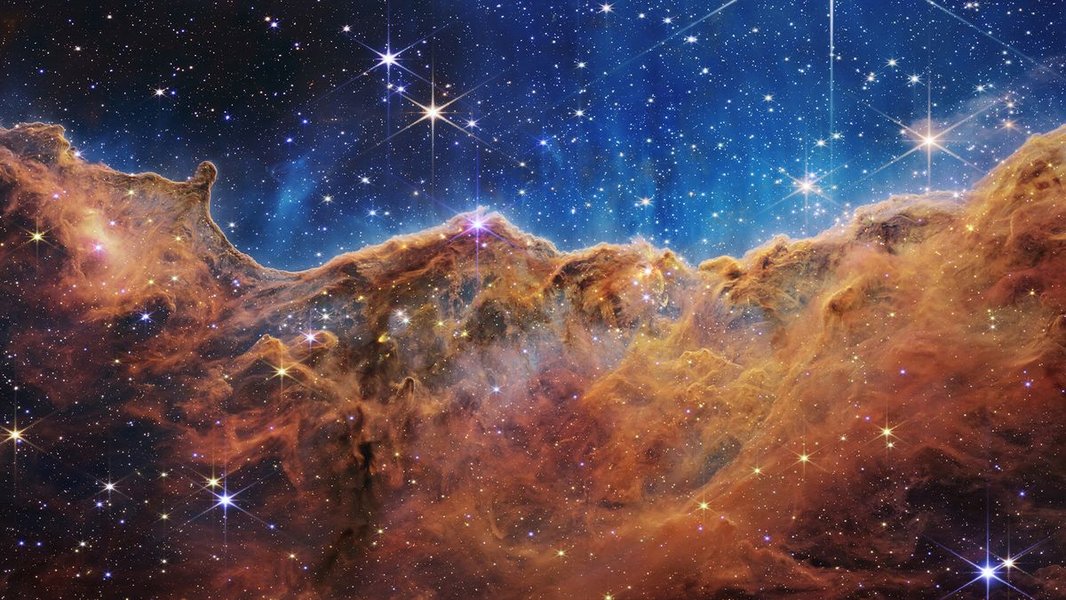
The sheer scale is almost incomprehensible. The observable universe contains hundreds of billions, perhaps trillions, of galaxies, each housing billions or even trillions of stars. Many of these stars host planetary systems. On the largest scales, this cosmic structure appears remarkably uniform (isotropic) and homogeneous, suggesting no identifiable edge or center.
The Pillars of Creation, a star-forming region in the Eagle Nebula, showcasing the dynamic processes within the universe.
Evolution and Contents
From the initial hot, dense state following the Big Bang, the universe cooled and expanded, allowing fundamental particles to form, followed by atoms, stars, galaxies, and eventually, complex structures like planets and potentially life. It's filled with not only visible matter (stars, gas, dust) but also mysterious components like dark matter and dark energy, which dominate its mass-energy content and drive its accelerated expansion.
The Quest for Meaning: Science, Philosophy, and Purpose
While science excels at describing *what* the universe is and *how* it works, the question of its *meaning* or *purpose* pushes beyond the boundaries of empirical observation into the realms of philosophy and interpretation.
The Scientific Lens: An Absence of Inherent Purpose?
From a purely scientific standpoint, based on current evidence, the universe doesn't appear to possess an inherent, predetermined purpose. Concepts like meaning and purpose usually imply intention, goals, or design, which are not features science can readily detect or verify in the cosmos itself. The universe, as described by physics and cosmology, simply *is*—a result of physical processes governed by natural laws and potentially influenced by chance.
Many scientists and thinkers, like astrophysicist Neil deGrasse Tyson, argue that asserting a definitive cosmic purpose lacks empirical foundation. The universe operates according to physical principles, leading to complexity and structure, but this doesn't necessarily equate to a 'purpose' in the human sense. It is vast, ancient, and often appears indifferent to the life that exists within it.
Philosophical Explorations: Intrinsic Goal or Human Projection?
Philosophy engages deeply with the question, offering a diverse range of perspectives:
No Intrinsic Purpose
Many philosophical viewpoints align with the scientific perspective, suggesting the universe has no inherent meaning or purpose. Purpose is seen as a human concept, projected onto a cosmos that operates without intent. Meaning, in this view, is not discovered but *created* by conscious beings navigating their existence. Existentialist thought, for example, often emphasizes the freedom and responsibility of individuals to define their own meaning in an indifferent universe.
Possibilities of Cosmic Purpose
Other philosophical traditions explore the idea that the universe might possess some form of intrinsic purpose or directionality:
- Teleological Laws: Some philosophers propose the existence of "teleological laws"—impersonal natural tendencies guiding the universe towards specific outcomes, such as increasing complexity or the emergence of life and consciousness. This suggests a purpose embedded within the fundamental workings of nature itself.
- Fine-Tuning Argument: The observation that certain fundamental physical constants and initial conditions of the universe appear finely tuned for the existence of complex structures and life is sometimes cited as potential evidence for purpose or design. However, interpretations vary widely, including explanations involving the anthropic principle or multiverse theories.
- Cosmopsychism: A more speculative idea, proposed by philosophers like Philip Goff, suggests that consciousness might be a fundamental property of the universe itself (panpsychism) or that the universe as a whole is a conscious entity (cosmopsychism), potentially having its own goals or purposes, such as fostering conscious experience.

Exploring distant galaxies like AzTEC/COSMOS-1 pushes our understanding of cosmic evolution and the conditions for life.
Religious Interpretations: Divine Design
Many world religions offer frameworks where the universe was created by a divine intelligence with a specific purpose. This purpose often involves humanity's relationship with the divine, spiritual growth, moral development, or the fulfillment of a cosmic plan. In these views, the meaning of the universe is intrinsically linked to a creator's intentions.
The Human Factor: Creating Meaning in a Vast Cosmos
Regardless of whether the universe possesses an inherent meaning, humans undeniably seek and create it. Psychologically, we are purpose-driven beings. Our brains evolved to find patterns, tell stories, and establish goals, which helps us navigate the world and find significance in our lives.
Meaning often arises from:
- Relationships and Connections: Love, family, community.
- Personal Growth and Achievement: Learning, creating, overcoming challenges.
- Values and Beliefs: Contributing to causes larger than oneself, living ethically.
- Awe and Wonder: Experiencing the beauty and complexity of nature and the cosmos.
From this perspective, even in a scientifically purposeless universe, meaning is profoundly real and vital for human flourishing. It's something we actively build through our choices, actions, and interpretations.
Visualizing Perspectives: A Conceptual Comparison
Understanding the different viewpoints on the universe's meaning can be complex. The radar chart below offers a conceptual comparison of various perspectives based on several dimensions. It reflects general tendencies rather than precise measurements, illustrating how different frameworks approach the question of cosmic meaning.
This chart highlights how different approaches prioritize evidence, subjectivity, the concept of intention, the role of humans, and the scope of their claims when discussing the meaning of the universe.
Mapping the Concepts: Understanding the Universe's Meaning
The question "What is the meaning of the universe?" involves several interconnected ideas. This mind map provides a visual overview of the core concepts discussed, branching from the central query into its definition, scientific understanding, philosophical debates, and the human element of meaning-making.
This map illustrates the multi-faceted nature of the question, connecting the physical reality of the universe with the abstract and personal search for significance within it.
Comparing Viewpoints: A Summary Table
To further clarify the different stances on the meaning of the universe, the following table summarizes the core tenets of the major perspectives discussed:
| Perspective | Does the Universe Have Inherent Meaning/Purpose? | Where Does Meaning Come From? | Role of Humanity |
|---|---|---|---|
| Scientific | Not detected; question may be outside the scope of science. | N/A (Focuses on physical processes, not meaning). | Observers and products of cosmic evolution. |
| Philosophical (No Intrinsic Purpose) | No, the universe is inherently purposeless or indifferent. | Created by humans through experience, values, choices, interpretation. | Creators of meaning in a meaningless cosmos. |
| Philosophical (Potential Intrinsic Purpose) | Possibly, through underlying laws, directionality, or consciousness. | Potentially inherent in the universe's structure or nature; also human-created. | Potentially part of a cosmic goal, or interpreters of an underlying purpose. |
| Religious | Yes, typically designed by a divine creator. | From the divine plan, creator's intentions, spiritual principles. | Often central, fulfilling a specific role in the divine plan. |
| Psychological / Humanist | Irrelevant whether it does or not; focus is on human experience. | Constructed through human psychology, needs, relationships, goals, and values. | Agents who actively create personal and collective meaning. |
This table highlights the fundamental differences in how each perspective approaches the question of cosmic significance and the source of meaning itself.
Exploring Further: Physics and Cosmic Meaning
The intersection of physics, cosmology, and the search for meaning is a fertile ground for discussion. Advances in our understanding of the universe's origins, evolution, and fundamental laws inevitably shape our philosophical outlook. The following video features physicists Max Tegmark and Marcelo Gleiser discussing how our growing scientific knowledge impacts the meaning we ascribe to the universe.
This discussion delves into how concepts from modern physics, like the multiverse or the nature of physical laws, influence philosophical debates about purpose, existence, and humanity's place in the grand cosmic narrative.
Frequently Asked Questions (FAQ)
Does science prove the universe is meaningless?
What is 'cosmic purpose' in philosophy?
Can humans find meaning if the universe has no inherent purpose?
What's the difference between 'meaning' and 'purpose' in this context?
References
- Universe - Wikipedia
- What is the Universe? - NASA Science
- The universe Definition & Meaning - Merriam-Webster
- Does the Universe Have a Purpose? - Psychology Today
- Why? The Purpose of the Universe - John Templeton Foundation
- Does the Universe Have a Purpose? - Reasons to Believe
- Philosophy of Cosmology - Stanford Encyclopedia of Philosophy
Recommended Reading
Last updated April 22, 2025