
Exploring the Meaning and Synonyms of 'Formal'
A comprehensive look at the nuances of formality in language and context.
Key Insights into the Concept of Formal
- Formal implies adherence to established rules and conventions: It often relates to situations, language, or dress that follow prescribed forms and customs.
- Synonyms for formal cover a range of related ideas: Words like "ceremonial," "official," "conventional," and "proper" highlight different facets of formality.
- Context is crucial in determining the most appropriate synonym: The specific situation dictates which synonym best captures the intended meaning of "formal."
The word 'formal' carries significant weight in the English language, describing anything that adheres to established rules, customs, or conventions. Its meaning extends across various domains, from social interactions and attire to official procedures and language. Understanding the nuances of 'formal' and its synonyms is essential for precise communication.
Defining 'Formal'
Understanding the core concept and its applications.
'Formal' generally refers to something that is in accordance with established forms, customs, or rules. This can manifest in several ways:
Formal Occasions and Dress
In social contexts, 'formal' often describes events or gatherings that require a specific level of decorum and dress. Examples include weddings, galas, and official ceremonies where adherence to a dress code, such as tuxedos or evening gowns, is expected. The behavior and language used at such events also tend to be more reserved and polite.
Individuals dressed for a formal occasion.
Formal Procedures and Agreements
In official or legal settings, 'formal' signifies that something is conducted according to prescribed procedures or constitutes a binding agreement. A formal contract, for instance, is legally recognized and enforceable, requiring specific language and structure. Similarly, formal meetings follow established protocols and agendas.
Formal Language and Communication
'Formal' language is characterized by its adherence to grammatical rules, complex sentence structures, and a wider vocabulary, often avoiding slang, contractions, and colloquialisms. It is typically used in academic writing, official documents, business correspondence, and formal speeches.
Exploring Synonyms for 'Formal'
A rich vocabulary for expressing adherence to form.
The English language offers a variety of synonyms for 'formal', each carrying slightly different connotations. Understanding these synonyms allows for more precise and varied expression.
Synonyms Emphasizing Ceremony and Ritual
- Ceremonial: Relating to or used in a ceremony; marked by ceremony. This synonym highlights the ritualistic aspect of formal events or procedures.
- Ceremonious: Marked by or given to ceremony or formality. Similar to ceremonial, but can also describe a person's behavior that is very proper and adheres strictly to etiquette.
- Ritualistic: Relating to or characteristic of a ritual or rituals. This emphasizes the aspect of following a set pattern of actions.
Synonyms Emphasizing Official Status and Authority
- Official: Relating to an office or position of authority; authorized. This synonym is often used when referring to something sanctioned or conducted by an authority.
- Authoritative: Able to be trusted as being accurate or true; official. This implies a source that is reliable and recognized.
Synonyms Emphasizing Convention and Establishment
- Conventional: Based on or in accordance with what is generally accepted or customary; standard. This synonym highlights adherence to widely accepted norms.
- Established: Having been in existence for a long time and therefore recognized and generally accepted. This suggests something that is firmly in place and traditional.
- Orthodox: Following or conforming to the traditional or generally accepted rules or beliefs of a religion, philosophy, or practice. This emphasizes adherence to established doctrines or practices.
Synonyms Emphasizing Correctness and Precision
- Proper: Truly what something is said to be; rightly so called; appropriate to the circumstances or occasion. This synonym stresses what is considered right or suitable.
- Precise: Marked by exactness and accuracy of expression or detail. This highlights the meticulous nature sometimes associated with formal processes or language.
- Correct: Free from error; in accordance with fact or truth; conforming to an approved or conventional standard. Similar to proper, emphasizing adherence to standards.
Synonyms Describing Stiff or Reserved Behavior
- Stiff: Not relaxed or friendly; unbending. This can sometimes be a negative connotation of formal behavior, suggesting a lack of warmth or spontaneity.
- Reserved: Slow to reveal emotion or opinions. Formal behavior can sometimes be characterized by emotional restraint.
Comparing and Contrasting Synonyms
Understanding the subtle differences in meaning.
While many words can be used as synonyms for 'formal', their suitability depends heavily on the specific context. The table below illustrates some of these differences:
| Synonym | Primary Connotation | Example Context |
|---|---|---|
| Ceremonial | Ritual, special occasions | A ceremonial cutting of the ribbon. |
| Official | Authority, authorization | An official government announcement. |
| Conventional | Accepted custom, standard practice | Following conventional procedures. |
| Proper | Correctness, suitability | Using proper etiquette. |
| Stiff | Lack of relaxation, unbending | A stiff and formal greeting. |
The Role of Context in Choosing Synonyms
Selecting the perfect word for the situation.
Choosing the most appropriate synonym for 'formal' requires careful consideration of the context in which it is used. For instance, when describing a diplomatic meeting, 'official' or 'ceremonial' might be suitable. When referring to academic writing, 'rigorous' or 'structured' could be more apt. In contrast, describing a person's demeanor might call for words like 'reserved' or 'stiff'.
Consider the sentence: "The meeting was very formal."
-
If the emphasis is on adherence to strict procedures, 'conventional' or 'methodical' might fit.
-
If the focus is on the serious and official nature, 'solemn' or 'official' could be better.
-
If the tone was perceived as unapproachable, 'stiff' or 'unbending' might be used.
The surrounding words and the overall tone of the communication provide clues to the intended meaning and help in selecting the most precise synonym.
Formal vs. Informal
Understanding the antonym and its implications.
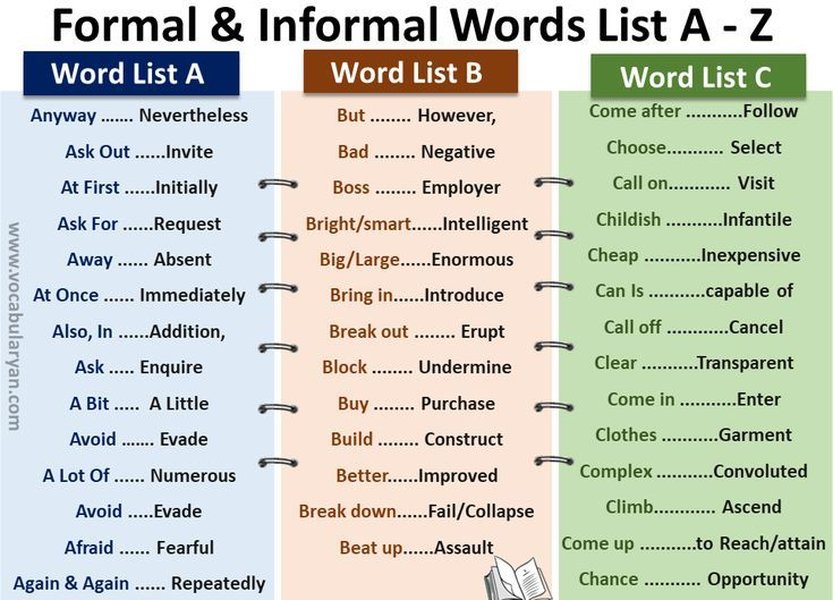
The direct antonym of 'formal' is 'informal'. Informal situations, language, and dress are characterized by a lack of strict rules, a relaxed atmosphere, and often a more casual approach. Understanding this contrast further illuminates the meaning of 'formal'.

A visual comparison of formal and informal contexts.
Informal language, for example, often includes contractions, slang, and a more conversational tone. Informal gatherings are typically relaxed and do not require a specific dress code or adherence to strict etiquette. The distinction between formal and informal is crucial in navigating social and professional situations effectively.
The following video provides further examples of formal and informal English words:
This video highlights how different words are used in formal and informal settings, demonstrating the importance of vocabulary choice based on the level of formality required.
Formal in Different Fields
Applications beyond everyday language.
The concept of 'formal' is also relevant in various academic and professional fields:
Formal Logic
In logic, 'formal logic' is the study of inference with purely formal content. This involves analyzing the structure of arguments, independent of their subject matter. This usage aligns with the core meaning of 'formal' as relating to form rather than content.
Formal Education
Formal education refers to the structured, hierarchical education system that runs from primary school through university. It follows a prescribed curriculum and is typically delivered by trained teachers in a classroom setting. This contrasts with informal education, which occurs outside of structured learning environments.
Formal Structures
In various disciplines, such as architecture or organizational theory, 'formal structure' refers to the defined and official arrangement of parts or elements. This contrasts with informal structures, which emerge spontaneously through interactions.
FAQ: Understanding 'Formal' and its Synonyms
What is the basic meaning of 'formal'?
The basic meaning of 'formal' is adhering to established rules, customs, or conventions. It implies a sense of structure, order, and often, seriousness.
How do synonyms help in understanding 'formal'?
Synonyms provide different perspectives on the concept of formality. Words like 'ceremonial' emphasize the ritual aspect, 'official' highlights authority, and 'conventional' points to accepted norms. Exploring these synonyms helps to grasp the various shades of meaning associated with 'formal'.
Is 'stiff' always a synonym for 'formal'?
'Stiff' can be a synonym for 'formal' when describing a lack of relaxation or naturalness in behavior. However, it often carries a negative connotation, suggesting an uncomfortable or overly rigid adherence to form. It's important to consider the context when using 'stiff' as a synonym.
When is formal language necessary?
Formal language is typically necessary in situations that require respect, professionalism, or precision. This includes academic writing, legal documents, official communication, job interviews, and formal speeches.
What is the opposite of formal?
The opposite of formal is informal. Informal contexts, language, and behavior are relaxed, casual, and do not adhere to strict rules or conventions.
References
Last updated April 25, 2025