
Unraveling the Invisible: A Comprehensive Guide to Measuring Microplastics in Water
Delving into the diverse techniques and challenges of microplastic detection and quantification in aquatic environments.
Key Insights into Microplastic Measurement
- Multi-faceted Approach: Measuring microplastics requires a combination of physical, chemical, and spectroscopic methods due to their diverse sizes, shapes, and compositions. No single method provides a complete picture, necessitating a comprehensive analytical workflow.
- Advanced Spectroscopic Techniques: Fourier-transform infrared (FTIR) spectroscopy and Raman spectroscopy are widely used and highly effective for identifying microplastic types and their size ranges. These techniques leverage light-matter interaction to determine chemical composition.
- Evolving Standardization: The field of microplastic analysis is still developing, with ongoing efforts to standardize methodologies for sampling, separation, identification, and quantification. This standardization is crucial for comparing results across studies and informing policy.
Microplastics, defined as plastic particles less than 5 mm in diameter, are ubiquitous contaminants found in various aquatic environments, including oceans, lakes, rivers, and even drinking water. Their widespread presence poses significant concerns for both ecological health and potential human health impacts. Accurately measuring these tiny particles is a complex but crucial step in understanding their distribution, sources, and potential risks, paving the way for effective mitigation strategies.
The challenge in measuring microplastics stems from their vast variability in size, shape, composition, and chemical identity. This complexity necessitates a multi-pronged approach, combining physical separation, chemical digestion, and advanced spectroscopic and thermal analysis techniques. The ultimate goal is to not only detect their presence but also to quantify their concentration, identify their polymer types, and characterize their physical properties like size and shape.
The Foundational Steps: Sampling and Pre-treatment
Gathering and preparing samples for accurate analysis.
The journey of measuring microplastics begins with careful sample collection. The sampling method largely depends on the specific aquatic environment being investigated, whether it's surface water, deep-sea water, sediment, or even drinking water. For water samples, techniques often involve filtering or sieving large volumes to concentrate the microplastic particles. For instance, sampling for drinking water typically requires collecting at least 1000 liters to ensure accurate quantification of microplastics.
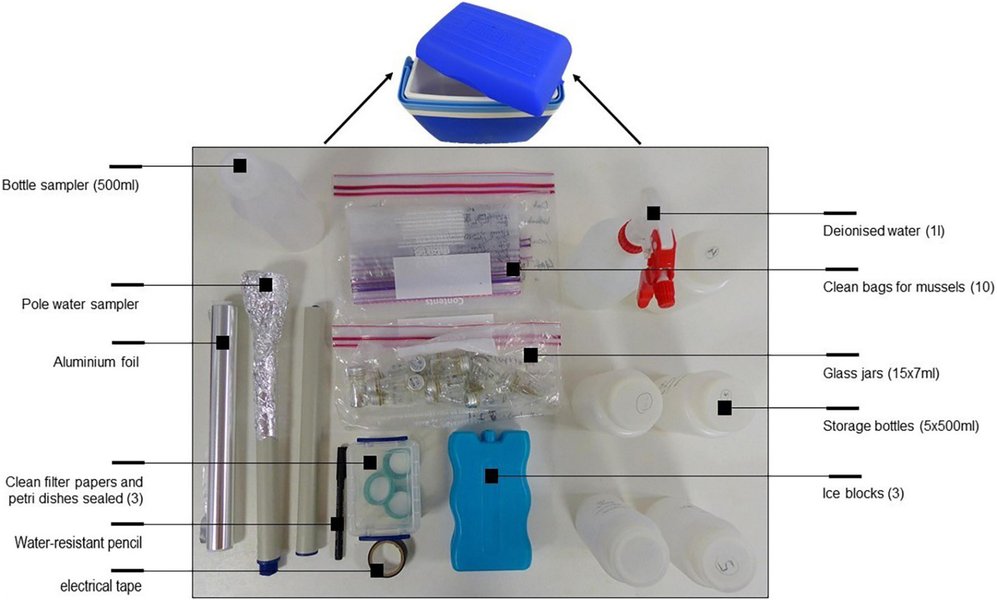
Specialized tools are crucial for effective microplastic sampling from diverse aquatic environments.
Once samples are collected, pre-treatment is a critical step to remove organic matter and other non-plastic interferences that can hinder accurate identification. This often involves chemical digestion using strong oxidizing agents like hydrogen peroxide or enzymatic digestion. The removal of organic matrices significantly improves the clarity of the sample, making it easier to isolate and analyze the microplastic particles. Filtration through appropriate filters, such as aluminum oxide filters, is then performed to separate the microplastics from the remaining liquid.
Differentiation from Natural Particles
A key challenge in microplastic analysis is distinguishing plastic particles from naturally occurring materials like microscopic rocks, sediment, or biological debris. Effective analytical methods must be capable of identifying the particles as plastic polymers and not confounding them with other environmental components. This highlights the importance of robust identification techniques that go beyond mere visual inspection.
Advanced Analytical Techniques: Unveiling Microplastic Characteristics
Exploring the cutting-edge tools for identification and quantification.
The core of microplastic measurement lies in advanced analytical techniques that can identify the chemical composition and physical properties of these minute particles. These methods are broadly categorized into spectroscopic and thermal analyses, each offering unique strengths.
Spectroscopic Methods: The Gold Standard for Identification
Spectroscopy is one of the most widely used and effective methods for microplastic detection and identification. These techniques rely on the interaction between light and matter to determine the chemical composition of particles, allowing for polymer identification. The two most popular methods are Fourier-transform infrared (FTIR) spectroscopy and Raman spectroscopy.
- Fourier-transform infrared (FTIR) Spectroscopy: FTIR microscopy is a prevalent approach in microplastic research. It measures the light absorption in the mid-infrared range (2.5–25 µm), producing a unique "fingerprint" spectrum for each polymer type. This allows for the identification of microplastics as small as a few micrometers. FTIR imaging can measure entire samples, capturing all particles on a filter, and the results can be analyzed with machine learning algorithms for automation and high precision.
- Raman Spectroscopy: Raman spectroscopy complements FTIR by providing different but equally valuable spectroscopic information. It relies on inelastic scattering of light to generate a unique spectral signature of the polymer. Raman spectroscopy plays a key role in identifying and characterizing the types and origins of microplastics, and can distinguish between particles of various sizes, though it has limitations on the maximum number of particles it can analyze in a given sample.
- Fluorescence Spectroscopy: This method involves staining microplastics with hydrophobic dyes that bind to them. When exposed to specific wavelengths of light, these stained particles fluoresce, allowing for detection under specialized microscopes. While promising, challenges include false positives due to organic material staining or natural fluorescence interference.
Thermal Analysis: Quantifying Mass Concentration
Thermal analysis techniques are crucial for measuring the mass concentration of microplastics, which can provide insights into the environmental load and potential sources. Pyrolysis-Gas Chromatography/Mass Spectrometry (py-GC/MS) is a prominent method in this category. It involves heating the plastic sample to break it down into smaller, volatile compounds, which are then separated and identified by gas chromatography and quantified by mass spectrometry. This technique can quantify concentrations of specific types of microplastics in milligrams per liter (mg/L).
Emerging and Complementary Techniques
- Single Particle Inductively Coupled Plasma Mass Spectrometry (spICP-MS): This advanced mass spectrometry technique is used to measure the quantity and size of nanoparticles and very small microplastics, addressing the challenge of detecting the tiniest particles.
- Scanning Electron Microscopy (SEM) and Atomic Force Microscopy (AFM): These high-resolution imaging techniques are increasingly used to study the smaller dimensions and morphological features of nanoplastics and microplastics, particularly their surface characteristics. AFM offers advantages like direct imaging without pre-treatment and the ability to distinguish material types within polymer blends.
- Polarized Light Scattering: An in-situ method that measures the polarization parameters of scattered light to detect microplastics in water. This approach shows potential for real-time water quality sensing and monitoring, offering insights into physical and chemical properties, weathering state, and concentration.
- Fluorescent Markers: Specially developed fluorescent markers can be added to water samples to detect microplastics, aiding in their visualization and quantification.
The Analytical Workflow: From Sample to Report
A systematic process for reliable microplastic analysis.
A typical analysis workflow for microplastic separation, counting, and identification by spectroscopic techniques involves several key steps to ensure accurate and reproducible results. This structured approach helps overcome the inherent complexities of microplastic analysis.
- Sampling: Collecting representative samples from the target environment using appropriate methods (e.g., manta nets for surface water, direct shoveling for sediment, or specific protocols for drinking water).
- Sample Preparation/Pre-treatment: This is one of the most critical steps, involving the removal of interfering matrices (like organic matter) through chemical digestion or enzymatic degradation. The goal is to isolate the microplastic particles.
- Filtration: Passing the pre-treated sample through filters (e.g., aluminum oxide) to capture the microplastic particles. The choice of filter size depends on the target size range of microplastics.
- Measurement/Data Acquisition: Applying advanced analytical techniques such as FTIR microscopy, Raman spectroscopy, or py-GC/MS to identify the polymer type, quantify particle numbers, or determine mass concentration. For image-based methods, this also involves acquiring high-resolution images of the particles.
- Analysis/Report: Interpreting the acquired data, often with the aid of machine learning algorithms, to classify particles, count their numbers, determine their sizes and shapes, and quantify their concentrations. The final step involves generating a comprehensive report detailing the findings.
The lack of standardization across these steps has historically made it challenging to compare results from different studies. However, significant efforts are underway to harmonize methodologies, with organizations developing international standards like ISO 24187 and ISO 16094 for microplastic analysis in various matrices, including drinking water.
Understanding Microplastic Measurement Capabilities
A comparative look at common techniques and their strengths.
Different analytical techniques offer varying capabilities in terms of particle size detection, information gathered, and suitability for different sample types. The table below summarizes some of the key methods and what they can reveal about microplastics in water.
| Measurement Method | Primary Information Obtained | Typical Size Range Detected | Key Advantages | Considerations/Limitations |
|---|---|---|---|---|
| FTIR Spectroscopy | Polymer identification, particle count, size, shape | ~1 µm to 5 mm | Widely used, high precision, automated workflows possible with imaging, robust polymer identification. | Can be affected by sample contamination, challenges with very small particles. |
| Raman Spectroscopy | Polymer identification, particle count, size, shape | ~1 µm to 5 mm | Non-contact (sample preserved), high spatial resolution, can distinguish various particle sizes. | Signal interference from additives/coloring agents, limited particle count capacity. |
| Pyrolysis-GC/MS | Mass concentration of specific polymer types | Broad range (quantifies mass) | Quantifies mass, provides information on polymer types and source. | Destructive method, does not provide individual particle characteristics (size, shape, count). |
| Single Particle ICP-MS | Nanoplastic quantity and size | <1 µm to a few µm | Excellent for detecting and quantifying very small particles (nano-scale). | Relatively new, specific to certain elements/polymers. |
| Optical Microscopy / Visual Analysis | Particle count, rough size and shape estimation | >50 µm | Simple, inexpensive, good for initial screening. | Prone to human error, cannot identify polymer type, difficult to distinguish from natural fibers. |
| Fluorescence Dye Tests | Presence/absence, particle localization | Variable, aids visual/microscopic detection | Rapid screening, highlights plastic particles. | Risk of false positives (staining of organic matter), does not identify polymer type. |
The Nuances of Microplastic Measurement
Factors influencing the accuracy and comparability of results.
Measuring microplastics is not a straightforward process, and several factors contribute to its complexity. These nuances must be considered to obtain meaningful and comparable data.
Particle Characteristics and Measurement Indicators
Microplastics vary significantly in their characteristics, including abundance (number of particles), size, shape, and mass. Researchers often use two primary indicators to measure the amount of microplastics:
- Quantitative Concentration: This refers to the number of microplastics converted into a concentration in environmental samples, often obtained through visual analysis and spectroscopy.
- Mass Concentration: Considered more reliable, this measures the total mass of microplastics, which can provide information on the environmental load and sources. Thermal analysis methods like py-GC/MS are commonly used for mass concentration.
The size of microplastics is particularly important due to its biological implications. Standardizing particle size measurements and incorporating shape descriptors are crucial for comprehensive characterization and risk assessment.
The Standardization Imperative
The lack of a unified, standardized method for quantitative analysis of microplastics across the field presents a significant challenge. This disparity in methodologies makes it difficult to compare findings from different studies, hindering a clear global understanding of microplastic pollution. International efforts, such as those by the European Commission and ISO, are working towards establishing uniform approaches to sampling, analysis, and data reporting to harmonize the measurement process.
This video provides an excellent introduction to microplastic research, explaining how scientists measure microplastics and even nanoplastics.
Home Testing vs. Certified Laboratory Analysis
While interest in home testing for microplastics is growing, it's important to note that there are currently no reliable at-home testing options (like strips) that can accurately identify the presence or quantity of microplastics. Detecting these tiny particles requires specialized equipment and expertise. For accurate results, water samples must be tested by certified laboratories. Services like SimpleLab Tap Score offer test kits where users collect a sample and send it to a certified lab for analysis. These lab tests can detect microplastics down to 1 micron and sometimes identify polymer types.
The Path Forward: Innovation and Collaboration
Driving progress in microplastic detection and monitoring.
The field of microplastic measurement is dynamic, with continuous advancements in technologies and methodologies. Researchers are actively developing more efficient, cost-effective, and in-situ detection methods to provide real-time data and better understand microplastic behavior in the environment.
Technological Innovations
Innovations like the portable, low-cost device developed by University of British Columbia researchers demonstrate promising advancements. This device can detect and quantify micro- and nanoplastics in water for a fraction of a penny per test, potentially making analysis more accessible for industries and the public. The integration of water quality sensors with optical methods, using light absorption or fluorescence to identify and quantify microplastics, is also a significant step towards effective in-field monitoring.
Collaborative Research and Data Harmonization
Given the global nature of microplastic pollution, collaborative research and harmonization of methodologies are paramount. Scientists are putting extra effort into standardizing protocols for sample collection, preparation, measurement, and data reporting. This collective endeavor will enable researchers to piece together findings from various studies, leading to a clearer, more comprehensive picture of microplastic contamination worldwide.
The radar chart above illustrates the comparative strengths of various microplastic measurement techniques across key performance indicators. FTIR and Raman Spectroscopy excel in accuracy, particle size detection, and polymer identification, making them robust tools for detailed analysis. Pyrolysis-GC/MS shines in quantitative mass analysis and identifying polymer types, though it sacrifices particle-specific details. Visual Microscopy, while cost-effective and easy to use for larger particles, falls short on accuracy and polymer identification, serving more as an initial screening tool. This chart highlights why a combination of methods is often necessary for comprehensive microplastic assessment, as no single technique optimally covers all aspects of this complex contaminant.
Frequently Asked Questions (FAQ)
Are there at-home tests for microplastics in water?
What is the most common method for identifying microplastic types?
Why is it challenging to measure microplastics?
Can microplastics be detected in drinking water?
Conclusion
Measuring microplastics in water is a complex yet crucial endeavor in addressing the global challenge of plastic pollution. It requires a sophisticated array of techniques, from careful sampling and rigorous pre-treatment to advanced spectroscopic and thermal analyses. While methods like FTIR and Raman spectroscopy provide detailed insights into polymer identity and particle characteristics, thermal analysis offers essential data on mass concentration. The ongoing efforts to standardize methodologies are vital for creating a cohesive global understanding of microplastic distribution and impact. As technology advances, more efficient and accessible detection tools are emerging, paving the way for more effective monitoring and informed policy decisions to mitigate this pervasive environmental threat.
Recommended Further Reading
- How do microplastics impact human health?
- What are the sources of microplastic pollution in aquatic environments?
- What are the latest technologies for removing microplastics from water?
- Comparison of microplastic testing standards and protocols
