
Unlocking the Secret to Everlasting Blooms: Melatonin's Transformative Impact on Cut Flowers
Discover how this natural compound revolutionizes floriculture, extending vase life and preserving beauty.
Key Insights into Melatonin's Role
- Vase Life Extension: Melatonin significantly prolongs the freshness and aesthetic appeal of cut flowers, often doubling their longevity through various physiological enhancements.
- Antioxidant Powerhouse: Acting as a potent antioxidant, melatonin effectively combats oxidative stress, a primary cause of senescence, by neutralizing harmful reactive oxygen species (ROS) and boosting enzymatic defenses.
- Holistic Quality Enhancement: Beyond longevity, melatonin improves water balance, maintains membrane integrity, strengthens stems, and can even influence flower morphology, ensuring superior postharvest quality.
The Multifaceted Benefits of Melatonin for Cut Flowers
Melatonin (MT), a naturally occurring indoleamine, has emerged as a groundbreaking, eco-friendly solution for enhancing the postharvest quality and extending the longevity of cut flowers. Its diverse physiological functions make it an invaluable tool in floriculture, addressing the inherent challenges of cut flower perishability and significantly boosting customer satisfaction.
Extending the Splendor: Prolonged Vase Life
One of the most prominent effects of melatonin is its remarkable ability to extend the vase life (VL) of a wide array of cut flower species. This extension can range from a few days to nearly doubling the flower's freshness compared to untreated controls. For instance, studies have shown that snapdragon flowers treated with 200 µmol·L⁻¹ melatonin exhibit a significantly extended vase life. Similarly, carnations have seen their vase life increased by up to 10 days with a 0.1 mM MT concentration. Alstroemeria cut flowers have even demonstrated an extension from 12–13 days to an impressive 20–21 days when treated with melatonin at 100 and 200 μM, sometimes in combination with other compounds like putrescine. This consistent finding across various species underscores melatonin's potential to revolutionize the cut flower industry by making blooms last longer and remain beautiful.
Halting the Clock: Delaying Senescence
Senescence, the natural aging process in flowers, leads to wilting, browning, and overall quality degradation. Melatonin effectively delays this process through multiple sophisticated mechanisms. It actively reduces the accumulation of hydrogen peroxide (H₂O₂) and malondialdehyde (MDA) levels, which are key indicators of oxidative damage and lipid peroxidation. By mitigating these markers, melatonin preserves cellular membrane integrity and maintains the aesthetic appeal of petals. This anti-senescence effect is crucial for maintaining the ornamental value of cut flowers, ensuring they retain their freshness and vibrant appearance for an extended period.
The Guardian Within: Antioxidant Defense and Oxidative Stress Mitigation
Melatonin is a powerful antioxidant, playing a critical role in scavenging reactive oxygen species (ROS) that contribute to oxidative stress and accelerate senescence in cut flowers. It achieves this by stimulating the activity of both enzymatic and non-enzymatic antioxidants. Key antioxidant enzymes such as superoxide dismutase (SOD), catalase (CAT), ascorbate peroxidase (APX), and glutathione reductase (GR) are significantly enhanced by melatonin treatment. For example, in peony, SOD activity peaks and CAT activity significantly increases with melatonin application, demonstrating its robust protective effect. This enhanced antioxidant capacity helps shield cellular components from oxidative damage, ensuring flowers remain healthy and vibrant for longer.
Optimal Hydration: Improved Water Relations and Quality
Maintaining water balance is paramount for the turgidity and overall quality of cut flowers. Melatonin application has been consistently shown to improve water relations by reducing water loss and maintaining higher relative water content. In cut roses, melatonin treatments have been observed to reduce stomatal aperture, thereby helping maintain water content and prevent wilting. For peonies, melatonin improved water balance, with some cultivars maintaining stability for several days longer than controls. Beyond hydration, melatonin can also enhance various quality parameters, including inflorescence length, flower quality, and floret size in snapdragons, and increase maximum flower diameter in peonies, contributing to a superior visual appeal.
Structural Integrity: Stem Strength and Flower Morphology
In certain species, melatonin goes beyond preserving freshness and actively contributes to the structural integrity of the cut flower. For instance, in herbaceous peony, melatonin has been shown to increase stem lignin content and secondary cell wall thickness. This structural enhancement strengthens the stems, significantly reducing the likelihood of bending or drooping, which is a common issue affecting the display quality of cut flowers. Furthermore, melatonin can promote desirable morphological traits such as inflorescence length, stem elongation, floret number, and flower diameter, directly contributing to an improved ornamental quality and market appeal.
A Greener Future: Eco-Friendly Preservation
One of the most appealing aspects of melatonin as a postharvest treatment is its eco-friendly nature. As a naturally occurring biomolecule, it offers a sustainable and environmentally responsible alternative to traditional chemical preservatives, such as silver thiosulfate, which raise concerns regarding environmental impact and human health. The research and development of nanochitosan-encapsulated melatonin further exemplify this commitment to sustainability, providing a method for sustained release that prolongs its beneficial effects throughout the vase life with minimal environmental footprint.
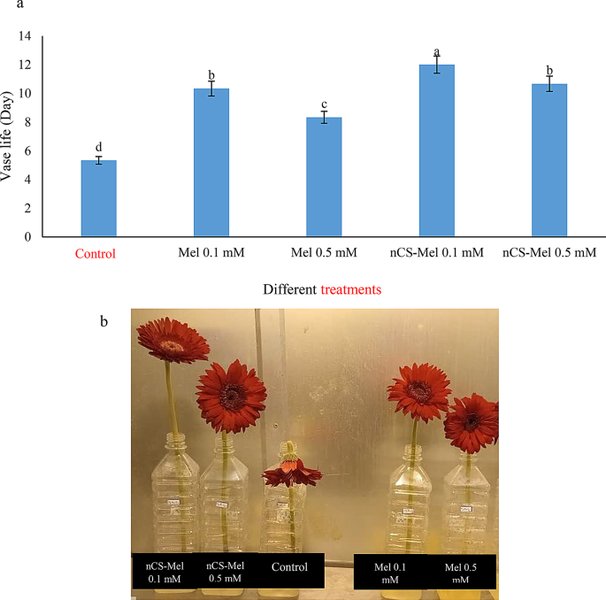
Nanochitosan-encapsulated melatonin prolonging freshness in gerbera flowers.
Mechanisms Behind Melatonin's Remarkable Effects
Melatonin’s profound influence on cut flowers stems from its multifaceted roles as a signaling molecule and a direct physiological regulator. Its mechanisms are complex and interconnected, contributing to a holistic improvement in postharvest quality.
Cellular Protection and Homeostasis
At the cellular level, melatonin acts as a robust protector. It directly scavenges reactive oxygen species (ROS), which are highly damaging byproducts of metabolic processes that accumulate during stress and senescence. By neutralizing these free radicals, melatonin prevents oxidative damage to cellular components like lipids, proteins, and DNA. This protective action is further amplified by its ability to enhance the activity of crucial antioxidant enzymes, thereby bolstering the flower's intrinsic defense system and maintaining cellular homeostasis. This leads to reduced electrolyte leakage and preserved membrane integrity, vital for maintaining cellular turgor and preventing premature cell death.
Modulation of Physiological Pathways
Beyond its antioxidant role, melatonin is involved in modulating various physiological pathways critical for plant health and longevity. It can influence gene expression related to senescence, hormonal pathways (including ethylene and abscisic acid, known senescence-promoting hormones), and carbohydrate metabolism. By subtly altering these pathways, melatonin shifts the balance towards delayed aging and sustained vitality. It also plays a role in enhancing water uptake and retention by the cut stems, ensuring a continuous supply of water to the petals and preventing wilting.
Quantifying Melatonin's Impact: A Performance Overview
To better visualize the comprehensive impact of melatonin on cut flowers, the following radar chart illustrates its performance across key postharvest quality parameters based on research findings. Each spoke represents a different aspect of flower quality, with higher values indicating a stronger positive effect.
As the chart illustrates, melatonin consistently outperforms untreated controls across all assessed quality parameters, particularly in areas related to senescence delay and antioxidant activity, highlighting its significant potential in postharvest care.
Specific Impacts Across Flower Varieties
The efficacy of melatonin has been observed across a diverse range of cut flower species, with optimal concentrations and application methods varying. Below is a summary of its documented effects on specific flower types.
| Flower Species | Key Effects of Melatonin Treatment | Typical Concentrations / Application |
|---|---|---|
| Roses | Significant vase life extension (up to double), reduced H₂O₂ and MDA, improved water retention, delayed senescence. | 0.1 – 0.3 mM (pulse treatment) |
| Peonies | Extended vase life (1.2–1.6 days), enhanced water balance, increased SOD and CAT activity, improved flower diameter, increased stem lignin. | 50 µmol·L⁻¹ (optimal) |
| Carnations | Vase life extension (up to 10 days), delayed petal wilting, reduced oxidative stress. | 0.1 mM |
| Snapdragons | Extended vase life, increased inflorescence length, improved flower quality, enhanced stem elongation. | 200 µmol·L⁻¹ (preharvest/postharvest) |
| Tuberose | 1.5-fold increase in vase life, enhanced floret size, improved postharvest quality, reduced water loss. | 250 µM (pulse), 200 µmol·L⁻¹ (preharvest foliar) |
| Amaryllis | Vase life extended by 2 days, improved quality, reduced oxidative stress, better water uptake (often with sucrose). | Concentrations vary (often with sucrose) |
| Alstroemeria | Vase life extended from 12–13 days to 20–21 days. | 100–200 μM (sometimes with putrescine) |
| Gerbera | Delayed petal senescence, reduced H₂O₂ accumulation, lower MDA levels, vase life extension (up to 9 days with nano-encapsulation). | Nanochitosan-encapsulated melatonin (nCS-MT) |
| Chrysanthemums | Improved storage duration, maintained physiological parameters like water content, reduced electrolyte leakage. | Exogenous application |
This table highlights the broad applicability of melatonin and the consistent positive outcomes across various commercially important cut flower species.
The Horticultural Value Chain and Melatonin's Impact
Melatonin plays a pivotal role in enhancing the postharvest value chain of horticulture, specifically within floriculture. By extending vase life and maintaining quality, it reduces wastage, improves marketability, and increases consumer satisfaction. This contributes significantly to the economic viability of the cut flower industry.
This video discusses post-harvest value chains and the effects of melatonin in agriculture, emphasizing its relevance to maintaining the quality and longevity of horticultural products.
The video above touches upon the broader context of postharvest management in agriculture and horticulture. Melatonin's application directly aligns with the goals of reducing spoilage and enhancing the value of perishable goods like cut flowers. By keeping flowers fresh for longer, growers and retailers can reduce losses, expand market reach, and ultimately deliver a superior product to consumers.
Understanding Melatonin's Practical Application
The integration of melatonin into postharvest protocols offers significant practical implications for the floriculture industry. It provides a sustainable alternative that is both effective and environmentally sound.
Application Methods and Considerations
Melatonin can be applied through various methods, each with its own advantages. Pulse treatments involve a short immersion of cut stems in a melatonin solution, allowing for rapid uptake. Foliar sprays can be applied preharvest, conditioning the plant for better postharvest performance even before cutting. Finally, melatonin can be incorporated into vase water solutions, providing a continuous supply during the flower's display period. The development of nano-encapsulation, for instance, with nanochitosan, represents an advanced method to provide sustained release and prolonged benefits, enhancing its efficacy over time.
Synergistic Combinations
Research indicates that melatonin's effects can be further amplified when combined with other compounds. For example, co-application with sucrose or polyamines has shown synergistic improvements in vase life and overall flower quality. These combinations suggest a holistic approach to postharvest care, leveraging multiple beneficial agents to maximize longevity and aesthetic appeal.
The Broader Context: Melatonin's Regulatory Role in Plants
Melatonin is not just an antioxidant; it's a pleiotropic molecule involved in a wide array of physiological processes in plants. Understanding its broader regulatory roles provides context for its specific effects on cut flowers.
The mindmap illustrates the extensive influence of melatonin within the plant kingdom, highlighting its involvement in fundamental physiological processes and its specific benefits in postharvest applications. Its regulatory capacity extends beyond cut flowers, influencing growth, stress responses, and overall plant development, underscoring its versatility as a biostimulant.
Frequently Asked Questions (FAQ)
What is melatonin?
How does melatonin extend the vase life of cut flowers?
Is melatonin safe and eco-friendly for flower preservation?
Can melatonin improve the overall quality of flowers, not just vase life?
How is melatonin typically applied to cut flowers?
Conclusion
The evidence overwhelmingly supports melatonin's efficacy as a superior, eco-friendly preservative for cut flowers. By significantly extending vase life, delaying senescence, enhancing antioxidant defenses, and improving water relations, melatonin not only preserves the beauty of flowers but also contributes to a more sustainable and economically viable floriculture industry. Its multifaceted actions and natural origin make it a compelling alternative to conventional treatments, promising fresher, longer-lasting blooms for consumers worldwide. As research continues to refine optimal application methods and concentrations, melatonin is poised to become an indispensable tool in the postharvest management of cut flowers.
Recommended Searches
- Optimal melatonin concentrations for various cut flower species
- Synergistic effects of melatonin with other plant hormones on cut flowers
- Nano-encapsulation technology for melatonin in floriculture
- Economic impact of extended vase life in the global cut flower industry