
Unlock Full-Stack Mastery: Your Complete MERN & Next.js Learning Path for 2025
Your step-by-step guide from beginner to building modern, powerful web applications with essential resources.
Embarking on the journey to learn the MERN stack (MongoDB, Express.js, React, Node.js) and Next.js can seem daunting, but with a structured approach and the right resources, it's an achievable and highly rewarding goal. This roadmap provides a clear path, combining foundational knowledge with practical application, guiding you from the basics of web development to building sophisticated full-stack applications.
Key Takeaways for Your Learning Journey
- Build a Strong Foundation: Mastering HTML, CSS, and especially JavaScript (including ES6+ features and asynchronous concepts) is non-negotiable before diving into frameworks and libraries.
- Sequential Learning is Crucial: Learn React thoroughly before tackling Next.js, as Next.js is a framework built upon React. Understand each MERN component (Node.js, Express, MongoDB) before integrating them.
- Practice Through Projects: Theoretical knowledge is vital, but applying concepts by building progressively complex projects is the most effective way to solidify your skills and create a portfolio.
Phase 1: Mastering Web Development Fundamentals
Laying the Groundwork (Estimated Time: 2-4 Weeks)
Every great structure needs a solid foundation. Before touching the MERN stack or Next.js, you must become proficient in the core technologies that power the web.
HTML (HyperText Markup Language)
Learn how to structure web content using semantic HTML5 elements. Understand tags, attributes, and how to create well-formed documents.
CSS (Cascading Style Sheets)
Master styling your HTML content. Focus on selectors, the box model, positioning, responsive design principles (like Flexbox and CSS Grid), and perhaps a preprocessor like SASS/SCSS later on.
JavaScript (The Core Language)
This is the most critical part of the foundation. You need a deep understanding of JavaScript as it's used across the entire MERN stack and Next.js.
- Basics: Variables (var, let, const), data types, operators, control flow (loops, conditionals).
- Functions: Declaration, expressions, arrow functions, scope, closures.
- Data Structures: Arrays and Objects, including common methods.
- DOM Manipulation: Interacting with HTML elements, handling events.
- Asynchronous JavaScript: Callbacks, Promises, async/await – essential for backend and fetching data.
- ES6+ Features: Destructuring, template literals, modules, classes.
Recommended YouTube Resources for Fundamentals:
- freeCodeCamp.org: Offers comprehensive, full-length courses on HTML, CSS, and JavaScript for beginners. Search for their "HTML Full Course", "CSS Full Course", and "JavaScript Programming Full Course".
- Traversy Media: Provides crash courses and tutorials on HTML, CSS, and Modern JavaScript (including ES6+). Search for "HTML Crash Course For Absolute Beginners", "CSS Crash Course For Absolute Beginners", "Modern JavaScript From The Beginning".
- Programming with Mosh: Known for clear explanations, especially for JavaScript fundamentals. Look for his "JavaScript Tutorial for Beginners".
Phase 2: Diving Deeper into JavaScript & Tools
Solidifying Your Core Skills (Estimated Time: 2-3 Weeks)
Before moving to frameworks, ensure your JavaScript knowledge is robust, and get comfortable with essential development tools.
Advanced JavaScript Concepts
Revisit asynchronous patterns, understand the event loop, learn about prototypes, higher-order functions, and functional programming concepts.
Essential Tools
- Package Manager (npm/yarn): Learn how to manage project dependencies.
- Git & GitHub: Master version control for tracking changes and collaborating. This is crucial for any developer role.
- Browser DevTools: Become proficient in debugging JavaScript, inspecting the DOM, and analyzing network requests.
Recommended YouTube Resources:
- JavaScript Mastery: Often focuses on modern JavaScript practices within project builds.
- Web Dev Simplified: Breaks down complex JavaScript topics into easy-to-understand videos.
- Academind: Offers deep dives into JavaScript concepts.
Phase 3: Mastering React.js
Building Dynamic User Interfaces (Estimated Time: 4-6 Weeks)
React is the 'R' in MERN and the foundation for Next.js. Focus on understanding its core principles for building interactive UIs.
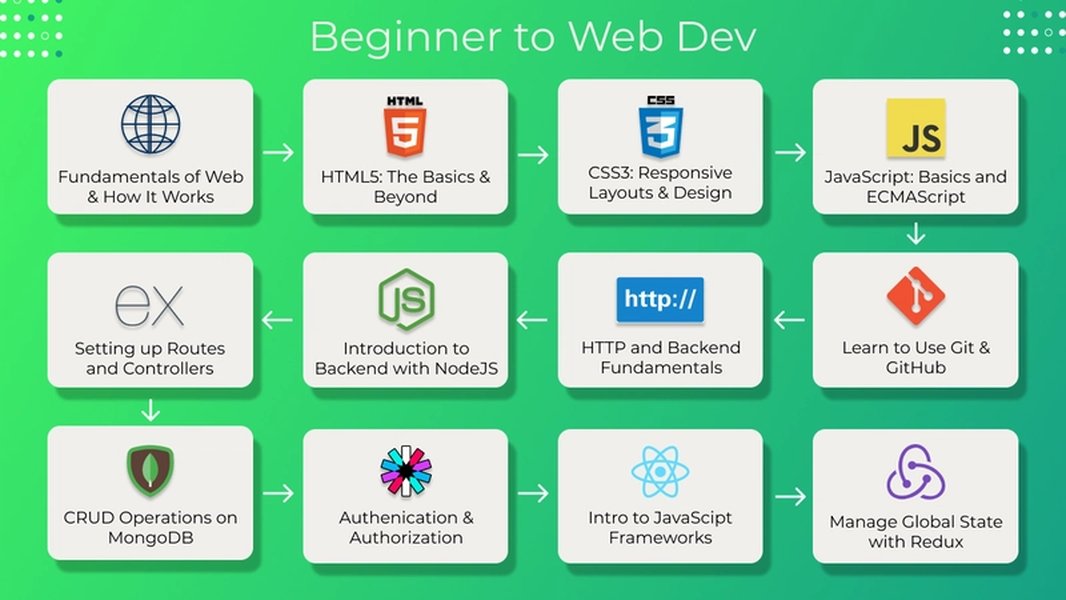
The MERN stack components: MongoDB, Express.js, React, Node.js.
Core React Concepts
- JSX: Syntax extension for writing HTML-like structures in JavaScript.
- Components: Functional components (preferred) and Class components (good to understand).
- Props: Passing data down the component tree.
- State: Managing component-local data that changes over time.
- Hooks: Essential for functional components (
useState,useEffect,useContext, etc.). - Conditional Rendering: Displaying different UI based on conditions.
- Lists and Keys: Rendering dynamic lists efficiently.
- Forms Handling: Managing user input.
- React Router: Implementing client-side navigation for Single Page Applications (SPAs).
- State Management (Basic): Context API for managing global state. (More advanced libraries like Redux or Zustand can be learned later).
Practice by building small applications like a to-do list, a weather app, or a simple data fetching display.
Recommended YouTube Resources for React:
- freeCodeCamp.org: Look for their "React Course - Beginner's Tutorial".
- Traversy Media: Offers React crash courses and project-based tutorials. Search for "React Crash Course".
- The Net Ninja: Provides structured playlists on React fundamentals and hooks.
- Codevolution: Highly recommended for in-depth React concept explanations. Check their React playlist.
Phase 4: Building the Backend with Node.js & Express.js
Server-Side Development (Estimated Time: 4-6 Weeks)
Now, let's build the server-side logic. Node.js allows you to run JavaScript on the server, and Express.js is a minimal and flexible framework for building web applications and APIs.
Node.js Fundamentals
- Understanding the Node.js runtime environment.
- Working with modules (CommonJS and ES Modules).
- File System (fs) module.
- HTTP module (understanding the basics before Express).
- Asynchronous nature of Node.js.
Express.js Framework
- Setting up an Express server.
- Routing: Handling different HTTP methods (GET, POST, PUT, DELETE) for various endpoints.
- Middleware: Understanding and writing custom middleware for tasks like logging, authentication, validation.
- Request & Response Objects: Handling incoming data (body, params, query) and sending responses (JSON, status codes).
- RESTful API Design: Principles of creating structured and stateless APIs.
Recommended YouTube Resources for Node.js & Express:
- Traversy Media: Provides excellent tutorials on Node.js and Express, often building REST APIs. Search for "Node.js & Express.js Full Tutorial".
- freeCodeCamp.org: Offers extensive courses covering Node.js and Express, including backend development concepts. Look for "Node.js and Express.js - Full Course".
- Academind: Has detailed courses explaining Node.js and Express from the ground up.
Phase 5: Managing Data with MongoDB & Mongoose
Database Integration (Estimated Time: 2-4 Weeks)
Learn how to store and manage application data using MongoDB, a popular NoSQL database, often paired with Mongoose for easier data modeling in Node.js.

Visual representation of MERN stack development.
MongoDB Concepts
- NoSQL fundamentals (documents, collections vs tables, rows).
- Setting up MongoDB (local or cloud service like MongoDB Atlas).
- CRUD Operations: Create, Read, Update, Delete documents.
- Basic querying and filtering.
Mongoose ODM (Object Data Modeling)
- Connecting your Express app to MongoDB.
- Defining Schemas and Models.
- Data validation.
- Performing CRUD operations using Mongoose methods.
- Populating related data.
Recommended YouTube Resources for MongoDB & Mongoose:
- freeCodeCamp.org: Has tutorials covering MongoDB basics and integration with Node.js. Search for "MongoDB Tutorial for Beginners".
- Traversy Media: Offers crash courses on MongoDB and Mongoose, often within the context of MERN projects. Look for "MongoDB Crash Course".
- The Net Ninja: Provides playlists covering MongoDB and Mongoose integration.
Phase 6: Building Full MERN Stack Applications
Bringing It All Together (Estimated Time: Ongoing Practice)
This is where you connect the frontend (React) with the backend (Node/Express/MongoDB) to create fully functional applications. This phase focuses heavily on practical application.
Key Integration Concepts
- Fetching data in React from your Express API (using
fetchor libraries likeaxios). - Handling User Authentication (e.g., using JWT - JSON Web Tokens).
- State management for handling shared data between components.
- Error handling across the stack.
- Deployment strategies (e.g., Heroku, Vercel, AWS).
Project Ideas
- Blog application with user accounts and comments.
- E-commerce site with product listings, cart, and user profiles.
- Social media platform clone (simplified).
- Task management application.
Recommended YouTube Resources for MERN Projects:
- Traversy Media: Famous for "MERN Stack Front To Back" and other full-stack project tutorials.
- JavaScript Mastery: Builds numerous MERN stack projects with modern practices.
- freeCodeCamp.org: Offers long-form MERN project tutorials.
This comprehensive tutorial by Dave Gray covers building a full MERN stack application, providing practical experience after learning the individual components.
Phase 7: Learning Next.js
Enhancing React with a Framework (Estimated Time: 4-8 Weeks)
Once you are comfortable with React and the MERN stack, you can learn Next.js. It's a powerful React framework that offers features like server-side rendering (SSR), static site generation (SSG), file-based routing, and API routes, making it excellent for performance, SEO, and full-stack development.
Next.js enables building performant and scalable React applications.
Key Next.js Features
- File-based Routing: Simplified routing by creating files and folders in the
pages(orappin newer versions) directory. - Rendering Methods:
- Server-Side Rendering (SSR) with
getServerSideProps. - Static Site Generation (SSG) with
getStaticPropsandgetStaticPaths. - Incremental Static Regeneration (ISR).
- Client-Side Rendering (CSR - standard React behavior).
- (App Router introduces React Server Components).
- Server-Side Rendering (SSR) with
- API Routes: Create backend API endpoints directly within your Next.js project.
- Image Optimization: Built-in component for optimizing images.
- Built-in CSS and Sass Support: Easy styling integration.
Recommended YouTube Resources for Next.js:
- Next.js Official Documentation & Learn Section: (https://nextjs.org/learn) The best place to start.
- Traversy Media: Offers Next.js crash courses and project tutorials. Search for "Next.js Crash Course".
- freeCodeCamp.org: Provides comprehensive tutorials on Next.js. Look for "Next.js Tutorial for Beginners".
- Academind: Has detailed courses covering various Next.js features.
- Vercel's YouTube Channel: (Creator of Next.js) Features talks, updates, and tutorials.
Phase 8: Building Full-Stack Apps with Next.js
Leveraging Next.js Capabilities (Estimated Time: Ongoing Practice)
Now you can build full-stack applications leveraging Next.js features, potentially integrating with your existing MERN backend knowledge or using Next.js API routes for simpler backends.
Integration Strategies
- Use Next.js for the frontend and connect to a separate Express/MongoDB API (your MERN backend).
- Build a full-stack application entirely within Next.js using its API routes to handle backend logic and database interactions (e.g., connecting to MongoDB Atlas directly from API routes).
- Combine Next.js rendering strategies (SSR/SSG) with client-side data fetching.
Project Ideas
- An SEO-friendly blog using SSG or ISR.
- A dashboard application requiring SSR for user-specific data.
- A full-stack e-commerce site using Next.js API routes or a separate backend.
Recommended YouTube Resources for Full-Stack Next.js:
- JavaScript Mastery: Often builds full-stack applications using Next.js, sometimes with MongoDB.
- Traversy Media: Has tutorials demonstrating full-stack Next.js development.
Visualizing Your Learning Path: Roadmap Mindmap
This mindmap provides a visual overview of the key stages and technologies involved in learning the MERN stack and Next.js.
(Flexbox, Grid)"] id1_3["JavaScript
(ES6+, Async, DOM)"] id2["Phase 2: JS Deep Dive & Tools"] id2_1["Advanced JS Concepts"] id2_2["npm / yarn"] id2_3["Git / GitHub"] id3["Phase 3: React.js"] id3_1["Components, Props, State"] id3_2["Hooks (useState, useEffect)"] id3_3["React Router"] id3_4["Context API"] id4["Phase 4: Backend (Node.js & Express)"] id4_1["Node.js Basics"] id4_2["Express Setup"] id4_3["Routing & Middleware"] id4_4["REST API Design"] id5["Phase 5: Database (MongoDB & Mongoose)"] id5_1["NoSQL Concepts"] id5_2["CRUD Operations"] id5_3["Mongoose ODM
(Schemas, Models)"] id6["Phase 6: Full MERN Projects"] id6_1["API Integration"] id6_2["Authentication (JWT)"] id6_3["Deployment"] id6_4["Build Portfolio Apps"] id7["Phase 7: Next.js"] id7_1["File-based Routing"] id7_2["Rendering (SSR, SSG, ISR)"] id7_3["API Routes"] id7_4["Data Fetching Methods"] id8["Phase 8: Full-Stack Next.js Apps"] id8_1["Integration with Backend"] id8_2["Using API Routes"] id8_3["Advanced Projects"] id9["Phase 9: Advanced Topics"] id9_1["TypeScript"] id9_2["State Management (Redux/Zustand)"] id9_3["Testing (Jest, Cypress)"] id9_4["CI/CD"] id9_5["GraphQL"]
Comparing Learning Resource Focus
Different YouTube channels offer varying strengths. This chart provides a subjective comparison based on common perceptions, helping you choose resources that fit your learning style at different stages. (Scale: 1=Low Focus, 5=High Focus)
Skill Progression and Focus Areas
As you progress through the roadmap, your focus will shift. This table outlines the key skills and concepts typically mastered at each stage.
| Milestone | Key Focus Areas | Technologies / Concepts |
|---|---|---|
| Beginner (Phase 1-3) | Frontend Fundamentals, UI Creation | HTML, CSS, Basic JavaScript (DOM, ES6), React Basics (Components, Props, State, Hooks), Git Basics |
| Intermediate (Phase 4-6) | Backend Development, API Creation, Database Interaction, Full-Stack Integration | Node.js, Express.js (Routing, Middleware), REST APIs, MongoDB, Mongoose (Schemas, Models), Basic Authentication (JWT), API fetching (Axios/Fetch), Version Control (Git Branching/Merging) |
| Advanced (Phase 7-9+) | Advanced Frontend Frameworks, Performance Optimization, Scalability, Full-Stack Architecture | Next.js (SSR, SSG, API Routes), Advanced State Management (Redux/Zustand), TypeScript, Testing (Unit, Integration), Deployment (Vercel, AWS, Docker), CI/CD, potentially GraphQL |
Phase 9: Advanced Topics & Continuous Learning
Beyond the Basics
Technology evolves rapidly. Once you're comfortable with MERN and Next.js, consider exploring these areas:
- TypeScript: Adding static types to JavaScript for better code maintainability and catching errors early.
- Advanced State Management: Libraries like Redux Toolkit or Zustand for complex application state.
- Testing: Frameworks like Jest, React Testing Library, and Cypress for unit, integration, and end-to-end testing.
- GraphQL: An alternative to REST for API development.
- Docker & Containerization: For consistent development and deployment environments.
- CI/CD Pipelines: Automating testing and deployment.
- WebSockets: For real-time communication.
- Performance Optimization: Techniques for speeding up your applications.
Stay curious, keep building, contribute to open source, and engage with the developer community (e.g., Reddit, Dev.to, Stack Overflow) to continue growing.
Frequently Asked Questions (FAQ)
How long does it realistically take to learn MERN and Next.js?
Learning duration varies greatly depending on your background, time commitment, and learning pace. For a complete beginner dedicating consistent daily hours (e.g., 2-4 hours), expect roughly:
- Fundamentals (HTML, CSS, JS): 1-2 months
- React: 1-2 months
- Node/Express/MongoDB (MERN Backend): 1-2 months
- MERN Integration & Projects: 1-3 months (ongoing practice)
- Next.js: 1-2 months
So, a realistic timeline is often 6 to 12 months to gain proficiency and build a portfolio. Consistency and project work are key.
Do I need to learn MERN before Next.js?
You don't necessarily need to master the *entire* MERN stack before starting Next.js, but you absolutely must learn React first, as Next.js is a React framework. Understanding Node.js and potentially Express/MongoDB is also very beneficial:
- React: Prerequisite for Next.js.
- Node.js: Understanding server-side JavaScript helps grasp Next.js concepts like SSR and API routes.
- Express/MongoDB: Helpful if you plan to build complex backends that Next.js API routes might not be suitable for, or if you want to connect your Next.js frontend to a separate, dedicated MERN backend.
Learning React, then Node.js basics, and then moving to Next.js (potentially using its API routes for simpler backend tasks initially) is a common path.
Which YouTube channels are best for MERN/Next.js project tutorials?
Several channels excel at project-based learning:
- Traversy Media: Widely recommended for practical, real-world MERN and Next.js projects.
- JavaScript Mastery: Focuses on building modern, full-stack applications using MERN, Next.js, and other popular technologies. Often includes deployment guides.
- freeCodeCamp.org: Offers very long, comprehensive project tutorials covering entire application builds.
- Web Dev Simplified: While also strong on concepts, includes project builds that are well-explained.
It's often beneficial to follow along with tutorials from multiple channels to get different perspectives and build a diverse portfolio.
Is the MERN stack still relevant in 2025 with frameworks like Next.js?
Yes, the MERN stack is still highly relevant. While frameworks like Next.js offer integrated solutions (especially with API routes), understanding the individual MERN components provides valuable flexibility and deeper knowledge:
- Standalone Backends: Many applications require robust, standalone backends, where Express and MongoDB excel.
- Microservices: Knowledge of Node/Express is crucial for building microservices.
- Job Market: Many companies still use and hire for MERN stack skills.
- Foundation: Learning Express/MongoDB provides a solid backend foundation applicable even when using other frameworks or languages.
Next.js often complements MERN rather than entirely replacing it. You might use Next.js for the frontend and parts of the backend (API routes), while still relying on a separate, more complex Express/MongoDB backend for heavy lifting.
Recommended Next Steps
- Compare MERN stack vs Next.js for full-stack development pros and cons.
- What are some unique project ideas to build a strong MERN stack portfolio?
- Explore the different ways to deploy a full MERN stack application.
- How can I integrate TypeScript into my React and Node.js projects?
References
Last updated May 4, 2025