
Unlocking Pan-India Success: Your Blueprint for Meta Ads D2C E-commerce Campaigns
Craft a comprehensive Meta Ads media plan to strategically target and convert customers across India's diverse landscape.
Key Insights for a Winning Pan-India Meta Ads Strategy
- Strategic Segmentation: Effective D2C e-commerce relies on granular audience segmentation across India, considering diverse demographics, languages, and regional consumer behaviors to maximize relevance and conversion.
- Integrated Planning: A successful Meta Ads media plan for Pan-India requires a holistic spreadsheet approach, encompassing campaign overview, detailed ad set configurations, creative strategy, precise budget allocation, and robust performance tracking for continuous optimization.
- Data-Driven Optimization: Regular monitoring of Key Performance Indicators (KPIs) like ROAS, CPA, and Conversion Rate, coupled with A/B testing of creatives and targeting, is crucial for refining campaigns and achieving sustainable growth in the competitive Indian D2C market.
For Direct-to-Consumer (D2C) e-commerce brands aiming for significant reach and conversions across India, a meticulously crafted Meta Ads media plan is indispensable. This strategy, vital in a market projected to reach $100 billion by 2025, allows brands to connect directly with consumers, bypassing traditional retail intermediaries. By leveraging Meta's extensive advertising ecosystem (Facebook, Instagram, Messenger, Audience Network), D2C brands can build strong customer relationships, optimize sales, and achieve sustainable growth.
This comprehensive guide outlines a spreadsheet-based Meta Ads media plan template, designed for pan-India targeting. It integrates crucial elements from campaign planning to performance analysis, ensuring a structured, data-driven approach to advertising in India’s diverse and rapidly evolving digital landscape. The template accounts for the nuances of regional targeting, language preferences, and varying consumer behaviors across different Indian states and cities.
Structuring Your Meta Ads Media Plan Spreadsheet
To effectively manage your Meta Ads campaigns for a D2C e-commerce brand targeting Pan-India, organize your media plan into a multi-sheet spreadsheet. This modular design facilitates clear organization, efficient day-to-day management, and robust performance tracking.
Sheet 1: Campaign Overview - The Strategic Blueprint
This sheet serves as the foundational blueprint for your entire Meta Ads strategy. It outlines the overarching goals and high-level parameters for each campaign, ensuring alignment with your D2C brand’s objectives, such as increasing sales or building brand awareness.
Essential Columns for Campaign Overview:
- Campaign Name: A unique identifier (e.g., "MonsoonSale_PanIndia_2025").
- Campaign Objective: Select from Meta's predefined objectives (e.g., Conversions, Sales, Traffic, Brand Awareness, Lead Generation). Align this with your specific marketing funnel stage.
- Start Date & End Date: Define the duration of your campaign.
- Total Budget (INR): The overall budget allocated for the entire campaign. Consider setting account-level spending limits for better control.
- Daily Budget (INR): The maximum amount to be spent per day.
- Target Market (Pan-India):
- Geographic Targeting: Initially "India," with notes for potential segmentation into Tier-1, Tier-2, or Tier-3 cities, specific states, or regions to address India's diversity.
- Demographics: Age range, gender, and languages (e.g., English, Hindi, Tamil, Bengali).
- Interests: Relevant interests based on your product category (e.g., "sustainable fashion," "organic skincare").
- Behaviors: Online purchasing behavior, engagement with competitor pages, or specific D2C brand interactions.
- Custom Audiences: Based on website visitors, customer lists, or app users for retargeting.
- Lookalike Audiences: Created from your high-value customer segments to find new potential customers.
- Unique Value Proposition (UVP): A concise statement of what makes your D2C brand unique (e.g., "ethically sourced materials," "personalized subscription boxes"). This helps inform ad copy and creative direction.
- Status: Track the current state (Planned, Active, Paused, Completed).
Sheet 2: Ad Set Details - Granular Control and Audience Segmentation
This sheet dives deeper, detailing specific ad sets within each campaign. It allows for granular control over audience targeting, placements, and optimization events, which is crucial for maximizing ROI in a diverse market like India.
Essential Columns for Ad Set Details:
- Ad Set Name: Unique identifier for each ad set (e.g., "Prospecting_NorthIndia_Females_25-34").
- Linked Campaign: Reference to the campaign this ad set belongs to.
- Audience Description: Detailed breakdown of the specific audience segment targeted (e.g., "Females, 25-34, interested in contemporary fashion, living in Delhi & Mumbai").
- Daily Budget (INR): Budget allocated specifically to this ad set.
- Placement Strategy: Where the ads will appear (e.g., Facebook Feed, Instagram Stories, Reels, Audience Network). Consider Advantage+ placements for Meta to automatically choose optimal placements.
- Optimization Event: The specific action Meta should optimize for (e.g., Purchase, Add to Cart, Link Clicks, Landing Page Views).
- Bid Strategy: How you manage bids (e.g., Lowest Cost, Bid Cap, Cost Cap).
- Start Date & End Date: Specific run times for the ad set.
- Status: Track the current state (Active, Paused, Completed).
Sheet 3: Creative & Copy Strategy - Engaging Your Audience
This sheet focuses on the actual ad content, crucial for capturing attention and conveying your brand's unique value proposition. High-quality, culturally relevant visuals and compelling copy are key for D2C brands in India.
Essential Columns for Creative & Copy Strategy:
- Ad Name: Unique identifier for each individual ad creative.
- Linked Ad Set: Name of the ad set utilizing this creative.
- Ad Format: Type of ad (e.g., Single Image, Video, Carousel, Collection Ad). Collection Ads are highly effective for e-commerce, allowing direct shopping from the ad.
- Creative Assets: Links or paths to your visual files (images/videos).
- Primary Text: The main ad copy. Ensure it addresses customer pain points and highlights your UVP. Consider localizing for regional languages.
- Headline: A concise, attention-grabbing text.
- Description: Additional details displayed under the headline.
- Call to Action (CTA): Clear and concise button text (e.g., Shop Now, Learn More, Get Offer).
- Landing Page URL: The specific URL where users are directed. Ensure it's optimized for conversion, potentially with custom landing pages.
- A/B Testing Notes: Plan for testing variations in creatives, copy, or CTAs.
- User-Generated Content (UGC) Integration: Plan to incorporate customer reviews and testimonials to build social proof.
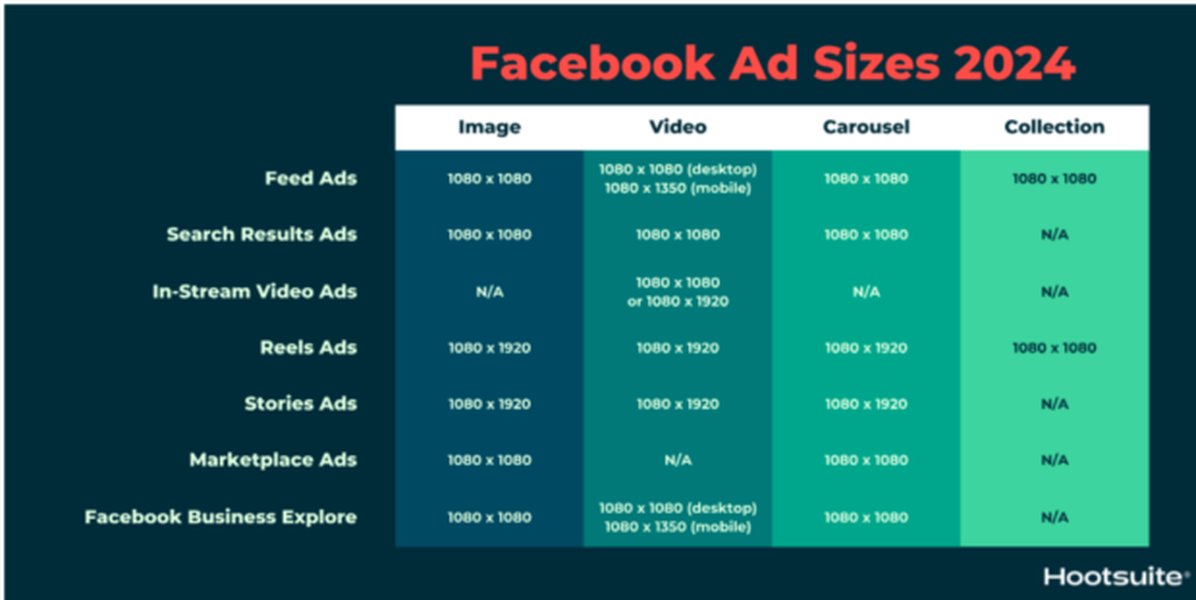
An example of Meta ad sizes and specifications to consider when planning your creatives.
Sheet 4: Budget & Spend Tracking - Financial Prudence and Optimization
This sheet is critical for financial management, allowing you to monitor daily spend against allocated budgets and track key performance indicators (KPIs) to ensure campaigns remain cost-effective and profitable.
Essential Columns for Budget & Spend Tracking:
- Campaign / Ad Set: Corresponding campaign or ad set name.
- Date: Date of spend recorded.
- Daily Spend (INR): Amount spent on that specific day.
- Cumulative Spend (INR): Running total of expenditure.
- Impressions: Total number of times your ad was displayed.
- Clicks: Total number of times your ad was clicked.
- CTR (%): Click-Through Rate (Clicks/Impressions × 100).
- CPC (INR): Cost Per Click (Daily Spend / Clicks).
- CPM (INR): Cost Per 1000 Impressions ((Daily Spend / Impressions) × 1000).
- Conversions: Number of desired actions (e.g., purchases, leads).
- Cost per Conversion (INR): Daily Spend / Conversions (e.g., Cost Per Acquisition - CPA).
- ROAS: Return on Ad Spend (Revenue Generated / Spend). This is a critical metric for D2C e-commerce.
- Notes: Any daily observations or adjustments made to the campaign.
Visualizing Your Meta Ads Performance
To gain a quick understanding of how your Meta Ads campaigns are performing across different key aspects, a radar chart can be incredibly useful. This chart visualizes performance metrics in relation to each other, offering a comprehensive view of campaign health.
This radar chart illustrates the perceived performance of different Meta Ads campaign aspects for a hypothetical D2C brand targeting Pan-India. Higher values indicate stronger performance in that area. This visualization helps in quickly identifying strengths and areas needing improvement, such as optimizing creative performance or refining targeting for better ROI.
Holistic D2C E-commerce Strategy Beyond Ads
While Meta Ads are a powerful tool, a comprehensive D2C e-commerce strategy extends beyond paid advertising. It involves understanding the entire customer journey, from brand discovery to post-purchase engagement. The following mindmap illustrates key strategic considerations for a D2C brand in the Indian market.
This mindmap illustrates the interconnected components of a successful D2C e-commerce strategy, emphasizing the central role of digital marketing (including Meta Ads) within a broader framework of customer experience, operations, product strategy, and data analytics. It highlights the importance of a holistic approach for Pan-India success.
Optimizing for Pan-India Success: Key Considerations
The Indian market presents unique opportunities and challenges due to its vast size, diverse demographics, and varying digital adoption rates. To ensure your Meta Ads media plan is highly effective for a D2C e-commerce brand, consider the following:
Deep Dive into Audience Segmentation
Pan-India targeting is not a monolith. It requires understanding regional nuances. Consider:
- Geographical Breakdown: Segment by metropolitan cities (Tier-1), developing urban centers (Tier-2), and rural areas (Tier-3). Consumer behavior, spending power, and language preferences can differ significantly.
- Linguistic Diversity: Beyond English and Hindi, explore advertising in regional languages like Tamil, Telugu, Kannada, Bengali, Marathi, and Gujarati, especially for Tier-2/3 cities where local language content resonates more strongly.
- Cultural Nuances: Tailor ad creatives and copy to reflect local festivals, traditions, and consumption patterns. For instance, campaigns around Diwali in North India will differ from Onam celebrations in Kerala.
Meta's AI-powered advertising tools are increasingly adept at reaching audiences in Tier-2/3 cities, which are driving significant new digital consumer growth. Leverage these tools for effective cross-regional scaling.
Creative Localization and A/B Testing
Eye-catching visuals and compelling copy are paramount. For D2C brands, emphasizing the unique value proposition (UVP) is crucial. Implement a robust A/B testing strategy:
- Ad Formats: Experiment with single image/video, carousel, and collection ads. Collection Ads are particularly effective for e-commerce to drive immediate sales.
- Visual Elements: Use high-quality imagery and video that aligns with your brand identity and resonates culturally. Test different visuals with local models or settings.
- Copy Variations: Test primary text, headlines, and descriptions, paying attention to emotional triggers, benefits-driven messaging, and local slang or idioms.
- Call-to-Action (CTA): Test different CTAs (e.g., "Shop Now," "Learn More," "Get Offer") to see which drives the most conversions.
Regularly analyze performance data to identify which creative elements and messaging variations are most effective for different audience segments.
Budgeting and Bidding Strategies
Meta offers flexibility in budget allocation and bidding strategies. For pan-India campaigns:
- Daily vs. Lifetime Budgets: Choose based on campaign duration and flexibility requirements.
- Bidding Strategies: Experiment with "Lowest Cost" for maximum reach within budget, or "Cost Cap" and "Bid Cap" for more control over Cost Per Acquisition (CPA) if you have specific profitability targets.
- Regional Spend Allocation: Allocate budget based on the potential of different regions, often starting with higher spend in Tier-1 cities or areas with known higher purchasing power, then expanding.
- Monitoring CPM/CPC: Keep a close eye on Cost Per Mille (CPM) and Cost Per Click (CPC) as these can vary significantly by audience and competition in India. Be prepared to adjust bids or refine targeting if costs become prohibitive.
Performance Tracking and Continuous Optimization
Religiously tracking Key Performance Indicators (KPIs) is fundamental for continuous improvement and achieving breakthrough growth in e-commerce. Focus on metrics such as:
- ROAS (Return on Ad Spend): The most critical metric for D2C e-commerce, directly indicating profitability.
- CPA/CPP (Cost Per Acquisition/Purchase): The cost incurred to acquire a customer or make a sale.
- Conversion Rate: Percentage of clicks leading to a desired action (e.g., purchase).
- Frequency: Monitor how many times a unique user sees your ad. High frequency can lead to ad fatigue.
Regularly analyze your data (daily or weekly) and make data-driven decisions. If a specific ad set or creative is underperforming, pause it or reallocate the budget. If an ad set is performing exceptionally well, consider scaling it up.
Importance of Mobile Responsiveness and Pixel Implementation
- Mobile Responsiveness: Given that the majority of online shoppers in India use smartphones, ensure your D2C e-commerce website is fully mobile-responsive and offers a seamless user experience. Slow loading times or poor mobile design can significantly impact conversion rates.
- Meta Pixel/SDK Implementation: Confirm that the Meta Pixel (for websites) or SDK (for apps) is correctly implemented. This is vital for accurate tracking of conversions, building custom audiences (e.g., website visitors, add-to-carts), and optimizing your campaigns for specific events.
Strategic Insights for D2C Brands
The D2C model thrives on direct customer relationships and personalization. Your Meta Ads strategy should reflect this:
- Strong Brand Identity: Ensure your ads consistently convey your brand's story, values, and unique selling points.
- Customer Reviews & UGC: Actively solicit and integrate customer reviews and user-generated content into your ad creatives. This provides powerful social proof and builds trust, especially in a new market.
- Retargeting Strategies: Implement comprehensive retargeting campaigns for users who have interacted with your brand (e.g., visited your website, added to cart) but haven't converted. These audiences often have a higher intent to purchase.
- Integration with OMS: If applicable, ensure your Meta Ads strategy aligns with your Order Management System (OMS) to streamline fulfillment and enhance the overall customer experience.
- Seasonal & Cultural Variations: Plan campaigns around major Indian festivals (Diwali, Holi, Eid, Christmas), regional events, and seasonal sales (e.g., summer, monsoon, winter) to capitalize on increased consumer spending.
This video provides practical guidance on how to run Facebook and Instagram (Meta) Ads specifically for Indian e-commerce businesses in 2025. It covers essential steps and considerations for effectively reaching the Indian market, supplementing the spreadsheet template with actionable insights on campaign setup and optimization.
Frequently Asked Questions (FAQ)
What is a D2C e-commerce brand?
Why is a Meta Ads media plan important for Pan-India targeting?
What are the key sections of a Meta Ads media plan template for D2C e-commerce?
How does Pan-India targeting influence Meta Ads strategy?
What KPIs are most crucial for D2C e-commerce Meta Ads?
Conclusion
Creating a comprehensive Meta Ads media plan template is a strategic imperative for any D2C e-commerce brand looking to succeed in the dynamic Pan-India market. By meticulously structuring your campaigns across distinct phases—from initial planning and detailed ad set configuration to creative execution and rigorous performance tracking—you empower your brand with the precision needed to navigate India's diverse consumer landscape. The template provides a robust framework for managing budgets, optimizing for conversions, and ensuring your advertising spend translates into tangible business growth. Continuous monitoring, data-driven adjustments, and a keen eye on localized trends will enable your D2C brand to build strong, direct relationships with customers, fostering loyalty and driving sustained profitability across the subcontinent.
Recommended Searches
- Advanced Meta Ads targeting strategies for Indian D2C brands
- Best practices for localizing ad creatives in India
- Optimizing ROAS for D2C e-commerce on Meta Ads
- Integrating Meta Ads with D2C CRM and OMS systems
Referenced Search Results
 shopify.com