
Unlocking Subscriber Growth: Your Definitive Guide to Structuring Meta Ads for Subscription Apps in 2025
Master the art of Meta Ads to transform viewers into loyal subscribers with a strategically built account and cutting-edge campaign tactics.
Effectively structuring your Meta Ads account is paramount for the success of a subscription-based application. It's not just about running ads; it's about building a sustainable acquisition funnel that attracts, converts, and retains subscribers. As of May 2025, Meta's platform offers sophisticated tools and requires a nuanced approach, especially for services relying on recurring revenue. This guide will walk you through creating a robust Meta Ads structure tailored for your subscription app.
Key Insights for Subscription App Advertising Success
- Prioritize Clear Campaign Objectives: Focus on "Conversions" (optimized for subscriptions or trial starts) or "App Promotion" to align Meta's algorithm with your primary goal of acquiring subscribers.
- Implement Robust Tracking & Measurement: Utilize the Meta Pixel (for web funnels) and SDK (for in-app events) in conjunction with Aggregated Event Measurement (AEM) for accurate performance insights and to navigate privacy changes.
- Develop Compelling, Compliant Creatives: Craft ads that clearly communicate your subscription's unique value proposition and adhere strictly to Meta's policies on transparency, especially regarding pricing and recurring billing.
Foundation: Setting Up Your Meta Ads Account
A well-organized Meta Ads account is the bedrock of successful advertising. For subscription apps, this initial setup is crucial for accurate tracking and efficient management.
1. Meta Business Manager & Ad Account Creation
Begin by establishing your presence within Meta Business Manager (also known as Meta Business Suite). This central hub allows you to manage all your marketing and advertising activities.
Creating Your Ad Account
Navigate to Business Settings within your Meta Business Manager. Under "Accounts," select "Ad Accounts." Here, you can either add an existing ad account or, more commonly for a new endeavor, "Create a new ad account."
- Assign a clear, descriptive name to your ad account (e.g., "[YourAppName] Subscription Ads").
- Set the correct time zone and currency for your business operations.
- Link your app's associated Facebook Page and Instagram account to this ad account. This enables advertising across these platforms under a unified structure.
- Assign necessary permissions to team members or agency partners who will be managing the campaigns.
2. Essential Integrations: Pixel and SDK
For subscription apps, tracking user actions accurately is non-negotiable. This requires integrating Meta's tracking tools.
Meta Pixel for Web-Based Funnels
If your subscription funnel involves a website (e.g., a landing page where users can sign up before downloading the app or for a web-based app), install the Meta Pixel. This JavaScript snippet tracks website visitor actions, allowing you to measure conversions, optimize ads, and build targeted audiences.
Facebook SDK for In-App Events
For mobile subscription apps, integrating the Facebook SDK (Software Development Kit) is vital. The SDK enables you to track in-app events crucial for subscription models, such as:
- App Installs
- Trial Starts (e.g.,
fb_mobile_start_trial) - Subscription Purchases (e.g.,
fb_mobile_purchaseor a custom event likeSubscribed) - Subscription Renewals (can be tracked as custom events)
Proper SDK setup is fundamental for optimizing your campaigns towards users most likely to subscribe and for understanding the lifetime value (LTV) of your acquired customers. Tools like RevenueCat can also integrate with Meta Ads to provide more granular subscription data.
3. Billing and Compliance
Ensure your payment method is correctly set up in the Ad Account Settings under "Payment Settings." For subscription services, it's crucial to be aware of and adhere to Meta's advertising policies, particularly those concerning Subscription Services. This includes clear disclosure of pricing, billing frequency, and cancellation terms in your ad creatives and landing pages.
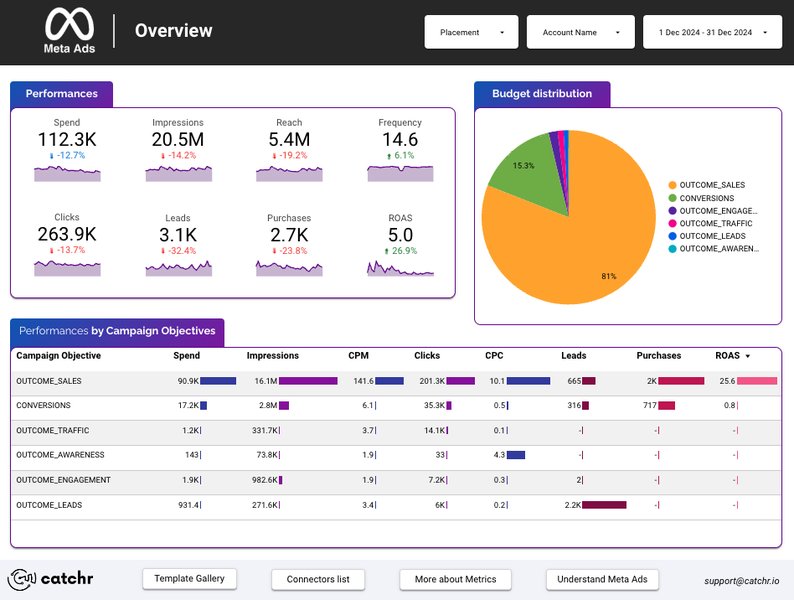
An example dashboard illustrating the hierarchical overview of Meta Ads campaigns.
Blueprint: Structuring Your Campaigns Effectively
A logical campaign structure allows for better control, testing, and optimization. Meta Ads are organized hierarchically: Campaigns > Ad Sets > Ads.
1. Campaign Level: Objectives and Budgeting
At the campaign level, you define your primary advertising objective and manage your budget.
Choosing the Right Objective
For subscription apps, common objectives include:
- Sales (Conversions): This is often the most suitable objective. Optimize for specific conversion events like "Subscribe" or "Start Trial." Meta's algorithm will then target users most likely to perform these actions.
- App Promotion: If your primary goal is to drive app installs and then convert users in-app, this objective can be effective. You can optimize for app installs or specific in-app events.
- Leads: If your app offers a free trial initiated via a form, this objective might be relevant for capturing trial sign-ups.
Budgeting Strategy: Campaign Budget Optimization (CBO)
As of 2025, Campaign Budget Optimization (CBO), now often part of Advantage+ Campaign Budget, is highly recommended. With CBO, you set your budget at the campaign level, and Meta's algorithm dynamically allocates it to the ad sets performing best. This simplifies budget management and often leads to better results. Start with a modest daily budget to gather data, and scale as you see positive returns.
2. Ad Set Level: Targeting, Placements, and Bidding
Ad sets are where you define your audience, choose where your ads appear (placements), and set your bidding strategy (if not fully automated by CBO and chosen objective).
Audience Targeting for Subscription Apps
- Custom Audiences:
- Retarget users who started a trial but didn't subscribe.
- Engage with expired subscribers to encourage re-subscription.
- Target users who have interacted with your app or website but haven't converted.
- Lookalike Audiences: Create audiences similar to your most valuable subscribers, trial users, or highly engaged app users. This is a powerful tool for finding new potential customers.
- Interest and Behavior Targeting: Target users based on their interests, behaviors, and demographics relevant to your app's niche. For instance, if you have a fitness subscription app, target users interested in health, wellness, and fitness apps.
- Broad Targeting (Wide-Open): Especially with CBO, starting with broader audiences can sometimes be effective, allowing Meta's algorithm more room to find converters. This is often paired with strong creative.
Placements
While Meta often recommends "Advantage+ Placements" (Automatic Placements) to maximize reach, you can also manually select placements (Facebook Feed, Instagram Stories, Reels, Audience Network, etc.). For subscription apps, ensure your creatives are adapted for the placements where they will appear, especially video-centric ones like Reels and Stories.
Bidding Strategy
If not using fully automated bidding tied to your objective (like "Highest Volume" or "Value Optimization"), you might consider options like setting a cost per result goal. For subscription apps with sufficient conversion data, "Value Optimization" can be powerful, allowing Meta to bid for users likely to generate higher lifetime value.
3. Ad Level: Creative and Copy
This is where your messaging comes to life. Your ads must be compelling and compliant.
Creative Best Practices
- Highlight Unique Subscription Benefits: Clearly communicate what makes your subscription valuable – exclusive content, unique features, convenience, etc.
- Use High-Quality Visuals: Video ads, carousels showcasing app features, and engaging static images are crucial. Test different formats. For subscription apps, demonstrating the app in action or using user testimonials can be very effective.
- Emphasize Special Offers: Promote free trials, introductory discounts, or annual plan savings.
- Clear Call-to-Action (CTA): Use direct CTAs like "Start Your Free Trial," "Subscribe Now," "Download and Subscribe," or "Get Offer."
Ad Copy and Compliance
Your ad copy must be persuasive and transparent. Crucially for subscription services, clearly disclose pricing, trial lengths, and how to cancel. This is not only a Meta policy requirement but also builds trust with potential subscribers.

App campaigns offer benefits like optimized targeting for installs and in-app actions, crucial for subscription models.
Powering Subscriptions: Advanced Strategies & 2025 Edge
To maximize ROI for your subscription app in 2025, leverage Meta's evolving features and adopt advanced strategies.
1. Leveraging AI and Automation
Meta continues to invest heavily in AI. Utilize features like:
- Advantage+ Placements & Advantage+ Creative: Let Meta's AI optimize where your ads are shown and make automatic enhancements to your creatives for better performance.
- AI-Powered Text Tools: Meta has introduced features like "Translate Text" for multilingual campaigns and tools to help refine ad copy tone and style, ensuring consistency with your brand.
- AI for Creative Generation: Experiment with AI tools for generating creative variations or using AI to specialize in prompts for ad content.
2. Measurement in a Privacy-Centric World: AEM
Aggregated Event Measurement (AEM) is Meta's protocol for measuring web and app events from iOS 14.5+ users, respecting user privacy choices. Ensure your events are configured correctly within AEM to get the most accurate measurement possible. For subscription apps, this is critical for tracking delayed conversions, like when a user starts a trial and subscribes several days later.
3. Omnichannel Campaigns
Meta has launched 'Omnichannel' ad campaigns designed to boost sales both online and, if applicable, in physical stores through a single campaign. While more tailored to e-commerce with physical presence, the underlying principle of unified campaign objectives can be adapted for apps that might have web and app-based subscription entry points.
4. Continuous Testing and Optimization
The digital advertising landscape is dynamic. Continuously:
- Test Creatives: A/B test different ad formats, visuals, copy, and CTAs.
- Test Audiences: Experiment with different targeting segments.
- Monitor Key Metrics: Track Cost Per Install (CPI), Cost Per Trial, Cost Per Subscription (CPS), Trial-to-Subscription Conversion Rate, and Lifetime Value (LTV).
- Stay Updated: Follow Meta's official resources (like the Meta for Business Blog) to stay informed about new features and best practices.
This video discusses advanced Meta Ads strategies specifically tailored for subscription apps, featuring expert insights that can help refine your approach.
Strategic Focus Areas for Subscription App Campaigns
This radar chart visualizes different strategic focuses for Meta Ads campaigns at various stages of a subscription app's lifecycle. A higher score indicates a greater emphasis on that particular aspect. For instance, an "Initial Launch Phase" might prioritize broad targeting and testing various creatives, while a "Mature App Optimization" phase would focus more on LTV, granular measurement, and hyper-segmented targeting.
Understanding these shifts in focus can help you allocate resources more effectively and adapt your Meta Ads strategy as your subscription app evolves.
Visualizing Your Subscription App's Meta Ads Structure
A mindmap can help illustrate the hierarchical organization of a Meta Ads account tailored for a subscription app. It outlines the key components from the overarching account setup down to specific considerations for ad creatives and measurement, emphasizing the unique needs of a subscription model.
(e.g., Trial Non-Converters, Expired Subs)"] id3_1_2["Lookalike Audiences
(based on Best Subscribers, Trial Users)"] id3_1_3["Interest/Behavior/Demographic Targeting"] id3_1_4["Broad Targeting (with strong creative & CBO)"] id3_2["Placements"] id3_2_1["Advantage+ Placements (Automatic)"] id3_2_2["Manual Placements (Feed, Stories, Reels, etc.)"] id3_3["Bidding Strategy"] id3_3_1["Highest Volume / Value Optimization"] id3_3_2["Cost Per Result Goal"] id4["Ad Creative & Messaging"] id4_1["Compelling Visuals"] id4_1_1["Video Ads (Demo, Testimonials)"] id4_1_2["Carousel Ads (Features)"] id4_1_3["Static Images"] id4_2["Persuasive Ad Copy"] id4_2_1["Highlight Subscription Value & USP"] id4_2_2["Clear Call-to-Actions (CTAs)"] id4_2_3["Promote Trials/Offers"] id4_3["Adherence to Transparency"] id4_3_1["Clear Pricing & Billing Terms"] id4_3_2["Cancellation Information"] id4_4["A/B Testing Different Ad Elements"] id5["Measurement, Reporting & Optimization (2025 Focus)"] id5_1["Aggregated Event Measurement (AEM) Setup"] id5_2["Key Performance Indicators (KPIs)"] id5_2_1["Cost Per Trial, Cost Per Subscription"] id5_2_2["Trial-to-Paid Conversion Rate"] id5_2_3["Lifetime Value (LTV)"] id5_2_4["Return on Ad Spend (ROAS)"] id5_3["Leveraging AI Tools & Automation"] id5_4["Omnichannel Considerations (if applicable)"] id5_5["Regular Performance Review & Iteration"]
This visual map reinforces the interconnectedness of each element and how they contribute to a successful subscription app advertising strategy on Meta platforms.
Key Considerations for Subscription App Ad Campaigns
The approach to advertising a subscription app can vary based on its model (e.g., free trial vs. direct paid subscription) and its stage of growth. This table outlines some key strategic considerations:
| Aspect | Strategy for Trial-Based Apps | Strategy for Direct Subscription Apps | General Best Practice |
|---|---|---|---|
| Primary Objective Focus | Optimize for Trial Starts initially, then nurture users to full Subscription. Key event: `StartTrial`. | Optimize directly for Subscription Purchase. Key event: `Subscribe` or `Purchase`. | Align chosen Meta campaign objective (e.g., "Sales," "App Promotion") with the most critical conversion point. |
| Key Event Tracking (Pixel/SDK) | `AppInstall`, `ViewContent` (pricing page), `StartTrial`, `Subscribe` (post-trial conversion). | `AppInstall`, `ViewContent` (subscription options), `InitiateCheckout` (if applicable), `Subscribe`. | Implement comprehensive event tracking through Meta Pixel/SDK and configure for AEM. |
| Ad Copy & Offer Emphasis | Highlight "Free Trial," risk-free exploration, benefits unlocked during trial. Clearly state trial duration and auto-renewal terms. | Emphasize immediate value, exclusive content, core benefits of subscribing directly. Clearly state subscription cost and billing frequency. | Maintain a clear value proposition, strong CTAs, and full transparency on terms as per Meta's policies. |
| Retargeting Priorities | Target users who started a trial but didn't convert; users whose trials are ending; users who completed a trial but churned. | Target users who visited the subscription page but didn't purchase; users who added a subscription to cart (if applicable) but didn't complete. | Utilize Custom Audiences from app/website activity to re-engage high-intent users. |
| Core Metrics for Success | Cost Per Trial, Trial-to-Paid Conversion Rate, Time to Convert, Cost Per Acquired Subscriber (post-trial). | Cost Per Acquisition (CPA) for a subscriber, immediate Return on Ad Spend (ROAS). | Monitor Lifetime Value (LTV) of subscribers, overall ROAS, and churn rates. |
| Creative Approach | Showcase the trial experience, ease of getting started, and a glimpse of premium features. | Focus on the premium experience, unique selling propositions, and long-term benefits. | Test various creative formats (video, carousel, image) and messaging angles continuously. |
Adapting your strategy based on these considerations will enable more effective and efficient use of your Meta Ads budget for your subscription app.

A sample Meta Ads dashboard provides insights into campaign performance, essential for ongoing optimization.
Frequently Asked Questions (FAQ)
What's the best campaign objective for a new subscription app? ▼
For a new subscription app, if you offer a free trial, often the "Sales" objective optimized for "Start Trial" events or "App Promotion" optimized for app installs followed by in-app trial events is a good starting point. This helps gather initial users and data. As you collect more data on who converts to paid subscribers, you can then shift optimization towards "Subscribe" events.
How important is the Meta Pixel/SDK for subscription apps? ▼
Extremely important. The Meta Pixel (for web funnels) and Facebook SDK (for in-app actions) are crucial for tracking key events in your subscription funnel, such as trial starts, subscription purchases, and even renewals (as custom events). This data allows Meta's algorithm to optimize ad delivery to users most likely to convert, enables you to measure campaign effectiveness accurately, and facilitates retargeting campaigns.
Should I use Campaign Budget Optimization (CBO)? ▼
Yes, Campaign Budget Optimization (CBO), often referred to as Advantage+ Campaign Budget, is generally recommended in 2025. CBO allows Meta to dynamically allocate your campaign budget to the ad sets that are performing best, which can lead to more efficient spending and better overall results. It simplifies budget management, especially when testing multiple audiences or creatives.
How do I comply with Meta's rules for subscription ads? ▼
Compliance is key. Meta's Subscription Services Ad Standards require transparency. This means your ads and landing pages must clearly state: the subscription price, billing frequency (e.g., monthly, annually), the duration of any free trial, what happens after the trial ends (e.g., auto-renews at X price), and how users can cancel their subscription. Failing to do so can lead to ad disapproval or account restrictions.
What are some key metrics to track for subscription app ads? ▼
Key metrics include: Cost Per Install (CPI), Cost Per Trial Start, Cost Per Subscription (or Cost Per Acquisition - CPA), Trial-to-Subscription Conversion Rate, Average Revenue Per User (ARPU), Customer Lifetime Value (LTV), and Return on Ad Spend (ROAS). Tracking these will help you understand campaign performance and profitability.
Recommended Next Steps
- What are the best practices for creating high-converting Meta Ad creatives for subscription apps in 2025?
- How can I effectively use Meta's Aggregated Event Measurement (AEM) to track trial and subscription conversions for my app?
- What are advanced audience targeting strategies on Meta Ads for reaching potential subscribers for a niche app?
- How do I calculate and optimize for Lifetime Value (LTV) in my Meta Ad campaigns for a subscription service?
References
Last updated May 7, 2025