
Mastering Your Professional Journey: Effective Self-Evaluation Strategies
Unlock Your Full Potential Through Insightful Self-Assessment
Self-evaluation is a powerful tool for professional development, enabling individuals to reflect on their accomplishments, identify areas for growth, and align their contributions with broader organizational goals. Far from being a mere formality, a thoughtful self-assessment empowers you to take ownership of your career trajectory, celebrate successes, and strategically address challenges. It transforms the performance review process from a potentially daunting experience into a collaborative dialogue focused on continuous improvement and mutual understanding.
Key Insights for a Powerful Self-Evaluation
- Strategic Reflection: A comprehensive self-evaluation necessitates looking beyond immediate tasks, considering your entire year's performance, alignment with company values, and overall contribution to team and organizational objectives.
- Data-Driven Storytelling: Support your assessments with specific examples, quantifiable data, and the STAR (Situation, Task, Action, Result) method to vividly illustrate your impact and growth.
- Proactive Growth Mindset: Embrace self-evaluation as an ongoing process for identifying developmental areas and setting clear, actionable goals (e.g., SMART goals) that foster continuous learning and increased accountability.
Core Methods for Comprehensive Self-Evaluation
Evaluating your own performance effectively requires a structured approach that encompasses various perspectives and types of data. Here are three highly effective methods:
1. Objective Tracking and Data Analysis (Quantitative Measures)
One of the most objective ways to assess your performance is through the systematic tracking and analysis of quantifiable data. This method moves beyond subjective impressions, grounding your evaluation in measurable results and clear metrics. It involves consistently monitoring your progress against predetermined goals and key performance indicators (KPIs).
Leveraging SMART Goals and KPIs
The foundation of effective objective tracking lies in setting SMART goals: Specific, Measurable, Achievable, Relevant, and Time-bound. These goals, when coupled with clearly defined KPIs, provide a tangible framework for assessment. For instance, a salesperson might track conversion rates, sales volume, or client acquisition numbers. A project manager might focus on on-time project completion rates, budget adherence, or bug resolution times. Regularly comparing your actual performance against these benchmarks allows for a clear understanding of your productivity and impact.
Quantitative measures offer several benefits. They provide objective evidence of your achievements, which is crucial for substantiating claims during performance reviews and salary discussions. They also highlight areas where performance might be lagging, prompting targeted interventions and skill development. However, it's important to remember that while quantitative data is powerful, it shouldn't be the sole measure. Creativity, teamwork, and leadership—often qualitative aspects—can be overlooked if the focus is exclusively on numbers.

A typical performance evaluation process, highlighting the integration of various assessment methods.
Practical Application: Documenting Achievements
Throughout the year, it's highly beneficial to maintain a running log of your accomplishments. This record should include specific projects, challenges overcome, initiatives led, and contributions made. For each entry, try to quantify your impact wherever possible. For example, instead of saying "improved efficiency," state "streamlined XYZ process, leading to a 15% reduction in processing time." This meticulous documentation proves invaluable when it's time to compile your self-evaluation, allowing you to recall precise examples and metrics that might otherwise be forgotten.
2. Soliciting and Integrating Feedback (Qualitative Insights)
While objective data provides a numerical assessment, qualitative feedback offers invaluable insights into your performance from the perspective of others. This method involves actively seeking input from peers, superiors, and even subordinates, painting a more holistic picture of your contributions and interactions within the team and organization.
The Power of 360-Degree Feedback
One prominent qualitative method is 360-degree feedback. This approach gathers feedback from multiple sources—your manager, direct reports, colleagues, and sometimes even clients. Each perspective offers unique insights into your strengths, areas for development, and how your actions impact those around you. For example, a colleague might highlight your exceptional collaborative skills, while a direct report might suggest improvements in delegation. This multi-faceted feedback helps to identify blind spots and provides a balanced view, reducing potential biases that can arise from a single viewpoint.
When seeking feedback, focus on specific behaviors and outcomes rather than general impressions. Ask questions like: "What could I have done differently on Project X?" or "How could I have better supported the team during Y challenge?" Open-ended questions encourage more detailed and constructive responses. It's also crucial to create a safe environment where individuals feel comfortable providing honest feedback.
Aligning with Company Values and Culture
Beyond direct work performance, qualitative feedback helps assess your alignment with company values and culture. Your manager and peers can offer insights into how well your actions reflect the organization's core principles. This aspect is increasingly important in modern workplaces, as companies often prioritize cultural fit and values alignment alongside technical competence. A self-evaluation is an opportunity to reflect on how you embody these values and contribute to a positive work environment, and feedback from others can validate or challenge your perceptions.
3. Reflective Self-Assessment and Goal Setting (Introspection and Future Focus)
The third method centers on introspection and forward-looking goal setting. This involves a deep personal reflection on your experiences, identifying lessons learned, and proactively charting a course for future growth and development. It's about understanding not just what you did, but how you did it and what you can learn from the process.
Analyzing Strengths, Weaknesses, and Growth Areas
A critical component of reflective self-assessment is honestly evaluating your strengths and weaknesses. This isn't about self-criticism, but rather a realistic appraisal of your capabilities. What tasks or projects truly energized you, indicating areas of strength and enjoyment? Where did you encounter difficulties, suggesting areas for improvement? Reflecting on past mistakes or challenges is an opportunity to learn and refine your approach for future performance. Many sources emphasize the importance of honesty in this process, noting that an overly positive self-assessment can be counterproductive.
This introspection directly feeds into goal setting. Once you've identified areas for growth, you can establish actionable goals for professional development. These might include pursuing new skills, seeking mentorship, improving time management, or enhancing communication abilities. The self-evaluation becomes a roadmap for continuous learning and personal growth, aligning your individual aspirations with the organization's evolving needs.
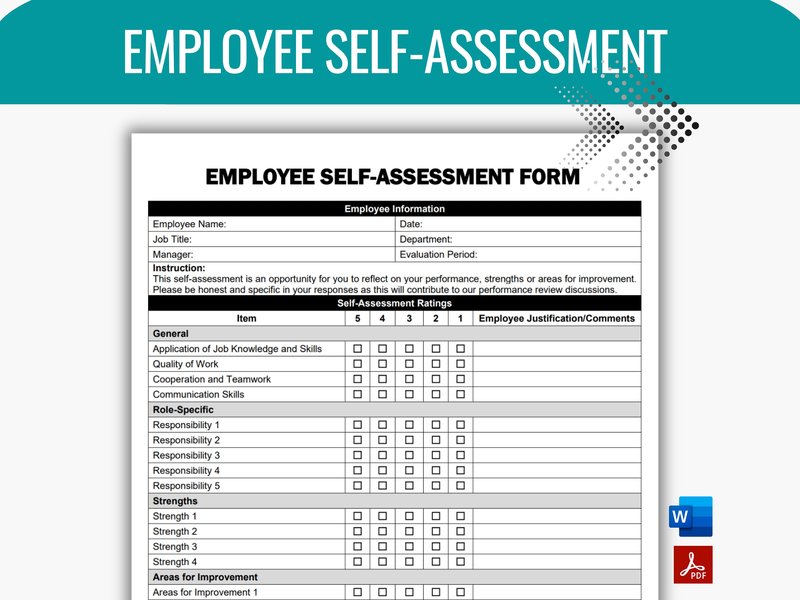
A visual example of a self-assessment template, emphasizing structured reflection.
The Iterative Nature of Self-Evaluation
Self-evaluation is not a one-time event but an ongoing, iterative process. It's a continuous improvement cycle where you assess, learn, adapt, and refine your approach. Regularly scheduled self-assessments, perhaps quarterly or annually, allow for consistent reflection and adjustment of goals. This agility ensures that your development remains relevant and impactful in a dynamic work environment.
Comparing Self-Evaluation Methodologies
Understanding the distinct characteristics of different self-evaluation methods is crucial for choosing the most appropriate approach for your situation. The table below outlines key features, advantages, and disadvantages of several common methodologies:
| Methodology | Key Focus | Example Techniques/Tools | Advantages | Disadvantages |
|---|---|---|---|---|
| Objective Tracking (Quantitative) | Measurable results and outcomes | KPIs, SMART goals, Sales figures, Project completion rates, Budget adherence, Task tracking software | Provides clear, verifiable evidence; Reduces bias; Identifies concrete areas for improvement; Supports data-driven discussions. | May overlook qualitative aspects (e.g., teamwork, creativity); Can be rigid; Not all roles easily quantifiable. |
| 360-Degree Feedback (Qualitative) | Perceptions and interactions with others | Surveys, Interviews, Peer reviews, Manager feedback, Subordinate feedback, Client testimonials | Offers diverse perspectives; Identifies blind spots; Enhances self-awareness; Fosters open communication. | Can be subjective; Requires trust and psychological safety; Feedback quality varies; Time-consuming to administer. |
| Self-Reflection & Assessment (Introspection) | Personal growth, learning, and future planning | Journaling, SWOT analysis (Strengths, Weaknesses, Opportunities, Threats), Personality assessments (e.g., MBTI, DISC), Goal setting exercises | Promotes self-awareness and accountability; Drives personal development; Allows for ownership of career path; Helps align personal and organizational goals. | Can be biased if not approached honestly; Requires discipline and critical thinking; May not always align with external perceptions. |
| Management by Objectives (MBO) | Goal achievement within a collaborative framework | Joint goal setting with manager, Regular progress reviews, Performance contracts based on objectives | Aligns individual and organizational goals; Increases employee ownership; Clear targets for evaluation. | Can be too focused on results, neglecting process; Requires strong communication; Goals must be realistic to avoid demotivation. |
Integrating Self-Evaluation into Your Professional Development
The goal of self-evaluation is not just to complete a form, but to foster continuous personal and professional growth. By consistently applying these methods, you gain deeper insights into your performance, paving the way for targeted development and enhanced career satisfaction.
The Role of Self-Awareness
At the heart of effective self-evaluation is self-awareness. It's the ability to critically examine your own performance, identify your motivations, and understand your impact on others. This continuous process of introspection allows you to recognize patterns, learn from experiences, and adapt your approach for better outcomes. Developing self-awareness can involve practices like mindfulness, seeking feedback from trusted mentors, and regularly journaling about your work experiences.
Building a Growth-Oriented Mindset
Approaching self-evaluation with a growth mindset is paramount. Instead of viewing weaknesses as failures, see them as opportunities for learning and improvement. This perspective encourages you to embrace challenges, persist in the face of setbacks, and continuously develop your skills. A positive, forward-looking attitude transforms the evaluation process from a judgment into a catalyst for advancement.
Understanding Your Performance Landscape: A Radar Chart Analysis
To further illustrate the multifaceted nature of self-evaluation, let's consider a radar chart that visualizes performance across key dimensions. This chart represents an individual's self-perception of their performance, providing a visual snapshot of strengths and areas for development. It combines aspects from quantitative tracking, qualitative feedback integration, and self-reflection.
This radar chart illustrates two datasets: "My Perceived Performance" and "Aspirational Performance" across six key performance dimensions. The inner polygon (green) represents a self-assessment of current capabilities, while the outer polygon (gold) signifies desired or stretch performance levels. This visualization helps pinpoint specific areas where the gap between current and aspirational performance is largest (e.g., 'Leadership & Initiative' and 'Adaptability & Problem-Solving' in this example), thereby guiding targeted development efforts. It effectively synthesizes the insights derived from quantitative tracking, qualitative feedback, and introspective self-reflection to provide a clear roadmap for growth.
Harnessing Video Insights for Self-Evaluation
To further deepen your understanding of effective self-evaluation practices, the following video offers practical tips and strategies. It covers common mistakes to avoid and provides actionable advice to make your self-assessment truly impactful.
"Self Evaluation | Performance Review Tips to Slay Your Self Assessment At Work" provides valuable guidance for a successful self-evaluation.
This video delves into common pitfalls and offers practical advice on how to present your achievements and growth areas effectively. It emphasizes the importance of preparing thoroughly, using specific examples, and aligning your self-evaluation with your career goals. Watching this can help you refine your approach and ensure your self-assessment resonates with your manager and supports your professional aspirations.
Frequently Asked Questions (FAQ)
What is the primary purpose of a self-evaluation?
How often should I conduct a self-evaluation?
Should I only focus on achievements in my self-evaluation?
How specific should I be with examples in my self-evaluation?
Does self-evaluation really impact my performance review?
Conclusion
Effective self-evaluation is a cornerstone of professional growth and a vital component of a meaningful performance review. By meticulously tracking your achievements, actively seeking diverse feedback, and engaging in honest introspection, you can build a comprehensive understanding of your performance. This proactive approach empowers you to articulate your value, identify strategic areas for development, and collaboratively chart a course for your continued success within your organization.
Recommended Further Exploration
- How to write a self-assessment using the STAR method for impactful performance reviews?
- What are the best practices for incorporating 360-degree feedback into personal development plans?
- What are effective strategies for setting and achieving SMART goals in a professional setting?
- Explore the psychology behind self-assessment and learn how to avoid common biases in your evaluation.