
Launching Your E-commerce Venture in the Middle East: A Simpler Path to Online Retail Success?
Your comprehensive guide to building a user-friendly online store tailored for Middle Eastern customers, inspired by Amazon's model but focused on simplicity.
Key Insights for Your Journey
- Understand Your Audience: Success in the Middle East hinges on catering to local preferences, including Arabic language support (RTL), popular regional payment methods (like Cash on Delivery and local digital wallets), and culturally relevant design.
- Choose the Right Foundation: Select an e-commerce platform that balances ease of use with the necessary features for the Middle Eastern market. Options range from user-friendly builders like Shopify and Wix to more customizable solutions like Bagisto or Magento, or even pre-built scripts.
- Simplicity is Key: While Amazon offers vast functionality, your initial focus should be on core e-commerce features: intuitive product discovery, a seamless checkout process, reliable order management, and robust customer support. Avoid overcomplication to ensure a smooth user experience.
Phase 1: Defining Your Vision and Understanding the Market
Before diving into the technical aspects, it's crucial to lay a solid foundation by defining your business model and understanding the unique characteristics of the Middle Eastern e-commerce landscape. This region is experiencing significant growth, with projections indicating a market volume of around US$50 billion by 2025, driven by a young, tech-savvy population, high internet penetration, and increasing mobile commerce.
Clarifying Your Business Scope
What Kind of E-commerce Site?
Consider the following:
- Business Model: Will you be selling directly to consumers (B2C), facilitating consumer-to-consumer sales (C2C), or a hybrid? For a "simpler Amazon," starting B2C or with a curated set of third-party sellers might be more manageable.
- Product Niche: What products will you offer? Electronics, fashion, beauty, and groceries are popular categories. Focusing on a specific niche can simplify operations initially.
- Degree of Simplicity: Identify the core functionalities you absolutely need. This typically includes product listings, a shopping cart, user accounts, order management, and payment processing. Advanced features seen on Amazon, like extensive personalization algorithms or a vast third-party seller ecosystem, can be deferred.
Tailoring to the Middle Eastern Consumer
The Middle Eastern market has distinct preferences and behaviors:
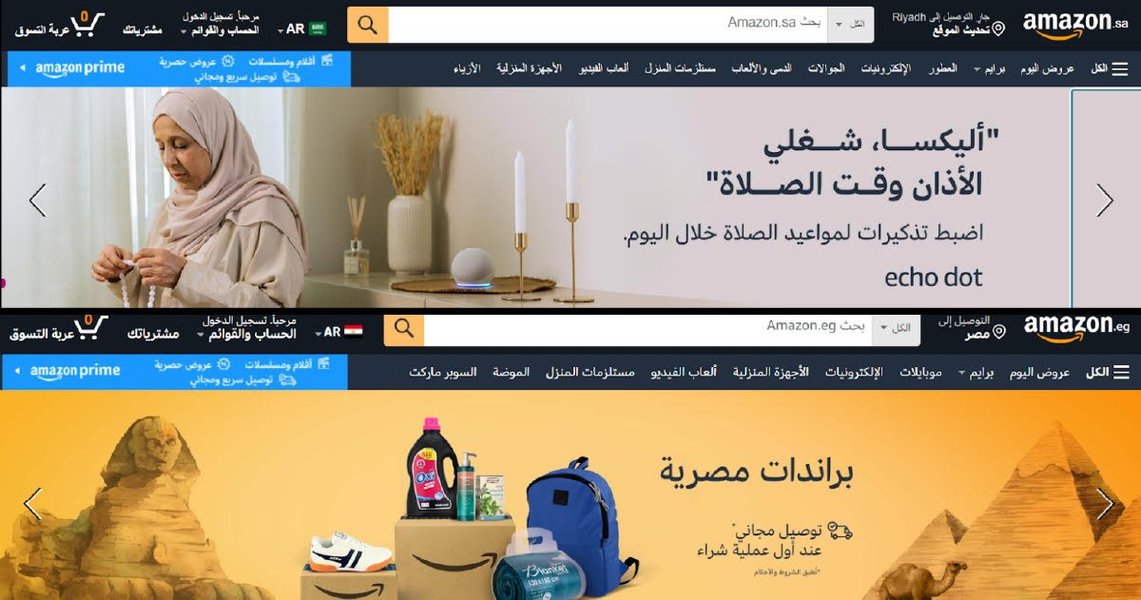
Localization, including language and regional promotions, is key in the Middle East, as shown by major platforms.
Language and Localization
Arabic is the predominant language. Your website must support Arabic, including Right-to-Left (RTL) text direction. Offering English as a secondary language is also highly recommended to cater to a diverse population.
Payment Preferences
While digital payments are growing, Cash on Delivery (COD) remains a popular option in many parts of the Middle East. You'll need to integrate various payment gateways, including:
- International providers like PayPal and Stripe (if widely used and trusted in your target countries).
- Regional gateways such as PayFort, Telr, PayTabs, and HyperPay.
- Support for local debit/credit card schemes.
Logistics and Shipping
Efficient and reliable shipping is critical. Research and partner with local and international courier services that have a strong presence and good reputation in your target countries (e.g., UAE, Saudi Arabia, Egypt). Consider customs duties and import regulations if sourcing products internationally.
Mobile-First Approach
Smartphone penetration is exceptionally high in the Middle East. A responsive, mobile-first design is not just an option but a necessity. Ensure your website offers a seamless experience on all devices, with fast loading times.
Building Trust
Consumers in the region value trust and security. Clear return policies, transparent pricing, secure payment processing, and accessible customer service (preferably in Arabic and English) are vital.
Phase 2: Choosing Your E-commerce Foundation
Selecting the right technology or platform is a pivotal decision that will impact your development time, cost, scalability, and the ease of implementing Middle East-specific features.
Platform Options: Pros and Cons
Several paths can lead to your e-commerce website:
- All-in-One E-commerce Builders (e.g., Shopify, Wix, BigCommerce):
- Pros: User-friendly interfaces, many pre-built templates, integrated hosting, good for quick setup without coding, often have app stores for extensions (e.g., for RTL or specific payment gateways). Shopify is often praised for scalability, while Wix is known for its drag-and-drop simplicity.
- Cons: Transaction fees or monthly subscriptions can add up, customization might be limited compared to open-source solutions, full Arabic/RTL support might rely on themes or apps.
- Open-Source Platforms (e.g., WooCommerce for WordPress, Magento, OpenCart, Bagisto):
- Pros: Greater flexibility and customization, no licensing fees (but hosting and development costs apply), large communities and many plugins/extensions available. Bagisto, being Laravel-based, is highlighted for its suitability for Middle Eastern markets with native Arabic support. Magento is powerful but can be complex.
- Cons: Steeper learning curve, requires more technical expertise for setup and maintenance, security is your responsibility.
- Pre-built Amazon Clone Scripts (e.g., RentALLScript):
- Pros: Can significantly speed up development by providing core Amazon-like features out-of-the-box, often customizable.
- Cons: Quality and support can vary, may require significant customization to truly simplify and localize, ensure you have ownership of the code.
- Custom Development:
- Pros: Complete control over design and functionality, tailored precisely to your needs. Tech stacks could include React/Vue.js for frontend, Node.js/Django/Laravel for backend.
- Cons: Most expensive and time-consuming option, requires a skilled development team.
Visualizing Platform Suitability
To help you weigh your options, the radar chart below provides an opinionated comparison of different platform types based on criteria relevant to building a simpler, Middle East-focused e-commerce site. The scores are illustrative (1=Low, 10=High):
This chart visualizes how platforms like Shopify and Wix excel in ease of use and offer good scalability, while solutions like Bagisto might offer stronger native Middle East localization. Custom builds provide maximum flexibility but come with higher complexity and cost. WooCommerce offers a balance, especially if you're familiar with WordPress.
Phase 3: Crafting Core Features and Designing for User Experience
With your platform choice in mind, focus on implementing essential features and designing an intuitive, culturally appropriate user experience.

A clean, intuitive user interface is crucial for engaging customers and encouraging sales.
Essential E-commerce Functionality
For a "simpler Amazon," ensure these core features are robust:
- User Accounts: Secure registration and login, user profiles for managing orders, addresses, and wishlists.
- Product Catalog: Easy-to-navigate categories, detailed product pages with high-quality images and descriptions (in Arabic and English), clear pricing.
- Search and Filtering: Effective search functionality with relevant filters (e.g., by price, brand, category) to help users find products quickly.
- Shopping Cart: Intuitive add-to-cart functionality, clear display of items, easy modification of quantities.
- Checkout Process: Streamlined, multi-step checkout with options for guest checkout, clear indication of shipping costs and taxes, and selection of payment methods.
- Order Management: System for customers to track their order status and for admins/sellers to manage orders, inventory, and shipping.
- Reviews and Ratings: Allow customers to leave product reviews to build social proof and trust.
- Admin Panel: A comprehensive backend for managing products, users, orders, promotions, and site settings.
UI/UX Design with Middle Eastern Sensitivity
- Clean and Intuitive Interface: Avoid clutter. Focus on clear navigation and prominent calls-to-action (CTAs).
- RTL Layout: Ensure flawless RTL display for Arabic content. This affects not just text but the entire layout of elements.
- Culturally Appropriate Imagery and Colors: Use visuals and color schemes that resonate positively with the target audience.
- Mobile Responsiveness: As mentioned, a mobile-first design is paramount. Test thoroughly on various devices and screen sizes.
- Trust Signals: Clearly display security badges, customer service contact information, and transparent policies.
Phase 4: Navigating Operations, Launch, and Growth
Legal and Compliance
Ensure your e-commerce operations comply with local laws in your target Middle Eastern countries. This includes:
- Business registration and licensing.
- Data privacy regulations (e.g., similar to GDPR, or specific national laws).
- Consumer protection laws.
- Taxation policies (e.g., VAT).
Marketing and SEO
Once your site is ready, you need to attract customers:
- SEO: Optimize your site for search engines using relevant Arabic and English keywords.
- Social Media Marketing: Platforms like Instagram, Snapchat, and Facebook are very popular in the Middle East.
- Content Marketing: Create valuable content that resonates with your target audience.
- Influencer Marketing: Collaborate with regional influencers.
Customer Support
Provide excellent customer support in both Arabic and English through multiple channels (e.g., phone, email, live chat, WhatsApp).
Mapping Your E-commerce Journey
The mindmap below outlines the key stages and considerations involved in building your e-commerce platform for the Middle Eastern market. It serves as a visual checklist for your project.
(Shopify, Wix, Bagisto, Custom, etc.)"] id2b["Select Technology Stack (if custom)"] id2c["Budget Allocation & Timeline Planning"] id3["Phase 3: Core Features & Design"] id3a["Essential Functionality
(Products, Cart, Secure Payments, Orders)"] id3b["Localization
(Arabic RTL, Currency, Regional Payments like COD)"] id3c["UI/UX Design
(Mobile-first, Cultural Sensitivity, Simple Navigation)"] id4["Phase 4: Operations & Launch"] id4a["Logistics & Shipping Partnerships"] id4b["Marketing & SEO Strategy (Local Focus)"] id4c["Multilingual Customer Support Setup"] id4d["Thorough Testing & Official Launch"] id4e["Post-Launch: Monitoring & Scaling"]
This mindmap highlights the interconnectedness of various tasks, from initial research and platform selection to design, localization, and finally, launching and growing your e-commerce business.
Understanding the Middle Eastern E-commerce Ecosystem
The Middle East boasts a vibrant e-commerce scene with established local and international players. Understanding their strengths can inform your strategy. The table below provides a snapshot of key platform types and their relevance for your simplified, Middle East-focused e-commerce site.
| Platform Type/Approach | Key Strengths for Middle East Focus | Considerations | Simplicity Factor | Example Platforms |
|---|---|---|---|---|
| Hosted E-commerce Platforms | Ease of use, quick setup, often good mobile themes, app ecosystems for localization. | Subscription costs, potential limitations in deep customization for specific ME needs without apps. | High (designed for users without extensive coding skills). | Shopify, Wix, BigCommerce |
| Open-Source E-commerce Platforms | High customizability, strong community support, potential for deep Arabic/RTL integration, often more cost-effective long-term (excluding development). | Requires more technical expertise, ongoing maintenance, security management. | Medium to Low (more setup and configuration involved). | WooCommerce (WordPress), Magento, OpenCart, Bagisto |
| Region-Specific Platforms | Often built with native support for Arabic, RTL, and local payment gateways. | May have smaller communities or fewer third-party integrations compared to global giants. | Medium (can vary). | Bagisto (strong ME focus) |
| Pre-built Clone Scripts | Faster initial development of Amazon-like features. | Code quality can vary, extensive customization may be needed for true simplification and localization, ensure IP ownership. | Medium (depends on the script's flexibility). | Various marketplace scripts |
| Custom Development | Ultimate control and tailoring to specific ME market needs and desired simplicity. | Highest cost, longest development time, requires a skilled team. | Low (complex undertaking but can result in a simple UX if designed well). | N/A (built from scratch) |
This table helps illustrate that while platforms like Shopify and Wix offer simplicity and speed, solutions like Bagisto or custom development might provide deeper localization capabilities from the outset, albeit with different effort levels.
Video Insight: E-commerce in the UAE and Middle East
To further understand the context of launching an e-commerce business in this dynamic region, the following video offers insights into the UAE and Middle Eastern e-commerce landscape. It discusses market dynamics, opportunities, and considerations relevant to online sellers, which can be valuable as you plan your venture.
This video touches upon the growth, trends, and specific advice for businesses looking to enter or expand their e-commerce presence in the Middle East. Key takeaways often revolve around understanding local consumer behavior, leveraging digital marketing effectively, and navigating the logistical and payment landscapes unique to the region.
Frequently Asked Questions (FAQ)
What are the most crucial features for a "simpler" Amazon-like site targeting the Middle East?
Focus on:
- User-friendly product browsing and search (in Arabic and English).
- Clear product pages with high-quality images and detailed descriptions.
- A simple and secure shopping cart and checkout process.
- Support for popular Middle Eastern payment methods (including COD and local e-wallets).
- Efficient order tracking and management.
- Basic customer account management.
- Mobile responsiveness and RTL language support are non-negotiable.
How important is Arabic language support and Right-to-Left (RTL) layout?
It is absolutely critical. Arabic is the primary language for a significant portion of your target audience. A proper RTL layout ensures that the website is intuitive and natural for Arabic speakers to use, significantly impacting user experience and conversion rates. Simply translating text is not enough; the entire interface must adapt to RTL conventions.
What payment methods are most popular and should be prioritized in the Middle East?
While credit/debit card usage is increasing, Cash on Delivery (COD) remains highly prevalent and expected in many Middle Eastern countries. Additionally, integrate local digital wallets and payment gateways popular in the region, such as PayFort, Telr, PayTabs, HyperPay, Mada (in Saudi Arabia), KNET (in Kuwait), and Fawry (in Egypt). Offering a variety of trusted options is key.
Should I start with a multi-vendor marketplace model immediately if I want something "Amazon-like"?
For a "simpler" version, it's often advisable to start with a single-seller model (where you sell your own inventory) or a very curated multi-vendor setup with a small number of trusted sellers. Building and managing a full-fledged multi-vendor marketplace adds significant complexity in terms of technology, seller onboarding, commission structures, and dispute resolution. You can always scale to a broader marketplace model later as your business grows and stabilizes.
What are the typical costs involved in creating such an e-commerce website?
Costs can vary widely based on your approach:
- Hosted Platforms (Shopify, Wix): Monthly fees typically range from $29 to $300+, plus transaction fees and costs for premium themes/apps. Initial setup can be relatively low.
- Open-Source (WooCommerce, Bagisto): No platform license fees, but you'll pay for hosting (can be $10-$100+/month), premium themes/plugins ($50-$200+ each, one-time or annual), and potentially developer fees for customization ($500-$5000+).
- Custom Development: This is the most expensive, potentially ranging from $10,000 to $100,000+ depending on complexity and features.
Recommended Further Exploration
- What are the specific data privacy laws for e-commerce in key Middle Eastern countries like UAE and Saudi Arabia?
- How can I effectively market my new e-commerce website to a young, mobile-first audience in the Gulf Cooperation Council (GCC) region?
- Compare the best logistics and last-mile delivery solutions for e-commerce businesses operating in the Middle East.
- What are the latest trends in e-commerce UI/UX design that resonate most with Middle Eastern consumers in 2025?
References

Last updated May 17, 2025