
Addressing Milwaukee County's Budget Challenges
Strategies and Forecasts for Fiscal Stability
Key Insights into Milwaukee County's Budget Situation
- Structural Deficits Persist: Despite recent efforts and new revenue sources, Milwaukee County faces ongoing structural budget deficits projected to grow significantly in the coming years.
- Balancing Act Engages Public: The county utilizes tools like the "Balancing Act" platform to involve residents in understanding budget complexities and exploring potential adjustments to expenditures and revenues.
- Fair Deal and State Aid are Crucial: Securing local control over revenue generation and advocating for increased state aid remain critical components of the county's long-term strategy to achieve fiscal health.
Milwaukee County has been grappling with budget deficits, a challenge that requires a multi-faceted approach involving strategic planning, revenue diversification, and careful expenditure management. The county's Office of Strategy, Budget and Performance plays a key role in overseeing these efforts, aiming to align strategic goals with financial realities.
In recent years, Milwaukee County has taken steps to address its budget gaps. For instance, in 2024, the county passed a budget that included lowering property taxes and investing in services, partly due to a new state law, Act 12, which has provided some relief. However, the fundamental challenge of structural deficits, where recurring expenses outpace recurring revenues, remains.
Understanding the Nature of the Deficit
Projected Shortfalls and Underlying Causes
While Milwaukee County successfully addressed a projected $19 million deficit in its 2024 budget through measures including the use of federal American Rescue Plan Act (ARPA) funds and, if necessary, debt service reserves, forecasts indicate larger deficits in the near future.
According to reports from the county's Comptroller Office, Milwaukee County is projected to face a $46.7 million deficit in 2026, which could escalate to a structural deficit of $171.6 million by 2030 if sustainable, long-term solutions are not implemented. This situation highlights the need for more than just short-term fixes.
The deficits are attributed to various factors, including increasing costs for services, reliance on property taxes as a primary funding source, and the limitations on local revenue generation without state approval. The county's budget is funded through multiple sources, including property tax and sales tax, but these revenues have not kept pace with rising expenditures.
Strategies for Closing the Budget Gap
Exploring Revenue Enhancement and Cost Reduction
Milwaukee County is exploring several avenues to close its budget deficit. These strategies generally fall into two main categories: increasing revenue and reducing expenditures. The county's Office of Strategy, Budget and Performance is actively looking into ideas to offset the looming deficits.
Revenue Diversification and the Fair Deal Initiative
A significant part of the county's strategy involves the "Fair Deal" initiative. This initiative advocates for allowing Milwaukee County local control to generate new revenue. The goal is to reduce the current heavy reliance on property taxes through a binding referendum process. This could involve exploring options such as additional local sales taxes or other fees, provided the state legislature grants the necessary authority.
The importance of state aid cannot be overstated. Discussions with state leaders regarding local revenue reform and avoiding a "fiscal cliff" are ongoing. Increasing shared revenue from the state is seen as a crucial element in achieving fiscal stability for the county.
Expenditure Management and Efficiency
On the expenditure side, the county is examining ways to manage costs and improve efficiency. This includes analyzing departmental budgets and identifying areas where savings can be realized without significantly impacting essential services. The goal is to reverse the trend of planning for cuts and instead plan for strategic investments.
One potential long-term solution that has been explored is the merging of city and county services. Reports have analyzed ways both the city and county of Milwaukee could save money by consolidating services, although this is a complex undertaking with significant logistical and political considerations.
Public Engagement and Budget Tools
Milwaukee County is also engaging the public in the budget process through tools like the "Balancing Act" platform. This online tool allows residents to interact with the county's budget, understand the different expenditure categories, and even propose their own budget adjustments. This initiative aims to increase transparency and gather public input on budget priorities.
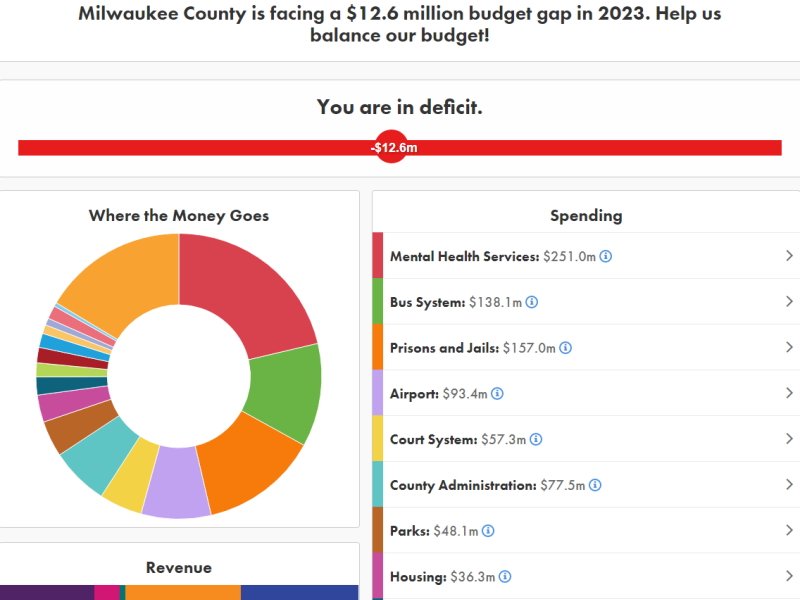
The "Balancing Act" tool allows residents to interact with the county budget.
The Role of Strategic Planning
Aligning Budget with County Vision
The Office of Strategy, Budget and Performance was created to better align strategic planning with budgeting efforts. The county has developed strategic outcomes that its services are linked to in the budget narrative. This approach aims to ensure that budget decisions support the county's overarching goals and priorities.
Implementing mechanisms to make investments into strategic priorities is a key focus. This includes considering racial equity in budget decisions, ensuring that investments contribute to equitable outcomes for all residents of the county.
Recent Budget Actions and Future Outlook
Progress and Remaining Challenges
The county has made considerable progress in reducing its structural budget deficit, largely thanks to the new state law (Act 12). The 2025 executive budget, for example, was able to mostly avoid cuts in departmental staff and services, partly by using the Debt Service Reserve. However, this does not eliminate the need for long-term solutions.
While the projected deficit for the 2025 budget has been reported at a lower figure of $3.7 million more recently, the outlook for subsequent years remains challenging. The projected $47 million deficit in 2026 and the growing structural deficit in the following years necessitate continued focus on sustainable fiscal strategies.
The Milwaukee County Board has been actively involved in addressing the budget situation, including forming work groups to study the problem and propose solutions. The goal is to develop a comprehensive plan that ensures the county's financial health and the continued provision of essential services to its residents.
External Perspectives and Collaboration
Engaging Stakeholders and Seeking Expertise
Addressing the budget deficit also involves engaging external stakeholders, including community leaders and business organizations. The Greater Milwaukee Committee, for instance, has supported studies on the city's budget and potential revenue fixes, recognizing the interconnectedness of the city and county's fiscal health.
Professional services firms like EY-Parthenon have also collaborated with the City of Milwaukee in the past to find ways to balance its budget, demonstrating the value of external expertise in navigating complex financial challenges.
The dialogue with state lawmakers remains critical, as state-level decisions regarding shared revenue and local control over taxation have a significant impact on Milwaukee County's financial capacity.
This video from FOX6 News Milwaukee discusses the projected $19 million deficit faced by Milwaukee County and the efforts to address it, highlighting the immediate challenges.
This video provides a snapshot of the immediate budget challenges Milwaukee County faced, illustrating the need for prompt action to avoid service cuts. It underscores the importance of the strategies discussed, including utilizing reserves and exploring revenue options, to bridge these gaps.
Comparing Past and Future Deficits
A Look at the Numbers
Understanding the scale of the projected deficits over time is crucial for appreciating the urgency of finding long-term solutions. The following table summarizes some of the recent and projected deficit figures:
| Fiscal Year | Projected Deficit | Source |
|---|---|---|
| 2024 (Mid-year) | $19 million (projected) | Multiple reports |
| 2025 | $3.7 million (projected) | Comptroller Office report |
| 2026 | $46.7 million (projected) | Comptroller Office report |
| 2027 | $69.8 million (projected structural deficit) | County forecast |
| 2030 | $171.6 million (projected structural deficit) | County forecast |
The table clearly shows the increasing trend in the projected structural deficit, emphasizing that while immediate deficits may be addressed, the underlying fiscal challenges require sustainable solutions.
FAQs about Milwaukee County's Budget Deficit
What is a structural budget deficit?
A structural budget deficit occurs when a government's recurring expenditures exceed its recurring revenues, indicating an imbalance in the fundamental financial structure. Addressing a structural deficit requires more than one-time fixes; it necessitates changes to either the revenue streams or the cost structure.
How does the Fair Deal initiative aim to help?
The Fair Deal initiative seeks to grant Milwaukee County more local control over generating revenue, primarily by reducing reliance on property taxes. This could involve the ability to enact additional local sales taxes or other fees through a referendum, providing the county with more diverse and potentially larger revenue sources.
Has using AI helped in addressing the budget crisis?
An experiment exploring the use of AI to solve Milwaukee County's budget crisis did not yield a foolproof plan to close the deficit. However, the exercise was considered valuable, suggesting that while AI may not provide a complete solution on its own, it could potentially be a tool to inform budget decisions and explore scenarios.
What is the "Balancing Act" tool?
The "Balancing Act" is an online platform launched by Milwaukee County to engage residents in the budget process. It allows users to interact with the county's budget, see how funds are allocated, and experiment with increasing or decreasing spending in different areas, fostering a better understanding of the budget's complexities.
How does state aid affect Milwaukee County's budget?
State aid, including shared revenue, is a significant funding source for Milwaukee County. Decisions made at the state level regarding the amount and distribution of this aid directly impact the county's ability to fund services and balance its budget. Increased state support is seen as vital for long-term fiscal health.
References
Last updated May 4, 2025