
Outline Minimalistic Drawing of a Robin Redbreast
A detailed guide and comprehensive approach to capturing the essence of a Robin with minimal lines
Key Highlights
- Essential Structure: Understand the basic shapes that form the foundation of the drawing.
- Simplified Details: Learn how subtle details like the beak, eye, and wing curves bring the minimalistic look to life.
- Flexible Techniques: Explore both hand-drawn and digital methods to create a clean, continuous line outline.
Introduction
Creating a minimalistic outline drawing of a Robin Redbreast is a rewarding exercise in simplicity and artistic expression. Minimalism in art focuses on capturing the fundamental essence of the subject with a few deliberate lines and shapes. In this guide, we will explore a step-by-step procedure that emphasizes clean, uncluttered lines and the basic geometric forms that together form a recognizable depiction of a Robin. This process not only enhances your understanding of form and structure but also offers creative insights into how minimal details can evoke a powerful visual representation of nature.
The Robin Redbreast is known for its distinctive features: a gently contoured body, a prominent red breast, and subtle wing curves. A minimalistic drawing aims to distill the complexity of these features into a few essential strokes. Whether you are a beginner or an experienced artist, the techniques presented here will help you create an elegant, uncluttered image that captures the unique silhouette and personality of the robin.
Materials and Preparation
Before diving into the actual drawing, it is important to gather the necessary materials and set up your workspace. Whether you choose to work on paper or digitally, having the right tools can enhance your creative process:
Traditional Tools
For a hand-drawn piece, you may need:
- Pencil and eraser for initial sketching.
- Fine line pen for outlining.
- Paper suitable for ink drawing – smooth, medium-weight paper is ideal.
- A ruler or compass for precise curves if required (though the emphasis here is on organic, free-flowing lines).
Digital Tools
If you prefer a digital approach, consider using:
- A digital drawing tablet or touchscreen device.
- Software that supports vector drawing or continuous line sketches (such as Adobe Illustrator, Procreate, or Inkscape).
- A stylus that allows for smooth, pressure-sensitive strokes.
Step-by-Step Drawing Guide
Step 1: Establish Basic Shapes
Begin your drawing by sketching an assortment of simple geometric shapes that form the foundation of the Robin:
Defining the Head and Body
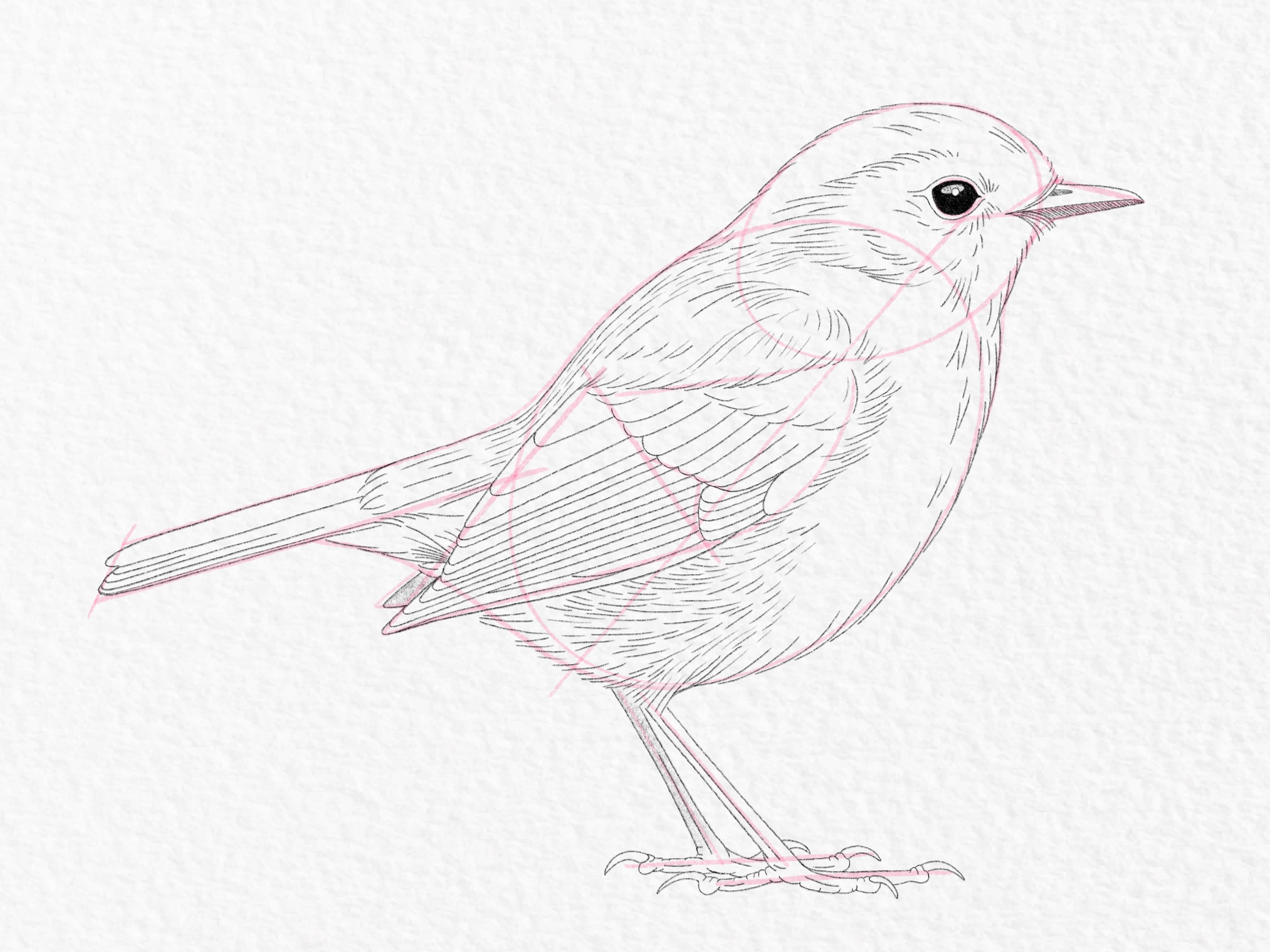
Start with a small circle or oval to represent the head. Adjacent to this, draw a larger, slightly elongated oval for the body. Ensure these shapes overlap slightly along what will become the neck. This overlapping informs the viewer about the connection between head and body in a fluid, natural way.
Sketching the Outline
Using a single continuous line, connect the head and body to form the neck. The continuity of the line is a hallmark of minimalist line art, conveying a sense of movement and unity without the need for multiple strokes. Extend the line to sketch the tail; the tail should be short, displaying a gentle curve that hints at the natural form and flow of a bird in motion.
Step 2: Adding Details with Minimal Lines
Minimalism in drawing requires the artist to be judicious with the inclusion of details. Each line must serve a purpose:
Wings
Draw two simple curved lines from either side of the body to symbolize the wings. The curves should be smooth and flowing, conveying both the relaxed nature of the robin and suggesting the contours of the feathered wings. Avoid adding intricate details such as individual feather lines; instead, let the curve suggest the form of the wings.
Beak and Eyes
Minimal detail is key to achieving a balanced artwork. For the beak, incorporate a small triangle at the front of the head, angled slightly downward to mimic the natural position. For the eye, a small dot or a tiny circle placed near the beak is sufficient. The simplicity of the detail allows the viewer to recognize the iconic features of the robin without overwhelming the drawing with excessive information.
Legs and Feet
To complete the figure, sketch two thin lines emerging from the lower portion of the body to represent legs. At the end of each leg, add small strokes or minimal shapes to indicate the feet, which may include a suggestion of claws. As with the rest of the drawing, keep these details subtle, ensuring that they complement rather than detract from the overall simplicity.
Step 3: Optional Enhancements
While a minimalistic drawing emphasizes simplicity, you may wish to include an accent that captures a defining feature of the Robin Redbreast – its vibrant chest:
Color Accents
Consider adding a splash of color exclusively to the breast area. A light wash of red or orange can emphasize the distinctive characteristic of the robin without detracting from the minimalistic style. This selective use of color should be applied sparingly and with purpose.
Refinement and Clean-up
Once the basic outline has been completed, refine the drawing by:
- Going over the entire sketch with a finer pen or digital brush to smooth out any inconsistencies.
- Erasing unnecessary pencil marks once the ink has dried or the digital layer has been fixed.
- Adjusting the weight of lines to emphasize the most critical parts of the drawing, such as the continuous line connecting the head and body.
Comparative Analysis: Traditional vs. Digital Methods
Although the principles of creating a minimalistic drawing remain constant across mediums, the tools and techniques used in traditional drawing differ from those in digital art. Below is a table comparing aspects of both approaches:
| Aspect | Traditional Method | Digital Method |
|---|---|---|
| Tools | Pencil, paper, ink pen | Digital tablet, stylus, drawing software |
| Control | Hand-drawn, physical control | Layer management, undo/redo options |
| Editing Process | Erasable pencil marks followed by ink tracing | Digital layers allow non-destructive editing |
| Finish | Unique, spontaneous strokes | Precise lines and the ability to refine details infinitely |
| Color Application | Optional watercolor or colored pencil accents | Digital filling tools and gradient options |
The table above showcases that regardless of the medium, the essential techniques for achieving minimalism depend on simplicity, calculated stroke decisions, and the ability to capture the form with minimal guides.
Artistic Considerations and Creative Flexibility
Embracing minimalism in art involves making deliberate choices about which details to include and which to omit. The minimalistic approach not only challenges you to capture the essence of the subject with fewer marks but also emphasizes the emotional and symbolic aspects of the art.
The Importance of Continuous Line Art
Continuous line drawing is a popular technique in minimalistic art. It involves creating the entire figure or significant parts of it without lifting the pen from the paper or interrupting the digital stroke. This method conveys movement and energy by creating an unbroken connection between different parts of the drawing. In the case of the robin, a continuous line can elegantly connect the head, neck, body, and tail, providing a fluid representation that is both modern and timeless.
Balancing Detail and Simplification
An effective minimalist drawing must strike a balance between too little detail and over-simplification. While the objective is to use minimal lines, each stroke must be purposeful. The placement and curvature of the lines should hint at the robin's natural anatomy without rendering every feather or muscle. This is especially pertinent for the wing and tail, where slight curves can insinuate the presence of feathers without drawing each one individually.
Consider the iconic feature of the robin – the red breast. When opting for minimalism, you have the flexibility to retain this critical element either through a single accent color or a brief, deliberate stroke that differentiates the chest from the rest of the figure. Even if you choose a purely monochromatic approach, the suggestion of texture and form can evoke the distinctive appearance of the bird.
Digital Techniques to Enhance Minimal Detail
Using Vector Tools
In digital environments, vector-based tools give you the advantage of replicating smooth curves and continuous lines effortlessly. Vector art allows for scaling without loss of clarity, making it ideal for minimalistic illustrations where each line must be crisp. Such tools let you experiment with varying stroke weights, which may be used to emphasize the robin’s silhouette and render a beautiful contrast between its form and the negative space around it. This ensures that even a simple drawing appears rich in artistic value and precision.
Layering for Depth
Digital drawing software often provides layering options that can be manipulated to simulate depth. For instance, you can have one layer dedicated solely to the continuous outline and separate layers for optional accents like the red breast or subtle texture lines. This system allows you to adjust or remove individual elements without affecting the base drawing.
Exploring Creative Variations and Interpretation
While the guide illustrated above offers a straightforward methodology, creativity often thrives when artists experiment with style and form. Below are a few variations that can help expand the horizons of your minimalistic drawing:
Abstract Minimalism
In this approach, you may choose to distort or exaggerate certain features for an abstract interpretation of a robin. For example, extending the curve of the wing or altering the angle of the head can produce a more dynamic and expressive image. The abstract approach challenges conventional perceptions while still remaining faithful to the essential characteristics of the bird.
Combining Negative Space
Negative space—the area around and between the subject—plays an influential role in minimalist art. By carefully considering the empty spaces, you can make the drawing resonate more with the viewer. Instead of filling every gap with lines, allow the background or white space to define form and provide contrast. This technique not only enhances the overall aesthetics but also reinforces the simplicity and elegance of the drawing.
Integrating Textural Elements
Although minimalism often means reducing visual clutter, you may choose to introduce textural elements subtly. For instance, small, controlled strokes within the body or wing regions can suggest a feathered texture without compromising the overall minimalistic look. This interjection of controlled complexity can give the drawing a tactile feel while keeping the global design in check.
Practical Exercise: Creating Your Own Minimalistic Robin
To synthesize all the concepts discussed, here is a structured exercise designed to help you create your own minimalistic drawing of a Robin Redbreast:
Instructions
- Start With a Light Sketch: On your chosen medium, lightly sketch an overlapping circle (head) and oval (body), ensuring a smooth transition between them.
- Create the Continuous Line: Draw a flowing line connecting the head to the body, extending the line to form a short, curved tail. Aim for fluidity in the stroke to emphasize unity.
- Add the Wings: On either side of the body, draw simple, curved lines that gently suggest wings. Keep these lines minimal without extraneous details.
- Define Facial Features: Place a small triangle at the front of the head for the beak and add a tiny dot or circle nearby to represent the eye.
- Detail the Legs: Sketch two simple lines extending downward to indicate legs, finishing with minimalistic representations of the feet.
- Optional Accent for the Breast: Carefully add a small splash of red or a brief line accent on the breast area to hint at the robin’s iconic colored chest.
- Review and Refine: Go over the drawing with a refined line, removing stray marks or unnecessary pencil lines, ensuring that every component maintains the minimalistic style.
Tip: Consider creating several rough drafts or practicing each part of the drawing individually to eventually synthesize them into a unified, minimalistic composition.
Advanced Considerations
For those looking to push the bounds of traditional minimalism, consider these advanced points:
Dynamic Composition
Breaking away from a straightforward profile, try experimenting with dynamic angles. A slightly rotated perspective can enhance the sense of movement and vitality in your drawing. This dynamic composition might involve tilting the head further forward or elongating the neck and wing curves to convey motion in mid-flight.
Balancing Simplicity with Expression
One challenge in minimalist art is ensuring the final work still carries emotion and character. Focus on the expressive power of your lines—tiny variations in stroke curvature and line thickness can add depth and interest. Emphasize the energy of the robin’s form without resorting to detailed rendering; sometimes, a seemingly slight alteration in a line can evoke the gentle spirit of the bird.
Incorporating Regional or Cultural Styles
Minimalism often intersects with regional artistic traditions. Exploring local or cultural art styles can offer innovative ways to interpret a classic subject like the robin. For example, you might integrate elements inspired by traditional Japanese ink washes, which capitalize on negative space and spontaneous, fluid brush strokes. Learning from such styles can broaden your perspective and refine your minimalist approach.
Summary and Final Thoughts
In conclusion, drawing a minimalistic outline of a Robin Redbreast distills the art of simplification into an exercise that is both challenging and deeply rewarding. By starting with basic shapes and progressively refining details through the use of continuous lines, you capture the essence of the subject with thoughtful precision. Whether working traditionally on paper or employing modern digital tools, the goal remains the same: to evoke the character and beauty of the robin through a minimal yet expressive depiction.
Embrace the balance between simplicity and expression. Experiment with both monochromatic and accented approaches, allowing subtle hints of the robin’s signature features to emerge without overwhelming the composition. The continuous line technique not only provides a sense of unity and fluidity but also invites viewers to imagine the inherent life and motion behind each curve.
By integrating these detailed step-by-step instructions and advanced artistic considerations, you can refine your skills and produce a compelling piece of minimalist art that is simultaneously modern and timeless. The process is an invitation to look deeper into the link between form, gesture, and emotion, capturing the natural elegance of the Robin Redbreast with an economy of lines.
Conclusion
The journey of creating a minimalistic outline drawing of a Robin Redbreast is not just about reproducing a bird; it is an exploration of the beauty found in simplicity. We have discussed materials, techniques, and creative choices that allow you to build an evocative representation using minimal lines. Whether you choose to incorporate subtle accent colors or maintain a stark, monochromatic style, the minimalistic approach emphasizes fluidity, cohesion, and expressive detail with every stroke.
The method described here encourages experimentation and personal interpretation while grounding you in the fundamental principles of line art. It’s an opportunity to refine your artistic voice while celebrating the intrinsic charm and elegance of the robin. With diverse approaches available—ranging from traditional hand drawing to advanced digital methods—the process can be both introspective and liberating. We hope these insights will inspire you to rediscover the art of minimalism through the timeless subject of the Robin Redbreast.
References
- Robin Red Breast on Pinterest - Pinterest
- Robin Line Drawing on Pinterest - Pinterest
- Robin Line Drawing on Shutterstock - Shutterstock
- Robin Printable Wall Art - Etsy
- Robin Redbreast Drawings on iStockphoto - iStockphoto
Recommended
Last updated February 20, 2025