
Charting the Course: A History of Minneapolis Light Rail
From Streetcars to Modern Lines: Tracing the Evolution of Public Transit in the Twin Cities
Key Insights into Minneapolis Light Rail History
- Revival of Rail Transit: After the decline of streetcars in the mid-20th century, the Twin Cities region saw a significant push for the reintroduction of rail transit, culminating in the development of modern light rail lines.
- The Blue Line: A Pioneering Effort: The METRO Blue Line, formerly the Hiawatha Line, was the first modern light rail line in Minnesota, opening in 2004 and connecting downtown Minneapolis, the airport, and the Mall of America.
- Expansion and Future Growth: The success of the Blue Line paved the way for the METRO Green Line and ongoing extensions, demonstrating a continued commitment to expanding the light rail network to better serve the growing metropolitan area.
The history of light rail in Minneapolis is a compelling narrative of evolving urban transportation, reflecting shifts in technology, urban planning, and public demand. While the modern light rail system is a relatively recent development, the Twin Cities area has a rich history of rail transit that dates back to the late 19th century with the extensive streetcar network.
The Twin City Rapid Transit Company (TCRT) operated a renowned intercity streetcar system from the 1890s until the mid-20th century. At its peak in 1922, the TCRT boasted 523 miles of track, significantly impacting the structure and growth of neighborhoods by allowing people to travel beyond walking distance. However, like many streetcar systems across the United States, the Twin Cities network saw a decline, with the last electric streetcar making its final run in Minneapolis on June 19, 1954. This marked a shift in focus towards bus transportation.
The Push for Modern Rail Transit
Advocacy and Early Studies
The idea of reintroducing rail transit in the Twin Cities began to gain traction in the latter half of the 20th century. Proposals for a modern streetcar or light rail system along the Hiawatha Avenue corridor appeared as early as 1974. The creation of the Metropolitan Transit Commission (MTC) in 1967, which later became Metro Transit, was a significant step towards a more integrated public transportation system. While the initial vision in the 1960s leaned towards "heavy rail" (grade-separated subway and elevated trains), inspired by systems in New York and Chicago, the emergence of modern light rail on the European model, as seen in Edmonton in 1981, influenced North American transit planners. Light rail offered greater flexibility and lower construction costs, making it a more attractive option.
Early studies and proposals faced hurdles. An MTC proposal for an LRT study in 1979 was initially prevented by the Met Council. However, the City of Minneapolis and the Minnesota Department of Transportation jointly studied light rail in the Hiawatha Corridor in the same year, a corridor where citizen opposition had successfully stopped a freeway from being built, demonstrating a desire for alternative transportation solutions.
The Birth of the Blue Line (Hiawatha Line)
Minnesota's First Light Rail Line
The Hiawatha Light Rail Line, now known as the METRO Blue Line, was the culmination of years of planning and advocacy. This project was significant as it marked the return of rail-based public transit to Minnesota after decades of absence. The line was built along the Highway 55 corridor, a decision influenced by earlier community efforts to prevent freeway expansion in that area.
The first phase of the Hiawatha Light Rail Line opened on June 26, 2004, providing service between Hennepin Ave./Warehouse District Station in downtown Minneapolis and Fort Snelling Station. This was a historic moment for the region's public transportation. Later that year, on December 4, 2004, service was extended to the Mall of America station via Minneapolis–St. Paul International Airport, connecting key destinations in the metropolitan area.
The Blue Line was further extended a few blocks north to Target Field Station on November 14, 2009, to provide connections with the new Northstar Commuter Rail line. The line currently runs from downtown Minneapolis to the southern suburb of Bloomington, serving 19 stations along its 12.4-mile route. It has become a vital link for commuters and travelers, including providing direct access to the airport terminals.
The initial success of the Hiawatha Line (Blue Line) demonstrated the demand for and benefits of modern light rail in the Twin Cities, paving the way for future expansions.

METRO Blue and Green Line trains at Target Field Station, a key transfer point in the light rail system.
The Green Line and System Expansion
Connecting the Twin Cities
The METRO Green Line represents the second major light rail corridor in the Twin Cities. Planning for the Green Line, also known as the Central Corridor project, began with initial environmental studies in 2001. Construction commenced in late 2010, and the line officially opened on June 14, 2014. The Green Line connects downtown Minneapolis, the University of Minnesota, and downtown St. Paul, significantly enhancing connectivity between the two core cities.
The Green Line shares stations with the Blue Line in downtown Minneapolis, including the crucial Target Field Station, allowing for seamless transfers between the two lines. This interconnected network provides a more comprehensive transit option for residents and visitors alike.

METRO Green Line trains operating on both tracks.
Ongoing and Planned Extensions
The development of the Twin Cities light rail system continues with significant extensions planned and underway:
METRO Green Line Extension (Southwest LRT)
The METRO Green Line Extension, also known as the Southwest Light Rail Transit (SWLRT) project, is a major undertaking that will extend the Green Line 14.5 miles southwest from downtown Minneapolis to Eden Prairie. This extension will add 16 new stations and connect Minneapolis with the suburban communities of St. Louis Park, Hopkins, Minnetonka, and Eden Prairie. The estimated one-way travel time from Southwest Station in Eden Prairie to Target Field Station in Minneapolis is projected to be 32 minutes. While facing challenges with budget and timeline, the project is anticipated to open in 2027. Over $1.8 billion in development has been built or permitted along the route in anticipation of the extension's opening, highlighting its potential impact on economic development.
This video provides a behind-the-scenes look at the Southwest Light Rail Project, offering insights into the complexities of its development.
METRO Blue Line Extension
A northern extension of the METRO Blue Line is also under development. This project aims to extend light rail service from Target Field Station in downtown Minneapolis through North Minneapolis and up to Brooklyn Park, adding approximately 13.4 miles of track. The planned route for the extension was modified after an initial plan using the BNSF rail corridor faced challenges. The new route will follow Bottineau Boulevard (County Road 81) in Crystal and Robbinsdale, and West Broadway in Minneapolis. Major construction for the Blue Line Extension is anticipated to begin between 2027 and 2030, with an estimated opening in 2028.
Timeline of Minneapolis Light Rail Development
Key Dates in the Evolution of the System
Understanding the history of Minneapolis light rail is aided by examining key dates in its development:
| Year | Event/Milestone | Details |
|---|---|---|
| 1890s | Twin City Rapid Transit Company (TCRT) established | Operated an extensive streetcar network. |
| 1954 | Last streetcar service in the Twin Cities | Marked the end of the initial rail transit era. |
| 1967 | Metropolitan Transit Commission (MTC) founded | Precursor to Metro Transit, focused on public transportation planning. |
| 1974 | Early proposals for rail transit in Hiawatha Corridor | Initial ideas for modern rail service emerged. |
| 2001 | Initial environmental studies for Central Corridor (Green Line) | Began planning for the second light rail line. |
| 2004 (June) | METRO Blue Line (Hiawatha Line) opens (Phase 1) | Service begins between downtown Minneapolis and Fort Snelling. |
| 2004 (December) | METRO Blue Line extended to Mall of America | Connected the line to the airport and a major retail destination. |
| 2009 | METRO Blue Line extended to Target Field Station | Provided a connection to the Northstar Commuter Rail. |
| 2010 | Construction begins on METRO Green Line | Started building the line connecting Minneapolis and St. Paul. |
| 2014 | METRO Green Line opens | Established the second major light rail corridor. |
| 2019-2025 | Green Line Extension (SWLRT) construction (structure and station) | Major construction phases for the southwest extension. |
| 2025-2027 | Green Line Extension (SWLRT) systems construction and testing | Installation and testing of operational systems. |
| 2026 | Blue Line Extension Final Design continues | Detailed planning for the northern extension. |
| 2027 | Anticipated opening of METRO Green Line Extension (SWLRT) | Expected start of passenger service on the southwest line. |
| 2027-2030 | Major construction anticipated for Blue Line Extension | Heavy construction phase for the northern extension. |
| 2028 | Anticipated opening of METRO Blue Line Extension | Expected start of passenger service on the northern line. |
Current Operations and Future Vision
Serving the Community Today
Today, the METRO Blue and Green Lines are integral parts of the Twin Cities public transportation network, operated by Metro Transit. The Blue Line typically operates with 15-minute headways for most of the day, from early morning until late night. Fares for light rail trips are the same as local bus fares, ranging from $2 to $3.25 depending on the time of day. Passengers can pay using exact change, a Go-To Card, or the Metro Transit app.
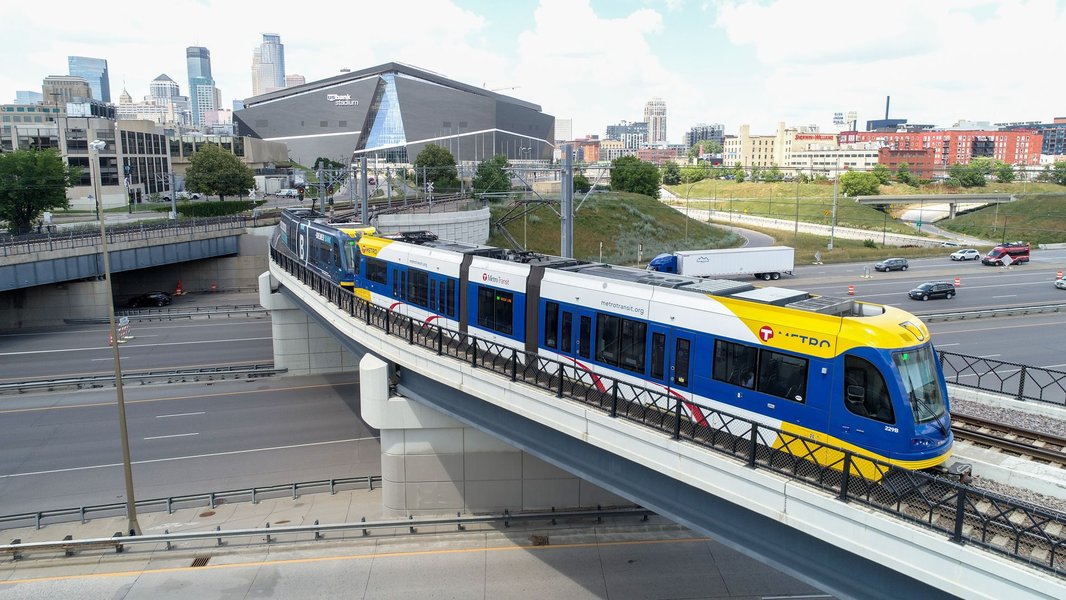
A Minneapolis light rail train in operation.
Bus routes are often timed to connect with light rail trains at stations, creating a more integrated transit experience. Occasionally, scheduled maintenance or construction may require bus bridges to replace train service, ensuring continuity of transportation for riders.
The Future of Light Rail in Minneapolis
The ongoing Green Line Extension and planned Blue Line Extension highlight the region's commitment to expanding its light rail network. These projects aim to connect more communities to the urban core, provide convenient access to jobs, education, and entertainment, and support transit-oriented development along the corridors.
While challenges in project management and funding have been noted, particularly with the Southwest LRT project, the long-term vision for light rail in the Twin Cities remains focused on creating a robust and accessible transit system that can serve the growing population and contribute to sustainable urban development.
Frequently Asked Questions
When did the first modern light rail line open in Minneapolis?
The first modern light rail line in Minneapolis, the Hiawatha Line (now METRO Blue Line), opened on June 26, 2004.
What is the difference between the Blue Line and the Green Line?
The Blue Line primarily connects downtown Minneapolis, the airport, and the Mall of America, running north-south. The Green Line connects downtown Minneapolis and downtown St. Paul via the University of Minnesota, running east-west. They share stations in downtown Minneapolis.
What are the planned light rail extensions in Minneapolis?
There are two major light rail extensions planned: the METRO Green Line Extension (Southwest LRT) to Eden Prairie and the METRO Blue Line Extension to Brooklyn Park.
When are the light rail extensions expected to open?
The METRO Green Line Extension is anticipated to open in 2027, while the METRO Blue Line Extension is anticipated to open in 2028.
How much does it cost to ride the light rail in Minneapolis?
Light rail fares are the same as local bus fares, ranging from $2 to $3.25 depending on the time of day.
References
Last updated April 24, 2025