
Completing the Cube: A Comprehensive Analysis
Determining the Number of Missing Cubes to Form a Larger Structure
Key Insights
- The largest possible complete cube that can be formed from the given structure is a 5x5x5 cube. This is determined by the maximum dimensions of the base layer.
- To find the number of missing cubes, we calculate the volume of the completed larger cube and subtract the total number of cubes present in the given shape.
- Each layer's number of cubes is calculated by subtracting the empty spaces from the potential total for that layer's dimensions.
Understanding the Structure and the Goal
The provided shape is constructed from 1x1 small cubes arranged in multiple layers. Our goal is to determine how many additional 1x1 cubes are required to transform this incomplete structure into a solid, larger cube. To achieve this, we first need to identify the dimensions of the largest possible complete cube that can be formed, and then calculate the total number of 1x1 cubes in that complete cube. Finally, we will count the number of cubes currently present in the given shape and subtract that number from the total required for the complete cube.
Analyzing the Layers
Let's examine each layer provided to determine the number of 1x1 cubes it contains.
Bottom Layer: 3x5 cubes
The bottom layer is described as a 3x5 arrangement of cubes. Since there are no empty spaces mentioned in this layer, the total number of cubes in the bottom layer is simply the product of its dimensions.
\[ \text{Cubes in Bottom Layer} = 3 \times 5 = 15 \]Second Layer: 3x5 with one missing in the south west angle
This layer is also based on a 3x5 grid but has one missing cube. The total possible cubes in a 3x5 layer would be 15. With one missing cube, we subtract 1 from this total.
\[ \text{Cubes in Second Layer} = (3 \times 5) - 1 = 15 - 1 = 14 \]Third Layer: Described by a pattern
The third layer is described with the pattern:
CCCCC
EECCC
EEECC
This represents a 3x5 grid. Let's count the 'C's to find the number of cubes in this layer.
- Row 1: 5 cubes
- Row 2: 3 cubes
- Row 3: 2 cubes
Total cubes in the third layer:
\[ \text{Cubes in Third Layer} = 5 + 3 + 2 = 10 \]Fourth Layer: Described by a pattern
The fourth layer is described with the pattern:
CCCCC
EEEEC
EEEEC
This also represents a 3x5 grid. Let's count the 'C's to find the number of cubes in this layer.
- Row 1: 5 cubes
- Row 2: 1 cube
- Row 3: 1 cube
Total cubes in the fourth layer:
\[ \text{Cubes in Fourth Layer} = 5 + 1 + 1 = 7 \]Calculating the Total Number of Cubes Present
Now, we sum the number of cubes in each layer to find the total number of 1x1 cubes currently in the shape.
\[ \text{Total Present Cubes} = \text{Cubes in Bottom Layer} + \text{Cubes in Second Layer} + \text{Cubes in Third Layer} + \text{Cubes in Fourth Layer} \] \[ \text{Total Present Cubes} = 15 + 14 + 10 + 7 = 46 \]Determining the Target Complete Cube
To form a complete larger cube, the resulting structure must have equal dimensions in length, width, and height. Looking at the given layers, the maximum dimension is 5 (from the 3x5 base). The structure currently has 4 layers, implying a height of 4 units. To form a complete cube based on the largest dimension of the base, the target complete cube would be a 5x5x5 cube.
Volume of the Complete Cube
The volume of a cube is calculated by cubing the length of one side. For a 5x5x5 cube, the volume is:
\[ \text{Volume of Complete Cube} = \text{side}^3 = 5^3 = 5 \times 5 \times 5 = 125 \]This means a complete 5x5x5 cube is made up of 125 small 1x1 cubes.
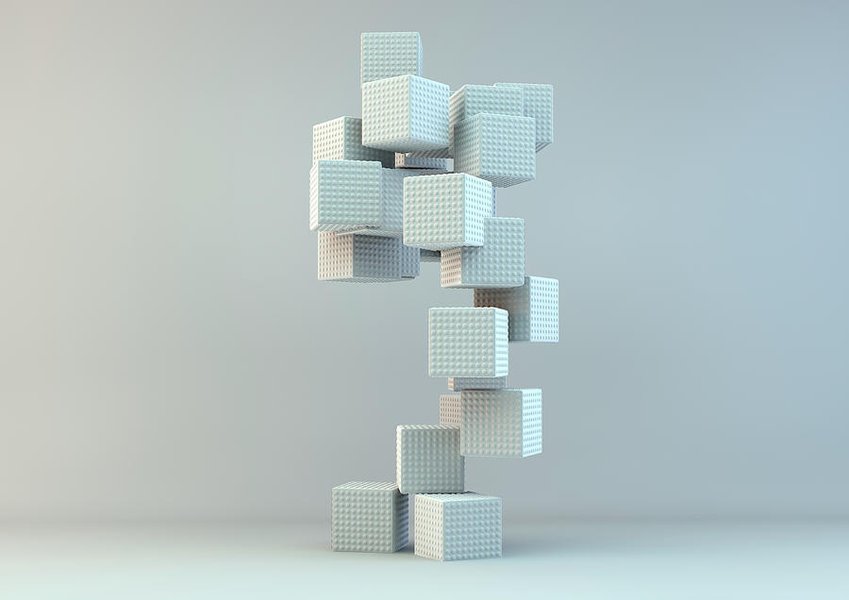
Illustration of stacked cubes.
Calculating the Number of Missing Cubes
The number of missing cubes is the difference between the total number of cubes in the complete 5x5x5 cube and the number of cubes currently present in the given shape.
\[ \text{Missing Cubes} = \text{Volume of Complete Cube} - \text{Total Present Cubes} \] \[ \text{Missing Cubes} = 125 - 46 \] \[ \text{Missing Cubes} = 79 \]Therefore, 79 additional 1x1 cubes are needed to complete the shape to form a larger 5x5x5 cube.
Detailed Breakdown of Missing Cubes by Layer
We can also visualize the missing cubes by considering how many cubes are missing in each layer to complete it to a 5x5 layer, and then how many layers are needed to reach a height of 5.
Missing Cubes per Layer (to complete to 5x5)
Each layer in a complete 5x5x5 cube would be a 5x5 grid, containing \(5 \times 5 = 25\) cubes.
Missing in Bottom Layer (to be a 5x5 layer):
The bottom layer is 3x5. To become a 5x5 layer, it is missing cubes in the width dimension.
\[ \text{Missing in Bottom Layer (width)} = (5 \times 5) - (3 \times 5) = 25 - 15 = 10 \]However, the description states the bottom layer is 3x5 cubes made of 1x1 cubes. This implies the existing structure's maximum width and depth are 5 and 3 respectively. To form a 5x5x5 cube, the base itself needs to be expanded.
Let's reconsider the interpretation. If the layers are stacked on a 3x5 base, the resulting complete cube must accommodate these dimensions. The largest possible complete cube would have side lengths equal to the maximum dimension present in the structure. The maximum length is 5, the maximum width is 3, and the current height is 4. To form a complete cube, all dimensions must be equal. Thus, the target complete cube must be 5x5x5.
Let's revisit the missing cubes per layer based on completing each layer to a 5x5 grid, and then adding the missing layers.
Missing in Layer 1 (to become 5x5):
Present: 15 (3x5). Needed: 25 (5x5).
\[ \text{Missing in Layer 1} = 25 - 15 = 10 \]Missing in Layer 2 (to become 5x5):
Present: 14. Needed: 25.
\[ \text{Missing in Layer 2} = 25 - 14 = 11 \]Missing in Layer 3 (to become 5x5):
Present: 10. Needed: 25.
\[ \text{Missing in Layer 3} = 25 - 10 = 15 \]Missing in Layer 4 (to become 5x5):
Present: 7. Needed: 25.
\[ \text{Missing in Layer 4} = 25 - 7 = 18 \]Missing Layers
The current structure has 4 layers. To form a 5x5x5 cube, we need a total of 5 layers. Therefore, one entire 5x5 layer is missing on top.
\[ \text{Cubes in Missing Layer 5} = 5 \times 5 = 25 \]Total Missing Cubes (Layer by Layer Calculation)
Summing the missing cubes in each of the existing layers (to make them 5x5) and the entirely missing layer:
\[ \text{Total Missing Cubes} = \text{Missing in Layer 1} + \text{Missing in Layer 2} + \text{Missing in Layer 3} + \text{Missing in Layer 4} + \text{Cubes in Missing Layer 5} \] \[ \text{Total Missing Cubes} = 10 + 11 + 15 + 18 + 25 = 79 \]Both methods yield the same result, confirming the calculation.
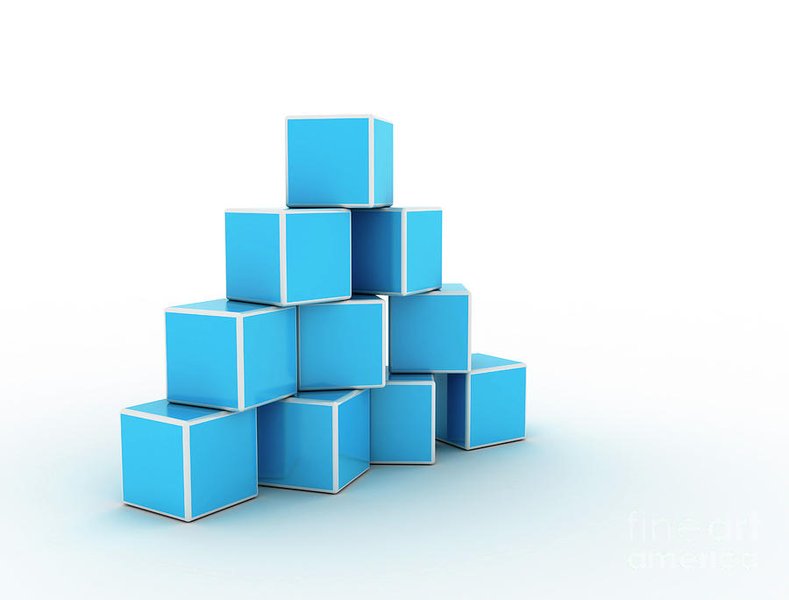
Visualizing stacked cubes and potential missing parts.
Summary of Cube Counts
Here is a summary of the cube counts at each stage of the calculation:
| Description | Number of Cubes |
|---|---|
| Bottom Layer (3x5) | 15 |
| Second Layer (3x5 - 1) | 14 |
| Third Layer (Pattern) | 10 |
| Fourth Layer (Pattern) | 7 |
| Total Present Cubes | 46 |
| Volume of Complete 5x5x5 Cube | 125 |
| Total Missing Cubes | 79 |
Exploring Cube Properties and Calculations
The calculation of volume is a fundamental concept in geometry. For a cube with side length 's', the volume (V) is given by the formula \(V = s^3\). Other properties of a cube include its surface area, face diagonal, and space diagonal.
Relevant Cube Formulas
Let 's' be the side length of a cube.
- Volume (V): \(V = s^3\)
- Surface Area (SA): A cube has 6 identical square faces. The area of one face is \(s^2\). So, the total surface area is \(SA = 6s^2\).
- Face Diagonal (f): The diagonal across one of the square faces. Using the Pythagorean theorem, \(f = \sqrt{s^2 + s^2} = \sqrt{2s^2} = s\sqrt{2}\).
- Space Diagonal (d): The diagonal connecting opposite vertices through the interior of the cube. Using the Pythagorean theorem in 3D, \(d = \sqrt{s^2 + s^2 + s^2} = \sqrt{3s^2} = s\sqrt{3}\).
These formulas are essential for various calculations involving cubes, such as determining capacity or the amount of material needed to construct a hollow cube.
Applications of Cube Calculations
Understanding cube volume and other properties has numerous practical applications:
-
Packaging and Shipping: Calculating the volume of boxes (which are often cuboidal or cubic) to determine how many items fit or the space required in a shipping container.
-
Construction: Estimating the amount of concrete, soil, or other materials needed for cubic or cuboidal structures.
-
Storage: Determining the capacity of storage containers or rooms.
-
Science and Engineering: Calculations in physics, chemistry, and engineering often involve volumes of three-dimensional shapes.
Cubic shapes are common in packaging and display.
FAQ
What is a cube?
A cube is a three-dimensional solid figure characterized by six square faces, twelve equal edges, and eight vertices. All angles are right angles (90 degrees).
How do you calculate the volume of a cube?
The volume of a cube is calculated by multiplying the length of one side by itself three times, or cubing the side length (\(V = s^3\)).
What are some real-world examples of cubes?
Common examples of cubes in everyday life include dice, sugar cubes, ice cubes, and Rubik's Cubes.
If I know the surface area of a cube, can I find its volume?
Yes, if you know the surface area (SA), you can find the side length (s) using the formula \(SA = 6s^2\). Once you have the side length, you can calculate the volume (\(V = s^3\)).
References
Last updated May 7, 2025