
Evolution of Industrial Networking: Mitsubishi Electric's Strategic Adaptations
Unpacking Mitsubishi Electric's transition and coexistence of CC-Link and EtherNet/IP in industrial automation.
In the dynamic landscape of industrial automation, communication protocols are the backbone of interconnected systems. Mitsubishi Electric, a leading provider of factory automation solutions, has continuously evolved its networking strategies to meet the growing demands for speed, flexibility, and data integration. The perception of a complete "switch" from CC-Link to EtherNet/IP is often a simplification of a more nuanced reality: a strategic expansion and integration of various network technologies to offer comprehensive solutions.
Key Insights into Mitsubishi Electric's Network Evolution
- Strategic Coexistence, Not Replacement: Mitsubishi Electric has not entirely "switched" from CC-Link to EtherNet/IP. Instead, it has embraced both, recognizing their distinct strengths and applications. CC-Link, particularly CC-Link IE, remains a cornerstone of Mitsubishi's integrated automation platforms, while EtherNet/IP offers broader interoperability with third-party devices.
- Addressing Industry 4.0 Demands: The increasing need for real-time data exchange, diagnostics, and seamless integration between operational technology (OT) and information technology (IT) has driven the adoption of industrial Ethernet protocols like EtherNet/IP and advanced versions of CC-Link (e.g., CC-Link IE TSN).
- Enhanced Connectivity and Flexibility: By supporting a diverse range of protocols, including EtherNet/IP, CC-Link, PROFIBUS, and Modbus/TCP, Mitsubishi Electric provides customers with flexible communication options to integrate various production assets and achieve data-driven operations.
Understanding Industrial Fieldbus Technologies
Industrial fieldbus systems are communication networks designed to connect field devices (such as sensors and actuators) with control devices like Programmable Logic Controllers (PLCs), Human-Machine Interfaces (HMIs), and industrial PCs. These networks form the lowest level in the hierarchy of industrial communication, facilitating real-time data exchange and control in various automation applications.
The Landscape of Industrial Networks: Fieldbus vs. Industrial Ethernet
Historically, traditional fieldbus systems like PROFIBUS and DeviceNet dominated industrial communication. These systems typically use serial communication and are designed for deterministic, real-time control. However, with the advent of Industry 4.0 and the Industrial Internet of Things (IIoT), there has been a significant shift towards industrial Ethernet protocols.
Industrial Ethernet leverages standard Ethernet technology but incorporates modifications to ensure real-time performance, determinism, and robustness required for industrial environments. Examples include EtherNet/IP, PROFINET, EtherCAT, and CC-Link IE.
Mitsubishi Electric's Journey with CC-Link
CC-Link (Control & Communication Link) is an open industrial network developed by Mitsubishi Electric and supported by the CC-Link Partner Association (CLPA). It has been a foundational technology for Mitsubishi Electric's automation solutions, offering high-speed communication for various applications.
The Evolution of CC-Link
The CC-Link family has evolved significantly to meet changing industrial demands:
Traditional CC-Link:
Based on the RS-485 standard, traditional CC-Link provides cost-effective device-level connectivity and supports extended network distances.
CC-Link IE (Industrial Ethernet):
Recognizing the benefits of Ethernet, Mitsubishi Electric developed CC-Link IE, an industrial Ethernet network operating at 1 Gigabit per second. This network enables real-time control and diagnostics for a wide range of applications, including discrete manufacturing, process control, motion, and robotics. It supports various topologies like star, line, and ring, offering wiring flexibility. CC-Link IE Controller Network is used for communication between PLCs and robots, while CC-Link IE Field is designed for remote I/O and field-level devices.
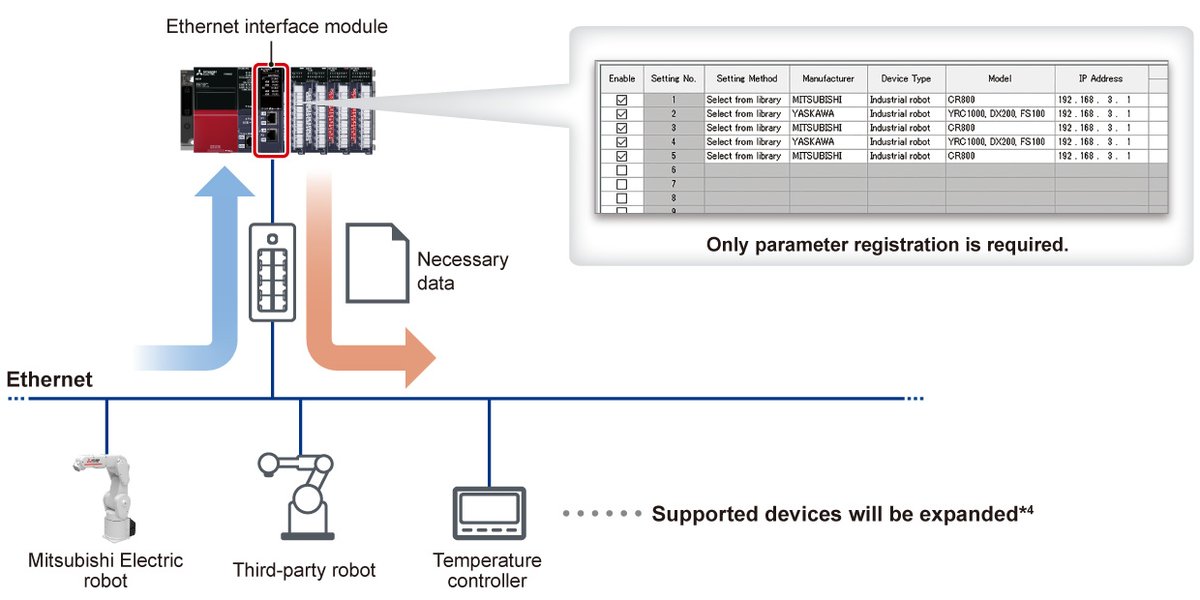
A typical CC-Link IE Field Network configuration, illustrating its industrial Ethernet capabilities.
CC-Link IE TSN (Time-Sensitive Networking):
This is the latest iteration, incorporating Time-Sensitive Networking (TSN) technology. CC-Link IE TSN supports TCP/IP communications, allowing real-time control communications to be mixed with standard Ethernet communications (like information from edge devices and IT systems) on the same line without performance degradation. This is crucial for building robust IIoT infrastructures and enabling smart manufacturing. It supports flexible system configurations with star topology via managed Ethernet switches and can be used as a remote station on CC-Link IE TSN while also acting as a master or local station on CC-Link IE Field Network, facilitating integration between different CC-Link generations.
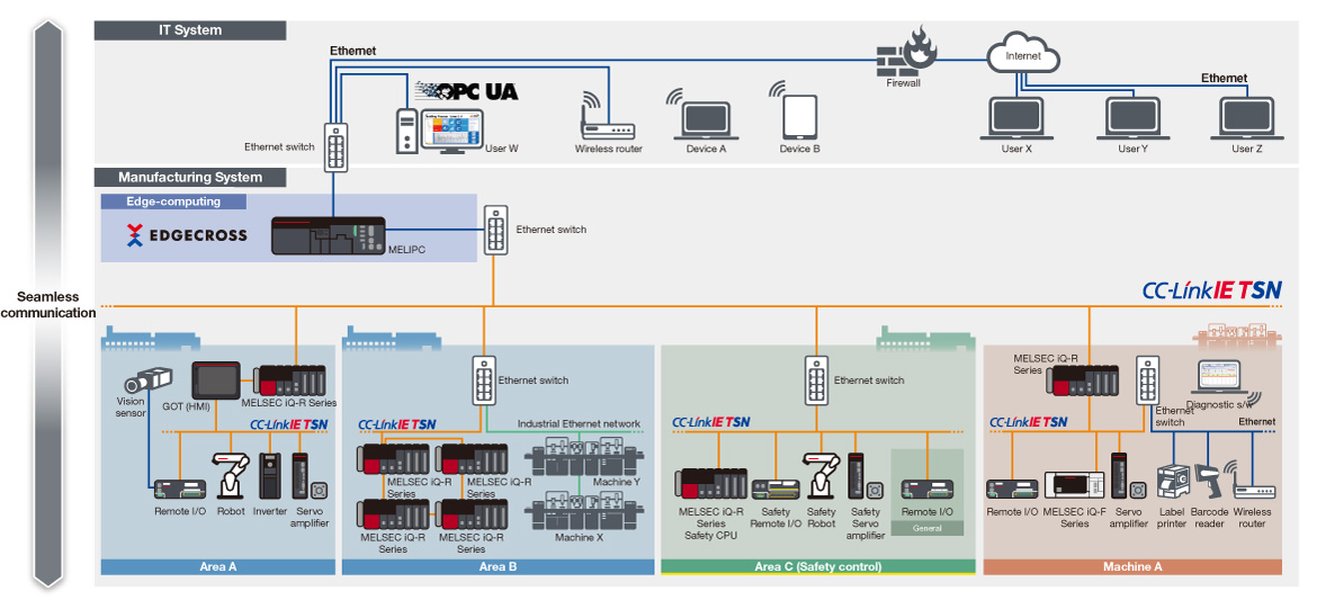
An illustration of CC-Link IE TSN system configuration, highlighting its advanced capabilities for integrated networks.
Integration of EtherNet/IP by Mitsubishi Electric
EtherNet/IP (Ethernet Industrial Protocol) is another prominent industrial Ethernet standard, widely adopted across various industries, especially in North America. It leverages standard Ethernet and TCP/IP, allowing for seamless data exchange with a broad range of devices from different manufacturers. Mitsubishi Electric's decision to support EtherNet/IP was driven by the need for enhanced interoperability and flexibility in diverse industrial environments.
When and Why EtherNet/IP Adoption?
Mitsubishi Electric started integrating EtherNet/IP capabilities into its product lines to cater to customer demands for connecting with third-party devices and to expand its market reach. This wasn't a sudden "switch" but rather a strategic expansion of their networking portfolio. For instance, Mitsubishi Electric offers EtherNet/IP scanner modules for its Q Series and MELSEC iQ-R Series PLCs, allowing these controllers to communicate with EtherNet/IP devices. This eliminates the need for individual wiring and parallel I/O terminals, reducing setup time and hardware costs, especially in systems with multiple robots or diverse equipment.
A notable development is the iQ-R Series CC-Link IE TSN Plus module (RJ71GN11-EIP), which supports both CC-Link IE TSN and EtherNet/IP networks simultaneously. This module allows users to connect CC-Link IE TSN devices to one port and EtherNet/IP devices to another, without compromising the performance of either network. This demonstrates Mitsubishi Electric's commitment to providing versatile solutions that bridge different industrial Ethernet protocols.
The motivation behind adopting EtherNet/IP includes:
- Interoperability: Many industrial facilities utilize a mix of equipment from various vendors. EtherNet/IP's widespread acceptance facilitates easier integration with third-party devices, such as Allen-Bradley PLCs and VFDs, which often use EtherNet/IP as their primary communication protocol.
- Flexibility and Scalability: Standard Ethernet infrastructure provides a highly flexible and scalable foundation for industrial networks, enabling easier expansion and modification of systems.
- Cost-Effectiveness: While traditional fieldbus networks often require additional network interface cards, Ethernet capabilities are increasingly built into CPU units, potentially reducing hardware costs.
- Data Integration: As industries move towards Industry 4.0, the ability to seamlessly integrate operational data with IT systems for analytics and monitoring becomes crucial. EtherNet/IP, being based on standard Ethernet, facilitates this integration.
Coexistence and Strategic Positioning of Protocols
Rather than a complete abandonment of CC-Link, Mitsubishi Electric has adopted a strategy of offering a comprehensive suite of network options. The choice between CC-Link IE and EtherNet/IP often depends on the specific application, existing infrastructure, and the vendor ecosystem. Mitsubishi Electric positions its CC-Link IE family, especially CC-Link IE TSN, as a high-performance, integrated solution for its entire automation platform, while EtherNet/IP support ensures broad compatibility and easy integration into multi-vendor environments.
Comparing Key Industrial Ethernet Protocols
To illustrate the distinct characteristics that influence their application, here's a comparative overview of CC-Link IE TSN and EtherNet/IP:
| Feature | CC-Link IE TSN | EtherNet/IP |
|---|---|---|
| Origin/Governing Body | CC-Link Partner Association (CLPA) | ODVA (Open DeviceNet Vendor Association) |
| Base Technology | Industrial Ethernet with Time-Sensitive Networking (TSN) | Standard Ethernet (TCP/IP) with Common Industrial Protocol (CIP) |
| Primary Focus | Integrated, high-performance, deterministic control and information on a single network | Interoperability, data exchange, and control across diverse vendors |
| Real-time Capability | Excellent (enhanced by TSN for synchronized control and mixed traffic) | Good (achieved through CIP and optimized Ethernet communication) |
| Bandwidth | 1 Gbps | Typically 100 Mbps or 1 Gbps (standard Ethernet speeds) |
| Interoperability with IT | High (seamless integration of OT and IT data via TSN) | High (inherent compatibility with standard Ethernet/TCP/IP) |
| Typical Application Areas | Mitsubishi-centric integrated systems, high-speed motion, robotics, synchronized control, IIoT backbone | Multi-vendor environments, general industrial automation, connecting with Allen-Bradley PLCs/devices |
| Complexity for Setup | Can be more involved for advanced TSN features but offers simplified wiring with specific switches | Generally straightforward, leveraging familiar Ethernet concepts |
The table highlights that while both are robust industrial Ethernet protocols, CC-Link IE TSN excels in integrated, time-sensitive control within a Mitsubishi ecosystem, while EtherNet/IP provides broad interoperability essential for multi-vendor systems.
Diving Deeper into Network Configuration
The following video provides an excellent visual explanation of CC-Link IE TSN network configuration, demonstrating how Mitsubishi Electric integrates this advanced protocol into its systems.
CC-Link IE TSN Network Configuration by Mitsubishi Electric: A detailed look at setting up and optimizing this advanced industrial network.
This video further illustrates the ease of configuration and the robust capabilities of CC-Link IE TSN, underscoring Mitsubishi Electric's continuous investment in its proprietary network technologies while simultaneously integrating widely adopted open protocols.
Assessing Network Protocol Capabilities
The choice of an industrial network protocol depends on various factors, including required speed, determinism, ease of integration, and vendor ecosystem. Here’s a radar chart comparing the perceived strengths of CC-Link IE TSN and EtherNet/IP based on common industrial automation needs:
This radar chart illustrates the typical strengths and weaknesses of CC-Link IE TSN and EtherNet/IP based on industrial automation requirements. CC-Link IE TSN shows strong performance in speed, determinism, and IT/OT convergence due to its TSN capabilities, making it ideal for highly synchronized and integrated systems. EtherNet/IP, while also performing well, particularly shines in interoperability and scalability, making it a robust choice for environments with diverse hardware from multiple vendors.
Conclusion
Mitsubishi Electric's approach to industrial networking is not a simple "switch" from CC-Link to EtherNet/IP, but rather a strategic evolution to provide comprehensive and flexible solutions. The company continues to develop and promote its high-performance CC-Link IE family, particularly CC-Link IE TSN, for integrated and time-sensitive applications within its ecosystem. Concurrently, it has embraced EtherNet/IP to ensure broad interoperability with third-party devices and to meet the demands of diverse industrial environments. This dual approach allows Mitsubishi Electric to cater to a wider range of industrial automation needs, empowering businesses to build future-ready, data-driven production systems in the era of Industry 4.0.
Frequently Asked Questions
Why didn't Mitsubishi Electric just stick with one network protocol?
What are the main advantages of CC-Link IE TSN over older fieldbus systems?
Can Mitsubishi PLCs communicate with Allen-Bradley devices using EtherNet/IP?
Is CC-Link IE TSN an open standard?
Recommended Queries
- How has Time-Sensitive Networking (TSN) revolutionized industrial communication?
- Compare major industrial Ethernet protocols for factory automation.
- What is Mitsubishi Electric's e-F@ctory concept and its networking implications?
- How do PLCs communicate with robots and VFDs in industrial automation?
References
Last updated May 21, 2025