

Visual representation of complex numbers, a fundamental component of the Mittag-Leffler function's definition.
Essential Insights into the Mittag-Leffler Function
- Generalized Exponential: The Mittag-Leffler function extends the familiar exponential function, serving as its natural counterpart in the realm of fractional calculus.
- Fractional Calculus Cornerstone: It is indispensable for solving fractional differential and integral equations, making it a "Queen Function" in this advanced mathematical field.
- Versatile Applications: From modeling anomalous diffusion and viscoelastic materials to probability theory, its influence spans various scientific and engineering disciplines.
The Mittag-Leffler function, named after the Swedish mathematician Gösta Mittag-Leffler, is a special function of paramount importance in modern mathematics and its applications. It acts as a fundamental generalization of the exponential function, which is a cornerstone of classical calculus. While the exponential function provides solutions for integer-order differential equations, the Mittag-Leffler function naturally emerges as the solution for differential and integral equations of non-integer (fractional) order. This makes it a central tool in the burgeoning field of fractional calculus, offering a powerful framework for describing phenomena with memory and hereditary properties.
Defining the Mittag-Leffler Function: From Basic to Generalized Forms
The Mittag-Leffler function is not a single entity but a family of related functions, defined by infinite series with varying parameters. These parameters govern the function's behavior and determine its specific applications.
The One-Parameter Mittag-Leffler Function: \(E_\alpha(z)\)
The most basic form is the one-parameter Mittag-Leffler function, denoted as \(E_\alpha(z)\). It is defined by the series:
\[ E_\alpha(z) = \sum_{k=0}^\infty \frac{z^k}{\Gamma(\alpha k + 1)} \]Here, \(z\) is a complex variable, and \(\alpha\) is a complex parameter with a positive real part (\(\operatorname{Re}(\alpha) > 0\)). The Gamma function, \(\Gamma(\cdot)\), is a generalization of the factorial function to complex and real numbers. This series converges for all \(z \in \mathbb{C}\), making \(E_\alpha(z)\) an entire function (analytic everywhere).
A key insight is that when \(\alpha = 1\), the function simplifies to the standard exponential function:
\[ E_1(z) = \sum_{k=0}^\infty \frac{z^k}{\Gamma(k + 1)} = \sum_{k=0}^\infty \frac{z^k}{k!} = e^z \]This direct connection underscores its role as a fractional generalization of the exponential function.
The Two-Parameter Mittag-Leffler Function: \(E_{\alpha,\beta}(z)\)
Further generalizing the concept, the two-parameter Mittag-Leffler function, sometimes called the generalized Mittag-Leffler function, introduces an additional parameter, \(\beta\). It is defined as:
\[ E_{\alpha,\beta}(z) = \sum_{k=0}^\infty \frac{z^k}{\Gamma(\alpha k + \beta)} \]For the series used here, require \(\operatorname{Re}(\alpha)>0\). The second parameter \(\beta\) may be complex; reciprocal-Gamma coefficients handle its nonpositive-integer cases. For positive real \(\alpha\), the resulting entire function has order \(1/\alpha\).
For example, if \(\alpha = 1\) and \(\beta = 2\), we get:
\[ E_{1,2}(z) = \sum_{k=0}^\infty \frac{z^k}{\Gamma(k + 2)} = \sum_{k=0}^\infty \frac{z^k}{(k+1)!} = \frac{1}{z} \sum_{k=0}^\infty \frac{z^{k+1}}{(k+1)!} = \frac{e^z - 1}{z} \]Beyond Two Parameters: The Prabhakar Function
The generalization doesn't stop at two parameters. The three-parameter Mittag-Leffler function, often referred to as the Prabhakar function, extends the concept further, incorporating a parameter \(\gamma\). This advanced form is crucial for specialized applications within fractional calculus and integral operators.
Fundamental Properties and Characteristics
The Mittag-Leffler function possesses several properties that make it highly adaptable and essential for various mathematical models.
Entire Function and Growth Order
With \(\operatorname{Re}(\alpha)>0\), these series define entire functions of \(z\). The familiar order \(1/\alpha\) statement here is for positive real \(\alpha\), not an arbitrary complex growth order.
Interpolation and Special Cases
One of its remarkable features is its ability to interpolate between various well-known functions. Depending on the values of its parameters, it can reduce to the exponential function, Gaussian function, or Lorentzian functions. This versatility highlights its broad applicability.
Asymptotic and Monotonicity Properties
The function exhibits important asymptotic behaviors for large values of \(|z|\), as well as monotonicity properties. These are particularly valuable in modeling physical processes such as fractional relaxation and anomalous diffusion, where power-law memory or waiting times are observed.
Connections to Other Special Functions
The Mittag-Leffler function is deeply intertwined with other special functions, including generalized hyperbolic functions and generalized confluent hypergeometric functions. These connections allow for alternative representations and facilitate its analysis and computation.
Applications Across Disciplines
The Mittag-Leffler function's unique properties make it an indispensable tool across a wide spectrum of scientific and engineering fields.
Fractional Calculus and Differential Equations
Its most prominent application is in fractional calculus, where it serves as the natural solution to fractional-order differential and integral equations. These equations are vital for modeling systems that exhibit non-local behavior, memory effects, or long-range dependencies, which classical integer-order calculus struggles to capture. It's often dubbed the "Queen Function of Fractional Calculus" for this very reason.
Physics and Engineering: Modeling Complex Phenomena
In physics and engineering, the Mittag-Leffler function provides a robust framework for understanding and describing various complex phenomena:
- Anomalous Diffusion: It models superdiffusion and Lévy flights, which are types of transport where particles spread faster or differently than predicted by classical Brownian motion.
- Fractional Relaxation: It describes relaxation processes in materials that exhibit power-law decay, such as viscoelastic materials like polymers.
- Viscoelasticity: Used extensively to characterize the mechanical properties of materials that display both viscous and elastic characteristics.
- Electrical Circuits: Models in fractional-order electrical circuits.
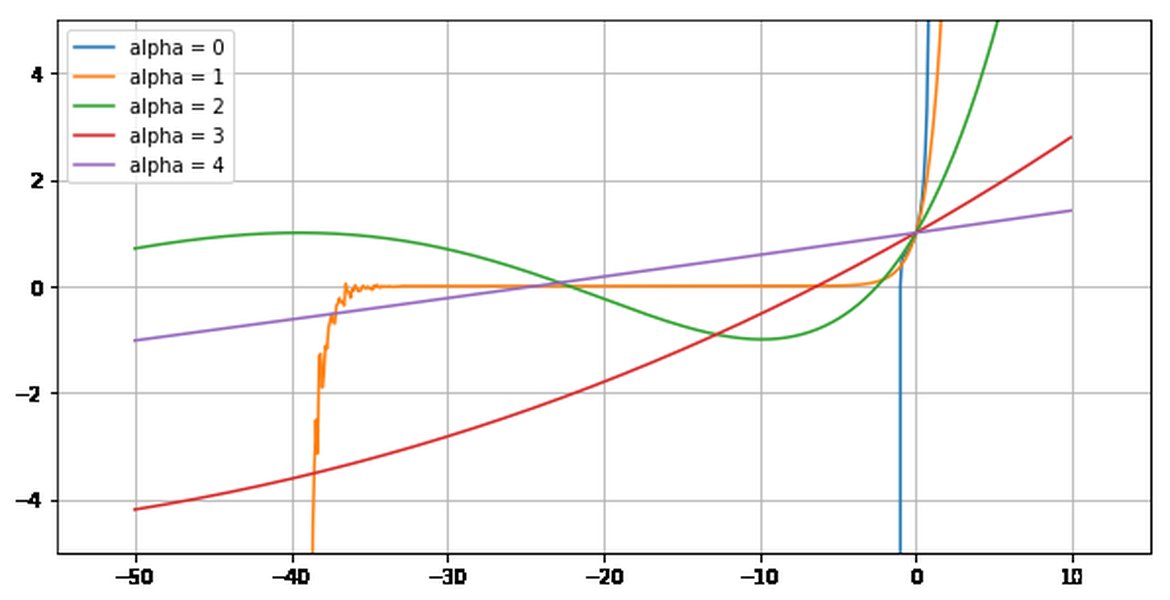
An example illustrating the numerical instability that can arise when computing the Mittag-Leffler function, highlighting the challenges in its practical application.
Probability and Statistics
The Mittag-Leffler function also extends into probability theory, leading to generalized probability distributions and processes. It plays a role in fractional Poisson processes and in defining generalized waiting times in renewal processes.
Geometric Function Theory
Recent developments have seen its application in geometric function theory, particularly through fractional integrals, opening new avenues for research in complex analysis.
Summary of Variants and Key Features
To consolidate the various forms and their characteristics, the following table provides a quick overview:
| Variant | Definition | Parameters | Key Features |
|---|---|---|---|
| One-parameter \(E_\alpha\) | \( \sum_{k=0}^\infty \frac{z^k}{\Gamma(\alpha k+1)} \) | \( \alpha \in \mathbb{C}, \operatorname{Re}(\alpha)>0 \) | Simplest form, direct generalization of \( e^z \) |
| Two-parameter \(E_{\alpha,\beta}\) | \( \sum_{k=0}^\infty \frac{z^k}{\Gamma(\alpha k + \beta)} \) | \(\operatorname{Re}(\alpha)>0\), \(\beta\in\mathbb{C}\) | Entire in z; for positive real α its order is 1/α. |
| Three-parameter (Prabhakar) | Extends \( E_{\alpha,\beta} \) with an additional parameter | Multiple complex parameters | Used in advanced fractional integral operators and models |
This mindmap provides a comprehensive overview of the Mittag-Leffler function, detailing its various definitions, key mathematical properties, and extensive applications across diverse scientific and engineering disciplines. It also touches upon the computational aspects and differentiates it from Mittag-Leffler's Theorem in complex analysis.
Computational Considerations and Software Implementations
While the Mittag-Leffler function is elegantly defined by an infinite series, its direct numerical evaluation can be computationally intensive, especially for large arguments or specific parameter ranges. More sophisticated numerical methods, including recurrence relations and approximations, have been developed to ensure fast and accurate computations for practical applications. Many mathematical software packages and libraries include implementations of the Mittag-Leffler function, simplifying its use for researchers and engineers:
- R: The "MittagLeffleR" package is available for probability-related usages and numerical evaluations.
Distinguishing the Mittag-Leffler Function from Mittag-Leffler's Theorem
It is important to note a common point of confusion: there is also a distinct mathematical concept known as "Mittag-Leffler's Theorem" in complex analysis. This theorem, also named after Gösta Mittag-Leffler, deals with the existence and representation of meromorphic functions with prescribed poles. It is a generalization of the partial fraction decomposition for meromorphic functions. While sharing the name of the same mathematician, this theorem is fundamentally different from the Mittag-Leffler function, which is a special function defined by a series.
Exploring the Mittag-Leffler Function
For a visual and auditory explanation of the Mittag-Leffler function, its definition, properties, and why it is so crucial in fractional calculus, you can watch the following video:
This video, titled "Mittag-Leffler Functions: The Key to Fractional Calculus?", provides an excellent introduction to the function, detailing its one-parameter, two-parameter, and three- or four-parameter forms. It explains how these functions are fundamental to understanding and solving problems in fractional calculus, making it highly relevant to gaining a foundational understanding of the topic.
FAQ: Understanding the Mittag-Leffler Function
What is the primary purpose of the Mittag-Leffler function?
Why is it called the "Queen Function of Fractional Calculus"?
What is the difference between the one-parameter and two-parameter Mittag-Leffler functions?
In which real-world applications is the Mittag-Leffler function used?
Are there any specific software tools available for computing the Mittag-Leffler function?
Conclusion
The Mittag-Leffler function stands as a testament to the continuous evolution of mathematics, extending classical concepts to address the complexities of fractional systems. Its role as a generalized exponential function has firmly established it as an indispensable tool in fractional calculus, enabling breakthroughs in modeling anomalous diffusion, viscoelasticity, and a host of other phenomena across physics, engineering, and probability. As research in fractional calculus continues to expand, the significance and utility of the Mittag-Leffler function are only set to grow, promising deeper insights into the intricate dynamics of the world around us.
Recommended Further Reading
- Explore further applications of fractional calculus in various engineering disciplines.
- Investigate advanced numerical methods for efficient computation of the Mittag-Leffler function.
- Delve into the three-parameter Prabhakar function and its specific uses in advanced fractional integral operators.
- Understand how the Mittag-Leffler function compares and relates to other special functions in mathematics.